Bellini’s Portrait of a young man à l’Antique

Giovanni Bellini, c. 1435/40 - 1516
Portrait of a Young Man à l'Antique (Andrea Mantegna?), about 1475–80, oil on board, 35 x 28 cm, Pinacoteca del Castello Sforzesco, Milan, Italy Germany (my amateurish attempt at photography of Bellini’s Painting as presented in the Exhibition GIOVANNI BELLINI Influences Croisées
Giovanni Bellini, c. 1435/40 – 1516
Portrait of a Young Man à l’Antique (Andrea Mantegna?), about 1475–80, oil on board, 35 x 28 cm, Pinacoteca del Castello Sforzesco, Milan, Italy Germany (my amateurish attempt at photography of Bellini’s Painting as presented in the Exhibition GIOVANNI BELLINI Influences Croisées (March 3 to July 17, 2023) at the Jacquemart-André Museum)

Born into a family of artists, Giovanni Bellini frequented, with his brother Gentile, the studio of their father, Jacopo Bellini, a painter of Gothic training who soon mastered the principles of Florentine Renaissance art. The young artist, write the Musée Jacquemart-André experts, Neville Rowley and Pierre Curie, introducing the Exhibition GIOVANNI BELLINI Influences croisées (Paris, from 3 March to 17 July 2023), immersed himself in the art alongside his father, brother and his brother-in-law Andrea Mantegna, whom his sister Nicolosia had just married. Classicism, sculptural forms, and a good command of Mantegna’s perspective had a great influence on the artist… Is Bellini’s Portrait of a Young Man à l’Antique, presented in the exhibition, the Portrait of Andrea Mantegna?  https://www.musee-jacquemart-andre.com/en/giovanni-bellini

Mantegna’s marriage to Nicolosia Bellini was a positive development for both parties involved. Giorgio Vasari describes the event in his own, matter of fact, way… Andrea, thus left alone in the said chapel (Chapel of S. Cristofano, which is in the Church of the Eremite Friars of S. Agostino in Padua), painted the four Evangelists, which were held very beautiful. By reason of this and other works Andrea began to be watched with great expectation, and with hopes that he would attain to that success to which he actually did attain; wherefore Jacopo Bellini, the Venetian painter, father of Gentile and Giovanni, and rival of Squarcione, contrived to get him to marry his daughter, the sister of Gentile. Hearing this, Squarcione fell into such disdain against Andrea that they were enemies ever afterwards; and in proportion as Squarcione had formerly been ever praising the works of Andrea, so from that day onward did he ever decry them in public. http://www.travelingintuscany.com/art/gutenberg/vasarilives3.htm

The marriage of Andrea Mantegna to Nicolosia Bellini was significant in several ways. The marriage, for example, brought Mantegna into contact with the Bellini family, which had a significant influence on the development of Venetian art. Mantegna was already a highly respected artist in his own right, but his marriage to Nicolosia helped to solidify his reputation and establish him as a leading figure in the Italian Renaissance. For the younger brother-in-law, Giovanni Bellini, the marriage led to a cross-pollination of ideas and approaches between the two brothers-in-law. In fact, there is evidence to suggest that the two artists had, occasionally, a close working relationship. Mantegna’s influence on Bellini can be seen in his use of perspective, which was a technique that Mantegna had mastered. Furthermore, it is believed that Giovanni Bellini was influenced by Mantegna’s interest in classical antiquity, his Portrait of a Young Man à l’Antique is evidence enough, of the use of color, light, and shadow to create a sense of depth and three-dimensionality.

While in Paris, attending the brilliant Exhibition GIOVANNI BELLINI Influences Croisées, at the Musée Jacquemart-André, I was surprised, most pleasantly, by Bellini’s Portrait of a Young Man à l’Antique. The Exhibition curators present this unusual painting as a possible portrait of Andrea Mantegna. Searching the history and provenance of the painting, I came upon different identification names… Portrait of a young man à l’Antique, Portrait of a Humanist, or Poeta Laureato. Not just so, this is, I believe, a little-known painting with a complicated history of credit. It has been attributed to Antonello da Messina, Alvise Vivarini, and Giovanni Bellini. The depicted young man has been identified as the painter Andrea Mantegna, or the poet Raffaele Zovenzoni. Do I know the true identity of the artist and the represented young man? The answer is No! What I know is that the Portrait I saw was eye-catching, magnetic, bold, and alluring.

Giovanni Bellini, c. 1435/40 - 1516
Portrait of a Young Man à l'Antique (Andrea Mantegna?), about 1475–80, oil on board, 35 x 28 cm, Pinacoteca del Castello Sforzesco, Milan, Italy Germany (my amateurish attempt at photography of Bellini’s Painting as presented in the Exhibition GIOVANNI BELLINI Influences Croisées
Giovanni Bellini, c. 1435/40 – 1516
Portrait of a Young Man à l’Antique (Andrea Mantegna?) (detail), about 1475–80, oil on board, 35 x 28 cm, Pinacoteca del Castello Sforzesco, Milan, Italy
https://www.pinterest.dk/pin/609393393298256426/

The painting depicts a young man dressed in classical clothing, with a serene expression on his face. The background of the painting is a neutral brown color, which helps to emphasize the figure’s features and clothing. What I found striking is the incredible level of detail in the young man’s face, which, painted with great care and with subtle gradations of color, creates a lifelike appearance. Painted in front of a dark background, the young man is depicted wearing an olive-green and brown garment à l’Antique. His rich auburn hair is crowned by a wreath of myrtle, he features a strong chin, a straight nose, and olive-green coloured eyes! Whoever the young man is, I would like to believe this is a liking of Andrea Mantegna, Giovanni Bellini’s painting is a beautiful example of Renaissance portraiture, characterized by its attention to detail, lifelike rendering, and incorporation of classical imagery. The painting is a testament to Bellini’s skill as an artist and his contribution to the development of Renaissance art in Venice.

For a Student Activity, please… Check HERE!

Declaration of the Rights of Woman and the Female Citizen, 1791

Olympe de Gouges

Alexander Kucharsky, 1741–1819
Portrait of Olympe de Gouges, 18th century, pastel on canvas, Private Collection
Alexander Kucharsky, 1741–1819
Portrait of Olympe de Gouges, 18th century, pastel on canvas, Private Collection https://commons.wikimedia.org/wiki/File:Olympe_de_Gouges.png

Yesterday, at seven o’clock in the evening, a most extraordinary person called Olympe de Gouges who held the imposing title of woman of letters, was taken to the scaffold, while all of Paris, while admiring her beauty, knew that she didn’t even know her alphabet… She approached the scaffold with a calm and serene expression on her face and forced the guillotine’s furies, which had driven her to this place of torture, to admit that such courage and beauty had never been seen before… That woman… had thrown herself in the Revolution, body, and soul. But having quickly perceived how atrocious the system adopted by the Jacobins was, she chose to retrace her steps. She attempted to unmask the villains through the literary productions which she had printed and put up. They never forgave her, and she paid for her carelessness with her head… wrote an anonymous Parisian who kept a chronicle of the 1793 events. https://en.wikipedia.org/wiki/Olympe_de_Gouges

Olympe de Gouges was a French playwright, novelist, and political activist who is best known for her writings on women’s rights and social justice. She was born Marie Gouze on May 7, 1748, in Montauban, France. Her mother, Anne Olympe Mouisset Gouze, was the daughter of a bourgeois family, but the identity of her father is ambiguous. Marie Gouze encouraged rumors that Jean-Jacques Lefranc, Marquis de Pompignan was her father, and their relationship is considered plausible but historically unverifiable.

In 1765, Olympe de Gouges married Louis-Yves Aubry, a man much older than her. The marriage was an unhappy one. In 1766 her husband died, and Olympe, funded by her wealthy friend, Jacques Biétrix de Rozières, moved to Paris in 1770 to pursue a career in writing. Described as one of the prettiest women in Paris, de Gouges socialized in fashionable society, attending the most artistic and philosophical salons of Paris. She wrote plays, novels, and pamphlets on a variety of topics, including women’s rights, slavery, and political reform. Her most famous work is the Declaration of the Rights of Woman and the Female Citizen, which she wrote in response to the Declaration of the Rights of Man and Citizen during the French Revolution.

She was an advocate for women’s suffrage and believed that women should have the same rights as men. She also spoke out against the slave trade and called for the abolition of slavery. De Gouges was an active participant in the French Revolution and supported the Girondists, a moderate political group. However, her views were unpopular with the radical Jacobin faction, and she was arrested and executed by the guillotine on November 3, 1793, during the Reign of Terror. De Gouges’ legacy as a feminist and social justice advocate has been recognized in recent years. Her name is now engraved on the Pantheon in Paris, a mausoleum that honors distinguished French citizens.

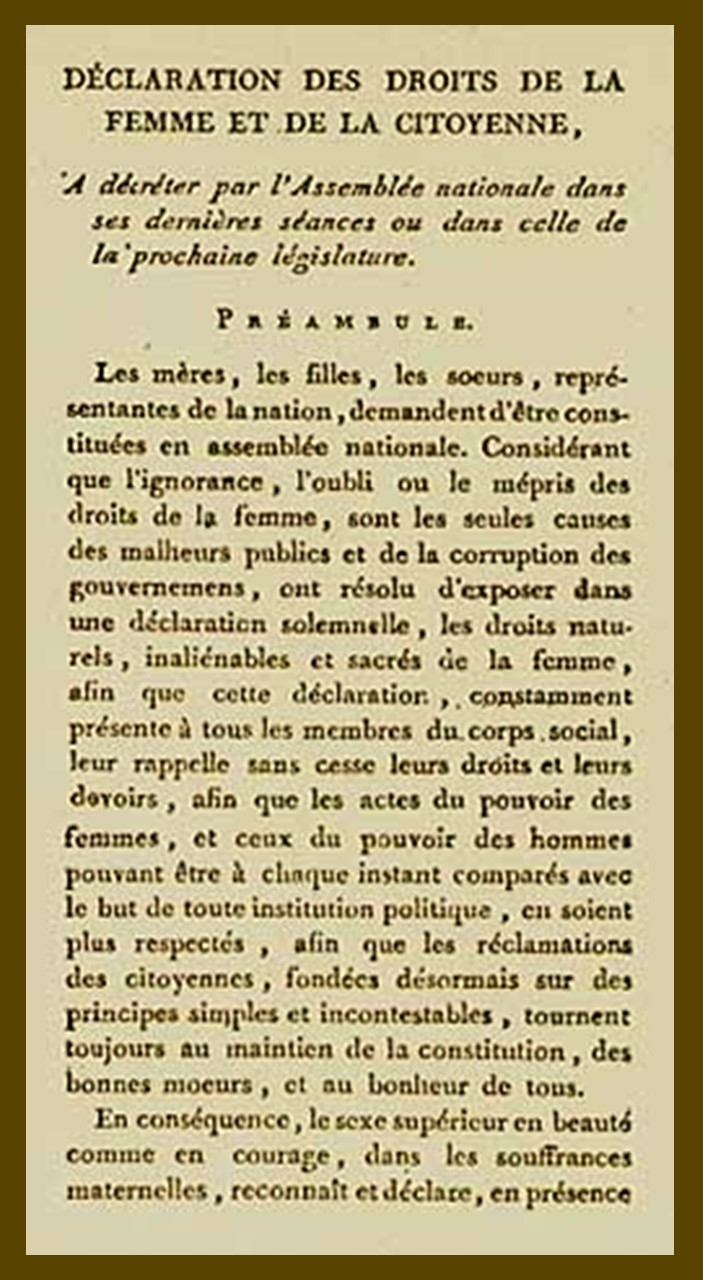
Declaration of the Rights of Woman and the Female Citizen, 1791
https://upload.wikimedia.org/wikipedia/commons/3/34/DDFC.jpg

Olympe de Gouges wrote The Declaration of the Rights of Woman and the Female Citizen in 1791, during the French Revolution. The revolution brought about a lot of discussion about individual rights and freedoms, and Gouges saw this as an opportunity to advocate for women’s rights as well. As a feminist writer and activist, who believed in the equality of men and women, Gouges was particularly concerned with the ways in which women were excluded from political and legal rights, and the ways in which they were treated as inferior to men in society. She believed that women were capable of reason and should be granted the same rights and opportunities as men.

The Declaration of the Rights of Woman and the Female Citizen was Gouges’ response to the Declaration of the Rights of Man and of the Citizen, which was passed by the National Assembly in 1789 and proclaimed the equality of all men. Gouges argued that this declaration did not go far enough and that women were also entitled to the same rights and freedoms. In her declaration, Gouges called for women to have the right to vote, to hold public office, and to receive education. She also argued that marriage should be based on mutual consent and that women should have the right to divorce if they wished. Her declaration was a radical and controversial document at the time, and it was not widely accepted by the French government or society.

Hoping to expose the failures of the French Revolution in the recognition of gender equality.. Houges’ The Declaration of the Rights of Woman starts…

Mothers, daughters, sisters, female representatives of the nation ask to be constituted as a national assembly. Considering that ignorance, neglect, or contempt for the rights of woman are the sole causes of public misfortunes and governmental corruption, they have resolved to set forth in a solemn declaration the natural, inalienable, and sacred rights of woman: so that by being constantly present to all the members of the social body this declaration may always remind them of their rights and duties; so that by being liable at every moment to comparison with the aim of any and all political institutions the acts of women’s and men’s powers may be the more fully respected; and so that by being founded henceforward on simple and incontestable principles the demands of the citizenesses may always tend toward maintaining the constitution, good morals, and the general welfare.

In consequence, the sex that is superior in beauty as in courage, needed in maternal sufferings, recognizes and declares, in the presence and under the auspices of the Supreme Being, the following rights of woman and the citizeness… https://revolution.chnm.org/d/293

For a Student Activity, please… Check HERE!

Élisabeth Louise Vigée Le Brun, French Artist, 1755–1842, Self-portrait with Her Daughter, Julie, 1786, and Self-Portrait with Her Daughter, Julie (à l’Antique), 1789

Élisabeth Louise Vigée Le Brun with Her Daughter Julie

Élisabeth Louise Vigée Le Brun, French Artist, 1755–1842, Self-portrait with Her Daughter, Julie, 1786, and Self-Portrait with Her Daughter, Julie (à l’Antique), 1789
Élisabeth Louise Vigée Le Brun, French Artist, 1755–1842
Self-portrait with Her Daughter, Julie, 1786, oil on panel, 105 × 84 cm, the Louvre, Paris, France https://histoire-image.org/etudes/nouveau-visage-amour-maternel
Self-Portrait with Her Daughter, Julie (à l’Antique), 1789, oil on canvas, 130×94 cm, the Louvre Museum, Paris France https://commons.wikimedia.org/wiki/File:Self-portrait_with_Her_Daughter_by_Elisabeth-Louise_Vig%C3%A9e_Le_Brun.jpg

Sonnet IV by Victorian Poet Augusta Davies Webster, the Victorian Poet, reads… ‘Tis but a child. The quiet Juno gaze /     Breaks at a trifle into mirth and glow, /     Changed as a folded bud bursts into blow, / And she springs, buoyant, on some busy craze, / Or, in the rhythm of her girlish plays, /     Like light upon swift waves floats to and fro, /     And, whatsoe’er’s her mirth, needs me to know, And keeps me young by her young innocent ways.    /    Just now she and her kitten raced and sprang /     To catch the daisy ball she tossed about; /     Then they grew grave, and found a shady tree, / And kitty tried to see the notes she sang: / Now she flies hitherward–“Mother! Quick! Come see! /     Two hyacinths in my garden almost out!” Presenting two paintings of Élisabeth Louise Vigée Le Brun with Her Daughter, Julie is my humble contribution to May 14, and Mother’s Day! https://allpoetry.com/Mother-and-Daughter–Sonnet-Sequence

Élisabeth Louise Vigée Le Brun (1755-1842) was a French portrait painter who became one of the most celebrated artists of her time. Born in Paris, she was the daughter of a painter, Louis Vigée, and began studying art at a young age. She showed a remarkable talent for portraiture, and by the age of fifteen, she was supporting herself and her family through her art. In 1776, Vigée Le Brun married a wealthy art dealer named Jean-Baptiste-Pierre Le Brun, which helped to expand her social and professional networks. She soon became a favorite painter of the French aristocracy, including Queen Marie Antoinette, whom she painted numerous times.

During the French Revolution, Vigée Le Brun fled France due to her close association with the royal court. She spent several years traveling throughout Europe, painting portraits of various members of the nobility and aristocracy. She eventually settled in Russia, where she became a favorite painter of Catherine the Great. After the fall of Napoleon and the restoration of the French monarchy, Vigée Le Brun was able to return to France. She continued to paint portraits and exhibited her work regularly at the Paris Salon. She was also an accomplished writer, publishing several memoirs that detailed her life and career.

Vigée Le Brun’s art is known for its refined elegance and sensitivity to the individual character of her subjects. She painted many of the leading figures of her time, including royalty, politicians, and artists, and her work is now housed in museums and collections around the world. She was a pioneer for women in the male-dominated world of art, and her legacy as a ground-breaking female artist continues to inspire generations of artists today.

Élisabeth Louise Vigée Le Brun, French Artist, 1755–1842
Self-portrait with Her Daughter, Julie, 1786, oil on panel, 105 × 84 cm, the Louvre, Paris, France
Élisabeth Louise Vigée Le Brun, French Artist, 1755–1842
Self-portrait with Her Daughter, Julie, 1786, oil on panel, 105 × 84 cm, the Louvre, Paris, France https://histoire-image.org/etudes/nouveau-visage-amour-maternel
Élisabeth Louise Vigée Le Brun, French Artist, 1755–1842
Self-portrait with Her Daughter, Julie, 1786, oil on panel, 105 × 84 cm, the Louvre, Paris, France
Élisabeth Louise Vigée Le Brun, French Artist, 1755–1842
Self-portrait with Her Daughter, Julie (detail), 1786, oil on panel, 105 × 84 cm, the Louvre, Paris, France
https://www.facebook.com/museedulouvre/photos/naissance-de-%C3%A9lisabeth-louise-vig%C3%A9e-le-brun-birth-of-%C3%A9lisabeth-louise-vig%C3%A9e-le-b/10154657162619926/

In 1786, Élisabeth Louise Vigée Le Brun painted her first Self-Portrait with her daughter Jeanne Julie Louise, whom she called Julie, and caused a scandal! She presented herself holding her child most affectionately, looking straight to the viewer and smiling with her lips parted and her teeth showing. The 1787 gossip sheet ‘Mémoires secrets’ wrote… An affectation which artists, art-lovers and persons of taste have been united in condemning, and which finds no precedent among the Ancients, is that in smiling, [Madame Vigée-Lebrun] shows her teeth. Yet, Count of Angiviller, director general of the King’s Buildings, liked her Self-Portrait, as exhibited in the Salon of 1787, and requested that the artist paint a second version of the same subject. In 1789, Élisabeth Louise Vigée Le Brun complied and presented Self-Portrait with Her Daughter, Julie (à l’Antique). https://histoire-image.org/etudes/nouveau-visage-amour-maternel

Élisabeth Louise Vigée Le Brun, 1755–1842
Self-Portrait with Her Daughter, Julie (à l’Antique), 1789, oil on canvas, 130x94 cm, the Louvre Museum, Paris France
Élisabeth Louise Vigée Le Brun, 1755–1842
Self-Portrait with Her Daughter, Julie (à l’Antique), 1789, oil on canvas, 130×94 cm, the Louvre Museum, Paris France https://commons.wikimedia.org/wiki/File:Self-portrait_with_Her_Daughter_by_Elisabeth-Louise_Vig%C3%A9e_Le_Brun.jpg

Both paintings by Vigée Le Brun are beautiful examples of the artist’s work and a significant representation of the Late Rococo Style. The paintings are notable for their emotional depth and the strong depicted bond between mother and child. They are a testament to the artist’s skill and her ability to capture the essence of her subject in a way that is both truthful and beautiful.

For a Student Activity, please… Check HERE!

Pisanello’s Medallion of Ioannis VIII Palaiologos, a loan from the Galleria Giorgio Franchetti at the Ca' D’Oro, Venice, as exhibited in the Hôtel de la Marine, in Paris, France

Face to Face with Emperor Ioannis VIII Palaiologos

Pisanello’s Medallion of Ioannis VIII Palaiologos, a loan from the Galleria Giorgio Franchetti at the Ca' D’Oro, Venice, as exhibited in the Hôtel de la Marine, in Paris, France
Pisanello’s Medallion of Ioannis VIII Palaiologos, a loan from the Galleria Giorgio Franchetti at the Ca’ D’Oro, Venice, as exhibited in the Hôtel de la Marine, in Paris, France My amateurish attempt at photography…

A page of Pisanello’s sketchbook in the Louvre Museum presents the mounted figure of the Byzantine Emperor Ioannis VIII Palaiologos and the short descriptive passage reads… The hat of the Emperor should be white on top and red underneath, the profile red all round. The doublet is green damask and the mantle on top crimson. A black beard on a pale face, hair and eyebrows alike. The eyes between grey and green, and the stooped shoulders of a small person. The boots of pale yellow leather; the sheath of the bow brown and grained, and also that of the quiver and of the scimitar. On the 5th of March, while in Paris, I visited the Hôtel de la Marine, and I came Face to Face with Emperor Ioannis VIII Palaiologos. Pisanello’s famous Medallion of the penultimate Byzantine Emperor was among the selected artifacts presented at the Exhibition Ca’ d’Oro, Masterpieces of the Renaissance in Venice (November 30, 2022 – May 7, 2023). I was touched… Some Preparatory Drawings for Pisanello’s Medallion of John VIII Palaeologus, by Michael Vickers, The Art Bulletin, Vol. 60, No. 3 (Sep. 1978), pp. 417-424 (8 pages) https://www.jstor.org/stable/3049816?read-now=1&seq=8#page_scan_tab_contents

Pisanello’s Medallion and two pages with preparatory drawings and comments, by Pisanello as well, one in the Louvre, the other in the Art Institute of Chicago, are vital in reconstructing the features and the physique of the Emperor. The Medallion I saw in Paris, like the rest of the exhibited artworks, loans from the Galleria Giorgio Franchetti at the Ca’ D’Oro, Venice, was an opportunity to read and refresh my knowledge of Ioannis VIII Palaionogos… his ‘works and days.’ https://www.thealthanicollection.com/hdlm/ca-doro-masterpieces-of-the-renaissance-in-venice

Ioannis VIII Palaiologos (or John VIII Palaiologos) was a Byzantine Emperor who ruled from 1425 to 1448. He was born on December 18, 1392, as the oldest son of Emperor Manuel II Palaiologos and Helena Dragaš. He was an intellectual, well-educated, and a patron of arts and learning. He was fluent in several languages, including Greek, Latin, and some Turkish. His reign was marked by a series of desperate attempts to save the Byzantine Empire from its rapid decline, particularly due to the increasing pressure from the Ottoman Empire.

In an effort to save his empire, he sought the aid of the West by advocating for a union of the Eastern Orthodox Church and the Roman Catholic Church. This led him to attend the Council of Ferrara/Florence (1438-1439), where he personally negotiated with Western leaders and agreed to a theological compromise that would allow for the churches to reunite. However, this decision was met with strong opposition from many within the Byzantine Empire, particularly the clergy and the people who saw the reunion as a betrayal of their Orthodox faith. Ultimately, the church union failed to secure the military and financial assistance Ioannis had hoped for, and the empire’s decline, continued, with a loss of territory and influence. Ioannis VIII Palaiologos died on October 31, 1448. Five years later, the Byzantine Empire ceased to exist. It was the 29th of May, 1453.

The Medallion of John VIII Palaiologos is a bronze portrait medal created by the renowned Italian artist Pisanello in 1438. This medallion, an outstanding example of Renaissance art, is considered one of the earliest examples of portrait medals in the history of art and stands as a testament to the diplomatic, cultural, and artistic exchanges that occurred during this tumultuous period in history. The medal is not only significant for its portrayal of the Byzantine Emperor but also for its role in the development of the art of medal-making in Europe.

Pisanello, c. 1395 - 1455
Medal with John VIII Palaeologus (Ioánnis VIII), Emperor of Constantinople, 1438, National Gallery of Art, Washington, DC, USA
Pisanello, c. 1395 – 1455
Medal with John VIII Palaeologus (Ioánnis VIII), Emperor of Constantinople, 1438, National Gallery of Art, Washington, DC, USA
https://www.nga.gov/collection/artist-info.2228.html#works

Looking at Pisanello’s portrait of the Emperor, I wonder how John VIII Palaiologos felt during his trip to Italy. I am sure he hoped that by engaging in negotiations and pushing for the reunification of the Eastern Orthodox and Roman Catholic Churches, he could secure much-needed assistance from Western Europe. At the same time, he was also likely to have felt anxiety and pressure. The theological differences between the two churches were deeply rooted, and reaching a compromise would be a delicate and complex process. Furthermore, the Byzantine Emperor had to navigate diplomatic and protocol arrangements that were probably, at times, difficult and offensive, to put it politely.

Pisanello keeps his distance from the political intrigues and nuances. On the obverse side, the Emperor is depicted, in profile, dignified, imposing, and elegantly groomed. The artist displays individualized facial features, such as his well-groomed beard, high forehead, and strong nose. These details suggest an attempt to capture the likeness of the Emperor, rather than relying on stylized or idealized forms that were common in earlier periods. The clothing and adornments the Emperor wears, like his characteristic hat, reflect the luxurious aspects of Byzantine culture and provide a sense of authenticity to his portrayal. Around the perimeter of the obverse side, an inscription, in Greek, identifies the Emperor by name and title.

The reverse side of Pisanello’s Medallion, ‘signed’ by the artist in Latin and Greek, shows something entirely different. The Emperor, identified by his characteristic hat, is depicted astride his famous Eastern European horse, groomed for hunting. He is probably presented in the area of his residence, a convent outside Ferrara, where he indulged in his passion for the chase during the autumn of 1438. Was the Emperor depicted enjoying ‘personal time’ of relaxation, away from tension and stress? I wish he did…

For a PowerPoint inspired by Face to Face with Emperor Ioannis VIII Palaiologos, please… Check HERE!

For Face to Face with Emperor Ioannis VIII Palaiologos and Pisanello’s Medallion, please Check…

Some Prepatory Drawings for Pisanello’s Medallion of John VIII Palaeologus, by Michael Vickers, The Art Bulletin, Vol. 60, No. 3 (September 1978), pp. 417-424 (8 pages) https://www.jstor.org/stable/3049816?read-now=1&seq=8#page_scan_tab_contents

Some Notes on Pisanello and the Council of Florence, by James A. Fasanelli, Master Drawings, Vol. 3, No. 1 (Spring, 1965), pp. 36-47+84-93 (22 pages) https://www.jstor.org/stable/1552781?read-now=1&seq=10#page_scan_tab_contents

The Emperor John VIII Slept Here… by Kenneth M. Setton, Speculum, Vol. 33, No. 2 (April 1958), pp. 222-228 (8 pages) https://www.jstor.org/stable/2850780?read-now=1&seq=8#page_scan_tab_contents

Head of a royal figure, 1475–1292 BC, 18th Dynasty New Kingdom, 18th Dynasty, Red Jasper, H. 9.6cm; W. 6.1cm; D. 7.5cm, Al Thani Collection, The Hôtel de la Marine, Paris, France

Perhaps… a Portrait of Hatshepsut!

Head of a royal figure, 1475–1292 BC, 18th Dynasty New Kingdom, 18th Dynasty, Red Jasper, H. 9.6cm; W. 6.1cm; D. 7.5cm, Al Thani Collection, The Hôtel de la Marine, Paris, France
Head of a royal figure, 1475–1292 BC, 18th Dynasty New Kingdom, 18th Dynasty, Red Jasper, H. 9.6cm; W. 6.1cm; D. 7.5cm, Al Thani Collection, The Hôtel de la Marine, Paris, France https://www.thealthanicollection.com/recently-shown-highlights/head-of-a-royal-figure

I am still dreaming of Paris and the wonderful Exhibitions I saw! Today’s BLOG POST titled Perhaps… a Portrait of Hatshepsut! presents the Head of a Royal Figure of the New Kingdom era, the 18th Dynasty to be specific, that captured my eye and soul. It is exhibited at the Hôtel de la Marine, on the Place de la Concorde, in the heart of Paris, and it is part of the fabulous Al Thani Collection.

The Head of a Royal Figure is a testament to the skill of ancient Egyptian sculptors and their ability to capture the essence and power of their subjects. It is also a valuable artifact that provides insight into the art and culture of the New Kingdom period and the representation of pharaohs during this time.

Head of a royal figure, 1475–1292 BC, 18th Dynasty New Kingdom, 18th Dynasty, Red Jasper, H. 9.6cm; W. 6.1cm; D. 7.5cm, Al Thani Collection, The Hôtel de la Marine, Paris, France
Head of a royal figure 1475–1292 BC, 18th Dynasty New Kingdom, 18th Dynasty, Red Jasper, H. 9.6cm; W. 6.1cm; D. 7.5cm, Al Thani Collection, The Hôtel de la Marine, Paris, France https://www.hotel-de-la-marine.paris/en/The-visit/The-visitor-circuits/La-visite/The-Al-Thani-Collection/Elements-Collection-Al-Thani/Repertoire-Highlights-Collection/Head-of-a-Royal-Figure

This wonderful small jasper Royal Head was part of an ancient Egyptian composite statue, a type, that is, of sculpture that combines multiple elements to create a single figure. These statues were typically made of various materials, including stone, wood, and bronze, and were often created to represent gods, pharaohs, and other important figures in Egyptian society. The Al Thani Head of a Pharaoh would have been completed by a faience crown and the bronze beard of the god Osiris.

The Egyptian artist who created this Royal Head Figure used an exceptionally pure red jasper stone. Red Jasper is a variety of chalcedony, which is a mineral in the quartz family. It was a popular material used in ancient Egyptian sculpture, particularly during the New Kingdom period (1550-1070 BC). Often used to create small-scale figurines and amulets, like the Al Thani Royal Head, red jasper was believed to have protective and healing properties. It was also valued for its rich, warm color and smooth texture. Polished to a high sheen ancient Egyptian objects made of red jasper have an enduring beauty and power that continue to inspire people today.

Head of a royal figure, 1475–1292 BC, 18th Dynasty New Kingdom, 18th Dynasty, Red Jasper, H. 9.6cm; W. 6.1cm; D. 7.5cm, Al Thani Collection, The Hôtel de la Marine, Paris, France
My own amateurish attempt… at photography

The identity of the Pharaoh represented in the Al Thani Head of a Royal Figure is not absolutely clear. Carved in the 18th Dynasty, a high point of ancient Egyptian civilisation, this head is believed to depict either Queen Hatshepsut or King Thutmosis III. Its perfect state of preservation and outstanding artistic quality have earned this head a privileged place among sculpture of the New Kingdom.https://www.hotel-de-la-marine.paris/en/The-visit/The-visitor-circuits/La-visite/The-Al-Thani-Collection/Elements-Collection-Al-Thani/Repertoire-Highlights-Collection/Head-of-a-Royal-Figure

My personal wish… is that the Al Thani Egyptian Portrait represents Hatshepsut. I am particularly fond of this amazing woman… who ruled as any powerful pharaoh would during the 18th dynasty, accomplished successful military campaigns, finished ambitious building projects, like the funerary Temple at Deir el-Bahri, and undertook daring, explorative campaigns, like the expedition to the land of the Punt. The Al Thani Portrait depicts a Pharaoh with a round face, plump cheeks, large almond-shaped eyes, a straight nose slightly curved at the tip, and full lips. What a Portrait!!!

Head of a royal figure, 1475–1292 BC, 18th Dynasty New Kingdom, 18th Dynasty, Red Jasper, H. 9.6cm; W. 6.1cm; D. 7.5cm, Al Thani Collection, The Hôtel de la Marine, Paris, France
The Egyptian Head of a Royal figure as presented in the  Exhibition area of the Al Thani Collection at The Hôtel de la Marine, Paris, France https://www.nytimes.com/2021/11/18/fashion/jewelry-al-thani-collection-paris.html

Representing Hatshepsut or Thutmosis III, the ancient Egyptian Royal Head is part of the fabulous Al Thani Collection. Since November 2021, highlights from The Al Thani Collection have been on public exhibition at a dedicated museum space at the Hôtel de la Marine in Paris. The Collection contains an exceptional array of artworks spanning the ancient world to the present day. Encyclopaedic in its approach, and representing a diverse range of cultures and civilisations, this extraordinary collection celebrates creativity and the universal power of art through the ages. I spent a fulfilling morning, dazzled, once more, by the ‘beauty’ of art! https://www.thealthanicollection.com/

For a Student Activity, inspired by today’s BLOG POST titled Perhaps… a Portrait of Hatshepsut! please… Check HERE!

The Exhibition area of the Al Thani Collection at The Hôtel de la Marine, Paris, France
The Exhibition area of the Al Thani Collection at The Hôtel de la Marine, Paris, France https://www.parisladouce.com/2022/01/expo-tresors-de-la-collection-al-thani.html
Funerary Portrait of a Man with a Cup, ca. 225-250 AD, Antinopolis (?), Egypt, Wax Paint on Wood, 42.7 x 23 x 0.9 cm, The Louvre Abu Dhabi, Emirate of Abu Dhabi

Fayum Portrait of a Man with a Cup

Funerary Portrait of a Man with a Cup, ca. 225-250 AD, Antinopolis (?), Egypt, Wax Paint on Wood, 42.7 x 23 x 0.9 cm, The Louvre Abu Dhabi, Emirate of Abu Dhabi
https://www.thenationalnews.com/arts-culture/art/louvre-abu-dhabi-joins-global-research-project-to-analyse-ancient-mummy-portraits-1.1062790

For those fascinated with the past, it’s a recurring dream… to be able to “unlock” the doors of history… and see the faces of people who lived two thousand years ago… look them in the eye, capture their expressions, their personalities, and feel their presence. It is precisely this unusual experience that the Fayoum Portraits offer… Sometimes thanks to their faultless realism, and sometimes thanks to the clarity of their schematization… writes Euphrosyne Doxiadi, and I think of the Fayum Portrait of a Man with a Cup in the Louvre Abu Dhabi Museum https://www.politeianet.gr/books/9789605000158-doxiadi-eufrosuni-adam-portreta-tou-fagioum-135477

The Funerary Portrait of a Man with a Cup in the Louvre Abu Dhabi is, rightly so, a Museum Highlight! Clad in a Roman tunic and holding a myrtle branch and a cup filled with wine, a man in his prime looks out on us from ancient times. He comes from Egypt, probably the city of Antinoöpolis… and hopefully, the Questions and Answers that follow will help us better understand the importance of the Fayum Funerary Portraits.

What is a Fayum Portrait? Fayum Portraits are Mummy Portraits of men, women, and children of all ages, created in Egypt during the Roman period. They were popular from the 1st century AD to the 3rd or, according to other scholars, until the 4th century AD.  Even though cremation was the preferred Roman custom for dealing with the dead, the Romans who settled in Egypt, like the Greeks before them, adopted the Egyptian rituals of embalming and mummification. It is believed that the Fayum Portraits were painted while the sitters were alive, to be specifically used after their deaths, and thus replace the Egyptian funerary three-dimensional mask on the mummies’ faces. This development achieved two complementary aims: to preserve the face of the deceased for all eternity and to honour his or her memory in accordance with Greek and Roman practices. https://www.louvreabudhabi.ae/en/explore/highlights-of-the-collection/Funerary-Portrait-of-a-Man-with-Cup

Why are they popularly called Fayum Portraits? The first Fayum Portraits to reach Western Europe and the US, back in the late 1880s, came from Egypt’s Fayum Oasis. Since then, Fayum Portraits have been discovered in various locations in Egypt, like the cemetery of Antinoöpolis, where the Fayum Portrait of a Man with a Cup in the Louvre Abu Dhabi Museum was probably excavated. Today, about 1,000 Fayum paintings exist in collections in Egypt and at many Museums around the world.

What materials were used to create these artworks? Fayum Portraits were created by anonymous but brilliant artists on a thin panel of wood or linen cloth with two different Greek painting techniques: encaustic or tempera. Artists using the Encaustic Painting Technique work with pigments mixed with hot liquid wax. After the paint has been applied to the support, which is usually made of wood, plaster, or canvas, a heating element is passed over the surface until the individual brush or spatula marks fuse into a uniform film. This “burning in” of the colours is an essential element of the true encaustic technique. It was the ancient Greeks who invented the encaustic technique with brilliant final results, attractive effects, elegance, and expressive brushwork. The artists who use the Tempera Painting Technique, on the other hand, operate with fast-drying colored pigments mixed with a water-soluble binder medium, usually glutinous material such as egg yolkhttps://www.britannica.com/art/encaustic-painting and https://en.wikipedia.org/wiki/Tempera

What is so special about the Fayum Portraits? I can not write it better… The images seem to allow us to gaze directly into the ancient world. “The Fayum portraits have an almost disturbing lifelike quality and intensity,” says Euphrosyne Doxiadis, an artist who lives in Athens and Paris and is the author of The Mysterious Fayum Portraits. “The illusion, when standing in front of them, is that of coming face to face with someone one has to answer to—someone real.” https://www.smithsonianmag.com/history/the-oldest-modernist-paintings-20169750/

Who is the Man with a Cup on the Louvre Abu Dhabi Museum? According to the Museum experts… Clad in a Roman tunic and holding a myrtle branch and a cup filled with wine, the Man with a Cup, is depicted in his prime as he looks out on us from ancient times. Probably painted during his lifetime, his serious, hollow-cheeked face is rendered with remarkable skill. The anonymous artist of the Portrait was trained to combine Hellenistic naturalistic draftsmanship with Roman realism. While his long, straight, narrow nose, fleshy lips, moustache, and beard are all details that lend individuality, his disproportionately large eyes and fixed and captivating gaze are directly derived from the Egyptian tradition of representation. Interestingly, it combines two civilizations: the Greco-Roman aesthetics with ­ancient Egyptian culture all in one work of art. https://www.louvreabudhabi.ae/en/explore/highlights-of-the-collection/Funerary-Portrait-of-a-Man-with-Cup and https://www.thenationalnews.com/arts/louvre-abu-dhabi-stories-immortal-figures-showcasing-art-from-different-civilisations-to-open-at-manarat-al-saadiyat-1.76555

For a PowerPoint titled 10 Favorite Fayum Portraits, please… Click HERE!

A Lecture by Euphrosyne Doxiadi, on the funerary portraits of Fayum, in Greek… https://www.blod.gr/lectures/ta-portraita-tou-fagioum/

Portrait of Giovanni Arnolfini and his Wife

Jan Van Eyck, b. before 1395 - d. 1441
Portrait of Giovanni Arnolfini and his Wife, 1434, Oil on oak, 82 x 60 cm, National Gallery, London
Jan Van Eyck, b. before 1395 – d. 1441
Portrait of Giovanni Arnolfini and his Wife, 1434, Oil on oak, 82 x 60 cm, National Gallery, London https://www.thehistoryofart.org/jan-van-eyck/arnolfini-wedding/

When the time comes for me to introduce my students to Jan van Eyck’s Portrait of Giovanni Arnolfini and his Wife,  I start with his flamboyant signature, Johannes de Eyck fuit hic. 1434 – Jan van Eyck was here. 1434, inscribed immediately above the mirror on the portrait’s background wall. Unpretentious words… but how artfully do they draw attention to his extraordinary skills as a painter and a storyteller! https://www.nationalgallery.org.uk/paintings/jan-van-eyck-portrait-of-a-man-self-portrait

1395 - d. 1441
Portrait of Giovanni Arnolfini and his Wife (detail of inscription), 1434
Jan Van Eyck, b. before 1395 – d. 1441
Portrait of Giovanni Arnolfini and his Wife (detail of inscription), 1434, Oil on oak, 82 x 60 cm, National Gallery, London
https://en.wikipedia.org/wiki/File:The_Arnolfini_Portrait,_d%C3%A9tail_(6).jpg

Then, I am in trouble… I look at my students and I am flooded with questions, I do not have the precise answers. Is this exactly the reason why the Arnolfini Portrait is so attractive? How do I proceed?

“Jan van Eyck is credited with originating a style of painting characterized by minutely realistic depictions of surface effects and natural light. This was made possible by using an oil medium, which allowed the building up of paint in translucent layers, or glazes.” These two sentences by the National Gallery in London embody the essence of van Eyck’s painting style and technique. I like to read them to my students emphasizing his contribution to Western European Art. Information about his training and his life is scarce, we do know, however, that he was a member of the gentry class and that by 1425 he lived at Bruges and Lille as a court painter to Philip the Good, Duke of Burgundy. We also know that in 1428 he traveled to Portugal to paint Philip the Good’s future wife, Isabella of Portugal.     https://www.nationalgallery.org.uk/artists/jan-van-eyck

I still hesitate… and start with the background, the decorative details, the room itself! Easier to say than do…

Jan Van Eyck, b. before 1395 - d. 1441
Portrait of Giovanni Arnolfini and his Wife (upper half), 1434
Jan Van Eyck, b. before 1395 – d. 1441
Portrait of Giovanni Arnolfini and his Wife (upper half), 1434, Oil on oak, 82 x 60 cm, National Gallery, London https://www.dailyartmagazine.com/the-arnolfini-portrait/

First impressions… This seems to be a luxurious room in a house of brick, lit up by a window that opens onto a garden with a cherry tree, glimpsed through the open shutters. Colourful light comes in through the glass window at the top, with clear bulls-eye pieces set in blue, red, and green stained glass. What an amazing display of wealth and “hidden symbolisms”…  

Let’s start with the impressive, bronze chandelier, that has one lit candle, which represents the seeing eye of God. Consider the mirror, decorated with scenes from the Passion of Christ, unblemished so as to symbolize the piety of Mary, the Mother of God. The wooden sandals… could they imply a “sacred” ground, or are they another evidence of incredible wealth? Could the small dog between the couple symbolize marital fidelity? Last but not least… the figure of St. Margaret carved on the finial of the big chair by the bed is the patron saint of pregnancy and childbirth, while the cherry tree painted outside the window is a symbol of love! https://www.nationalgallery.org.uk/paintings/jan-van-eyck-the-arnolfini-portrait and https://www.artstor.org/2017/06/06/the-many-questions-surrounding-jan-van-eycks-arnolfini-portrait/

Jan Van Eyck, b. before 1395 - d. 1441
Portrait of Giovanni Arnolfini and his Wife (details of the dog and St. Margaret), 1434
Jan Van Eyck, b. before 1395 – d. 1441
Portrait of Giovanni Arnolfini and his Wife (details of the dog and St. Margaret), 1434, Oil on oak, 82 x 60 cm, National Gallery, London
https://en.wikipedia.org/wiki/Arnolfini_Portrait#/media/File:Jan_van_Eyck_009.jpg
https://oeuvremagazinecom.wordpress.com/2017/05/03/the-symbolic-meaning-of-the-arnolfini-wedding/

The Arnolfini room is full of smaller or bigger luxuries. The bed, for example, covered with expensive red woolen cloth dominates the scene along with ornately carved furniture, covered with red cushions and fabric. An intricately woven Oriental rug on the floor, oranges by the window, and beautiful rosary beads hanging next to the mirror… are all signifiers of great wealth in 15th century Belgium. https://www.nationalgallery.org.uk/paintings/jan-van-eyck-the-arnolfini-portrait and https://www.artstor.org/2017/06/06/the-many-questions-surrounding-jan-van-eycks-arnolfini-portrait/

The difficult questions must be addressed… Who are the people in this luxurious, very personal setting? So many questions… and so many diverse answers!

Jan Van Eyck, b. before 1395 - d. 1441
Portrait of Giovanni Arnolfini and his Wife (portraits), 1434
Jan Van Eyck, b. before 1395 – d. 1441
Portrait of Giovanni Arnolfini and his Wife (portraits), 1434, Oil on oak, 82 x 60 cm, National Gallery, London
https://www.artble.com/imgs/b/9/e/222687/249875.jpg and https://www.dailyartmagazine.com/the-arnolfini-portrait/

They are clearly, according to the National Gallery in London, husband, and wife, and for many years the painting was understood as representing a marriage ceremony, though not anymore. From early on the painting was identified as showing one ‘Hernoul le Fin’ or ‘Arnoult Fin’. The most likely candidate is Giovanni di Nicolao di Arnolfini, known as Giannino or Jehannin, who would have been in his late thirties in 1434. The lady is probably his second wife, whose identity is unknown. The large round mirror that hangs right in the centre of the composition is stunning! Its convex glass shows not just the compressed and contorted room but also two men coming in through a door behind us. Immediately above the mirror is the flamboyant signature: Johannes de Eyck fuit hic. 1434 (‘Jan van Eyck was here. 1434’). Are the two men in the mirror Jan van Eyck, in a red turban, and his servant, arriving on a visit? https://www.nationalgallery.org.uk/paintings/jan-van-eyck-the-arnolfini-portrait

Jan Van Eyck, b. before 1395 - d. 1441
Portrait of Giovanni Arnolfini and his Wife (detail of mirror), 1434
Jan Van Eyck, b. before 1395 – d. 1441
Portrait of Giovanni Arnolfini and his Wife (detail of mirror), 1434, Oil on oak, 82 x 60 cm, National Gallery, London
https://el.m.wikipedia.org/wiki/%CE%91%CF%81%CF%87%CE%B5%CE%AF%CE%BF:The_Arnolfini_Portrait,_d%C3%A9tail_%282%29.jpg

So many questions…

For a Student WRAP Activity on the Portrait of Giovanni Arnolfini and his Wife, please… Check HERE!

An informative Video (3:59 min) presentation of the Arnolfini Portrait prepared by the National Gallery in London… https://www.youtube.com/watch?v=wM6d9BOj4Ww

If you want to explore the Bibliography on the Portrait of Giovanni Arnolfini and his Wife… start with: Jan van Eyck’s Arnolfini Portrait, by Erwin Panofsky, The Burlington Magazine for Connoisseurs, Vol. 64, No. 372 (Mar. 1934), pp. 117-119+122-127 (9 pages) https://www.jstor.org/stable/865802

Photo of the 2019 Exhibition Becoming a Painter in 18th-Century Boston: Copley and Others. Copley’s Portrait of Paul Revere and the "Sons of Liberty Bowl," created by Paul Revere Jr. and commissioned by 15 members of the Sons of Liberty in 1768

John Singleton Copley’s Portrait of Paul Revere

John Singleton Copley, 1738 – 1815
Portrait of Paul Revere, 1768, oil on canvas, 89.22 x 72.39 cm, Museum of Fine Arts, Boston MA, USA
John Singleton Copley, 1738 – 1815
Portrait of Paul Revere,
1768, oil on canvas, 89.22 x 72.39 cm, Museum of Fine Arts, Boston MA, USA https://collections.mfa.org/objects/32401  

Listen, my children, and you shall hear /  Of the midnight ride of Paul Revere, / On the eighteenth of April in Seventy-Five; / Hardly a man is now alive / Who remembers that famous day and year. / He said to his friend, –“If the British march / By land or sea from the town to-night, / Hang a lantern aloft in the belfry-arch / Of the North-Church-tower, as a signal-light— / One if by land and two if by sea; / And I on the opposite shore will be, / Ready to ride and spread the alarm / Through every Middlesex village and farm, / For the country-folk to be up and to arm…     /     So through the night rode Paul Revere; / And so through the night went his cry of alarm / To every Middlesex village and farm,— / A cry of defiance, and not of fear, / A voice in the darkness, a knock at the door, / And a word that shall echo forevermore! / For, borne on the night-wind of the Past, / Through all our history, to the last, / In the hour of darkness and peril and need, / The people will waken and listen to hear / The hurrying hoof-beats of that steed, / And the midnight message of Paul Revere. Thus, begins and ends Henry Wadsworth Longfellow’s famous poem “Paul Revere’s Ride.” On the 4th of July 2022, I want to remember and honour the man, the brave Massachusetts Minuteman, and the talented silversmith… by looking at John Singleton Copley’s Portrait of Paul Revere! https://poets.org/poem/paul-reveres-ride

By 1867 Paul Revere was a member of the Massachusetts Minutemen, a group of patriots ready to act against the British army at a moment’s notice, had joined the Sons of Liberty group and was an active political figure. He was also famous for his considerable talents as a silversmith. Today his fame springs from Longfellow’s poem “Paul Revere’s Ride.”, a work that was first published in the January 1861 issue of The Atlantic Monthly, his remarkable portrait of 1768 by John Singleton Copley, and a select group of silverware like the “Sons of Liberty Bowl,” commissioned by 15 members of the Sons of Liberty in 1768, and made by the artist.

John Singleton Copley, 1738 – 1815
Portrait of Paul Revere (detail- face), 1768
John Singleton Copley, 1738 – 1815
Portrait of Paul Revere (details), 1768
John Singleton Copley, 1738 – 1815
Portrait of Paul Revere (details),
1768, oil on canvas, 89.22 x 72.39 cm, Museum of Fine Arts, Boston MA, USA https://smarthistory.org/john-singleton-copley-paul-revere/

It is interesting how John Singleton Coplay portrayed Paul Revere in his traditional job as a silversmith, and not as the important revolutionary figure he was. He stands behind his highly polished table, holding a silver tea-pot, tools of his trade in front of him, modestly dressed… showing an industrious and humble character. It is no surprise that Revere was portrayed this way, for the revolutionary Americans, especially those of the north, were very proud of their industrial nature. https://gschmittleinushistory.weebly.com/mfa-project.html

Copley’s portrait of Paul Revere is, according to Dr. Bryant Zygmont, striking in many ways. The way he is dressed is one of them… Revere, shown by Copley in half-length, wigless, holding his chin with his right hand and regarding the viewer as if he has just looked up, is not portrayed wearing his “Sunday’s Best” clothing, as was the custom of the time. Revere wears, for example, no Jacket or Coat, as every Colonial American man would have worn if they could afford to do so. Instead, he wears simple working attire, a decision that underscores his artisan, middle-class status. Details not to be missed are… the open-collared shirt, made from plain white linen, the lack of cravat, a kind of formal neckwear, the open undershirt peeking from underneath his linen shirt, and a wool (or perhaps a dull silk) waistcoat, unbuttoned as well, yet featuring two gold buttons. https://smarthistory.org/john-singleton-copley-paul-revere/

There are more details to notice. Revere’s, for example, open white shirt and the blue-green waistcoat is worn without a jacket are associated with work clothes. Yet, the cleanliness of his attire, the golden buttons of his vest, the nearly completed silver tea-pot in his left hand, and the polished, pristine table in front of him, do not reflect the garments Revere actually wore to ply his trade, nor the craftsman’s workbench. Is John Singleton Copley’s Portrait of Paul Revere an idealized image of the American artisan at work? One can only wonder! https://collections.mfa.org/objects/32401

Happy 4th of July

Information for my short presentation was sourced in https://smarthistory.org/john-singleton-copley-paul-revere/ and https://collections.mfa.org/objects/32401

For a Student Activity, please… Check HERE!

For a Student Activity on Copley’s Portrait of Paul Revere, Check the Teachers Resource Book of Picturing America by the National Endowment for the Humanities, pp. 10-11 https://web-archive-2017.ait.org.tw/zhtw/PUBS/PicturingAm/PA_TeachersResource_Book_en.pdf

Photo of the 2019 Exhibition Becoming a Painter in 18th-Century Boston: Copley and Others. Copley’s Portrait of Paul Revere and the "Sons of Liberty Bowl," created by Paul Revere Jr. and commissioned by 15 members of the Sons of Liberty in 1768
Photo of the 2019 Exhibition Becoming a Painter in 18th-Century Boston: Copley and Others. Copley’s Portrait of Paul Revere and the “Sons of Liberty Bowl,” created by Paul Revere Jr. and commissioned by 15 members of the Sons of Liberty in 1768.
https://www.mfa.org/programs/gallery-activities-and-tours/becoming-a-painter-in-18th-century-boston-copley-and-others

Portrait of Alexander Cassatt and Robert Cassatt

Mary Stevenson Cassatt, American Artist, 1844 – 1926
Portrait of Alexander J. Cassatt and His Son, Robert Kelso Cassatt, 1884, Oil on Canvas, 100.3 × 81.3 cm, Philadelphia Museum of Art, USA
Mary Stevenson Cassatt, American Artist, 1844 – 1926
Portrait of Alexander J. Cassatt and His Son, Robert Kelso Cassatt, 1884, Oil on Canvas, 100.3 × 81.3 cm, Philadelphia Museum of Art, USA https://philamuseum.org/collection/object/104479

The Portrait of Alexander Cassatt and Robert Cassatt by Alexander’s sister Mary Stevenson Cassatt is a perfect example of what an American artist could achieve in Paris… the Mecca of Modern Art, and Old World charm. Starting in 1865, at the end of the Civil War, traveling to Europe became an American institution! Americans were attracted by French culture and bohemian life. They attended social events, art exhibitions, and archaeological monuments. They studied art or collected antiquities, artworks of the Old Masters, or paintings by contemporary artists. This phenomenon is best described by Henry James who wrote…It sounds like a paradox, but it is the simple truth that when, today, we look for American art, we find it mainly in Paris. When we find it out of Paris, we at least find a great deal of Paris in it. https://www.studiointernational.com/index.php/americans-in-paris–1860-1900

Mary Stevenson Cassatt, American Artist, 1844 – 1926
Portrait of Alexander J. Cassatt and His Son, Robert Kelso Cassatt (Detail), 1884
Mary Stevenson Cassatt, American Artist, 1844 – 1926
Portrait of Alexander J. Cassatt and His Son, Robert Kelso Cassatt (Detail), 1884, Oil on
Canvas, 100.3 × 81.3 cm, Philadelphia Museum of Art, USA
https://www.gazette-drouot.com/en/article/mary-cassatt-the-franco-american/4732

How more affectionate can a father/son moment be! The great Alexander J. Cassatt is depicted sitting comfortably on a plush armchair reading his paper while his son Robert sits on the chair’s arm embracing him. Both portraits share similar characteristics… focused gazes, flushed cheeks, and black clothing. Mary Cassatt achieved to depict an intimate moment, the special bond between father and son, and the natural physical resemblance between them. Clad in black Alexander and Robert stand out, further emphasizing their tender rapport… Mary Cassatt’s famous double Portrait of Alexander Cassatt and Robert Cassatt was painted in December of 1884, during a surprise visit to Paris by her relatives. https://philamuseum.org/collection/object/104479

Mary Stevenson Cassatt, American Artist, 1844 – 1926
Portrait of Alexander J. Cassatt, 1880, Oil on Canvas, Pastel, 92.3x72 cm, Seattle Art Museum, USA
Mary Stevenson Cassatt, American Artist, 1844 – 1926
Portrait of Alexander J. Cassatt, 1880, Oil on Canvas, Pastel, 92.3×72 cm, Seattle Art Museum, USA https://commons.wikimedia.org/wiki/File:Mary_Cassatt_-_Portrait_of_Alexander_J._Cassatt_-_Seattle_Art_Museum.jpg

Alexander J. Cassatt was the first vice president of the Pennsylvania Railroad and one of the most powerful businessmen in the United States. He was also Cassatt’s beloved older brother, whom she painted on several occasions. Every time she did so, he is depicted casually posing in his sister’s house, a dear relative rather than a  famous public persona, absorbed in his thoughts, revealing both the kindness and formality that were attributed to him. In a letter home to the United States, Alexander’s wife wrote: “Mary has painted a very good portrait of Aleck for which he has been posing every morning for two hours for two weeks.” http://art.seattleartmuseum.org/objects/10259/portrait-of-alexander-j-cassatt;jsessionid=14B64D561385E3770309506FB79F6022

Mary Stevenson Cassatt, American Artist, 1844 – 1926
Portrait of Master Robert Kelso Cassatt, c. 1882, Oil on Canvas, 50x61cm, Private Collection
Mary Stevenson Cassatt, American Artist, 1844 – 1926
Portrait of Master Robert Kelso Cassatt, c. 1882, Oil on Canvas, 50x61cm, Private Collection https://www.sothebys.com/en/auctions/ecatalogue/2017/american-art-n09689/lot.45.html

Images of Mary Cassatt’s friends and family constitute a pivotal, according to the Sotheby’s experts, a component of the artist’s prolific body of work. Robert Kelso Cassatt was Mary’s favourite nephew and one of her favorite models. Robert first bonded with his expatriate aunt during the summer of 1880, when he visited the artist and his grandparents at their rented villa in Marly, in the countryside outside of Paris. Robert was not the easiest of Mary’s models… he wouldn’t sit still… but Cassatt grew fond of him, hoping for a time that he would become an artist himself… https://www.sothebys.com/en/auctions/ecatalogue/2017/american-art-n09689/lot.45.html

Happy Father’s Day

For a Student Activity on the Portrait of Alexander Cassatt and Robert Cassatt, please… Check HERE!

Woman in Monsieur Forest’s Garden

Henri de Toulouse-Lautrec, French Artist, 1864 – 1901
Woman in Monsieur Forest’s Garden, 1891, Oil on Board, 60,7 × 55 cm, Basil and Elise Goulandris Foundation, Athens, Greece
Henri de Toulouse-Lautrec, French Artist, 1864 – 1901
Woman in Monsieur Forest’s Garden, 1891, Oil on Board, 60,7 × 55 cm, Basil and Elise Goulandris Foundation, Athens, Greece
https://goulandris.gr/el/collection/highlights

How vainly men themselves amaze / To win the palm, the oak, or bays, / And their uncessant labours see / Crown’d from some single herb or tree, / Whose short and narrow verged shade / Does prudently their toils upbraid; / While all flow’rs and all trees do close / To weave the garlands of repose …     /     Fair Quiet, have I found thee here, / And Innocence, thy sister dear! / Mistaken long, I sought you then / In busy companies of men; / Your sacred plants, if here below, / Only among the plants will grow. / Society is all but rude, / To this delicious solitude… writes Andrew Marvell (1621 – 1678) back in the 17th century… and I think that maybe… Henri de Toulouse-Lautrec’s Woman in Monsieur Forest’s Garden, sitting uptight with fingers intertwined, seeks in the wild garden of Père Forestdelicious solitude… a place of repose and restfulness… an escape from the more frenetic world of public life that lies beyond the boundaries of the garden. https://interestingliterature.com/2017/07/a-short-analysis-of-andrew-marvells-the-garden/ and https://poets.org/poem/garden

In Montmartre, in Paris, where Henri de Toulouse-Lautrec lived, at the bottom of rue Caulaincourt, not far from Place de Clichy, Père Forest, an enthusiastic Parisian archer, owned a half-wild, half-cultivated garden where he often welcomed friends to walk in the undergrowth. Among Père Forest’s friends was Toulouse-Lautrec, whose studio was nearby, and upon the arrival of spring, used to walk down to his friend’s garden, where he would receive his models, paint en plein air surrounded by a large group of onlookers, and share many drinks with old friends and acquaintances till the late hours of the afternoon. https://www.histoires-de-paris.fr/toulouse-lautrec-jardin-pere-forest/

From 1889 to 1891, Lautrec experimented with the plein-air approach of the Impressionists, producing a group of studies showing figures set against the foliage in the garden of Monsieur Forest, his neighbor in the Paris district of Montmartre. Lautrec referred to these self-imposed exercises in technique as “impositions,” for which friends, as well as models, posed. One such “imposition” is the Basil and Elise Goulandris’s Foundation painting titled Woman in Monsieur Forest’s Garden of 1891. https://vrallart.com/artworks/woman_in_the_garden_of_monsieur_forest/ and https://goulandris.gr/en/artwork/henri-de-toulouse-lautrec-woman-in-monsieur-forests-garden

Henri de Toulouse-Lautrec, French Artist, 1864 – 1901
Woman in Monsieur Forest’s Garden (detail), 1891
Henri de Toulouse-Lautrec, French Artist, 1864 – 1901
Woman in Monsieur Forest’s Garden (detail), 1891, Oil on Board, 60,7 × 55 cm, Basil and Elise Goulandris Foundation, Athens, Greece
https://goulandris.gr/el/collection/highlights

The woman depicted in the Lautrec painting in Athens was named Honorine. She was most probably not a professional model or prostitute, and she was painted at least twice. In the Athens version, according to the Goulandris Foundation experts, the model appears in a three-quarter pose, looking the viewer straight in the eye, with her fingers intertwined, without wearing accessories. The painter opted for a minimalist palette with white, green, violet, and a warmer touch for the reddish-gold hair. The face is undoubtedly more treated: the thin brush strokes are small and precise; the features are subtly rendered, refuting the accusations that the painter constantly pursued caricature at that time. The gaze, reflecting a subtle worry, is not at all distant, but straight and gracious. https://goulandris.gr/en/artwork/henri-de-toulouse-lautrec-woman-in-monsieur-forests-garden

Henri de Toulouse-Lautrec, French Artist, 1864 – 1901
Woman with Gloves (Honorine Platzer), 1891, oil on cardboard, 54x40 cm, Musée d'Orsay, Paris, France
Henri de Toulouse-Lautrec, French Artist, 1864 – 1901
Woman with Gloves (Honorine Platzer), 1891, oil on cardboard, 54×40 cm, Musée d’Orsay, Paris, France
https://www.musee-orsay.fr/en/node/89835  

Toulouse-Lautrec painted Honorine Platzer three times as he clearly had some affection for her. In the Musée d’Orsay painting Woman with Gloves, the artist captured his model almost in spite of herself, her gaze focused elsewhere… ignoring the painter. Honorine was a slim, elegant woman with beautiful strawberry-blond hair and a gentle yet strong character. Both paintings show how close Toulouse-Lautrec approach to portraiture was to the Impressionists, who frequently painted outside using colours splashed with sunlight. But whereas the Impressionists searched out the passing moment, the ephemeral nature of the effects of light, and did not linger over the features in this type of portrait, Lautrec, in contrast, would disregard the changing elements to capture the inner personality of his models. https://www.musee-orsay.fr/en/node/89835

For a PowerPoint on Henri de Toulouse-Lautrec’s Portraits of Women in the Garden of Père Forest, please… Check HERE!