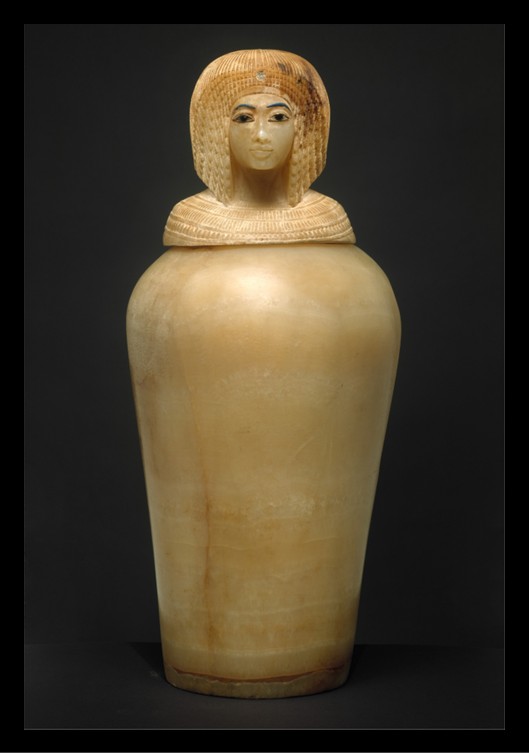
Canopic Jar with a Lid Depicting a Queen, New Kingdom, Amarna Period, Dynasty 18, reign of Akhenaten, ca. 1349–1330 BC, from Upper Egypt, Valley of the Kings, Tomb KV 55, Travertine (Egyptian alabaster), blue glass, obsidian, unidentified stone, Height of Jar and Lid: 53.2 cm, the MET, NY, USA https://www.metmuseum.org/art/collection/search/544689
The Amarna Canopic Jar presented here, created for a funerary purpose, bears a lid adorned with a face so exquisitely detailed that it showcases the skill of a master artist, as if it were a public portrait. The youthful features—marked by a long, slender nose, almond-shaped eyes, and a delicately sculpted mouth—reflect an idealized image intended to endure in the eternal afterlife, regardless of the owner’s true age at death. Stylistically, the jar aligns with the artistic innovations of Akhenaten’s later reign, a period defined by the relocation of the royal court to Amarna. Yet, the mystery lingers: alterations made to the jar and lid in antiquity obscure the identity of the original owner. Who is she? The question haunts this artifact, a silent testament to both artistic mastery and the enigmatic nature of its history.
The enigmatic Canopic Jar, discovered in 1907, offers a fascinating glimpse into the royal intrigues of Akhenaten’s court, its ownership shrouded in layers of mystery and historical debate. Was it created for Queen Tiye, the formidable matriarch of the Amarna dynasty? Or perhaps Queen Nefertiti, renowned for her beauty and influence? Some have speculated it belonged to Queen Kiya, Akhenaten’s favored secondary wife, whose identity is subtly suggested by faint traces of hieroglyphs and the distinctive Nubian wig. Others propose Princess Merytaten, Akhenaten’s eldest daughter and later consort. For a time, even Akhenaten himself was considered a possibility. This confusion underscores the complex dynamics of the royal family, whose intertwined stories continue to captivate and confound modern scholars.
Canopic Jar with a Lid Depicting a Queen, New Kingdom, Amarna Period, Dynasty 18, reign of Akhenaten, ca. 1349–1330 BC, from Upper Egypt, Valley of the Kings, Tomb KV 55, Travertine (Egyptian alabaster), blue glass, obsidian, unidentified stone, Height of Jar and Lid: 53.2 cm, the MET, NY, USA https://www.metmuseum.org/art/collection/search/544689
Whoever the original owner portrayed on the lid of the Canopic Jar in the MET was, she is undoubtedly a striking representation of one of the royal women of Amarna, embodying the elegance and refinement characteristic of this unique artistic period. Her features, including a long, slender nose, almond-shaped eyes, and a sensuous mouth, reflect the naturalistic yet idealized aesthetic that defined Amarna art. She wears the Nubian wig, a hairstyle of overlapping curls reserved for adults and favored by Akhenaten’s female relatives, emphasizing her status and maturity. At the center of her forehead, a hole marks the original placement of a separately carved rearing cobra, or uraeus, whose tail elegantly curves across the top of the wig. This royal insignia, exclusively worn by kings and queens, reinforces her elevated position within the court. The fusion of idealized beauty with symbolic details like the uraeus and the wig encapsulates the distinctive style and symbolic language of the Amarna period.
The Metropolitan Museum of Art Canopic Jar was discovered in 1907 within Tomb KV55 in the Valley of the Kings, one of Egypt’s most enigmatic burial sites. This tomb contained a mixture of funerary artifacts, including items inscribed for Queen Tiye, magical bricks bearing Akhenaten’s name, and four canopic jars, among them, the one in question, alongside a wooden coffin likely crafted for Kiya. It is believed that, to protect these items, Tutankhamun ordered their transfer from Akhenaten’s plundered Amarna tomb to Thebes. Subsequently, Kiya’s jars, and coffin may have been repurposed for another royal family member’s burial.
Canopic Jar with a Lid Depicting a Queen, New Kingdom, Amarna Period, Dynasty 18, reign of Akhenaten, ca. 1349–1330 BC, from Upper Egypt, Valley of the Kings, Tomb KV 55, Travertine (Egyptian alabaster), blue glass, obsidian, unidentified stone, Height of Jar and Lid: 53.2 cm, the MET, NY, USA https://www.metmuseum.org/art/collection/search/544689
Tomb KV55’s entrance is cut into the floor of the main valley between the resthouse and the tomb of Rameses IX (KV 6). The tomb comprises an entryway followed by a single corridor leading directly into the burial chamber and its side chamber. Marks on the walls indicate that, after the entrance and stairs were cut, the entrance was enlarged, the ceiling raised, and the number of stairs increased.
The tomb’s discovery and the subsequent analysis of its contents have provided significant insights into the complex burial practices and political dynamics of the late 18th Dynasty, particularly concerning the Amarna period and its aftermath. The relocation and reuse of funerary equipment highlight the period’s turbulent transitions and the efforts to preserve royal legacies amid shifting religious and political landscapes.
For a Student Activity, titled ‘Guardians of the Afterlife – Understanding the Role and Use of Egyptian Canopic Jars’ inspired by the Amarna period Canopic Jar in the MET, please… Check HERE!
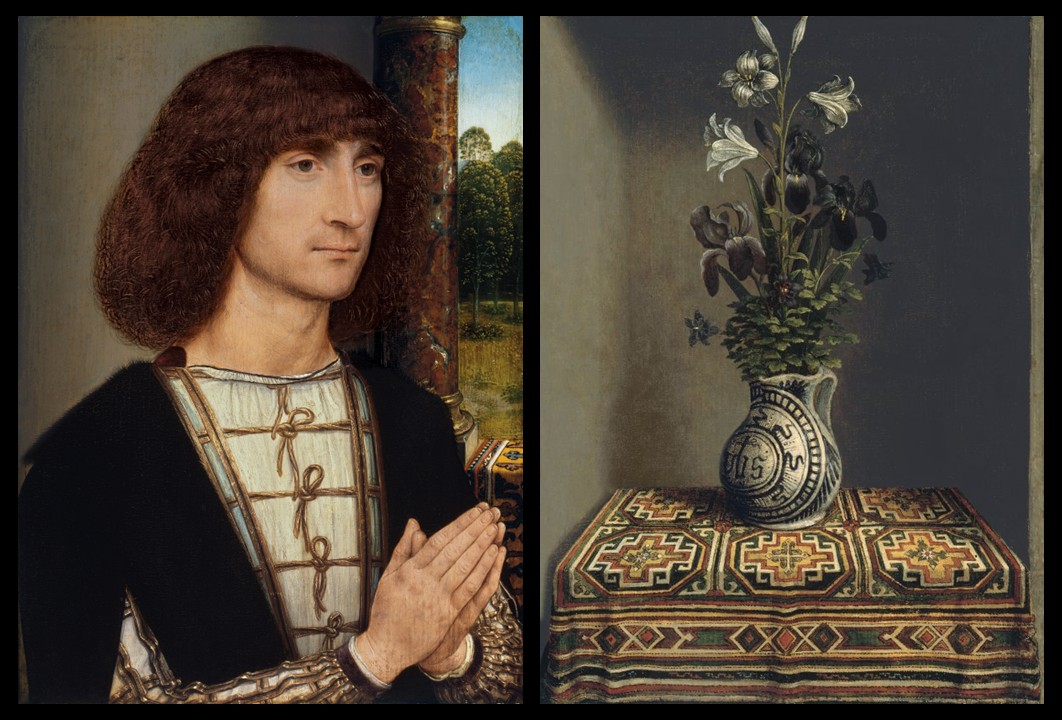
Hans Memling, a prominent Flemish artist of the 15th century, holds a significant place in the Thyssen-Bornemisza National Museum’s collection in Madrid. Known for his refined and emotive style that bridges the Gothic and early Renaissance, Memling’s works exemplify the sophisticated use of colour, meticulous detail, and spiritual depth characteristic of Early Netherlandish painting. The museum houses the double-sided painting of the Portrait of a Young Man Praying and Flowers in a Jug, which demonstrates the artist’s ability to convey sacred narratives with clarity and grace. Memling’s contribution to the collection enriches its representation of Northern Renaissance art, offering visitors a glimpse into the devotional and artistic sensibilities of his era.
Hans Memling, born in Seligenstadt near Frankfurt around 1435, was a German painter who became a leading figure in the Early Netherlandish school. By 1465, he had relocated to Bruges, where he obtained citizenship and established a successful workshop. Memling’s early training is believed to have been under Rogier van der Weyden in Brussels, which significantly influenced his artistic development. Throughout his career, Memling received numerous commissions from both local patrons and international clients, particularly from the Italian community in Bruges. He remained active in Bruges until his death in 1494.
The artist’s work is characterized by its refined elegance and serene compositions, often reflecting the influence of his mentor, Rogier van der Weyden. He was instrumental in popularizing the use of landscape backgrounds in portraiture, enhancing the naturalism and depth of his paintings. His portraits are noted for their meticulous attention to detail and the harmonious depiction of his subjects. Among his notable works are the Triptych of the Last Judgment (1467–1471) housed in the National Museum in Gdańsk, and the Diptych of Maarten van Nieuwenhove (1487) in the Memling Museum in Bruges. Memling’s art had a lasting impact on the development of Northern Renaissance painting, influencing artists such as Gerard David and Juan de Flandes.
Memling’s aesthetic is distinguished by his delicate balance between realism and idealization, a hallmark of Early Netherlandish painting. His works exhibit extraordinary attention to detail, from the intricate patterns of textiles to the soft rendering of skin tones and facial features. His use of colour is particularly notable, with a palette that combines rich, jewel-like tones with subtle gradations to create a sense of luminosity and depth. He masterfully employed oil paints to achieve smooth transitions and fine details, enhancing the lifelike quality of his figures. The tranquil expressions and poised gestures of his subjects contribute to the serene and contemplative mood that defines much of his oeuvre. Furthermore, his incorporation of detailed landscapes as backgrounds—featuring rolling hills, distant towns, and serene skies—imbued his compositions with a sense of expansiveness and connection to the natural world. Memling’s ability to blend spiritual gravitas with human intimacy made his works deeply appealing to both religious and secular patrons, securing his reputation as a preeminent painter of his time.
The Thyssen-Bornemisza double-sided painting, created around 1485, features the Portrait of a Young Man Praying on the obverse and Flowers in a Jug on the verso. The portrait depicts an unidentified young man in a devout posture, suggesting that the panel was originally part of a triptych. In such an arrangement, the central panel would likely have featured the Virgin and Child, with a female counterpart to the young man on the opposite wing. The subject’s attire and hairstyle indicate he may have been an Italian patron, reflecting Memling’s connections with the Italian community in Bruges. The meticulous attention to detail and serene expression exemplifies Memling’s refined portraiture style.
On the reverse side, Flowers in a Jug, the artist presents one of the earliest known independent still lifes. The composition includes symbolic elements: lilies representing the Virgin Mary’s purity and a jug adorned with Christ’s monogram, alluding to the Holy Family. This panel likely served as one of the exterior wings of the triptych, with the other wing possibly featuring a complementary still life or the couple’s emblem. Memling’s inclusion of such detailed still life elements highlights his innovative approach and contributes to the rich symbolism characteristic of his work.
For a PowerPoint Presentation of Hans Memling’s oeuvre, please… Check HERE!
The Portrait ofMäda Primavesi, the subject of Klimt’s painting currently in the MET, presents the lively nine-year-old daughter of a wealthy Viennese family of art patrons. Mäda’s parents, Otto and Eugenia Primavesi, were supporters of Gustav Klimt, and this portrait reflects their taste for Vienna Secession-style art, known for bold colours and expressive design. Mäda, wearing a white, aethereal dress, is depicted with an air of confidence and poise. Set against a colourful background, the portrait highlights Klimt’s skill in capturing the personality and vivacity of his young sitter.
The Primavesi family, especially Otto Primavesi, were prominent patrons of Gustav Klimt and the Wiener Werkstätte, an influential Viennese art collective that merged fine and decorative arts. Otto, a wealthy banker and industrialist, provided substantial financial support to the Werkstätte, ensuring its continuity after the departure of Fritz Waerndorfer, the group’s initial backer. This partnership allowed Klimt and other avant-garde artists to create some of their best-known works under more stable conditions. Klimt painted portraits of both Otto’s wife, Eugenia, an actress, and their daughter, Mäda, whose youthful confidence and vibrant attire convey a sense of strength and individuality rare in Klimt’s other portraits of the time. We went every few months to Vienna and stayed about 10 days, Miss Primavesi said to Rita Reif of the New York Times, of the trips she made with her mother while the portraits were in progress. I was a little girl, and Professor Klimt was awfully kind. When I became impatient, he would just say, ‘Sit for a few minutes longer.’ He made at least 200 sketches.https://www.nytimes.com/1987/05/09/arts/lost-klimt-to-be-sold-in-auction.html
After early financial setbacks, young Mäda’s portrait was sold in the 1930s and is now at the Metropolitan Museum of Art. For many years she did not know the whereabouts of her portrait. She had not seen it since it was sold in 1931 or 1932, until 1986, when she visited the Metropolitan Museum to view it. I asked Professor Klimt if he would write something in my book, she said in her interview of the autograph book she kept as a child and he wrote: The day is like night unless I see you. I am happier if I dream about you. Mäda, the daughter who never got married, moved to Canada in 1949, founded a convalescent hospital for children and dedicated 25 years to it before retiring.
Gustav Klimt’s Portrait of Mäda Primavesi exemplifies his shift from the ornate, gilded style of his Golden Phase to a more colourful, patterned aesthetic, influenced by modernist trends. It captures the spirited individuality of its young subject, painted when she was just nine years old. Unlike his typical female portraits, Klimt adopts an unconventional pose for Mäda: she stands squarely facing the viewer, her legs apart and arms folded behind her back, exuding a self-confidence and modernity that defy traditional depictions of children. Her serious yet engaging gaze reinforces her strong character, suggesting a collaborative process between artist and subject to capture her personality authentically. Mäda’s white dress, designed by Emilie Flöge, is simple and youthful, yet Klimt’s addition of a vivid rose motif at the chest height lends it a touch of his signature decorative flair. This interplay of youthful innocence and bold individuality situates the portrait firmly in the avant-garde aesthetic of the Vienna Secession.
The setting further enhances the portrait’s charm, with Mäda positioned against a lilac wall adorned with flowers and standing on a green carpet featuring red floral patterns and playful, stylized figures inspired by East Asian art. This vibrant and whimsical backdrop complements the liveliness of the composition, echoing Klimt’s admiration for decorative arts and his interest in integrating elements of his subjects’ lives into his work. The Primavesi family’s connection to Klimt and his artistic circle, including Josef Hoffmann and the Wiener Werkstätte, reflects their commitment to the innovative art and design of the time. The result is a portrait that transcends conventional child portraiture, embodying both the individuality of the sitter and the modern artistic ethos of early 20th-century Vienna.
This portrait also reflects the changing role of portraiture in early 20th-century art, moving beyond mere representation to convey mood and personality. Mada’s posture—relaxed but commanding—suggests her self-assurance and status, while the painting’s vibrant palette and intricate design evoke a world of luxury and artistic modernity. Klimt’s sensitivity to texture is evident in the soft rendering of Mada’s skin and the striking visual rhythm created by her clothing, which echo the decorative innovations of the Vienna Secession movement. The Portrait of Mada Primavesi stands as a testament to Klimt’s ability to celebrate individuality while merging it seamlessly with his iconic decorative style.
For a PowerPoint Presentation titled 18 Portraits by Gustav Klimt, please… Check HERE!
In the world of ancient Egyptian art, true portraits were a rarity, making the Bust of Prince Ankhhaf a remarkable exception. Housed in the Museum of Fine Arts, in Boston, this limestone bust, coated with a delicate layer of plaster, showcases the masterful hand that sculpted its intricate details. Unlike the stylized depictions typical of the era, Ankhhaf’s visage is that of a real individual, imbued with personality and character. Historical inscriptions from his tomb reveal Ankhhaf’s royal lineage as the son of King Sneferu, brother to Pharaoh Khufu, and a high-ranking official who served as vizier and overseer of works for his nephew, Pharaoh Khafre. In these roles, Ankhhaf may have played a pivotal part in overseeing the construction of the second pyramid and the carving of the iconic Sphinx, cementing his legacy in the annals of ancient Egypt. https://collections.mfa.org/objects/45982
Prince Ankhhaf, a distinguished figure of Egypt’s Old Kingdom during the Fourth Dynasty (circa 2600 BCE), is believed to have been the son of Sneferu, though his mother’s identity remains unknown. Despite holding the prestigious title of “eldest king’s son of his body,” it was his half-brother Khufu who ascended to the throne after Sneferu. Alternatively, there is a possibility that Ankhhaf was the son of Huni, which would make him Sneferu’s half-brother.
The Prince served as Vizier to his half-brother Pharaoh Khufu and possibly his nephew Pharaoh Khafre. Renowned for his architectural prowess, Ankhhaf played a crucial role in the later stages of the construction of the Great Pyramid at Giza, overseeing the delivery of Tura White Limestone from quarry to port and ensuring its placement atop the pyramid’s limestone base. Egyptologists speculate that he also contributed architecturally to the Great Sphinx, another iconic structure in Giza. Ankhhaf’s familial ties were equally noteworthy; he married his half-sister Princess Hetepheres, with whom he had a daughter, also named Princess Hetepheres. His own tomb, Mastaba G7510 in the Eastern Cemetery of Giza, is one of the largest discovered at the site, reflecting his high status and enduring legacy in ancient Egyptian history.
Maps of the Giza Necropolis where Prince Ankhhaf’s Mastaba Tomb G7510, the largest in the East Field Cemetery, was discovered https://historyofegypt.net/?page_id=4760
Ankhhaf’s mastaba had a mudbrick chapel attached to its east side, oriented in such a way that it faced the chapel’s entryway. The chapel walls were covered in exquisitely modelled low relief sculptures, exemplary representations of Old Kingdom artistry, and characterized by their detailed and realistic depictions. These reliefs primarily adorn the walls of the chapel within the mastaba and depict various scenes that illustrate both daily life and ceremonial activities. The scenes feature intricate details, such as the rendering of human figures, animals, and hieroglyphic inscriptions, providing a fragmentary narrative of Ankhhaf’s life and his contributions. These reliefs also serve a symbolic function, intended to ensure the deceased’s safe passage to the afterlife and to perpetuate his memory and legacy. The craftsmanship of these sculptures demonstrates the high level of skill possessed by the artisans of the time and offers valuable insights into the aesthetic and cultural values of ancient Egypt during the 4th Dynasty.
The Bust of Prince Ankhhaf was discovered in 1925 during an excavation by the Harvard University–Museum of Fine Arts Expedition in the eastern cemetery at Giza. The excavation revealed the bust in the tomb’s chapel, an area rich with artefacts and inscriptions that shed light on the life and status of Ankhhaf. This significant find was awarded to Boston by the Egyptian Antiquities Service in gratitude for the Harvard-Boston Expedition’s painstaking work to excavate and restore objects from the tomb of Queen Hetepheres. It was transported to the Museum of Fine Arts in Boston, where it remains one of the museum’s prized pieces, offering a tangible connection to Egypt’s ancient past. https://collections.mfa.org/objects/45982
The bust of the Egyptian Prince Ankhhaf is renowned for its striking realism, a characteristic that sets it apart from other contemporary Egyptian art. Carved from limestone and originally coated with a thin layer of plaster, the bust portrays Ankhhaf with a remarkable level of detail and individuality. His features, those of a mature man, are solemn and introspective, with a prominent nose, fleshy lips, and slight furrows on his forehead and the sides of his lips, suggesting a thoughtful and possibly authoritative demeanour. The eyes, which were once painted white with brown pupils and carried puffy pouches underneath, add to the lifelike quality of the sculpture. This bust not only exemplifies the artistic skills of the time but also provides a rare glimpse into the personal appearance of an individual from ancient Egypt’s elite class.
For a Student Activity inspired by the Bust of Prince Ankhhaf, please… Check HERE!
In the rich tapestry of Renaissance art, few relationships are as intriguing as that between Painter Lorenzo Lotto and collector Andrea Odoni. Lotto, a masterful Venetian painter known for his emotive portraits and religious works, found a patron and admirer in Odoni, a wealthy merchant and avid art collector. This post delves into their lives, their contributions to the art world, and the fascinating intersection of their paths.
Lorenzo Lotto was born around 1480 in Venice, Italy, and was a prominent painter of the High Renaissance. He trained in the vibrant Venetian art scene, which greatly influenced his early works. Despite his Venetian roots, Lotto spent much of his career working in other regions such as Treviso, Bergamo, and the Marches, seeking patronage and commissions. This itinerant lifestyle led to diverse influences and experiences that shaped his unique style. He remained relatively obscure compared to his contemporaries, partly due to his preference for working in smaller, less cosmopolitan cities.
Lotto’s artistic achievements are notable for their emotional depth and psychological insight, distinguishing him from many of his peers. His portraits are celebrated for their reflective quality, often capturing the sitter’s personality and mood with remarkable sensitivity. He also produced a significant body of religious works, characterized by their vivid colour, dynamic compositions, and intricate detail. Despite not achieving the same level of fame as some of his contemporaries during his lifetime, Lotto’s work has gained considerable recognition and appreciation in modern times for its originality and emotional intensity.
Andrea Odoni, born in 1488 in Venice, was a prominent merchant who became renowned for his extensive art collection during the Italian Renaissance. Coming from a wealthy family, Odoni had the means to indulge in his passion for art, which he cultivated alongside his successful mercantile career. His home in Venice became a treasure trove of artistic works, attracting artists, intellectuals, and fellow collectors. Odoni’s refined taste and discerning eye made him one of the most respected collectors of his time, and he played a significant role in promoting the arts and supporting contemporary artists.
Odoni’s achievements as an art collector are highlighted by his ability to amass a diverse and high-quality collection that included works from both renowned and emerging artists. His collection featured pieces by masters such as Titian, Giorgione, and Lorenzo Lotto, the latter of whom painted a famous portrait of Odoni himself. This portrait, known as “Portrait of Andrea Odoni,” is celebrated for its detailed depiction of Odoni surrounded by classical artefacts, symbolizing his deep appreciation for art and culture. Odoni’s contributions to the art world extended beyond his collection, as he was instrumental in fostering a culture of art appreciation and intellectual exchange in Venice. His legacy endures as a testament to the vital role that collectors play in the preservation and promotion of artistic heritage.
Lorenzo Lotto’s Portrait of Andrea Odoni painted in 1527 and housed in the Royal Collection at Hampton Court, UK, is a masterful representation of the distinguished Venetian merchant and art collector. The painting captures Odoni seated in an opulent setting, surrounded by classical artefacts, sculptures, and a rich array of objects that reflect his status and intellectual pursuits. Odoni’s expressive face, with keen eyes and a thoughtful gaze, is the focal point of the composition. He holds in one hand a statuette of Diana of Ephesus, symbol of nature and idolatry, and with the other he clasps a cross to his chest. https://www.rct.uk/collection/405776/andrea-odoni
From an artistic standpoint, the portrait is a testament to Lotto’s skill in capturing not just the physical likeness of his subjects but also their character and social standing. The use of light and shadow, particularly on Odoni’s face, enhances the three-dimensionality of the figure and imbues the painting with a sense of realism. The meticulous detail of the artefacts surrounding Odoni reflects the Renaissance fascination with antiquity and the humanist values of the period. The composition’s richness and complexity suggest a narrative of intellectual curiosity and cultural engagement. The painting not only serves as a personal homage to Odoni’s love for art but also as a broader statement on the importance of collectors in preserving and celebrating cultural heritage. Through this portrait, Lotto provides insight into the sophisticated world of Renaissance collectors and their pivotal role in the art world.
One more note… Lorenzo Lotto’s Portrait of Andrea Odoni is imbued with a complexity that transcends a mere depiction of a collector, inviting viewers to contemplate a deeper narrative. The painting’s juxtaposition of Odoni’s right hand holding the pagan statuette of Diana with his left hand clutching a cross to his heart suggests a profound choice between the enduring power of nature and the transitory nature of human achievement. This contrast emphasizes Odoni’s prioritization of Christian faith over pagan antiquity, highlighting a tension between the values of the time.
For a PowerPoint inspired by the Painter Lorenzo Lotto and collector Andrea Odoni presentation, please… Check HERE!
Thaleia Flora Karavia was a prominent Greek painter known for her vibrant depictions of everyday life, her contributions to war art, and her involvement in the Greek artistic community. Born in Siatista, in northern Greece, she moved to Constantinople as a child in 1874, where she pursued her education at the Zappeion Girls’ School, and received her early artistic education. After graduation, she spent a year teaching, but her passion for painting soon led her to Munich in 1895. There, she attended private schools and received training from renowned artists such as Nikolaos Vokos, Georgios Ιakovidιs, Nikolaos Gyzis, Paul Nauen, Anton Azbe, Walter Thor, and Fer.
The artist returned to Constantinople in 1898, but her artistic journey called her back to Munich, where she stayed until 1900. Upon her final return to Constantinople, she travelled extensively across various European cities. In 1907, she married journalist Nikolaos Karavias during a visit to Egypt. The couple settled in Alexandria, where Flora Karavia lived for thirty years. During her time there, she was highly active in the art community, founding and personally running an Artistic School.
Karavia’s work is distinguished by impeccable draftsmanship, harmonious composition, a delicate approach to colour, and an acute sense of realism. She excelled in a diverse range of subjects, including portraits, landscapes, still life, and genre scenes, capturing the essence of Greek life and culture. Initially, she adhered to the conservative guidelines of the Academy, but eventually embraced the principles of impressionism and plein-air painting. Beyond her canvas work, she also illustrated literary texts and designed lottery tickets to support the Greek National Fleet, showcasing her versatility and commitment to both art and national causes.
A particular favourite is the artist’s painting of Girl on the Beach, as it captures a serene but joyful moment, emphasizing her mastery of light and colour. The painting depicts a smiling, young girl seated on a sun-drenched beach, gazing at the viewer, her back out at the summer sea. The composition is both simple and evocative, with the girl positioned at the center, creating a sense of balance and harmony. Flora Karavia’s use of soft, warm tones reflects the gentle sunlight, casting delicate shadows that add depth and realism to the scene. The brushwork is fluid yet precise, capturing the textures of the gentle ripples of the water, and the girl’s curly hair. This painting highlights Flora Karavia’s ability to convey a mood of peaceful introspection and her keen observation of the natural world. Through this work, she invites the viewer to share in a happy moment of joyful reflection, making it a poignant example of her artistic sensitivity and skill.
During the Balkan Wars (1912-1913) and World War I, Karavia was one of the few female war artists who documented the experiences of soldiers and the impact of the wars on Greece. Her war art provides a unique and personal perspective on conflicts, focusing on the human side of war rather than the strategic or political aspects.
Apart from her painting, Flora Karavia was also an active member of the Greek artistic community, participating in exhibitions and promoting the arts in Greece. She was associated with the Art Group “Techni,” which played a crucial role in the development of modern Greek art.
Throughout her career, Thaleia Flora Karavia’s works were celebrated for their emotional depth, technical skill, and dedication to portraying the human condition. Her legacy continues to be honoured in Greece, where she is considered a significant figure in the nation’s art history.
For a PowerPoint titled 10 Portraits of Women by Thaleia Flora Karavia, please… Check HERE!
On Father’s Day consider the majestic, full-length portraits by Veronese, which celebrated the da Porto family, showcasing Count Issepo da Porto and his son Adriano alongside Countess Livia da Porto Thiene and her Daughter Deidamia. These paintings, originally placed in their Vicenza palace designed by Andrea Palladio, symbolize a family’s enduring connection and heritage. Just as Veronese’s art captures the richness of family life and the protection and care provided by fathers, Father’s Day allows us to honour and appreciate the fathers and father figures who have shaped our lives with their love and guidance.
The artist who created the double portraits, Father and Son, Mother and Daughter, of the da Porta family is Paolo Veronese, born Paolo Caliari in 1528 in Verona, Italy, one of the most prominent painters of the Venetian Renaissance. Trained in the workshop of local master Antonio Badile, Veronese’s early work reflects the influence of his native city’s art and architecture. Moving to Venice in the early 1550s marked a significant turning point in his career, allowing him to immerse himself in the city’s vibrant artistic community. Known for his vivid use of colour, dynamic compositions, and grandiose themes, Veronese quickly established himself as a master of large-scale paintings, creating works that adorned palaces, churches, and public buildings. His integration of classical themes with contemporary Venetian culture, coupled with his skilful rendering of fabrics, textures, and architectural elements, distinguished him from his contemporaries and earned him widespread acclaim.
Among Veronese’s most notable achievements are his grand frescoes and altarpieces, such as the Feast in the House of Levi and the Wedding at Cana, which showcase his ability to blend narrative complexity with a sense of opulence and theatricality. His portraits, on the other hand, like those of the da Porta family, demonstrate his keen ability to capture individual character and status, further cementing his reputation as a master portraitist. Veronese’s work not only exemplified the ideals of the High Renaissance but also laid the groundwork for the Baroque movement that followed. His legacy endures through his contributions to the development of Venetian art, influencing generations of artists and securing his place in the pantheon of great Renaissance painters.
Count Issepo da Porto, a nobleman from Vicenza, and his young son Adriano, painted by Paolo Veronese around 1555, make a masterful representation of Renaissance portraiture. Veronese’s skilful use of colour, light, and composition creates a striking and intimate portrayal of the father and son duo. In the portrait, Count Issepo da Porto is depicted standing, exuding an air of authority and elegance. He is dressed in luxurious Renaissance attire, characterized by rich, very dark fabrics and elaborate details, which signify his high social status. The count’s pose is dignified, with one hand resting on his hip and the other gently placed over his son’s shoulder, establishing a sense of connection and paternal care. His facial expression is composed and confident, reflecting his stature and the responsibilities that come with his position.
Adriano, the count’s first-born son, stands beside him, dressed in similarly fine clothing, lighter in tone, that mirrors his father’s, suggesting both the boy’s noble lineage and the care taken in his upbringing. Adriano’s pose is more relaxed, illustrating a sense of affection and dependence. The interaction between the two figures conveys a tender familial bond, enhanced by Veronese’s attention to the details of their postures, expressions, clothing, and the subtle interplay of light and shadow.
The background of the painting is relatively subdued, focusing the viewer’s attention on the figures and their relationship. Veronese’s use of colour, particularly the rich, dark, and warm tones, and the meticulous rendering of textures, such as the fabrics and the skin tones, demonstrate his mastery in creating lifelike and engaging portraits. The Portrait of Count Issepo da Porto and his son Adriano not only captures the likeness of the subjects but also conveys a narrative of lineage, status, and the deep familial connection between father and son.
For a PowerPoint, titled 10 Masterpieces by Paolo Veronese, please… Check HERE!
Maid of Athens, ere we part, / Give, oh give me back my heart! / Or, since that has left my breast, / Keep it now, and take the rest! / Hear my vow before I go, / Ζωή μου, σᾶς ἀγαπῶ. / By those tresses unconfined, / Wood by each Ægean wind; / By those lids whose jetty fringe / Kiss thy soft cheeks’ blooming tinge; / By those wild eyes like the roe, / Ζωή μου, σᾶς ἀγαπῶ. / By that lip I long to taste; / By that zone encircled waist; / By all the token-flowers that tell / What words can never speak so well; / By love’s alternate joy and woe. / Ζωή μου, σᾶς ἀγαπῶ. / Maid of Athens! I am gone: / Think of me, sweet! when alone. / Though I fly to Istambol, / Athens holds my heart and soul: / Can I cease to love thee? No! / Ζωή μου, σᾶς ἀγαπῶ. (Zoë mou, sas agapo – My Life, I love you)… wrote Lord Byron in 1810 while visiting Athens… https://allpoetry.com/Maid-Of-Athens,-Ere-We-Part
Lord Byron, the famous British poet, visited Greece in 1809-1810 as part of his Grand Tour of Europe and the Near East. He was motivated by a desire to explore the classical world and to see the ruins of antiquity. He was also interested in the politics of the region and was particularly intrigued by the ongoing struggles of the Greek people against Ottoman rule. Byron became a strong advocate of the Greek Struggle for Independence, donating money and resources to support the cause. His actions helped to raise awareness of the Greek cause and inspired other Europeans to support Greek independence as well. He is remembered as one of the most prominent philhellenes of the 19th century, the man whose influence on British public opinion helped the recognition of Greek independence by the British government.
Fascinated by the ancient Greek culture and history, Byron spent during 1810, several months in Athens, immersing himself in the local culture. Athens had a profound impact on his poetry, particularly in the creation of his epic poem Childe Harold’s Pilgrimage, which was published in 1812 and became a literary sensation. The poem is a reflection on the ruins of ancient Greece and the contemporary state of the country, which was still under Ottoman rule. Greece inspired him to write several other poems, such as The Curse of Minerva, The Isles of Greece,and The Siege of Corinth, all of which reflect his admiration for ancient Greece and its culture.
The Maid ofAthens is a poem by Lord Byron, published in 1810. It is a tribute to a Greek girl named Teresa Makri, whom the poet met during his first, 1810, stay in Athens. The poem expresses the speaker’s admiration for Teresa’s beauty and spirit, and his regret at not being able to spend more time with her. The poem is known for its romantic and exotic imagery and its evocation of the beauty and mystery of Greece.
In 1860, Theodoros Vryzakis, a 19th-century Greek painter, known for his historical and patriotic canvases depicting scenes from the Greek War of Independence, painted The Maid ofAthens, inspired by Byron’s famous poem.
According to the National Gallery of Greece citation… After his father was hanged by the Turks in 1821, Theodoros Vryzakis and his brother Euthymios were sent to the Capodistrias Orphanage on Aegina. In 1832, probably with the help of Ludwig Thiersch, a progressive educator in the Court of King Otto of Greece, he went to Munich where he studied at the Panhellenion, the Greek school founded by Ludwig I for the orphans of the veterans of the Greek War of Independence. In 1844, he was accepted by the Munich Academy of Fine Arts, and until 1855 continued on a scholarship financed by the Greek community in Munich. https://www.nationalgallery.gr/en/artist/vryzakis-theodoros/
From 1848 to 1851, still financed by the Greek community in Munich, Vryzakis returned to Greece for an extended visit. He aimed to study the landscape and the people of Greece so he could accurately depict them in his history paintings. Could the Maid of Athens be the result of such a study? I wish I could accurately say Yes or No!
Vryzakis’s painting of the Maid of Athens, a tribute to the famous Philhellene, Lord Byron, is characteristically executed in the artist’s classical romantic spirit. His style, clearly influenced by Neoclassicism, idealizes the girl’s features, emphasizing her dark hair and eyes. If the Maid of Athens is indeed Theresa Macri, the eldest daughter of Theodora Macri, the widow of a former English vice-consul, she is depicted as described by the artist, Hugh W. Williams, who visited Athens in May 1817… Theresa, the Maid of Athens, …has black, or dark hair and eyes; her visage is oval, and her complexion somewhat pale, with teeth of pearly whiteness. Her cheeks are rounded, her nose straight, rather inclined to aquiline. Her countenance, except when the conversation has something of mirth in it, may be said to be rather pensive. She is elegant, and her manners pleasing and lady-like, such as would be fascinating in any country… https://genius.com/Lord-byron-maid-of-athens-ere-we-part-annotated – Travels in Italy, Greece, etc., ii. 291, 292.
Celebrating the Greek Revolution of 1821 and remembering… people and events!
The painting by Gentile Bellini depicting Cardinal Bessarion in prayer before his Byzantine Reliquary, accompanied by two Members of the Scuola della Carità, housed in the National Gallery in London, captivates my fascination. Bellini’s masterpiece not only offers a tangible link to the historical context it portrays but also illuminates the cultural milieu of its time. Functioning as both an artistic treasure and a captivating historical document, this work by Bellini is a testament to the rich tapestry of the past. https://www.nationalgallery.org.uk/paintings/gentile-bellini-cardinal-bessarion-with-the-bessarion-reliquary
Born Basilios Bessarion in 1403 in Trebizond, on the Black Sea, Bessarion emerged as a distinguished Humanist and a significant figure of the Renaissance. Initially devoted to a monastic life within the Eastern Orthodox Church, his trajectory took a pivotal turn during the Council of Ferrara-Florence. Here, he fervently advocated for the union of the Eastern and Western Churches, leading to his relocation to Italy. Immersing himself in the Renaissance’s revival of classical learning, Bessarion’s scholarly contributions and diplomatic acumen were acknowledged by Pope Eugene IV in 1439, culminating in his appointment as a Cardinal of the Catholic Church.
Beyond his ecclesiastical responsibilities, Cardinal Bessarion carried influence as a significant Arts Patron, amassing an extensive collection of Greek and Latin manuscripts including ecclesiastical and classical texts. His library considered a beacon of erudition, played a pivotal role in disseminating Greek knowledge to Latin-speaking scholars, thus nurturing the flourishing Humanist movement. This rich repository, comprising rare manuscripts and ancient texts, reflected Bessarion’s fervent commitment to preserving and transmitting the cultural heritage of both Eastern and Western traditions. This passion left a lasting mark on the intellectual landscape of the Renaissance. On May 31, 1468, Cardinal Bessarion bestowed his precious library upon the Serenissima Republic of Venice, endowing hundreds of rare manuscripts to shape the nucleus of the renowned library of St Mark’s, the Biblioteca Marciana.
While Cardinal Bessarion is primarily celebrated for his scholarly contributions, efforts in reuniting the Eastern and Western Churches, and the establishment of his extensive library, he is also associated with a remarkable religious artifact known as Bessarion’s Reliquary or Staurotheke in Greek. This magnificent example of Late Byzantine craftsmanship, donated by Bessarion himself to the Scuola Grande della Carità in 1463, now forms part of the Collection of the Accademia in Venice. The Reliquary features a movable, gilded central Cross with origins traced back to the Byzantine princess Irene Paleologina. Encased within a wooden frame/box adorned with painted scenes depicting the Passion, intricate goldsmithing featuring blue-colored enameling, and flanked by the figures of Emperor Constantine and his mother Helena, the Cross also incorporates four chambers made of rock crystal. These chambers, situated on either side of the Cross, house the precious Relics of the True Cross and Christ’s robe.
Moving from the exploration of Cardinal Bessarion’s Reliquary to Gentile Bellini’s depiction of it, one can discern the symbiotic relationship between the historical artifact and the artist’s creative interpretation. Executed in 1972/73, precisely when Bessarion’s Reliquary made its way to Venice, Bellini was commissioned to craft a painted door panel. This panel was an integral component of a tabernacle designed to encase and safeguard the precious reliquary.
Gentile Bellini’s artistic pursuit not only captures the religious significance of the Reliquary but also breathes life into the personalities linked to its donation. The painting prominently features the generous donor, Cardinal Bessarion, portrayed in profile and modestly attired in black. Accompanying him are two distinguished members of the Scuola della Carità, adorned in their characteristic white robes. One of them is depicted holding an instrument for self-flagellation, projecting a sense of distinction and prominence. Despite the varied depictions, the central focus remains on Bessarion’s Reliquary, commanding attention in the composition. It serves as both a symbolic and visual anchor, connecting the historical artifact to the narrative brushstrokes of Bellini’s portrayal. Consequently, Bellini’s canvas emerges as a bridge between the tangible beauty of the relic and the nuanced storytelling of the individuals tied to it.
The Reliquary’s connection to Venice is beautifully narrated by Holgera A. Klein… In July 1463, ten years after the conquest of Constantinople (1453), Pope Pius II had sent Bessarion to Venice in an attempt to rekindle and promote the idea of a Crusade against the Ottoman Turks. Befitting his role as a Catholic Cardinal traveling as papal legate, the Doge and Senate went out to meet Bessarion in the lagoon on the Bucintoro, the doge’s great ceremonial barge, with chants, acclamations, and church bells resounding from all parts of the city. It was not the only honor bestowed on Bessarion in Venice, for on August 29, a few weeks after his arrival in Venice, Marco della Costa, the Guardian Grande of the Scuola della Carità, and a delegation of its most prominent members went to visit the Cardinal on the island of San Giorgio Maggiore and solemnly invited him to join their confraternity as a member. Touched by the city’s exhibit of respect, Bessarion, accepted the honor, accompanied the Scuola’s delegation back to the Rialto in festive procession, and vowed in gratitude to bestow a special gift on the Confraternity, namely his precious Stavrotheke, that previously belonged to Gregory III Melissenos, the Patriarch of Constantinople, with the sole provision that he would like to hold on to it during his lifetime.https://arthistory.columbia.edu/sites/default/files/content/faculty/pdfs/klein/Klein_estratto.pdf Cardinal Bessarion, Philippe de Mézières and the Rhetoric of Relics in late medieval Venice, by Holger A. Klein, pp. 23-26
In the spring of 1472, in Bolognia, on his way to France on yet another Papal mission, the ailing Bessarion decided to hand over the promised gift, which he had meanwhile ‘further adorned with silver, and fitted with a pole so that it could suitably be displayed in the context of pious devotion’. Three trusted men from the Cardinal’s familia were sent as couriers to hand over the precious panel, which, according to the confraternity’s reply, arrived in Venice in early June. At the request of the Venetian Senate the reliquary was first displayed on the high altar of San Marco on Trinity Sunday, and then carried in solemn procession through the city and across the Grand Canal into the Scuola della Carità accompanied by the entire populace chanting hymns…https://arthistory.columbia.edu/sites/default/files/content/faculty/pdfs/klein/Klein_estratto.pdf Cardinal Bessarion, Philippe de Mézières and the Rhetoric of Relics in late medieval Venice, by Holger A. Klein, pp. 23-26
What a magnificent story!
For a PowerPoint Presentation on Gentile Bellini’s oeuvre, please… Check HERE!
Information on the Conference ‘La Stauroteca di Bessarione: Restauro, Provenienza, Ambito Culturale tra Constantinopoli e Venezia’ (The Stauroteca of Bessarion: restoration, provenance, cultural context between Constantinople and Venice), organized by: Gallerie dell’Accademia, Istituto Hellenico, Veneto Institute of Sciences, Letters and Arts, in collaboration with the German Center of Venetian Studies, 17 – 18 October 2013 https://www.istitutoveneto.it/flex/cm/pages/ServeBLOB.php/L/IT/IDPagina/862
Titian, 1488-1576 Isabella d’Este, Marquise of Mantua (1474–1539), 1534/36, Oil on Canvas, 101.9 × 64 cm, Kunsthistorisches Museum Vienna, Austria https://tiziansfrauenbild.khm.at/en/
In a well-known passage in De pictura, Alberti describes the principal power of portraits,and even painting in general, as follows: Painting possesses a truly divine power in that it does not only make the absent present, as they say of friendship, but it also represents the dead to the living many centuries later […] Through painting, thefaces of the dead go on living for a very long time. Does Titian’s Portrait of Isabella d’Este possess a truly divine power in presenting the true likeness of the Marchioness of Mantua? https://scholarlypublications.universiteitleiden.nl/access/item%3A2889008/view page 125
Titian’s renowned painting of Isabella d’Este, commonly referred to as La Bella (The Beautiful), was created in 1534 when Isabella herself was approximately 60 years old. Notably, the Marchioness of Mantua did not directly sit for Titian’s brush; instead, she dispatched a portrait of herself executed by Francesco Francia (now lost) in 1511 to provide a reference for her likeness. Titian, the accomplished Venetian master, concluded his Portrait in 1536, earning Isabella’s delight with the outcome. In a letter to the Mantuan ambassador in Venice, she acknowledged… The portrait by Titian’s hand captures such a pleasing essence that we are prompted to question whether, during the age he depicts us, we ever possessed the beauty it encapsulates.
Titian’s Portrait of Isabella d’Este is currently housed in the Kunsthistorisches Museum in Vienna. It portrays Isabella as a young and exquisite woman, dressed in elegant attire, with a sophisticated hairstyle and adorned with jewels. The portrait may not be an accurate portrayal of Isabella turning sixty, but it effectively captures the regal poise and demeanor that defined the Marchioness of Mantua.
In the painting, Isabella is portrayed in a three-quarter profile, with her gaze slightly averted from the viewer. She is adorned in a sumptuous gown that combines shades of blue and black, intricately embellished with the fantasie dei vinci pattern, which serves as a testament to her position as a prominent noblewoman of her era. The hues of her attire are both dark and vivid, and the fashionable accessories that Isabella wears, pearl earrings and a fur shawl gracefully draped over her shoulder, have been meticulously rendered. These details not only reflect Isabella’s significance but also highlight Titian’s expertise in capturing textures and fabrics. https://scholarlypublications.universiteitleiden.nl/access/item%3A2889008/view pp.22-23
1 am particularly drawn to the elegant arrangement of Isabella’s hair. The Marchioness wears a captivating bulbous headdress featuring a sizable brooch adorned with eight pearls encircling a gem. Isabella was a famous fashionista. The bulbous headdress (known as zazara at the time) was designed by Isabella herself, and the Titian painting served her own trendsetting fashion put on display. What a magnificent way to emphasize her majestic presence!
Isabella’s expression is both serene and confident, befitting her reputation as a powerful and influential figure. Her gaze conveys a sense of introspection and sophistication, while the faint hint of a smile gracing her lips adds an air of subtle allure. The play of light and shadow in the painting adds depth and dimension to Isabella’s features, enhancing the overall realism of the portrait. Titian’s skillful use of chiaroscuro, a technique that contrasts light and dark tones, gives the portrait a lifelike quality and a sense of depth.
The background of the painting is relatively simple, allowing the focus to remain on Isabella’s presence and personality, her elegance, grace, and authority. Through meticulous attention to detail, refined use of color and light, and a keen understanding of portraiture, Titian created a lasting image that captures the essence of Isabella’s character and her place in history.
For a PowerPoint, titled 9 Portraits of Isabella d’Este, please… Check HERE!… Check HERE!
An Interesting Video about Isabella d’Este the Marchioness of Mantua during Early Renaissance Italy by World History Encyclopedia (8:09 min)