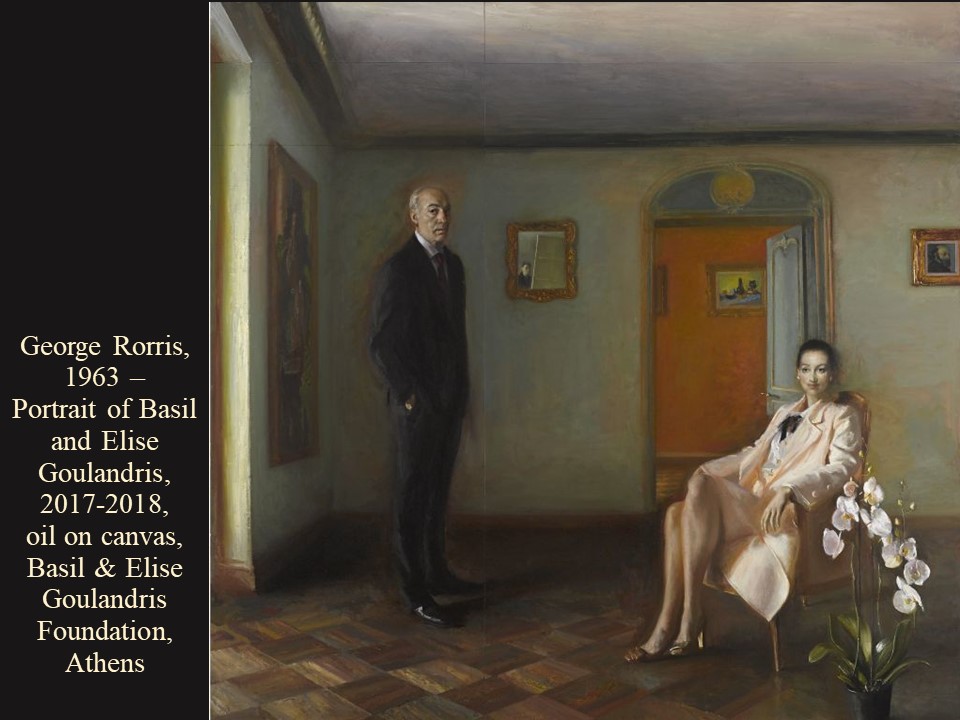
Portrait of Basil and Elise Goulandris by George Rorris.

“Bourgeois” Portrait

Portrait of Basil and Elise Goulandris by George Rorris.

Your tour of the new Basil and Elise Goulandris Foundation in Athens should start from the 4th floor… recommends the helpful Museum operator, and I hesitantly followed his recommendation. I was pleasantly surprised! An impressive “Bourgeois” Portrait of Basil and Elise Goulandris welcomed me, setting the tone for what I was about to experience.

Painted four years after Basil Goulandris’s passing, this eye-catching Portrait of the famous art collectors by George Rorris introduces you to the “atmosphere” that prevails in the latest cultural addition to the Athens Museum circuit! It’s grand, elegant yet understated. Basil Goulandris, clad in a dark suit, stands tall and aloof, staring at you intensely. Elise on the other hand, wearing the softest of pink, sits charmingly on an armchair and looks beyond you. They are surrounded by three favourite paintings from their legendary collection and a mirror that holds a secret worth exploring!

Little information is unfortunately provided by the Foundation on the “whats, the hows and the whys” of this painting. I hope, as time progresses, part of their “Permanent Collection” site will get richer with short descriptions and information on each and every one of their paintings. https://goulandris.gr/en/collection/works-of-art and https://goulandris.gr/en/artwork/rorris-george-portrait-of-basil-and-elise-goulandris

Basil and Elise Goulandris were known for their passionate love of the arts. They were avid collectors, famous for their superb “taste” and acute “eye.” ‘I spent months at a time with Basil and Elise when I was a child,’ says Fleurette Karadontis ‘they had no children of their own — they looked on the paintings as their children. The works were a genuine presence in their lives, a constant part of the conversation. Basil might suddenly say: look there, I never realised that the colour of the shirt in that painting is the same as the wall behind that still life. Or he would look at some cubist painting and ask: how many people do you see in it because I think there are three.’ https://www.christies.com/features/A-gift-to-Greece-the-Goulandris-Foundation-10209-1.aspx

For High School level student Activities on the George Rorris “Bourgeois” Portrait of Basil and Elise Goulandris… Click HERE!

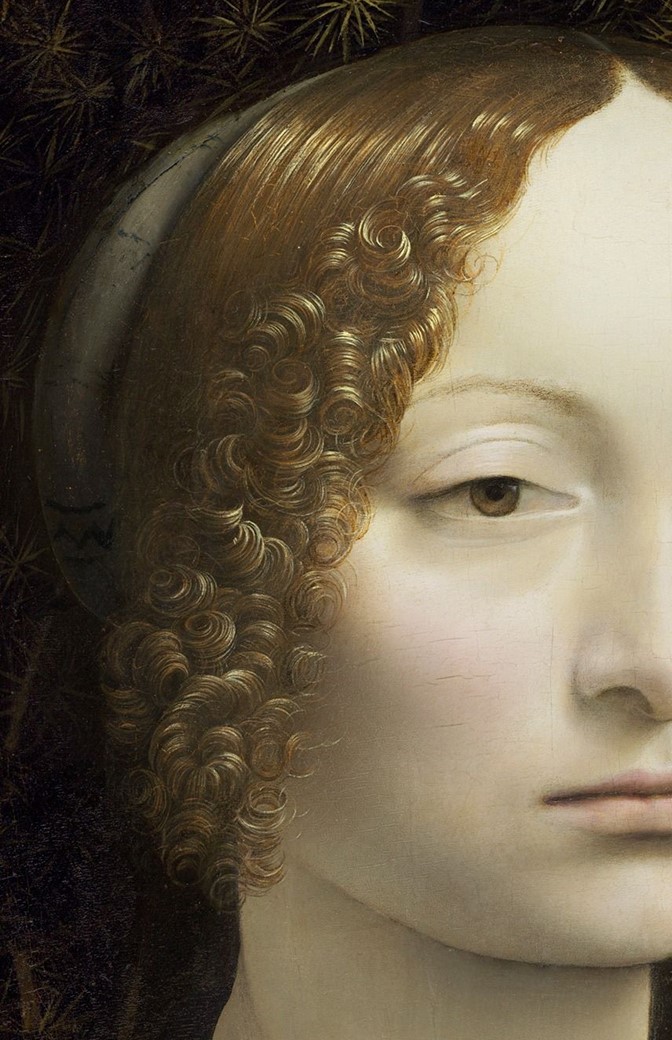
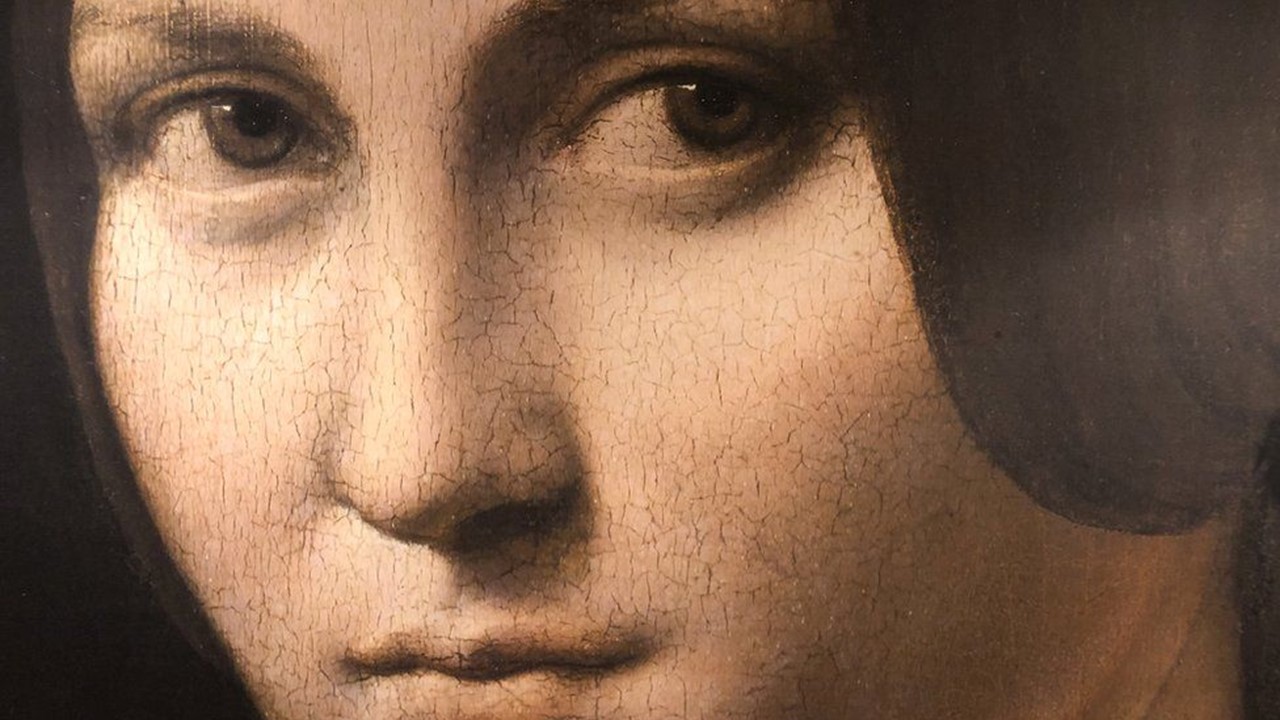
Leonardo's La Belle Ferronnière (detail)

Leonardo da Vinci

Leonardo's La Belle Ferronnière (detail)
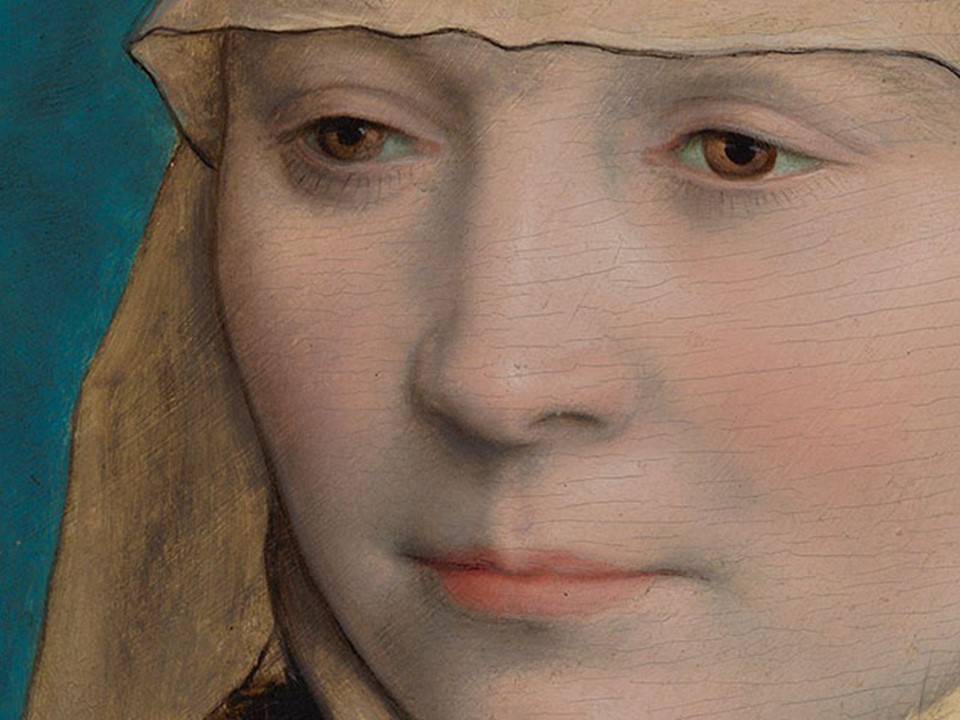
La Belle Ferronnière (detail), 1495 – 1499, oil on wood, 62 cm × 44 cm, Louvre Museum, Paris Photo Copyright: https://www.bbc.com/news/world-europe-50127095
…and her mesmerizing eyes

Five hundred years ago, one of the greatest Renaissance Homo Universalis passed away at the Château du Clos Lucé, in the Loire Valley. The Louvre Museum, wishing to commemorate the fifth centenary of the artist’s death, organizes an International Retrospective Exhibition on Leonardo da Vinci and his oeuvre. https://www.louvre.fr/en/expositions/leonardo-da-vinci

The Louvre Museum in Paris holds the largest collection in the world of the artist’s paintings, five of the fourteen to seventeen paintings now attributed to Leonardo, as well as 22 drawings. This collection is the core of the Retrospective that will also present “the latest research findings, critical editions of key documents and the results of the latest analysis carried out in laboratories or during recent conservation treatment by the Louvre.” https://www.louvre.fr/en/leonardo-da-vinci

A unique feature that the Exhibition presents to its visitors is the Virtual Reality experience for the Mona Lisa painting, the first of its kind at the Louvre. Virtual Reality enables visitors to go through the glass-case that protects the Mona Lisa and see minute details within the painting invisible otherwise to the naked eye. https://arts.vive.com/us/articles/projects/art-photography/mona_lisa_beyond_the_glass/ and https://www.youtube.com/watch?v=Au_UpzhzHwk

The PowerPoint I use for my Art History class on the artist… is HERE!

Virtual Reality and the Mona Lisa painting
Student Activity inspired by the Portraits of  Aulus Metellus and Emperor Augustus.

Augustus of Primaporta VS Aulus Matellus

Student Activity inspired by the Portraits of  Aulus Metellus and Emperor Augustus.
Grade 6, Social Studies Unit Project on Roman Government

How two great Roman statues can be used to discuss the Roman Government.  Augustus of Primaporta VS Aulus Matellus” is a Project my spirited Grade 6 students enjoy doing for their Social Studies Roman Unit.

Roman Portraits of Aulus Metellus,  and Emperor Augustus.,
Aulus Metellus, 1st century BC, bronze, National Archaeological Museum, Florence
Augustus of Primaporta, 1st century AD, marble, Vatican Museums

A lot of my Projects, I call them RWAP (Research Writing Art Project), ask students to focus on 4 parts: 1. Title 2. Provide colored copies of at least 2 artworks related to their Project, correctly identified. For the correct identification, I expect them to write the name of the artist (if known), the title of the work, date, medium, and current location, 3. Writing Assignment as required, 4. Art Assignment is open to student imagination and creativity.

For the Augustus vs Matellus Project students are asked to study their Social Studies Textbook Unit on Roman Government, and the following Khan Academy articles:

https://www.khanacademy.org/humanities/ancient-art-civilizations/etruscan/a/larringatore

https://www.khanacademy.org/humanities/ancient-art-civilizations/roman/early-empire/a/augustus-of-primaporta

Their Writing Assignment is to 1. Create a Ven Diagram comparing Matellus to Augustus. They are asked to use their RWAP Book and write in Bullet Points their Comments. 2. Write a paragraph presenting which of the two statues they prefer, explaining why by giving at least 3 reasons.

Their Art Assignment is to “study” the two statues and…  Be imaginative! Be creative! Be original!

For a PP on student Work… Click HERE!

For Student Project Worksheet… Click HERE!

Three Colonial period American Portraits.

American Colonial Portraits

Three Colonial period American Portraits.

So, we take a Selfie and post it on Instagram, or the school photographer comes along and takes our photo for the Yearbook. Have you thought about why or how it is done? How did people immortalize themselves before photography was invented in the mid-1800s? Can you guess the reasons behind historical portraits or contemporary snapshots? Do you want to explore, research or investigate American Colonial Portraits?

Are funny faces part of your repertoire when someone takes your photograph? For hundreds of years, it was rare to see facial expressions like frowning, laughing, or smiling in portraits. People were expected to look dignified and composed. Any facial expression was thought of as unpleasant or even ugly. Expressive eyes were more important than smiling mouths! Were all the portraits solemn and austere?

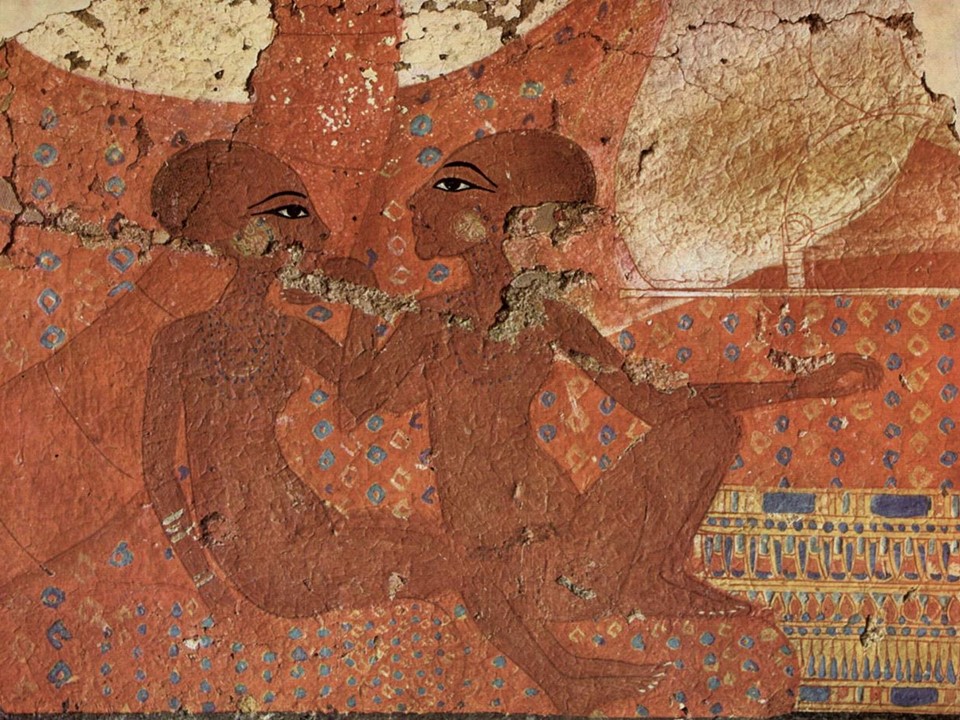
Portraits have been a popular subject among artists and patrons throughout the ages. From ancient Egyptian renderings on Tomb walls at Saqqara, in Egypt, to Rembrandt’s Self-Portraits and the abstracted works of Pablo Picasso, artists have depicted all kinds of portraits and in a wide variety of ways.

“American Colonial Portraits” Activities 

Activities in this presentation were created for my Grade 8 American Art class, but can be adapted and used for any Class or Unit on Portraiture. Students, individually or with partners, will explore and then express their own views on Portraiture by creating original work of writing or art.

For my PowerPoint … Click HERE!

Individual Student Activity 1:
This is a Writing Across the Curriculum Activity on Adjectives. Students are asked to INVESTIGATE the meaning of each adjective in the provided Worksheet, by Clicking HERE!

Students’ GOAL is to find, for each Letter, the most descriptive Adjective for the word PORTRAIT and what it represents. They are asked to WRITE the adjectives of their choice, next to the corresponding Letter on the provided Worksheet. In conclusion, students are further asked to WRITE explanatory sentences with the adjectives of their choice.

Student Activity … with a Partner 1:
Students are asked to work with a partner and prepare A POEM FOR TWO VOICES by… Clicking HERE!

Working in pairs, pretending to be Mr. John Freake and Mrs. Elizabeth Freake, students are asked to complete the phrases in the Template. For the “we” statements, students should find a word that describes the feelings/thoughts/wants/wills of both of them. Look at the painting for inspiration. A POEM FOR TWO VOICES is meant to be read aloud. So, rehearse with your partner for an incredible presentation. Each partner will read/recite their “I” parts individually and together, they will read/recite the “WE” parts. This is a wonderful activity for Upper Elementary and Middle School students.

Info on American Colonial Portraits and A Poem for Two Voices

http://americanexperience.si.edu/wp-content/uploads/2013/11/The-Role-of-Portraits-in-Colonial-America.pdf

https://www.poetryinvoice.com/teachers/lesson-plans/poetry-two-voices-reading-writing-and-performing

Portraits from 3 different periods in history, the Roman, the Early Christian and the Byzantine.

The Art of Portraiture during the Byzantine Period

Portraits from 3 different periods in history, the Roman, the Early Christian and the Byzantine.

The Art of Portraiture during the Byzantine Period is an interesting topic to explore! Portraits have been a popular subject among artists and patrons throughout the ages. From ancient Egyptian renderings on Tomb walls at Saqqara, in Egypt, to Rembrandt’s Self-Portraits and the abstracted works of Pablo Picasso, artists have depicted all kinds of portraits and in a wide variety of ways.

For Byzantine Art, the representation of the human face is important, yet very specific rules need to be followed, so as to depict it correctly. Byzantine Portraits embody a spiritual presence and the eyes play the role of the protagonist! Thus, eyes are affectionately called … the windows of the soul!

“The Art of Portraiture during the Byzantine Period” is an Activity I use in my Grade 7 Art History Class on Byzantium. Students enjoy comparing the three different portraits, discussing similarities and differences and thus, drawing conclusions.

Living in Thessaloniki, Greece, a city with 15 Byzantine UNESCO Monuments of Cultural Heritage, exploring the Art of the Byzantine Period is imperative!!!

https://whc.unesco.org/en/list/456

Student Activity

This is a Project that requires four parts: 1. A nicely written title 2.      Colored copies of the three Byzantine Portraits, correctly identified 3. Answers to assigned Questions 4. An Art Project

For more on “The Art of Portraiture during the Byzantine Period” Activity… Click HERE!