Salvador Dali or Pavlos Samios

Salvador Dali, 1904 - 1989
Figure at the Window, 1925, Oil on papier-mâché, 105 x 74,5 cm, Museo Nacional Centro de Arte Reina and Pavlos Samios, 1948 - 2021
Awaiting, 1983, Acrylic on canvas, 130 × 88 cm, Basil & Elise Goulandris Foundation, Athens
Salvador Dali, 1904 – 1989
Figure at the Window, 1925, Oil on papier-mâché, 105 x 74,5 cm, Museo Nacional Centro de Arte Reina Sofia https://en.opisanie-kartin.com/description-of-the-painting-by-salvador-dali-woman-at-the-window/
Pavlos Samios, 1948 – 2021
Awaiting, 1983, Acrylic on canvas, 130 × 88 cm, Basil & Elise Goulandris Foundation, Athens https://goulandris.gr/en/artwork/samios-pavlos-awaiting
https://www.iefimerida.gr/politismos/paylos-samios-kafeneia-pethane

“She opened her curtains, and looked out towards the bit of road that lay in view, with fields beyond outside the entrance-gates. On the road there was a man with a bundle on his back and a woman carrying her baby; in the field she could see figures moving – perhaps the shepherd with his dog. Far off in the bending sky was the pearly light; and she felt the largeness of the world and the manifold wakings of men to labor and endurance. She was a part of that involuntary, palpitating life, and could neither look out on it from her luxurious shelter as a mere spectator, nor hide her eyes in selfish complaining…” wrote George Eliot (Mary Anne Evans, 1819-1880) in Middlemarch. I believe her quotation can be a wonderful introduction for my new BLOG POST, Salvador Dali or Pavlos Samios, inspired by Awaiting, a beautiful painting by Pavlos Samios in the Basil & Elise Goulandris Foundation in Athens. https://www.goodreads.com/quotes/tag/window

Mid-July 2021 and with COVID still ON, I am constantly in front of my open windows or balcony doors searching for signs of a summer break… eager to be freed. Two paintings, by Salvador Dali and Pavlos Samios, inspire me to dream, hope, and be …merry!

Pavlos Samios, 1948 - 2021
Awaiting, 1983, Acrylic on canvas, 130 × 88 cm, Basil & Elise Goulandris Foundation, Athens
Pavlos Samios, 1948 – 2021
Awaiting, 1983, Acrylic on canvas, 130 × 88 cm, Basil & Elise Goulandris Foundation, Athens https://goulandris.gr/en/artwork/samios-pavlos-awaiting
https://www.iefimerida.gr/politismos/paylos-samios-kafeneia-pethane

Pavlos Samios is an artist I particularly like. His painting Awaiting in the Basil & Elise Goulandris Foundation in Athens is a favourite of mine. I also like what I read in his notes: In the early 1980s, the idea of ​​Surrealism and the Metaphysical School greatly influenced me. In Paris, he continues there is little sun and the sea is far away, and yet, I dream of an unforgettable summer and I create a number of very nostalgic paintings. Fantastic buildings in the sand… The feeling of a desirable girl in a special place, on an untouched island. https://goulandris.gr/el/artwork/samios-pavlos-awaiting

On the 25th of November 2019, I “published” my first BLOG POST ON the amazing Art Collection of the Basil & Elise Goulandris Foundation in Athens I am constantly surprised how much this new addition to the Athenian Art Gallery circuit will enthuse me… https://www.teachercurator.com/category/basil-and-elise-goulandris-foundation-athens/

Salvador Dali, 1904 - 1989
Figure at the Window, 1925, Oil on papier-mâché, 105 x 74,5 cm, Museo Nacional Centro de Arte Reina Sophia
Salvador Dali, 1904 – 1989
Figure at the Window, 1925, Oil on papier-mâché, 105 x 74,5 cm, Museo Nacional Centro de Arte Reina Sofia https://en.opisanie-kartin.com/description-of-the-painting-by-salvador-dali-woman-at-the-window/

When I first saw Samios’s Awaiting, I immediately thought of Salvador Dali and his1925 portrait of his sister Anna Maria in Figure at the Window, exhibited at the Museo Nacional Centro de Arte Reina Sofia in Madrid. A wonderful painting that “travels” you to magical places. I particularly like how the Spanish Museo experts describe the painting as a masterpiece of Dali’s series of portraits of Anna Maria and how Rafael Santos Torroella stated that the painting is a marvel for the skill with which it combines the occupied spaces and the empty spaces, giving them equal compositional importance to such an extent that the fact that he has simply eliminated one of the window casements (the left one) escapes the viewer, who does not even notice the anomaly, despite the fact that this is precisely where so much of the enigmatic beauty radiating from the painting, with its pure serenity, resides. https://www.museoreinasofia.es/en/collection/artwork/figura-finestra-figure-window

For a Student Activity on Salvador Dali or Pavlos Samios, please… Check HERE!

Lansdowne Portrait of George Washington

Gilbert Stuart,  American Artist, 1755–1828
Portrait of George Washington, the Lansdowne Type, 1796, oil on canvas, 243.8x152.4 cm, National Portrait Gallery , Washington, DC
Gilbert Stuart,  American Artist, 1755–1828
Portrait of George Washington, the Lansdowne Type, 1796, oil on canvas, 243.8×152.4 cm, National Portrait Gallery , Washington, DC https://npg.si.edu/object/npg_NPG.2001.13

My first wish is to see this plague of mankind, war, banished from the earth… George Washington once said… and every 4th of July I think how foresighted he was… every 4th of July the Lansdowne Portrait of George Washington comes to my mind and I pay my respects to a great man! https://www.brainyquote.com/quotes/george_washington_118910

Sarah Goodridge, American Artist, 1788-1853
Portrait of Gilbert Stuart, c. 1825, watercolour on ivory, 83x71 mm, National Portrait Gallery, Washington, DC, USA
Sarah Goodridge, American Artist, 1788-1853
Portrait of Gilbert Stuart, c. 1825, watercolour on ivory, 83×71 mm, National Portrait Gallery, Washington, DC, USA

When I can net a sum sufficient to take me to America, I shall be off to my native soil.  There I expect to make a fortune by [portraits of] Washington alone.  I calculate upon making a plurality of his portraits, whole lengths, what will enable me to realize; and if I should be fortunate, I will repay my English and Irish creditors. To Ireland and English, I shall be adieu. What a plan Gilbert Stuart had… and he was fortunate to accomplish it! It was early May of 1793 when the artist arrived in New York City, and he immediately put his plan to work. In 1794 a letter of introduction by John Jay, the first Chief Justice of the Supreme Court, an old acquaintance since Stuart’s London days, and a close political confidant to George Washington, was provided, and the rest is history. Gilbert Stuart painted three different types of portraits of the 1st American President and dozens of subsequent copies. The “Vaughan Type” shows Washington facing slightly to his left, the “Athenaeum Type” shows the first president facing to his right, and the “Lansdowne Type” is a full-length portrait. https://www.khanacademy.org/humanities/art-americas/british-colonies/early-republic/a/gilbert-stuarts-lansdowne-portrait

Although I particularly like the Athenaeum Portrait, I find the full-length Lansdowne Type best befitting its purpose… grand and imposing, the portrait of a distinguished representative of the new American Democracy. The portrait was commissioned by Senator and Mrs. William Bingham of Pennsylvania as a gift to the Marquis of Lansdowne, an English supporter of American independence. Standing in front of the Lansdowne Portrait remember that the Smithsonian experts ask the viewer to consider three filters exploring this American treasure. Each one of these three different filters – symbolic (consider the represented objects surrounding the Portrait), biographic (Washington’s achievement and character are of the utmost importance), and artistic (let us not forget Stuart’s artistic abilities and personality) – will provide unique information and a distinct interpretation. https://www.georgewashington.si.edu/portrait/non-flash.html

Gilbert Stuart,  American Artist,1755–1828
Portrait of George Washington, the Lansdowne Type - Details, 1796, oil on canvas, 243.8x152.4 cm, National Portrait Gallery , Washington, DC, USA
Gilbert Stuart,  American Artist,1755–1828
Portrait of George Washington, the Lansdowne Type – Details, 1796, oil on canvas, 243.8×152.4 cm, National Portrait Gallery , Washington, DC, USA
https://georgewashington.si.edu/portrait/sword.html
https://georgewashington.si.edu/portrait/inkwell.html
https://georgewashington.si.edu/portrait/chair.html

In an advertisement for the first exhibition of the Lansdowne portrait in 1798, we read…  He (George Washington) is surrounded with allegorical emblems of his public life in the service of his country, which are highly illustrative of the great and tremendous storms which have frequently prevailed. These storms have abated, and the appearance of the rainbow is introduced in the background as a sign. No doubt, all embellishments presented by the artist were chosen to further stress symbolic ideas to viewers.

He is the best and the greatest man the world ever knew… Neither depressed by disappointment and difficulties nor elated with temporary success. He retreats like a General and attacks like a Hero. Wrote the composer Francis Hopkinson as a reference to the president’s character. All you have to do is look at his relaxed posture, his expended hand, and unpretentious attire to understand Washington’s character and political strength.

Gilbert Stuart,  American Artist,1755–1828
Portrait of George Washington, the Lansdowne Type - Details, 1796, oil on canvas, 243.8x152.4 cm, National Portrait Gallery , Washington, DC, USA
Gilbert Stuart,  American Artist, 1755–1828
Portrait of George Washington, the Lansdowne Type – Details, 1796, oil on canvas, 243.8×152.4 cm, National Portrait Gallery, Washington, DC, USA
https://georgewashington.si.edu/portrait/rainbow.html
https://georgewashington.si.edu/portrait/books2.html
https://georgewashington.si.edu/portrait/clouds.html

Finally, let’s not forget the artist of the Portrait, Gilbert Stuart… the man Abigail Adams described as… Genius and Eccentric, the man you do not know how to take hold of… nor by what means to prevail upon him to fulfill his engagements.

For a PowerPoint, please… Check HERE!

PRINCESS FRESCO - The idyllic life of the daughters of Pharaoh, circa 1343-1335, painted plaster, 40x165, Ashmolean Museum

Nofernoferuaton and Nofernoferure

PRINCESS FRESCO - The idyllic life of the daughters of Pharaoh, circa 1343-1335, painted plaster, 40x165, Ashmolean Museum
PRINCESS FRESCO – The idyllic life of the daughters of Pharaoh, circa 1343-1335, painted plaster, 40×165, Ashmolean Museum
https://www.ashmolean.org/princess-fresco

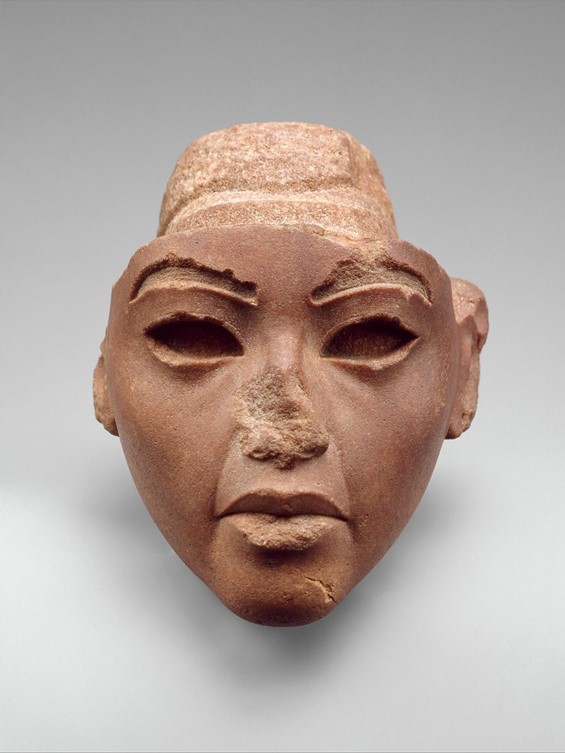
“With the move to Amarna the art becomes less exaggerated, but while it is often described as ‘naturalistic’ it remains highly stylised in its portrayal of the human figure. The royal family are shown with elongated skulls and pear-shaped bodies with skinny torsos and arms but fuller hips, stomachs and thighs. The subject matter of royal art also changes. Although formal scenes of the king worshipping remain important there is an increasing emphasis on ordinary, day-to-day activities which include intimate portrayals of Akhenaten and Nefertiti playing with their daughters beneath the rays of the Aten… While traditional Egyptian art tends to emphasise the eternal, Amarna art focuses on the minutiae of life which only occur because of the light – and life-giving power of the sun.” writes Dr Kate Spence for BBC History and I use this quote as an introduction to Nofernoferuaton and Nofernoferure, my new POST on Egyptian Art.     http://www.bbc.co.uk/history/ancient/egyptians/akhenaten_01.shtml

I would like to continue with another short quote by Dr Kate Spence “Akhenaten is a source of endless fascination and speculation – this often masks the fact that we actually know very little about him.” This quote marks the beginning of my Grade 7 Unit on the Art of the Amarna Period. I have been teaching this Unit for years and I can only testify to the fact that the Amarna Period allure attracts my student’s attention and captivates their imagination. They like to read and listen to their teacher describe the genesis of an almost “monotheistic” religion, the dynamics within a powerful royal family, the building of a new capital city, and how Egyptian Art of the period moved towards naturalism and informality.

The Amarna Idiom is an artistic style that captivates human reaction. My students are “hypnotized” by the unique Amarna pictorial beauty of deformation. They are charmed, yet question how in the depiction of faces, thin, long necks, hold greatly elongated skulls… facial folds are the norm, narrow, slitted eyes are prominent and jaws seem to be “hanging” low. The Amarna style body rendering amazes my students as well, particularly the discrepancy between the upper, lower and middle parts of the human body… the dropped, thin shoulders, heavy potbelly, large hips and thighs, and the rather thin, almost frail, legs.

PRINCESS FRESCO - The idyllic life of the daughters of Pharaoh, circa 1343-1335, painted plaster, 40x165, Ashmolean Museum
PRINCESS FRESCO – The idyllic life of the daughters of Pharaoh, circa 1343-1335, painted plaster, 40×165, Ashmolean Museum
https://www.ashmolean.org/princess-fresco

At some point, towards the end of my Amarna Unit, I ran a survey, titled “My Favourite Amarna Work of Art,” as I am always interested to understand what artistic qualities attract the admiration of my students. Among the finalists in my survey is the fresco painting of Nofernoferuaton and Nofernoferure, coming from Akhenaton’s capital city Akhetaten, known today as Tell el- Amarna, and exhibited in the Ashmolean Museum. Students love the bright, warm, terracotta-coloured palette, the casual, relaxed composition theme, the depicted stylistic exaggerations, and the overall sense of family affection that embraces the pictorial arrangement.

This fresco, fragile and precious, was discovered in the early 1890s by William Flinders Petrie, the renown archaeologist, at Akhetaten, “The horizon of the Aten,” where the visionary Pharaoh Akhenaton lived with his queen, Nefertiti, their six daughters, Nofernoferuaton and Nofernoferure among them, and the rest of the royal family. “The painting was made on a thin layer of gesso – powdered gypsum mixed with a glue – applied to mud plaster on a brick wall… (Petrie) discovered that the wall had been much damaged by ants and its preservation is a tribute to Petrie’s remarkable skills as an archaeologist.” https://www.ashmolean.org/princess-fresco     and     https://www.amarnaproject.com/pages/amarna_the_place/central_city/index.shtml

Plans of the King’s House in Amarna and the area where the fresco of the two Princesses was located. The discussed fresco, with the figure of the discoverer (F. Petrie), added to give scale. The scene of princesses (Ashmolean Museum) as it was originally located on a wall in the King’s House, with the painted dado restored
https://www.amarnaproject.com/pages/amarna_the_place/central_city/index.shtml
https://www.semanticscholar.org/paper/Wall-Paintings-from-the-King%27s-House-at-Amarna-*-Weatherhead/6939baf93dc88d6774e539c9cda0f3e920d54515/figure/2

Unearthed in the King’s House, “an enclosure measuring 123 by 140 meters, inside of which the building took the form of a U around a garden, with the actual residence of the king at the rear,” the Princess’s fresco depicts “Akhenaten and Nefertiti relaxing with their daughters, two of which are sitting casually on floor cushions in the foreground. The red sash of Nefertiti’s dress falls behind them, and to the right are Akhenaten’s sandaled feet. Between them stand three more daughters; the sixth daughter was probably shown seated on her mother’s lap, as suggested by a surviving fragment depicting a baby’s hand. The style and subject of this painting are in direct contrast to conventional Egyptian art and reflects the revolutionary character of the period.” Simply but beautifully said…     http://www.touregypt.net/featurestories/royalestate.htm     and     https://www.ashmolean.org/princess-fresco

For a PowerPoint on Nofernoferuaton and Nofernoferure, please… Check HERE!

For a Student Activity, please… Check HERE!

If interested in smart Amarna period Resources and Activities, please… Check https://www.arch.cam.ac.uk/research/projects/current-projects/life-ancient-egypt-amarna-resources-schools/ancient-amarna  

Édouard Manet, Portrait of Émile Zola

Émile Zola by Édouard Manet

Édouard Manet, Portrait of Émile Zola
Édouard Manet, 1832-1883
Portrait of Émile Zola, 1868, oil on canvas, 146,0 x 114,0 cm., Musée d’Orsay

“My dear Zola, – I am making up my mind to hold a private show. I have at least two score pictures to exhibit. I’ve already been offered a site in a very good location near the Champ de Mars. I am going to stake the lot and seconded by men like yourself, am hopeful of success. See you soon. Cordially, yours ever, All of us here are delighted with your article, and I am instructed to send you thanks.” This is a quote of Manet’s letter to Zola, Wednesday, 2 January 1867. My new POST Émile Zola by Édouard Manet further shows the relationship between the two men.     https://quotepark.com/quotes/1886775-edouard-manet-my-dear-zola-i-am-making-up-my-mind-to-hold-a-p/

It was 1866 and Émile Zola, disappointed with the way the French Academy and critics treated Édouard Manet’s work in the Salon of 1866 wrote an article on Manet in La Revue du XXe siècle and defended him. He did not stop, however, with this first article. The following year, 1867, when Manet organized a private exhibition on the fringes of the Universal Exhibition, Zola was once more present, supporting his friend, writing about Manet’s New Manner in Art, in the January La Revue du XXe siècle. Later in 1867, Zola republished the 1867 article in the form of a separate pamphlet. Zola wrote that he “instinctively loved” Manet’s Art replying to the critics who vilified the painter by saying  “I replied to them [to the crowd and to the art critics] that fate had undoubtedly already marked at the Louvre Museum the future place of the Olympia and of the Luncheon on the Grass.” This pamphlet was distributed on May 22, 1867, the opening day of the Private Exhibition of Edouard Manet, organized at his expense by the painter in a pavilion near the Pont de l’Alma.     https://www.librairie-faustroll.com/librairie-en-ligne/6684-zola-emile-edouard-manet-1867-dentu-edition-originale-de-cette-rare-plaquette-complet-de-l-eau-forte-d-apres-olympia.html     and     https://msu.edu/course/ha/446/zolamanet.htm

 Émile Zola on Édouard Manet,

According to the Musée d’Orsay presentation “To thank him, Manet offered to paint Zola’s portrait. The sittings took place in Manet’s studio, rue Guyot. The setting was arranged for the occasion with items characteristic of Zola’s personality, tastes and occupation. On the wall is a reproduction of Manet’s Olympia, a painting which sparked a fierce scandal at the 1865 Salon but which Zola held to be Manet’s best work. Behind it is an engraving from Velazquez’s Bacchus indicating the taste for Spanish art shared by the painter and the writer. A Japanese print of a wrestler by Utagawa Kuniaki II completes the décor. The Far East, which revolutionised ideas on perspective and colour in European painting, played a central role in the advent of the new style of painting. A Japanese screen on the left of the picture recalls this. Zola is seated at his work table. He is holding a book, probably Charles Blanc’s L’Histoire des peintres frequently consulted by Manet. An inkwell and a quill on the desk symbolise the writer’s occupation. This portrait sealed the start of a loyal friendship between Manet and Zola, both eager for success.”     https://www.musee-orsay.fr/en/collections/works-in-focus/search/commentaire_id/emile-zola-313.html

Édouard Manet, Portrait of Émile Zola

The symbolist artist Odilon Redon (1840-1916), known today for the “dreamlike” paintings, observed penetratingly Zola’s Portrait and in his Salon review (La Gironde, 9 June 1868), wrote… “It is rather a still life, so to speak, than the expression of a human being”. Apparently Zola himself was not entirely delighted with his portrait, which Manet presented to him, and Charles-Marie-Georges Huysmans (1848-1907) the French novelist and art critic noticed that he had relegated the painting to an antechamber of his home.     http://www.visual-arts-cork.com/paintings-analysis/portrait-of-emile-zola.htm

For a Student Activity, please… check HERE!

Leonardo da Vinci, Ginevra de' Benci

Bernardo Bembo and La Bencina

Hans Memling, Man with a Roman Coin (Bernardo Bembo) and 
Leonardo da Vinci, Ginevra de' Benci
Hans Memling, 1433 –1494
Man with a Roman Coin (Bernardo Bembo), ca. 1471-1474, oil on panel, 31 x 23,3 cm, Koninklijk Museum voor Schone Kunsten Antwerpen
Leonardo da Vinci, 1452-1519
Ginevra de’ Benci, 1474-78, oil on wood, 38,8 x 36,7 cm, National Gallery of Art, Washington DC – On the reverse side of the portrait of Ginevra: juniper, laurel, palm branches: VIRTUTEM FORMA DECORAT (Beauty adorns Virtue)     https://www.nga.gov/collection/art-object-page.50724.html     and     https://www.nga.gov/collection/highlights/da-vinci-ginevra-de-benci.html and https://www.facebook.com/mauritshuis/posts/allow-us-to-introduce-bernardo-bembovarious-details-reveal-that-this-man-is-the-/1438404546228025/

“Therefore we will sing of the chaste love of Bembo, so that Bencia may rise up, made known by my verses. O lovely Bencia, Bembo marvels at your beauty, with which you could surpass the goddesses of heaven. Great Mars would wish to prefer this to his love for Venus, and Jupiter himself would abandon Europa and desire it. But Bembo in astonishment marvels more at you ancient virtue, you chaste heart and hands with the skill of Pallas…” writes Cristoforo Landino for the LOVE of Bernardo Bembo and La Bencina.    http://www.italianrenaissanceresources.com/units/unit-2/sub-page-03/poems-about-ginevra-and-bembo/?fbclid=IwAR34DOVq8MMQgt7ZBJ651Bd2l-HGxjM6gTJFNNx0CHHsp2hZVi26XyAkHkM

The Venetian Ambassador to Florence, the intellectual Bernardo Bembo, first saw Ginevra on the 28th of January 1475, during the splendid Giostra Giuliano de Medici staged in Piazza Santa Croce in Florence. Ginevra de’ Benci, the daughter of Amerigo de’ Benci, director of the Medici Bank in Geneva and the second wealthiest man in Florence, seventeen years old, witty, enchanting and rich, married to Luigi di Bernardo Niccolini, a Florentine cloth-trader of importance, was present, dazzling with her charm, the elite of Florence. “In all the city you will not find a more beautiful girl, nor any more modest” wrote the poet Alessandro Braccesi. Suave Bernardo Bembo, a man in his early forties, married with children, with a mistress and a love-child, took little time in becoming La Bencina’s cavaliere servente. Among them, Leonardo da Vinci, young and amazingly talented, ready to immortalize an interesting story that still “haunts” us with its beauty and secrets, created one of his earliest masterpieces.    https://books.google.gr/books?id=KWCNItrBe6oC&pg=PT163&lpg=PT163&dq=Florence+1475+Giostra&source=bl&ots=jY6VGoEF7e&sig=ACfU3U3t2D0MaOTr2VF5cHfdBamVl8s_Zg&hl=el&sa=X&ved=2ahUKEwio79a81YHqAhXBw8QBHb37B5AQ6AEwEHoECAUQAQ#v=onepage&q=Florence%201475%20Giostra&f=false

Leonardo da Vinci, Ginevra de' Benci

Leonardo’s painting of La Bencina, characterized as “the earliest of all psychological portraits” and depicting “a new sense of mystery and uniqueness of the human personality” is for me an alluring mystery behind rich foilage and an “alabaster” façade. The surviving poems, however, of her beauty and character is another story…

Leonardo da Vinci, Ginevra de' Benci, the reverse side
The reverse side of Leonardo’s painting of Ginevra de’ Benci

“I beg for mercy; I am a wild tiger” LaBencina wrote in one of her poems, the only verse that survives of her entire oeuvre. We can only wonder about her response to Bembo’s “Courtly Love.”

“…Therefore, lovely Bencia, imitating such arts as these, you come as an example to Tuscan ladies. Well known, I confess, is the love of Paris and the frenzy of the Spartan woman, but it is known for its base adultery. You, Bencia, are more beautiful than Leda’s child and are known to all peoples for your rare chastity…” by Cristoforo Landino

“Ginevra shed tears as you go, Bembo./ May she desire long delays and / Beseech the Gods above that / Every difficulty may hinder your journey. / And may she wish that the kindly stars / With adverse winds and heavy storms / Prevent your departure” by Alessandro Bracessi

Lorenzo de’ Medici, on the other hand, addressed two poems to her praising her decision to “leave the passion and evil of the city and to devote herself to prayer in the country… never looking back!” https://books.google.gr/books?id=fMDoImNWqHQC&pg=PA302&lpg=PA302&dq=Lorenzo+de+Medici+sonnets+Ginevra&source=bl&ots=DFGL8O9riU&sig=ACfU3U1FKJK0wSGfLjtePymRgLwoRWYOPg&hl=el&sa=X&ved=2ahUKEwi7jdXxvIPqAhUFNOwKHTZ3BIgQ6AEwAnoECAYQAQ#v=onepage&q=Lorenzo%20de%20Medici%20sonnets%20Ginevra&f=false    and    http://www.italianrenaissanceresources.com/units/unit-2/sub-page-03/poems-about-ginevra-and-bembo/?fbclid=IwAR34DOVq8MMQgt7ZBJ651Bd2l-HGxjM6gTJFNNx0CHHsp2hZVi26XyAkHkM

For a RWAP dedicated to Ginevra de’ Benci (RWAP stands for Research-Writing-Art-Project) please… Check HERE!

For student work on a RWAP dedicated to Ginevra de’ Benci, please… Check HERE!

Leonardo da Vinci, Ginevra de' Benci, Student Activity
Student work

Hans Holbein the Younger (formerly attributed to), Portrait of a Woman from Southern Germany

The Mauritshuis

Hans Holbein the Younger (formerly attributed to), Portrait of a Woman from Southern Germany
Hans Holbein the Younger (formerly attributed to)
Portrait of a Woman from Southern Germany, c. 1520 – 1525, oil on panel, 45×34 cm, The Mauritshuis in The Hague

“A visit to a museum is a search for beauty, truth, and meaning in our lives. Go to museums as often as you can” wrote Maira Kalman and she couldn’t be more right. Go to the  Mauritshuis in the Hague, stand in front of the Portrait of a Woman from Southern Germany and quietly wait for the experience to envelop you!

Back in 2006, I visited the Mauritshuis in the Hague for the first time, and I will never forget the Experience. It is the kind of Museum I particularly enjoy and love… small, intimate and colourful!    https://www.mauritshuis.nl/en/

The Mauritshuis

Designed as a private house for Johan Maurits of Nassau, Count (from 1664), Prince of Nassau-Siegen, Grand Master of the Order of Saint John (Bailiwick of Brandenburg) and governor of Dutch Brazil, the   Mauritshuis is palatial in both, inspiration and essence. The Prince of Nassau-Siegen hired the finest architects of the time in The Netherlands, Jacob van Campen and his assistant Pieter Post, to design and materialize his dream residence. Johan Maurits, however, was not in a harry! As governor of the Dutch Brazil and one of Holland’s preeminent military leaders, he travelled extensively, while his architects were busy building important architectural works to establish their name. So, the Mauritshuis started in 1636 and finished in 1641. The Prince lived in the house for only three years, from 1644 to 1647, after which he moved to Germany for yet another important post, to become stadtholder of Kleef.

Mauritshuis is often referred to as Sugar Palace, but this is not a reference to the light-coloured natural stones used for building its façade. Johan Maurits earned a lot of money in Brazil trading in sugar cane, and Mauritshuis was made possible thanks to cane sugar and to the efforts of enslaved men and women from Africa. Sugar Palace is just one reminder of European colonialism and exploitation! https://www.mauritshuis.nl/en/discover/mauritshuis/history-of-the-building/

Today, the building Johan Maurits of Nassau commissioned is one of the finest examples of Classicist Dutch Architecture in The Netherlands and the Home of a Great Collection of Dutch Masterpieces. Mauritshuis is the home of Vermeer’s Girl with a Pearl Earring or the astounding View of Delft,  Rembrandt’s Anatomy Lesson of Dr Nicolaes Tulp or his 1669 Self-Portrait, Carel Fabritius’ Goldfinch of 1654, Paulus Potter’s Bull of 1647, and The Garden of Eden with the Fall of Man of 1615 by two famous Flemish masters: Rubens and Brueghel.

Hans Holbein the Younger (formerly attributed to), Portrait of a Woman from Southern Germany
Hans Holbein the Younger (formerly attributed to)
Portrait of a Woman from Southern Germany, c. 1520 – 1525, oil on panel, 45×34 cm, The Mauritshuis in The Hague

Today, I would like to stand in front of a Renaissance Painting I find alluring… the Portrait of a Woman from Southern Germany of 1520-25, formerly attributed to Hans Holbein the Younger. Her face is so striking, standing out well against a rather cool, blue background… beautiful but stark, pale, yet bright, clear and strong. She wears a finely pleated collared blouse, a fur-lined jacket fastened with a red cord and a rather old-fashioned cap and veil, like those worn by townswomen in Southern Germany. Whoever painted this magnificent Portrait, the Woman from Southern Germany, young and demure, greets us with her hands clasped, her eyes modestly cast down, and a faint smile to brighten her whole face! She is grand! https://www.mauritshuis.nl/en/explore/the-collection/artworks/portrait-of-a-woman-from-southern-germany-275/detailgegevens/

For a PowerPoint on more Renaissance Paintings in the Mauritshuis Museum, please… click HERE!

Alessandro Allori's Portrait of Bianca Cappello

What a life you had Bianca Cappello!

Alessandro Allori's Portrait of Bianca Cappello
Alessandro Allori, 1535–1607
Portrait of Bianca Cappello, Second Wife of Francesco I de’ Medici, c. 1580, fresco – tempera on plaster, 75 x 52 cm, Galleria degli Uffizi, Florence
https://centuriespast.tumblr.com/post/67158750360/allori-alessandro-portrait-of-bianca-cappello

What a life you had Bianca Cappello! Rich, powerful and passionate! Born a Venetian lady of noble birth, you chose love over propriety and married Pietro Bonaventuri, escaped to Florence… and found your destiny with Francesco I de’ Medici, Grand Duke of Tuscany… as a mistress, mother, and wife! You were loved devotedly! In 1579 you married the Grand Duke and on the 12th of June 1579, you were crowned the Grand Duchess of Tuscany at the Palazzo Vecchio in Florence. You were probably disliked equally strongly. You died along with Francesco in October 1587, at the famous Villa Medici in Poggio a Caiano. Some historians and scientific evidence suggest malaria fever, others believe you were both poisoned with arsenic! What a life you had Bianca Cappello! http://www.travelingintuscany.com/art/biancacappello.htm

Of all of Bianca’s Portraits, my favorite, painted by Alessandro Allori, c.1580, is in the Galleria Degli Uffizi, in Florence. She is depicted as the Grand Duchess of Tuscany, her beauty assured, elegant in an understated way, self-content, looking at us… critically thinking… are we among her supporters or her foes?  

Alessandro Allori's Portrait of Bianca Cappello (detail)

Where can we “feel” Bianca’s presence in Florence?

As soon as Bianca became Francesco’s mistress she moved from the humble lodgings of her in-laws, where she was expected to do manual work, to the Palazzo Venturi-Ginori. a splendid estate with a fine garden (so-called Oricellari Gardens) and a prestigious history. According to Giorgio Vasari, between 1483 and 1500, Bernardo Rucellai commissioned the construction of the Palazzo and the planting of the famous gardens following designs by Leon Battista Albert. It was during the same period that several meetings of the famous Neo-Platonic Academy took place in the Palazzo. In 1534, the property passed to Bianca Cappello and the Palazzo was turned into a place for leisure and entertainment. The gardens, in particular, were the stage for numerous festivities staged by Bianca Cappello, some of which… quite profane!

Palazzo Venturi-Ginori with a view of the  Oricellari Gardens
http://www.palazzospinelli.org/architetture/scheda.asp?ID=689  
and for Bianca’s Garden Parties…
https://books.google.gr/books?id=guN0CgAAQBAJ&pg=PA1&lpg=PA1&dq=Bianca+Cappello+Oricellari+Gardens&source=bl&ots=WTbhv9Bq6X&sig=ACfU3U0uHjTZbXkTksrfXPDP7aYoc_xwng&hl=el&sa=X&ved=2ahUKEwi315eT68vnAhWPyqQKHS2xBuwQ6AEwDHoECAcQAQ#v=onepage&q=Bianca%20Cappello%20Oricellari%20Gardens&f=false

In 1974, Francesco, still deeply in love with Bianca Cappello, commissioned  Bernardo Buontalenti to design and build a new house for his mistress, much closer to his official residence, Palazzo Pitti. The now-famous Casa Bianca Capello is one of the Florentine historical landmarks you can’t miss! The exterior decoration of the Casa, by Bernardino Pocetti, is done in the black and white sgraffito technique, in which Pocetti was considered an expert. To please the Venetian Lady, the artist designed the Medici crest along with that of the Capello family crest and motifs of marine life within an extravagance of Renaissance designs.

Casa Bianca Capello in Florence
https://en.wikipedia.org/wiki/Palazzo_di_Bianca_Cappello

For a Student Activity, on “What a Life you had Bianca Cappello!” please check… HERE!

Woman with wax tablets and stylus and Portrait of a man holding a papyrus roll, both from Pompeii

Pompeiian Portraits of Distinction

Woman with wax tablets and stylus and Portrait of a man holding a papyrus roll, both from Pompeii
Woman with wax tablets and stylus, 55-79 AD, IV Pompeian style, fresco, 37 x 38 cm, discovered in Pompeii VI – Insula Occidentalis, Museo Archeologico Nazionale di Napoli
Portrait of a man holding a papyrus roll, 55-79 AD, IV Pompeian style, fresco, discovered in Pompeii VI – Insula Occidentalis, Museo Archeologico Nazionale di Napoli

The Pompeiian Portraits of Distinction shows a young couple, stylish, bold and educated at the prime of their life. They are both adorable in the way she brings her stylus to her lips, he holds his papyrus under his chin. They are both pensive… contemplative. They make you wonder… are they thinking of something they have just read or are they pondering on what they are about to write?

According to the experts at the Museo Archeologico Nazionale di Napoli, the two portraits are amazing examples of the IV Pompeian style, discovered in Pompeii on May 24th, 1760. They were among the first discoveries made and dazzled the world! The small painting of “Sappho” holding a stylus and wax tablets, is the companion of the male portrait, depicting a young man holding a Papyrus Roll just under his chin, quite romantic looking, with blondish hair and wearing a lush laurel wreath.

What an elegant couple! Both rendered in pastel colours, they pose for eternity dressed in their… everyday finest. She has a dainty face with big brown eyes, rosy cheeks, full lips and a crest of curly auburn hair. She is richly adorned, but just so… a golden hairnet and a pair of thick golden ear loops are all she needs to look elegant. Her color scheme is on the cooler side, aubergine purple, forest green, and chestnut brown. The young man facing her is rendered in colours of mustard ochre and celery green. He has a pointed, elongated face and slightly slanted eyes. His adornment is a lush green wreath resting on blondish hair with thick curls. She boldly looks at us, he looks at her… both lost in thought! https://www.museoarcheologiconapoli.it/en/room-and-sections-of-the-exhibition/frescoes/ and https://commons.wikimedia.org/wiki/File:A_fresco_portrait_of_a_man_holding_a_papyrus_roll,_Pompeii,_Italy,_1st_century_AD.jpg

For a PowerPoint, please… click HERE!

Shrine Head, by unknown Ife (Nigeria) artist and Roger van der Weyden, Portrait of a Lady

An Unlike Comparison

Shrine Head, by unknown Ife (Nigeria) artist and Roger van der Weyden, Portrait of a Lady
Shrine Head, by unknown Ife (Nigeria) artist, 12th-14th century, Terracotta, 31.1 x 14.6 x 18.4 cm, Minneapolis Institute of Art, MN
Roger van der Weyden, Portrait of a Lady, c. 1460, oil on oak panel, 34 × 25.5 cm, National Gallery of Art, Washington, D.C.

They are both beautiful and aristocratic, they look demure but haughty, they represent two different cultures… two different continents, yet they share an “attitude” I find intriguing! Can they be compared? An Unlike Comparison is a RWAP (Research-Writing-Art-Project) my students like a lot!!!

The Yoruba people have a long tradition in creating unique terracotta portrait sculptures characterized by naturalism and a sense of individuality and humanism. The Minneapolis Institute of Art Shrine Head is striking… blending aesthetic charisma with strong technical skills. The Ife Lady in Minneapolis has a lovely oval face with almond-shaped eyes under heavy lids, full cheeks, and fleshy lips. She has a condescending attitude in the way she carries her posture, she looks decorously downwards, yet, you can easily “imagine the glint in her eye and the gleam of her lips.” The unknown artist of this amazing portrait follows the Yoruba fashion of the time and the face is rendered with “vertical lines following the natural contours of the woman’s face…” This is a tradition “associated with scarification, the practice of cutting designs into the skin as marks of beauty and lineage.” There is, however, a new theory among scholars suggesting that “the lines may be shadows cast by the veiled royal crown worn in her day.” https://collections.artsmia.org/art/4866/shrine-head-yoruba

Rogier van der Weyden is an unquestionably charismatic portraitist. He has the ability to “grasp” the essence of the sitter and “deliver” it, pure and genuine. He is also able to create balanced compositions, combining the elements of art and expressing “an aristocratic ideal of control.” The NGA Portrait of a Lady, a member of the flamboyant court of Philip the Good, Duke of Burgundy, is one such example. May I say, my favorite? Her name may be lost to us, but her high position in Burgundian court is, however, undisputed. She poses as the grand lady she is, in three-quarters view, resting her clasped hands under her chest, exquisitely groomed and dressed, eyes cast down, tranquil… lost in her thoughts. Is she? Rogier van der Weyden rendered her with great “affection.” Every aspect of the composition is well thought… the fall of the veil, the V of the neckline, the triangles formed by dark color schemes, the sharp juxtaposition of black and white in the sitter’s dress, and finally, la pièce de résistance, the bright red ornate belt, in the lowest part of the painting, behind her clasping hands, heightening up her rosy, fleshy lips. How masterful can Rogier be! https://www.nga.gov/collection/highlights/van-der-weyden-portrait-of-a-lady.html

Grade 10 Student Activity
Grade 10 student work

This is An Unlike Comparison, we love to talk about in my Secondary School Art History class and a RWAP (Research-Writing-Art-Project) my students really like to explore.

For the Student RWAP, please… click HERE!

For a PowerPoint, please… click HERE!

Franz Halls' painting of a Young Man and Woman in an Inn

Baroque Bliss

Franz Halls' painting of a Young Man and Woman in an Inn

If you ask my humble opinion, Hals’s painting of a Young Man and Woman in an Inn epitomizes Baroque Bliss! There is merriment in the way the woman cautiously leans over the young man. There is joy in how the young man laughingly raises his flask with his right hand and affectionately caresses an attending dog with his left. Extravagance in the background decoration is obvious in every aspect. So much so that a landscape painting hangs over the tavern’s mantle! The artist’s painting technique is equally excessive. With fluid movement and loose brushstrokes… is Hals implying that the painting was executed with speed, to catch a moment of great enjoyment? In the words of Walter Liedtke “…all artificial elements are swept away by a way of sensations: light, air, movement, and, one imagines, taste smell, and noise.”

Franz Halls' painting of a Young Man and Woman in an Inn (detail)

The Baroque is an elusive word and an interesting style to explain and understand. The first step I usually take, is to think of descriptive adjectives that best characterize the period: extravagant, theatrical, dramatic, grand, luxurious, sensual, majestic, opulent… to mention only a few. I also try to compare Baroque period artworks from different areas in Europe, a landscape painting for example by Claude Lorrain to a Rubens one. The differences are extraordinary, yet there are striking similarities. Finally, the word Baroque itself comes from the Portuguese word barroco, a term used to describe an irregularly-shaped pearl. How extravagant can it get! The Baroque style, dated during the 17th century, originated in Rome, spread all over Italy, from Sicily to Venice, and became particularly popular in Spain, France, and the Low Countries.

The Metropolitan Museum of Art has a large and quite representative collection of Fans Hals paintings. The Young Man and Woman in an Inn is one of their finest examples.  Frans Hals: Style and Substance, https://www.metmuseum.org/art/metpublications/Frans_Hals_Style_and_Substance?Tag=&title=style%20and%20Substance&author=&pt=0&tc=0&dept=0&fmt=0

For a Student Activity on Young Man and Woman in an Inn, please… check HERE!

Franz Halls' painting of a Young Man and Woman in an Inn (detail)