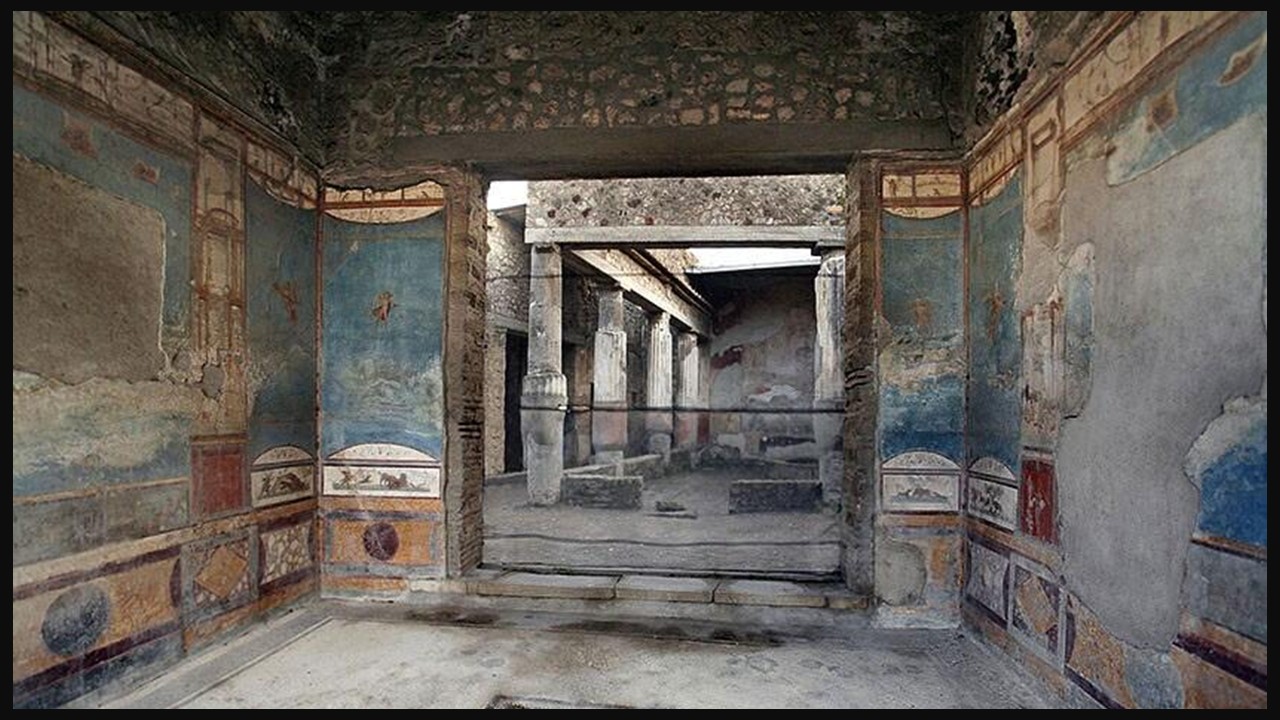
Tablinum in the House of the Ancient Hunt in Pompeii, Italy

House of the Ancient Hunt

Tablinum in the House of the Ancient Hunt in Pompeii, Italy
Tablinum in the House of the Ancient Hunt in Pompeii, Regio VII   Insula 4.48, Pompeii, Italy
https://www.planetpompeii.com/it/map/casa-della-caccia-antica.html

Nestled in the heart of Pompeii, the House of the Ancient Hunt (Casa della Caccia Antica) is a captivating glimpse into the artistry and domestic life of the ancient Roman elite. Named for its striking frescoes depicting dynamic hunting scenes, this modest yet elegant domus offers insight into the aesthetic tastes and daily routines of its former inhabitants. Unlike the grand villas of Pompeii’s wealthiest citizens, the House of the Ancient Hunt showcases a more intimate and functional design, yet it remains rich in decoration, reflecting the cultural fascination with nature and sport. As we step through its timeworn corridors, we uncover not just a beautifully preserved home, but a testament to the artistic mastery and lived experiences of a civilization frozen in time.

The House of the Ancient Hunt (Casa della Caccia Antica) is located on Via della Fortuna, in Regio VII, Insula 4, No. 48 within the city of Pompeii, near the Via degli Augustali, a central street that connected key areas of the city. Dating to the 2nd century BC, the house exemplifies a traditional Italic domus with a relatively compact yet elegant architectural plan. Upon entering, visitors pass through a narrow fauces (entrance corridor) that leads into a central atrium, which once featured an impluvium (a rainwater collection basin). Surrounding the atrium are several cubicula (bedrooms) and a tablinum (reception area), which opens into a charming peristyle garden adorned with frescoes. The house is best known for its vivid hunting-themed wall paintings, particularly in the peristyle, depicting dynamic scenes of hunters pursuing wild animals—a reflection of Roman aristocratic leisure and cultural ideals. Despite its relatively modest size compared to Pompeii’s grander residences, the House of the Ancient Hunt remains a fine example of domestic architecture, blending functionality with artistic refinement.

The tablinum of the House of the Ancient Hunt (Casa della Caccia Antica) served as the central reception area, positioned between the atrium and the peristyle, allowing for a seamless transition between the more public and private spaces of the house. This room, a hallmark of traditional Roman domus architecture, was likely used by the owner for conducting business, receiving guests, and displaying status through artistic decoration. In this case, the tablinum not only functioned as an administrative space but also as a visual gateway to the house’s most striking artistic feature – the vibrant frescoes that adorned the walls of this amazing house.
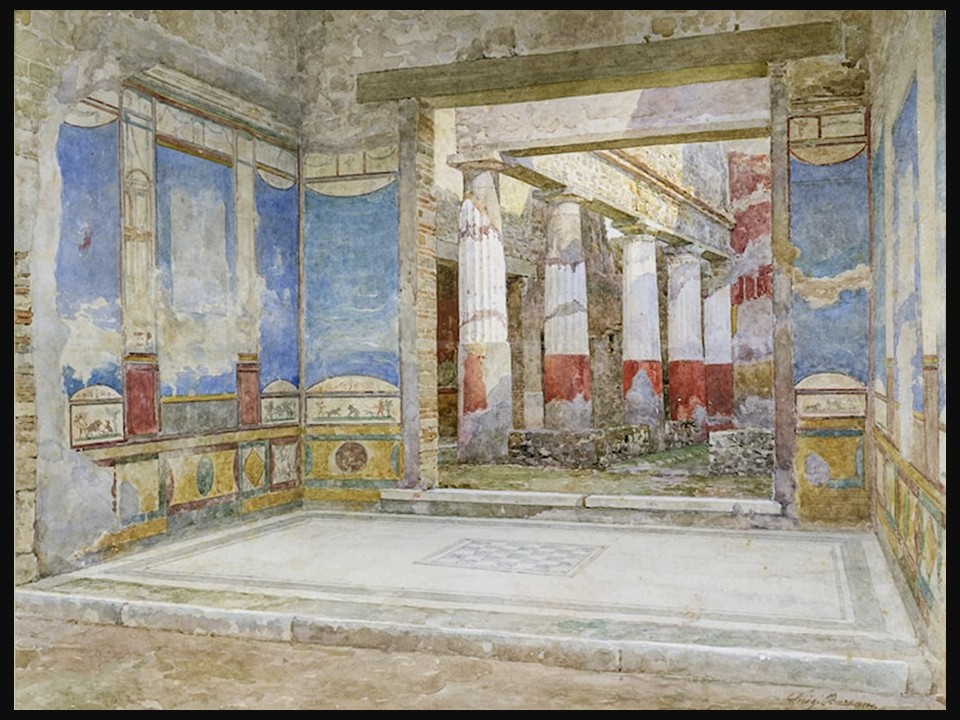
Luigi Bazzani painting of the 
Tablinum in the House of the Ancient Hunt in Pompeii
Luigi Bazzani, Italian Artist,1836-1927
Tablinum in the House of the Ancient Hunt in Pompeii, 1886, Watercolour on Paper, 34.92x 47.94, Victoria and Albert Museum, London UK https://www.artrenewal.org/artworks/atrium-a-pompei-nella-domus-della-caccia-antica/luigi-bazzani/92235  

The room’s wall decoration follows the Fourth Pompeian Style (c. 60–79 AD), a highly theatrical and elaborate aesthetic that integrates architectural illusionism, intricate ornamentation, and mythological narratives. The lower portion of the walls features an imitation of polychrome marble cladding, reflecting a taste for luxury by simulating the expensive materials used in elite Roman homes. The central register is striking, set against a turquoise blue background, divided into panels adorned with winged figures, architectural views on a white background, and predellas depicting cupids engaged in hunting, reinforcing the house’s thematic connection to the chase. Two prominent mythological scenes stand out: Theseus and Ariadne outside the labyrinth, symbolizing triumph and abandonment, and Daedalus presenting Pasiphae with the wooden bull, an episode tied to deception and desire in the myth of the Minotaur’s conception.

Aesthetically, the decoration of the Tablinum exemplifies the Fourth Style’s emphasis on illusionistic depth, vibrant color contrasts, and dynamic compositions. The turquoise blue central background, a rare and striking choice, enhances the ethereal quality of the winged figures while simultaneously creating a vivid contrast with the architectural elements. The mythological vignettes, rendered in delicate, miniature-like detail, evoke a refined taste for storytelling, drawing the viewer into dramatic moments from Greek mythology. The cupids hunting in the predellas serve as a playful yet symbolic nod to the themes of pursuit and conquest, which resonate both in the act of hunting and in the mythological narratives depicted above. The upper zone, with its white background and fantastical architectural motifs, further extends the illusionistic space, creating a sense of openness and grandeur. This interplay of myth, ornamentation, and spatial illusion not only enhances the aesthetic richness of the room but also reflects the intellectual and artistic ambitions of its owner, transforming the Tablinum into a theatrical stage of myth, power, and beauty.

For a PowerPoint Presentation of the House of the Ancient Hunt in Pompeii, please check HERE!

Bibliography: https://www.planetpompeii.com/it/map/casa-della-caccia-antica.html and https://pompeiiinpictures.com/pompeiiinpictures/R7/7%2004%2048%20p1.htm
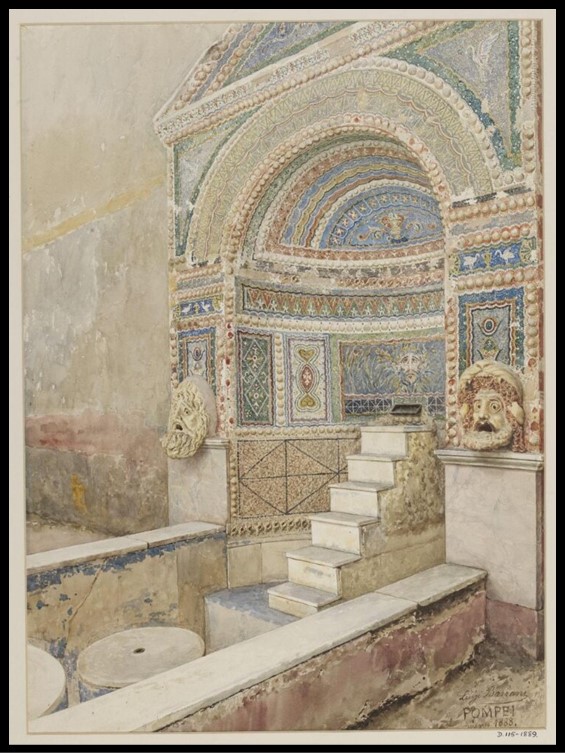
Luigi Bazzani's watercolour painting of a fountain in Pompeii (House of the Large Fountain, Pompeii).

Luigi Bazzani’s Watercolours of Pompeii

Luigi Bazzani's watercolour painting of a fountain in Pompeii (House of the Large Fountain, Pompeii).
Luigi Bazzani, Italian Artist, 1836–1927
A fountain in Pompeii (House of the Large Fountain, Pompeii), 1888, Watercolour on Paper, 46.35x 35.56 cm, Victoria and Albert Museum, London, UK https://collections.vam.ac.uk/item/O406355/painting-of-pompeii-drawing-luigi-bazzani/#object-details

I’m not sure if you enjoy Japanese Haiku, those three-line, 17-syllable poems, but as I gaze at Luigi Bazzani’s Watercolours of Pompeii in the Victoria and Albert Museum, I’m reminded of the Haiku games I once shared with my students. And with that, a new Haiku unfolds… Ancient stones speak soft, / Bazzani’s brush finds their voice, / Pompeii breathes anew.

Luigi Bazzani (1836–1927) was an Italian painter and architect born in Bologna. A master of both watercolors and detailed architectural renderings, Bazzani initially trained in the fine arts at the Accademia di Belle Arti in Bologna. His early works were primarily focused on landscapes and genre scenes, but he soon became captivated by ancient Roman architecture and archaeological subjects, which shaped his career. By the mid-19th century, he had joined a circle of artists, archaeologists, and scholars based in Rome, where he further refined his skills in portraying architectural details with exceptional precision. This passion led Bazzani to work extensively in archaeological illustration, making him a key figure in documenting Italy’s historical sites.

Bazzani’s work took on new significance when he became actively involved in the excavation and study of Pompeii. At the time, the archaeological site was undergoing one of its most intensive periods of excavation, and Bazzani’s watercolors played a vital role in visually recording the ruins before further deterioration. His paintings, known for their remarkable detail, accuracy, and fidelity to the textures of ancient stonework, served both scientific and artistic purposes. His ability to evoke the atmosphere of ancient Pompeii made him a celebrated artist among scholars and art lovers alike, particularly as his work bridged the realms of historical documentation and creative expression. Through his paintings, Bazzani preserved not just the structures of Pompeii but also conveyed a sense of the city’s former life and vibrancy.

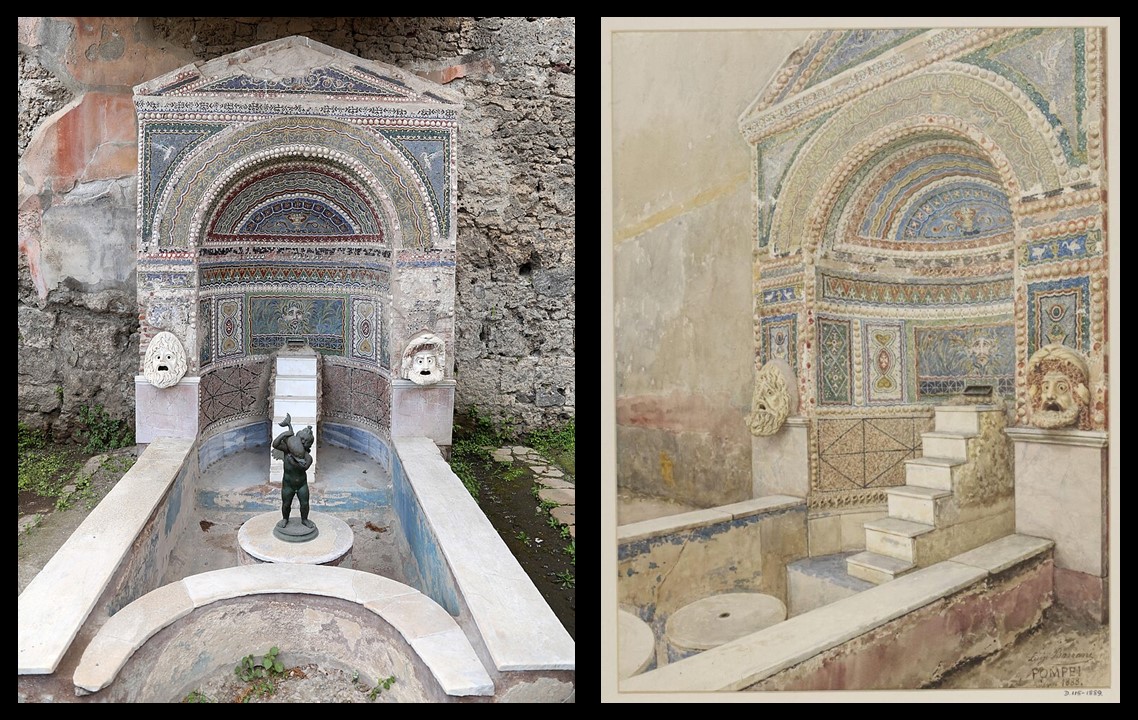
Luigi Bazzani's watercolour painting of a fountain in Pompeii and the actual House of the Large Fountain in Pompeii.
Luigi Bazzani, Italian Artist, 1836–1927
A fountain in Pompeii (House of the Large Fountain, Pompeii), 1888, Watercolour on Paper, 46.35x 35.56 cm, Victoria and Albert Museum, London, UK https://collections.vam.ac.uk/item/O406355/painting-of-pompeii-drawing-luigi-bazzani/#object-details
House of the Large Fountain, 2nd century BC to 1st century AD, Pompeii (Regio VI   Insula 8.22), Italy
https://www.planetpompeii.com/en/map/the-house-of-large-fountain/524-the-house-of-large-fountain.html

His artistic approach combined meticulous attention to detail with a romantic sensibility that brought depth and emotion to his portrayals of Pompeii. His use of watercolor allowed him to capture the luminous quality of Mediterranean light, which he skillfully balanced with shadow and contrast to convey the depth and scale of ancient architecture. Bazzani’s works are characterized by an almost photographic realism, yet they go beyond mere documentation, subtly imbuing his subjects with a sense of nostalgia for a lost world. His brushwork reveals an intimate knowledge of architectural form and materials, while his ability to evoke atmospheric conditions gives his scenes a timeless, almost haunting beauty. Through Bazzani’s artistry, the viewer not only sees Pompeii’s ruins but also senses the city’s enduring spirit.

The Victoria and Albert Museum houses a notable collection of Luigi Bazzani’s watercolors depicting the ancient site of Pompeii, showcasing his unparalleled skill in capturing the ruins with both accuracy and artistic flair. These works offer a vivid glimpse into the archaeological site during the late 19th and early 20th centuries, a period of intense excavation and exploration. Bazzani’s watercolors at the V&A highlight his meticulous attention to architectural detail and his ability to evoke the atmosphere of the ancient city, from crumbling walls to the intricate textures of stone and frescoes. Through these works, the museum preserves not only a historical record of Pompeii’s ruins but also an artistic interpretation of the past, allowing viewers to experience the city as it once stood—alive with the vibrancy of Roman life, even as it faced the inexorable passage of time.

The Louigi Bazzani watercolour painting of a Pompeiian Fountain within a highly decorated alcove, is a wonderful reconstruction of the Mosaic Fountain discovered in the Pompeiian House of the Large Fountain. The Pompeiian Houseis discussed… https://www.teachercurator.com/ancient-roman-villas/house-of-the-large-fountain/

For a PowerPoint on Luigi Bazzani’s Pompeian oeuvre, please… Click HERE!

Bibliography: https://collections.vam.ac.uk/search/?id_person=AUTH347957&page=1&page_size=15