https://www.museivaticani.va/content/museivaticani/en/collezioni/musei/museo-pio-clementino/sala-a-croce-greca/sarcofago-di-costanza.html
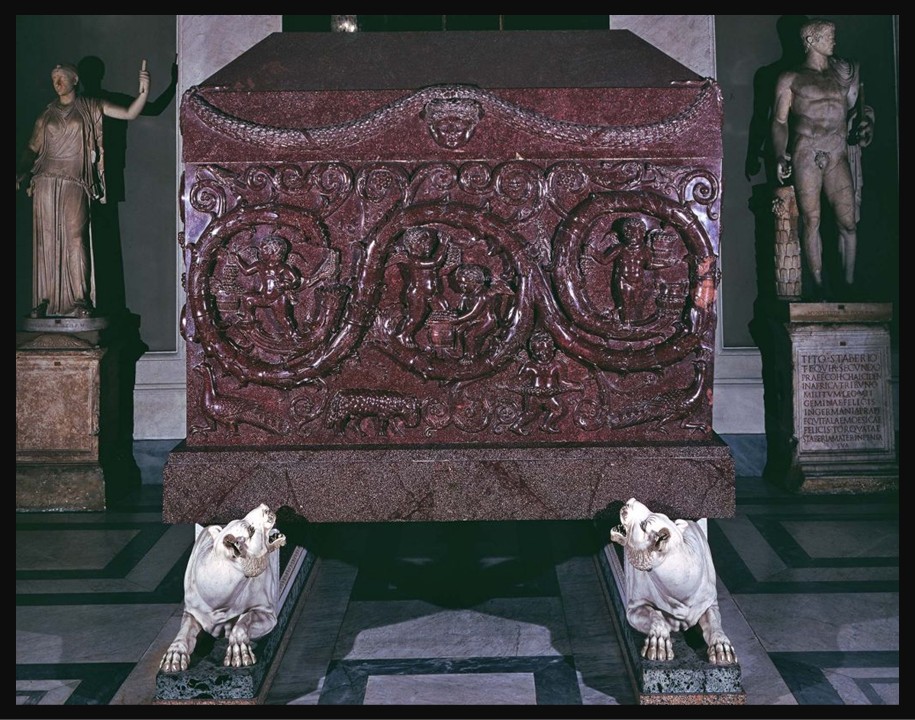
Stand long enough in the Greek Cross Hall of the Vatican Museums and the room eventually contracts around a single object. The sarcophagus of Constantia, carved in blood-red porphyry in 354 AD, standing 225 centimeters tall, is not the largest thing you will have seen that day, but it is the most insistent. It was made, most likely, for a daughter of the first Christian emperor. And it has been asking the same question for seventeen centuries: is this tomb pagan or Christian? The stone will not say.
Constantia, daughter of Constantine
The woman most scholars believe this sarcophagus was made for was Constantia, daughter of Constantine the Great, half-sister of Constantius II, and a figure of considerable dynastic weight in her own right. She was married twice for political purpose, widowed twice, and spent years wielding quiet influence at the edges of imperial power. She was also, by the time of her death in 354 AD, venerated for her piety, she would later be canonised as a saint, a somewhat surprising outcome given the ruthless world she navigated. She was buried in a circular mausoleum on the Via Nomentana, beside the basilica of Sant’Agnese, a building she herself had patronised. That mausoleum survives today as the church of Santa Costanza, and together, building and sarcophagus form one of the most layered funerary programmes to have reached us from the ancient world.
The colour of empire
The material alone announces that this is no ordinary burial. Red porphyry, porfido rosso antico, was quarried from a single site in the Egyptian desert, Mons Porphyrites, and its use was effectively the monopoly of the imperial house. To be buried in porphyry was not merely a luxury; it was a political statement, the visual equivalent of a dynastic seal stamped in stone. The colour, a deep purplish red, was the colour of Roman imperial power itself. The word porphyrogennetos, born in the purple, meant born to reign. Constantia’s coffin does not whisper her status. It declares it in a material no private citizen could legitimately touch.
https://en.wikipedia.org/wiki/Mausoleum_of_Constantina
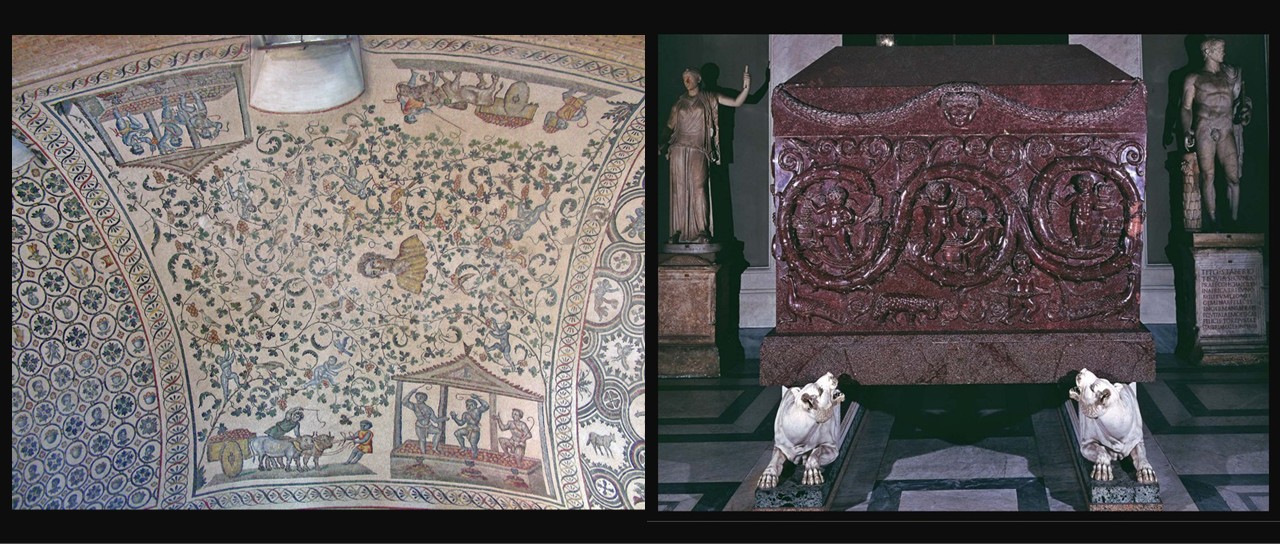
Monumental sarcophagus of Constance, 354 AD, Red Porphyry, Height 225 cm, Musei Vaticani
https://www.museivaticani.va/content/museivaticani/en/collezioni/musei/museo-pio-clementino/sala-a-croce-greca/sarcofago-di-costanza.html
Grapes, cupids, and deliberate ambiguity
The carved surfaces are where the interpretive difficulty lives. All four sides of the coffin are covered with a dense programme of grape vines, large acanthus scrolls, and cupids engaged in the work of the vintage, pressing grapes, carrying garlands, going about their business with cheerful indifference to the fact that they are decorating a tomb. Below, two peacocks flank a ram, with another cupid bearing a garland. The lid carries festoons of greenery tied to theatrical masks.
This is, on its face, Dionysian vocabulary, the imagery of wine, abundance, and the cyclical renewal associated with Dionysus and his promise of life beyond death. In the pagan tradition, these were entirely appropriate funerary images. But by 354 AD, the world had changed. Constantine’s conversion had made Christianity the religion of the court, and for a patron of Constantia’s generation and piety, the grape harvest carried a second register of meaning: the Eucharist, the blood of Christ, the vine as metaphor for the Church. Whether the imagery was chosen to speak both languages simultaneously, or whether it simply migrated from pagan to Christian use without anyone feeling the need to choose, is precisely what cannot be resolved. The same harvest scene covers the magnificent mosaics of the vault at Santa Costanza, offering us, in both stone and tesserae, the same unresolved ambiguity.
An object that outlived everything
The sarcophagus’s subsequent history is its own kind of story. It was removed from the mausoleum between 1467 and 1471 and installed in Piazza San Marco in Rome. In 1790, it made its final journey into the Vatican Museums, transported on a cart drawn by forty oxen, a detail that gives some sense of what it means to move 225 centimeters of solid porphyry across a city. It now rests on four lioness supports carved by the eighteenth-century sculptor Francesco Antonio Franzoni, a late addition that grounds the ancient object on something stable.
There is something fitting about the uncertainty that clings to it. We do not know for certain if it held Constantia’s remains. We cannot determine whether its grape-treading cupids speak to Dionysus or to Christ. The stone is silent on both counts, magnificent, imperial, and altogether unmoved by the question.
Classroom Activity: Bring the Constantinian era to life in your classroom with this hands-on student activity inspired by the Porphyry Sarcophagus of Constantia at Musei Vaticani. View the Student Activity →
Continue Exploring on Teacher Curator: Expand your understanding of the Porphyry Sarcophagus of Constantia with related articles: The Marble Portrait of Constantine the Great and The Mythical Singer Orpheus
Sources and further Reading: To dive deeper into Early Christian sculpture, visit the Musei Vaticani Catalogue entry for the Porphyry Sarcophagus of Constantia: https://catalogo.museivaticani.va/index.php/Detail/objects/MV.237.0.0?lang=en_US. For broader context, explore The Vatican: Spirit and Art of Christian Rome via the Metropolitan Museum of Art: https://books.google.gr/books?id=VZUsI-lePtIC&printsec=frontcover&redir_esc=y#v=onepage&q&f=false