https://www.ebyzantinemuseum.gr/?i=bxm.en.exhibit&id=142
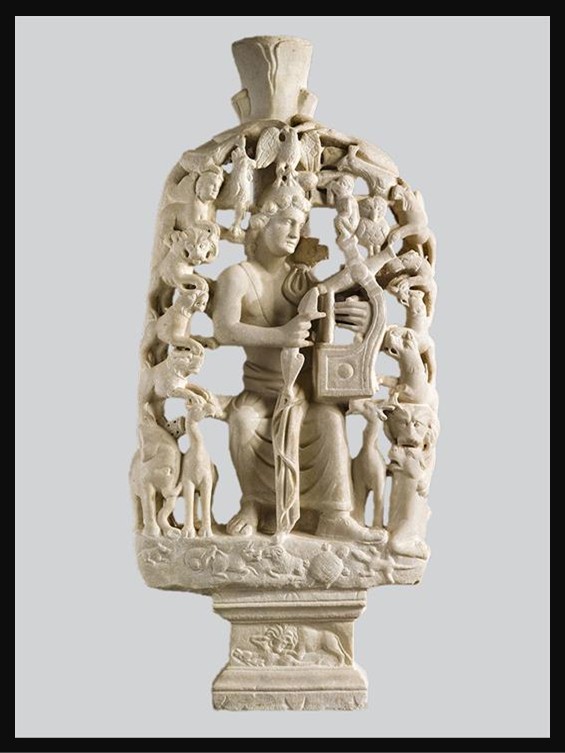
Among the most captivating objects in the Byzantine and Christian Museum in Athens stands a rare marble table support, a trapezophoron, that turns out to be far more than decorative furniture. Depicting the mythical singer Orpheus, this 4th-century AD sculpture is a remarkable example of Orpheus as a Christian symbol — a moment when the ancient world was quietly reinventing itself, borrowing the familiar face of a pagan myth to give shape to an emerging faith.
A Singer Surrounded by Wonder
At the center of the composition sits Orpheus, the legendary musician whose song could enchant all living beings. He is shown seated against a tree trunk, playing his lyre, dressed in a himation and wearing a distinctive Phrygian cap that identifies his Thracian origins. The sculptor has brought together a remarkable gathering of animals around him: lions, an elephant, a giraffe, a deer, wolves or dogs, a bear, and a variety of birds, including an owl, rooster, and peacocks.
Interspersed among these are fantastical creatures, griffins, a sphinx, even a monkey, blurring the boundary between the real and the imaginary. Additional animals appear in low relief along the base: a boar, a donkey, a ram, a tortoise, a snail, and a lizard. At the very bottom, a vivid scene of a lion attacking a deer introduces a note of tension, reminding us of the violence inherent in the natural world, a violence that Orpheus’ music seems, momentarily, to suspend.
The Myth Behind the Music
Orpheus was, according to Greek mythology, a citharoedus from Thrace, a musician of supernatural gift whose playing could charm not only men and animals, but the very rocks and rivers. His most famous story is one of love and loss: his descent into the Underworld to retrieve his wife Eurydice, armed with nothing but his lyre.
He was the archetype of the artist as enchanter, the voice that transcends the boundaries between worlds.
When Orpheus Became Christ
Here lies the most extraordinary dimension of this sculpture. By the 4th century AD, early Christians had begun borrowing the figure of Orpheus as an allegorical image of Christ — the divine shepherd who, like the Thracian musician, draws all living things toward him through the power of his word. This was no coincidence. Early Christian communities, navigating a world still saturated with classical imagery, found in Orpheus a natural bridge — a familiar, beloved figure through whom a new faith could speak. The animals gathering around him became the faithful gathering around Christ; the lyre became the Gospel.
On this trapezophoron, one detail strengthens that reading compellingly: an eagle perched on Orpheus’ head. In Christian iconography, the eagle carried powerful associations with resurrection and ascension, and was often linked to Christ himself. Its placement here is unlikely to be accidental. Rather, it suggests that viewers in Late Antiquity understood this figure not simply as the mythological singer, but as a symbolic image resonating with Christian meaning — the sculpture operating quietly on two levels at once, bridging the classical tradition and an emerging Christian world. This marble table support captures that precise, fleeting moment of transition: a pagan myth becoming a Christian truth.
Luxury Furniture in Late Antiquity
It is worth pausing to consider what this object actually was: a table support, a piece of high-end domestic furniture. The Romans and Late Antique elite furnished their homes with sculpted trapezophora, table legs carved with mythological figures, prized for both their function and their cultural prestige. Some scholars have proposed that trapezophora like the one in Athens, decorated spaces of leisure, baths, gardens, or fountains, where mythological scenes provided visual pleasure without necessarily carrying deep symbolic meaning.
Others, however, argue that the Christian associations of the imagery make such a context less likely. If the figure was intended to evoke Christ, its partial concealment beneath a table might seem counterintuitive, unless the table itself played a role in ritual activity, such as the Eucharist.
The original context of this sculpture remains, unfortunately, uncertain. It is known to have been found on the island of Aegina, but no detailed archaeological information about its discovery has survived. This lack of context prevents any definitive conclusions about its function or meaning. Instead, we are left with a work that invites interpretation while resisting certainty, a characteristic that, in many ways, reflects the transitional nature of the period in which it was created.
Ultimately, this trapezophoron stands as a compelling example of how art can embody cultural change. It is at once a practical object and a richly symbolic image, a product of skilled craftsmanship and a witness to shifting beliefs. In the figure of Orpheus, poet, musician, and, perhaps, a veiled image of Christ, we encounter a world in which myth and faith are not opposed but intertwined. The silent music of his lyre continues to resonate, inviting us to consider how meaning is shaped, transformed, and sustained across time.
Want to explore more? Download the free presentation and take the story further. Get the PowerPoint →
Continue Exploring on Teacher Curator: Expand your understanding of Sculpture during the Early Christian Period with related articles: Bust of a Lady and The Emperor Julian
Sources and further Reading: Heaven & Earth, Art of Byzantium from Greek Collections, Athens 2013, Pages: 61-62: https://www.academia.edu/31240474/Heaven_and_Earth_Art_of_Byzantium_from_Greek_Collections_exh_cat_National_Gallery_of_Art_Washington_DC_J_P_Getty_Museum_the_Art_Institute_of_Chicago_Athens_2013_Edited_by_A_Drandaki_A_Tourta_and_D_Papanikola_Bakirtzi and Byzantine and Christian Museum, Athens: https://www.ebyzantinemuseum.gr/?i=bxm.en.exhibit&id=142