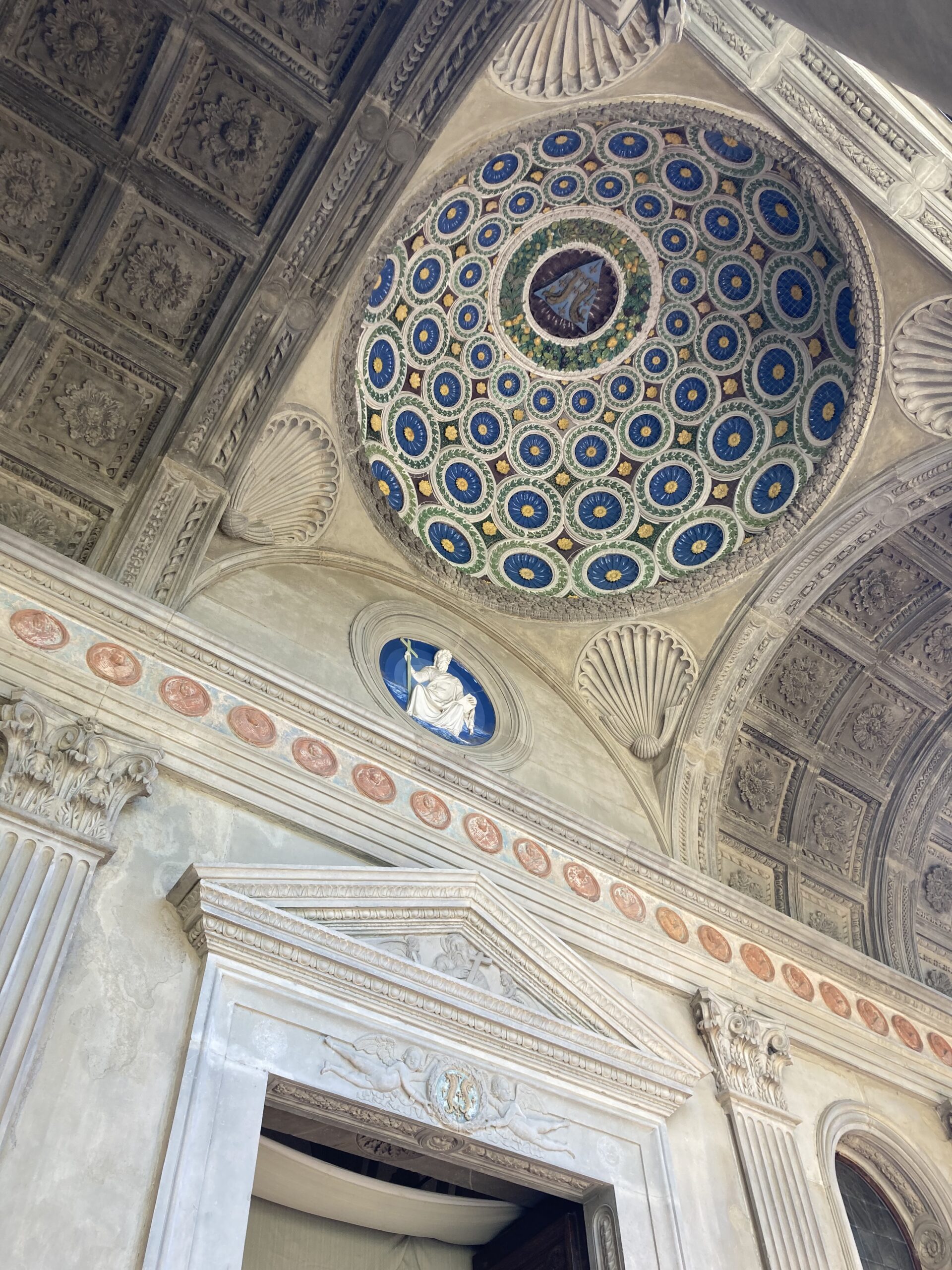
Glazed Terracotta Portico Dome, 1461, Cappella dei Pazzi, Florence, Itay – Photo Credit: Amalia Spiliakou, April 2025
In the spring light of Florence, tucked within the courtyard of the Basilica di Santa Croce, a radiant half-dome crowns the portico of the Cappella dei Pazzi with an intensity that still stops visitors in their tracks. Ringed in cobalt blue and gold, studded with glazed terracotta roundels, and anchored by a luminous central medallion, Luca della Robbia’s Glazed Terracotta Portico Dome (1461) remains one of the most technically innovative and visually captivating creations of the Italian Renaissance.
Who Was Luca della Robbia?
Born in Florence around 1400, Luca della Robbia emerged as one of the most inventive sculptors of the Early Renaissance. While contemporaries such as Donatello explored dramatic realism in bronze and marble, della Robbia developed a different artistic language: luminous glazed terracotta.
His breakthrough technique combined sculpture with a tin-based glaze that produced brilliant, durable surfaces resistant to humidity and weather. The distinctive white figures set against deep cobalt blue backgrounds became the hallmark of the della Robbia workshop and transformed terracotta from a modest material into one associated with elegance, refinement, and spiritual radiance.
The artist’s workshop would continue for generations through his nephew Andrea della Robbia and other family members, shaping the visual identity of Renaissance Florence far beyond the city itself.
The Setting: Brunelleschi’s Renaissance Vision
The dome decorates the portico of the Pazzi Chapel, one of the great architectural achievements of Filippo Brunelleschi. Commissioned by the wealthy Pazzi family and begun in the 1440s, the chapel exemplifies Brunelleschi’s revolutionary approach to architecture: harmony through proportion, clarity, and mathematical balance.
Unlike the vertical drama of Gothic churches, Brunelleschi’s spaces create calm through geometry. Every arch, pilaster, and decorative element contributes to a carefully measured sense of order. The portico itself acts as a transitional space between the busy cloister and the sacred interior of the chapel. Although it was most probably not designed by Brunelleschi, but the workshop of Bernardo Rossellino, it is precisely here that Luca della Robbia’s dome becomes so powerful. The brilliant glazed decoration softens Brunelleschi’s architectural restraint with colour and movement while remaining perfectly integrated into the structure’s symmetrical rhythm.
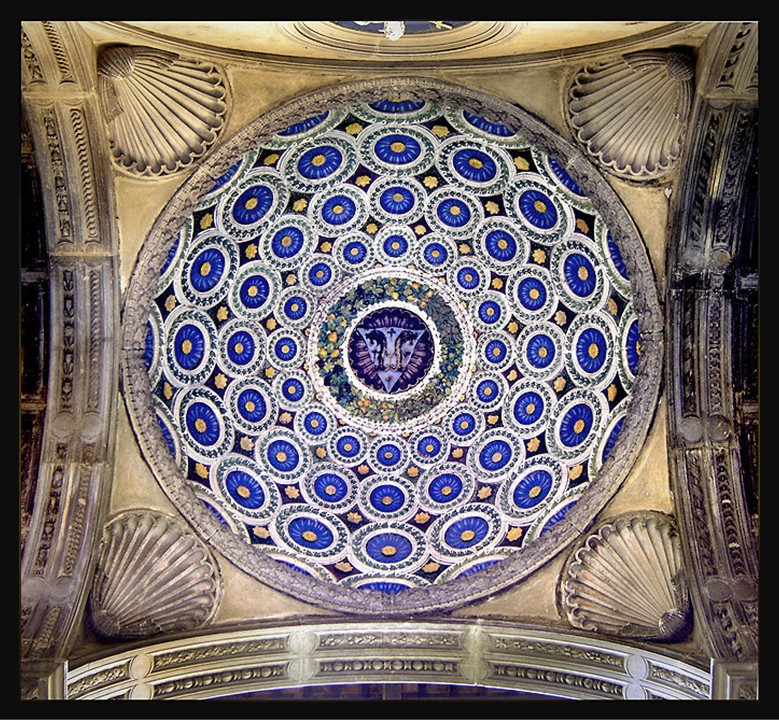
Glazed Terracotta Portico Dome, 1461, Cappella dei Pazzi, Florence, Itay
https://el.wikipedia.org/wiki/%CE%9B%CE%BF%CF%8D%CE%BA%CE%B1_

%CE%BD%CF%84%CE%B5%CE%BB%CE%BB%CE%B1_%CE%A1%CF%8C%CE%B
C%CF%80%CE%B9%CE%B1#/media/%CE%91%CF%81%CF%87%CE%B5%CE%AF%CE%BF:Cappellapazzi-portico.jpg
Reading the Dome: Form, Symbol, and Meaning
At first glance, the dome appears purely decorative. Yet Renaissance viewers would have immediately understood its symbolic richness. The deep blue background evokes the heavens, while the white glazed reliefs suggest divine purity and celestial light. The radial arrangement of the decoration creates the impression of a perfectly ordered cosmos, a visual expression of Renaissance humanist ideals linking beauty, mathematics, and divine harmony.
At the centre of the half-dome, the large glazed tondo serves as both a visual and symbolic focal point. It presents the coat of arms of the Pazzi family: two stylised dolphins flanking a flaming cross. In Renaissance heraldry, dolphins symbolised prosperity, harmony, and divine guidance, while the cross alluded to both religious devotion and the family’s spiritual aspirations. Suspended within the radiant blue field of the dome, the emblem transforms a dynastic device into part of a celestial vision, linking the Pazzi family directly to the sacred and harmonious order expressed throughout the chapel.
Around the central medallion, glazed rosettes and ornamental motifs unfold rhythmically across the surface, accompanied by a delicate garland that further softens and frames the composition. These floral forms often symbolised paradise, eternal renewal, and the perfection of divine creation, while their repetition reinforces the sense of cosmic order characteristic of Brunelleschi’s architectural language. Set within this celestial field, the Pazzi family emblem reminds every viewer who financed this sophisticated architectural and spiritual environment.
There is also a strong dialogue with Antiquity. The coffering and geometric structure of the half-dome recall ancient Roman architecture, particularly monumental domes such as the Pantheon in Rome. Filippo Brunelleschi and Luca della Robbia were consciously adapting classical forms into a distinctly Christian Renaissance vocabulary.
Technical Innovation: The Craft Behind the Colour
What makes the dome extraordinary is not only its symbolism but also its technical achievement. Glazed terracotta required an exceptionally complex process. Sculpted clay elements were coated with mineral-based glazes and fired at high temperatures, producing surfaces that became both luminous and durable. The brilliant cobalt blue, creamy white, green, and yellow tones retained their vibrancy far better than many painted surfaces of the period.
For Renaissance Florence, this represented a remarkable innovation. Marble sculpture was expensive and difficult to produce, while painted decoration could deteriorate quickly. Della Robbia’s glazed terracotta offered a new artistic solution: sculptural richness combined with vivid, long-lasting colour.
The material also transformed the viewer’s experience of architecture. As sunlight moves across the portico throughout the day, the glazed surfaces reflect and absorb light differently, creating a subtle shimmering effect. Even today, the dome feels alive in changing natural light. This interaction between surface and illumination is central to the work’s impact. The dome was designed not simply to be observed, but to be experienced physically as visitors passed beneath it.
Luca della Robbia’s Enduring Legacy
More than five centuries later, Luca della Robbia’s Glazed Terracotta Portico Dome continues to embody the spirit of the Early Renaissance: the union of artistic innovation, scientific curiosity, classical inspiration, and spiritual beauty. While Florence is often associated with monumental frescoes and marble sculpture, della Robbia demonstrated that terracotta could achieve equal refinement and emotional power. His glazed surfaces introduced a new visual language that was both accessible and technically revolutionary.
Today, the dome remains one of the most memorable details within the Pazzi Chapel complex, not because of monumental scale, but because of its extraordinary balance between architecture, sculpture, colour, and light. Standing beneath it in the Florentine spring, viewers encounter more than decoration. They encounter a Renaissance vision of harmony itself.
PowerPoint Presentation: Want to explore more? Download the free presentation and take the story further. Get the PowerPoint →
Continue Exploring on Teacher Curator: Expand your understanding of Luca della Robbia Glazed Terracotta Sculpture with related articles… Bliss Madonna by Luca della Robbia and Andrea della Robbia’s tender Portrait of a Child
Sources and further Reading: To dive deeper into the world of Luca della Robbia Glazed Terracotta Sculpture, visit Apollo Magazine and the Della Robbia’s glazed terracotta changed Tuscan art article https://apollo-magazine.com/della-robbia/, Learn more about the history, craftsmanship, and legacy of the Pazzi Chapel in Experiencing the Pazzi Chapel by Alexandra Korey https://www.arttrav.com/florence/pazzi-chapel/ and discover information and articles inspired by the MFA Boston 2016 Exhibition, Della Robbia Sculpting with Color in Renaissance Florence https://www.mfa.org/exhibitions/della-robbia