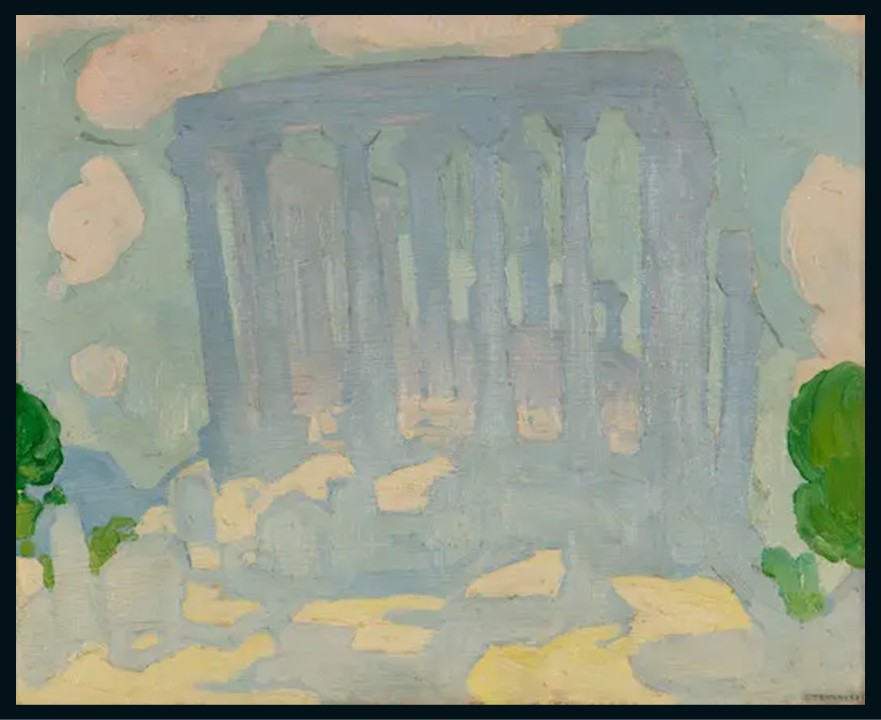
The Temple of Aphaia, Aegina, 1923, Oil on cardboard, mounted on canvas, 27.5×33.5 cm, Private Collection
https://www.bonhams.com/auction/31745/lot/3/spyros-papaloukas-1892-1957-le-temple-dafea-egine/
There is a particular quality of light on the island of Aegina in summer, dry, sharp, and unforgiving, bleaching stone to chalk and flattening shadows into near-nothingness. It is the kind of light that has drawn artists and philosophers to the Greek islands for centuries. In 1923, a grieving and exhausted Greek painter named Spyros Papaloukas sailed to Aegina to recover, and what he found there, that extraordinary light, those ancient ruins, that silence, would produce some of the most quietly powerful works of 20th-century Greek art. His painting The Temple of Aphaia is one of them.
A Painter in Retreat
To understand this small canvas, just 27.5 by 33.5 centimeters, you need to know something of the circumstances that brought Papaloukas to Aegina. He had spent 1921–22 as a war artist in the Asia Minor Campaign, one of the most catastrophic episodes in modern Greek history. The campaign ended in the destruction of Smyrna, and when Papaloukas put 500 of his paintings on a train bound for the ruined city, the train was set alight. His entire body of war work was lost in the flames.
He retreated to Aegina shattered. But grief, for a painter of his calibre, has a way of sharpening the eye. Papaloukas threw himself into the study of the Greek landscape with a new intensity, spending long days painting outdoors, en plein air, in the company of his friend the writer Stratis Doukas and the architect Dimitris Pikionis.
The Temple and Its History
The Temple of Aphaia, perched on a pine-covered hill in the northeast of the island, is one of ancient Greece’s most remarkable survivals. Built around 500 BC, on the ruins of an earlier wooden temple destroyed by fire in 510 BC, it is a masterpiece of the Doric order, with slender columns spaced more generously than was typical for the period, giving it an unusually airy, almost weightless character. Twenty-five of its original 32 columns still stand.
The temple was dedicated to Aphaia, a local Aeginetan goddess connected with nature and transformation, later absorbed into the cult of Athena. Its sculpted pediments, depicting battle scenes from the Trojan War, are among the finest examples of late Archaic sculpture. They were removed from the site in 1811 and today reside in the Glyptothek Museum in Munich. Together with the Parthenon in Athens and the Temple of Poseidon at Sounion, Aphaia’s temple forms what scholars call the ‘Sacred Triangle’ of ancient Greek religious architecture.
Reading the Painting
What makes Papaloukas’s treatment so distinctive is his materials as much as his vision. Like most of his Aegina works, this painting is executed in oil on unprimed cardboard, a surface that absorbs the oily binder from the paint and leaves the pigment sitting on top, opaque and chalky, like fresco or tempera. The effect is intentional. In the hands of a painter trained first as an icon-maker and later in Paris at the Académie Julian, this chalkiness becomes a tool: the colours read dry and sun-scorched, perfectly attuned to the Greek landscape in high summer.
His approach to composition reflects his broader artistic philosophy, what critics have described as a search for the “natural continuum” underlying all things. He was not interested in topographical accuracy. He was interested in structure, rhythm, and the harmony between the man-made and the natural. The ancient columns and the landscape around them are not two separate subjects; they are one continuous thing, held together by light.
This is the work of a painter who had absorbed Post-Impressionism in Paris without surrendering to it, who brought the lessons of Cézanne back to Greece and asked what they meant for a landscape this ancient, this particular.
Spyros Papaloukas’s Legacy
Papaloukas would go on to his celebrated ‘Mount Athos’ period later in 1923, spending a full year in the monasteries studying Byzantine art, an experience that would deepen his already strong sense of spiritual structure in painting. But the Aegina works are where that journey begins: intimate in scale, direct in execution, and suffused with a melancholy beauty that seems to come from a man who has seen destruction and chosen, deliberately, to paint something that has lasted 2,500 years.
“Nature is God’s miracle,” Papaloukas once said, “and art is the miracle of man.”
Standing before this small canvas, you feel both miracles at once.
PowerPoint Presentation: Ready to Dive Deeper? Download the a PowerPoint Presentation on the artist’s oeuvre and explore this topic at your own pace — ideal for sharing, discussing, or simply learning more. Get the PowerPoint →
Continue Exploring on Teacher Curator: Expand your understanding of Landscape in Modern Greek Art with related articles: Monemvasia by Konstantinos Maleas and Angelos Giallinas
Sources and further Reading: To dive deeper into the world of Papaloukas’s role as a war artist in the Asia Minor Campaign, see the B&M Theocharakis Foundation’s biographical timeline. https://artsandculture.google.com/story/spyros-papaloukas-1892-1957-b-m-theocharakis-foundation/vQVRDkFVYX-KKw?hl=en. Explore Papaloukas’s Post-Impressionist training in Paris and its synthesis with Greek tradition, and discover the Orthodox Arts Journal essay on his religious painting. https://orthodoxartsjournal.org/modernity-and-tradition-in-the-religious-art-of-spyros-papaloukas/. Discover how the painting Le Temple d’Afea, Égine (1923) is described at Bonhams, Greek Sale, Catalogue https://www.bonhams.com/auction/31745/lot/3/spyros-papaloukas-1892-1957-le-temple-dafea-egine/