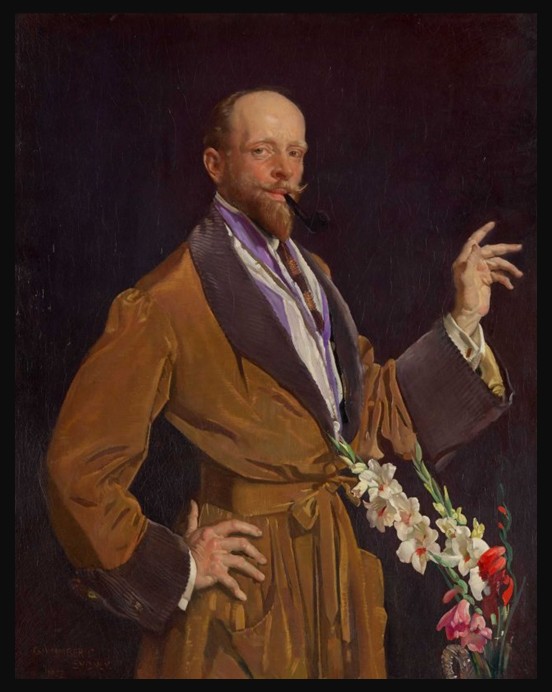
Self-portrait with Gladioli, before 1930, Oil on Canvas, 128.2×102.8 cm, National Portrait Gallery of Australia
https://www.portrait.gov.au/portraits/2003.93/self-portrait-with-gladioli/
There is a painting in the collection of the National Portrait Gallery of Australia that stops you mid-step. George Lambert’s Self Portrait with Gladioli (1922) presents a man standing before a deep purple background, pipe clenched in the corner of his mouth, one hand planted on his hip, the other raised in a gesture that is equal parts theatrical and self-aware. Beside him, a cut-crystal vase blazes with gladioli, red, pink, and creamy white. The man is George Washington Lambert: arguably the most remarkable Australian artist you may never have heard of.
From St Petersburg to a Sheep Station
George Lambert was born in St Petersburg, Russia, on 13 September 1873. His early years were peripatetic, Russia, Germany, England, before his family brought him to Australia at the age of fourteen. He landed not in a city studio but on a remote sheep property near Gilgandra in north-west New South Wales, working as a jackeroo on his great-uncle’s station. It was an unlikely starting point for one of the British Empire’s most celebrated portrait painters. While mustering stock, he struck up friendships with two other young men who would become legends of Australian culture: the poet Banjo Paterson and the ill-fated Breaker Morant.
Talent, however, has a way of making itself known. Lambert made his way to Sydney, began illustrating for the Bulletin, and enrolled at the Julian Ashton Art School in 1896. He was a natural. In 1899 he won the Wynne Prize for landscape painting, and the following year he became the first recipient of the NSW Society of Artists’ Travelling Scholarship, a prize that sent him, with his new wife Amy, to Paris and then London, where he would remain for the next two decades.
The Making of a Master
In Europe, Lambert immersed himself in the traditions he admired most. He studied at Colarossi’s in Paris, absorbed the lessons of Velázquez, Rubens, and Van Dyck, and steadily built a reputation as one of the finest portrait and figure painters working in the academic realist tradition. He exhibited regularly at the Royal Academy in London, became a member of the Chelsea Arts Club, and in 1922 made history as the first Australian artist elected as an Associate of the Royal Academy.
Between those years of studio painting came the First World War. Lambert served as an official war artist with the Australian Imperial Force, producing powerful works documenting the campaigns at Gallipoli and Beersheba, including his monumental The Charge of the Light Horse at Beersheba. He arrived in the Middle East despite contracting malaria, and departed with over 130 sketches. War correspondent C.E.W. Bean described him memorably as a man with ‘the golden beard, the hat, the cloak, the spurs, the gait, the laugh and the conviviality of a cavalier.’ He returned to Sydney in 1921 as the undisputed star of the Australian art world, and it was in the year that followed that he painted his most defining self-portrait.
A Portrait of Contradictions
Self Portrait with Gladioli is a painting of studied contradictions. Lambert stands in a sumptuous old-gold velvet smoking jacket with wide corduroy lapels, a violet and white silk scarf draped at his neck, a pipe in his mouth. The pose is dandyish, theatrical, the performance of an aesthete. In a letter to Amy in 1921, Lambert had written with wry self-knowledge: “I am a luxury, a hot house rarity… Scoffed at for preciousness. Despised for resembling a chippendale chair in a country where timber is cheap.”
And yet. Look at his hands. They are not a dandy’s hands. They are broad, strong, the knuckles swollen, the hands of someone who had wielded brushes, chisels, and horses’ reins with equal grip. In placing those hands so deliberately, one on his hip, one raised in the air, Lambert seems to be letting the painting tell two truths at once: yes, he was the glittering society figure, the Royal Academy associate, the man in velvet. But he was also, always, a craftsman.
The Gladiolus: August’s Flower of Strength
It is no accident that Lambert chose gladioli for this self-portrait. The gladiolus, named from the Latin gladius, meaning sword, is August’s birth flower, and its symbolism is as layered as Lambert’s painted persona. Ancient Romans associated the flower with gladiators and victory; the Victorians added a softer reading, believing the gladiolus could pierce the heart with beauty, giving it the additional meaning of infatuation. More broadly, the flower represents strength, moral integrity, sincerity, and remembrance.
In the painting, the gladioli in their cut-crystal vase glow against the purple ground, red for passion, pink for admiration, white for the purity of intention. They are not mere decoration. They are, in a sense, Lambert’s signature in floral form: bold, upright, impossible to overlook, and carrying more meaning than a first glance suggests.
A Legacy in Full Bloom
Lambert went on to win the Archibald Prize in 1927 with his portrait of Mrs Annie Murdoch, and in his final years he took on ambitious sculptural commissions, including a statue of Henry Lawson for Mrs Macquarie’s Chair in Sydney. He died suddenly on 29 May 1930, at the age of 56, following a diagnosis of mitral valve disease. Two memorial exhibitions were held before the year was out.
Self Portrait with Gladioli endures as his most intimate statement, a painting in which one of Australia’s greatest artists looked squarely at himself, pipe in hand, flowers at his side, and let the contradictions stand. It is the portrait of a man who was both luxury and labour, performance and craft, gladiator and aesthete.
This August, as gladioli bloom in gardens across the world, it feels entirely right to pause in front of this portrait and appreciate both the flower and the man who understood exactly what it meant to stand tall and claim your space.
PowerPoint Presentation: Ready to Dive Deeper? Download the presentation and explore George Washington Lambert’s oeuvre at your own pace, ideal for sharing, discussing, or simply learning more. Get the PowerPoint →
Continue Exploring on Teacher Curator: Expand your understanding of 19th-century academic portraiture and floral symbolism through related articles, including Philip Wilson Steer’s Jonquil and Dante Gabriel Rossetti’s The Day Dream. These works further explore the relationship between beauty, nature, and symbolism in late 19th-century painting.
Sources and further Reading: To explore the artistic world of George Washington Lambert in greater depth, visit the National Portrait Gallery of Australia’s presentation of Self-Portrait with Gladioli: https://www.portrait.gov.au/portraits/2003.93/self-portrait-with-gladioli/. For further insight into Lambert’s life, career, and artistic achievements, see the official Australian Dictionary of Biography entry: https://adb.anu.edu.au/biography/lambert-george-washington-7014