Emperor John II Komnenos in Art

Parallel Stories of Byzantine Imperial Portraits

Two Byzantine Roundels: Roundel with Emperor John II Komnenos, in the Byzantine Collection of the Dumbarton Oaks Museum
Angaran Rounde in Campiello de Ca'Angaran, Dorsoduro in Venice
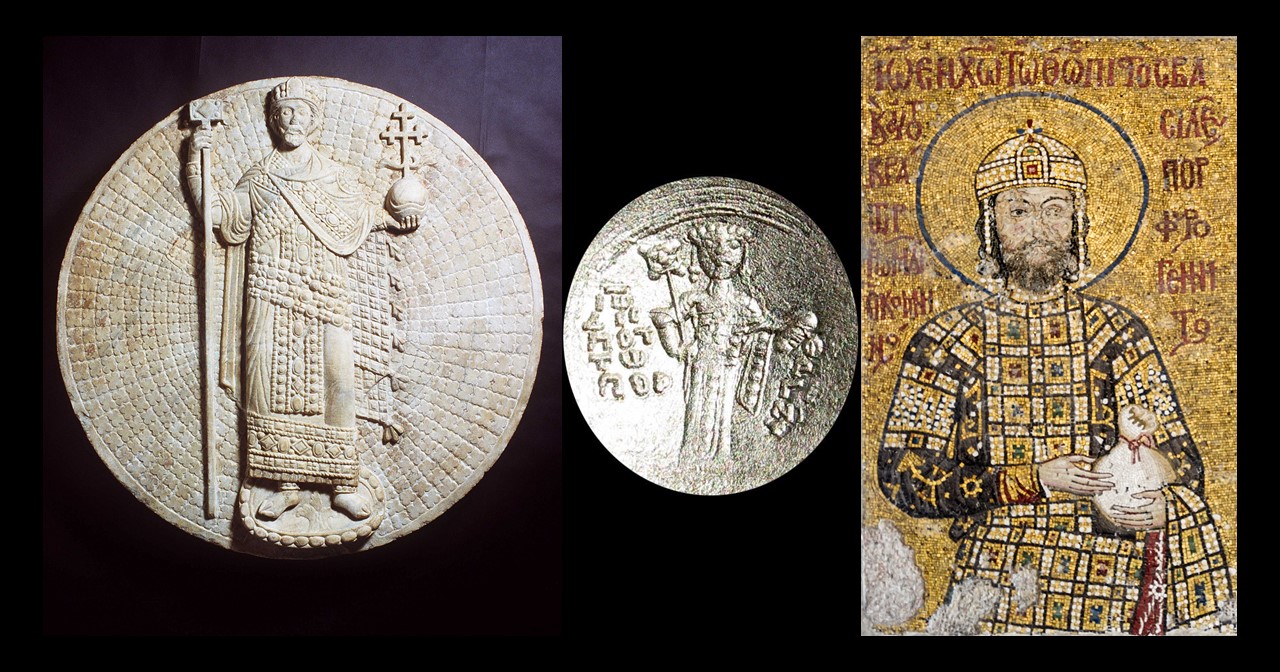
Roundel with Emperor John II Komnenos, ca. 1110 – 1118, marble, 90 x 90 x 7.5 cm, Byzantine Collection, Dumbarton Oaks Museum
Angaran Roundel, marble, d. 100 cm,Campiello de Ca’Angaran, Dorsoduro in Venice

Parallel Stories of Byzantine Imperial Portraits is about our fascination with the ‘image’ of the Byzantine Emperor… “The Emperor had to conform to idealized standards of deportment. He had to be seen as fixed, stable, and unmovable, a ruler whose character and judgement were unswayed by emotional excess. Such a demeanor was described by the eleventh century courtier and orator Michael Psellos in a speech addressed to Isaac I Komnenos…  You are straight, true, stiff… steadfast, firmly fixed, lofty… an impartial judge, unwavering in justice… a secure counselor, noble, unshaken in stormy waves. Psellos stressed the ruler’s lack of emotions: Where is there any anger in you, where are there streams of laughter, where are there traces of rage, and where is the babbling of speech? Where is there boasting, or violence and a willing mind? Where is there a knitting of the brows or an angry expression? For there are no unseemly qualities in you, neither easily excited emotions… nor delight, nor any graces, nor much laughter.” Writes Henry Maguire on IMAGES OF THE COURT in The Glory of Byzantium: Art and Culture of the Middle Byzantine Era, A.D. 843–1261, page 186     https://www.metmuseum.org/art/metpublications/The_Glory_of_Byzantium_Art_and_Culture_of_the_Middle_Byzantine_Era_AD_843_1261    

Two Byzantine Emperors – Two Parallel Lives

Emperor John II Komnenos in Art
Roundel with Emperor John II Komnenos, ca. 1110 – 1118, marble, 90 x 90 x 7.5 cm, Byzantine Collection, Dumbarton Oaks Museum
Silver Aspron Trachy of John II Komnenos, 1118-1143 AD, Thessalonica mint, 3.69 grams, 29/27 mm, (Iω/ΔЄC/ΠΟT/Tω/ΠOP – ΦV/PO/ΓЄ/NH/T, the Emperor standing facing, wearing divitision and loros, holding labarum and akakia), private collection     Copyright © 1998-2020, VHobbies.com
John II Comnenos, 1118, Komnenos Mosaic (John II Komnenos, Virgin Mary and Jesus Christ, Irene of Hungary), mosaic, Hagia Sophia Museum

Standing on a decorated suppedion, the Emperor of Byzantium at Dumbarton Oaks faces us in all his glory! He wears his ceremonial attire with poise and distinction: “a sagion (cape), bound at the right shoulder with a simple fibula, over a divitesion (tunic) and a loros (the gemmed scarf wrapped around the emperor’s torso.” Crowned and bejewelled, the Emperor stands in front of a vividly decorated background of cloverleaf arranged in a radiant design, holding the imperial insignia: “in his right hand he holds a labarum, a staff with a square finial” and in his left hand “an ornate globus cruciger with, in this instance, a leaved patriarchal cross.”

Who is the impressive Emperor depicted in this Byzantine relief sculpture Roundel exhibited today at the Dumbarton Oaks Museum of Byzantine Art? Is this a unique example of Byzantine imperial portraiture? The answer is NO! There is a second, matching Roundel in Venice, known as the  Angaran Roundel, embedded on the exterior wall of a Venetian house in the Dorsoduro district, equally rare in Byzantine imperial representation. “It has been suggested that these two emperors are Alexios I and John II Komnenos, father and son, who reigned jointly between 1092 and 1118.”

Both Roundels, made of marble, date from the 12th century. For their creation, the unknown artist used a “marble piece of a horizontal slab that was cut from the top of a column shaft of unusually large diameter. The roundels therefore are reused architectural elements of an ancient monument of considerable size.”     http://museum.doaks.org/OBJ27169.htm

Angaran Roundel, in Campiello de Ca'Angaran, Dorsoduro in Venice
Angaran Roundel, marble, d. 100 cm, Campiello de Ca’Angaran, Dorsoduro in Venice

The Angaran Roundel is almost identical to the one exhibited at the Dumbarton Oaks. Both depict Byzantine Emperors looking straight, true, stiff… steadfast, firmly fixed, lofty… holding the symbols of their power, gazing at us with majestic authority… but detached. Created by a great Constantinopolitan artist as an Imperial Ensemble, we can imagine, if this is a correct supposition,  a third roundel with Christ in the middle. The Imperial Portraits somehow ended up in the Veneto area, most probably as the 4th Crusade loot. They were still in the Veneto until 1937 when Robert Woods Bliss acquired the one depicting Emperor John II, through Royall Tyler, who writes to Bliss “I went to Lugano yesterday, & saw the Emperor, who is magnificent… There’s no change in the amount (33,000). H.F. prefers to receive it direct… Volbach was wrong about the material of the Emperor. He is marble (not limestone): I should say he was of exactly the same light grey marble, not shiny, as the Campiello Angaran roundel, & he’s exactly the same in style & in every respect except a few details of costume (the loros is different), & details of the footstool… The chances are they came from Constantinople, as one doesn’t see why the Venetians should have representations of the Byz. Emperor made, when they had not long before shaken off his overlordship… I’m simply delighted that you’ve got this superb carving, the like of which is most unlikely to turn up again…”     https://www.doaks.org/resources/bliss-tyler-correspondence/letters/25jul1937

On the 3rd of July, Ismail Safa Yalbaz, member of the Late Antique and Byzantine Studies Group, shared a POST on the Angaran Roundel that got me thinking… how many times have I been to Venice and missed visiting the Campiello de Ca’Angaran in Venice’s Dorsoduro district? I promised myself… next time in Venice, my respects to the Emperor will be the first thing to do!

For a Student Activity on the two Roundels, please… check HERE!

Angaran Roundel, Campiello de Ca'Angaran, Dorsoduro in Venice
Marble Rotunda Ambo from Thessaloniki

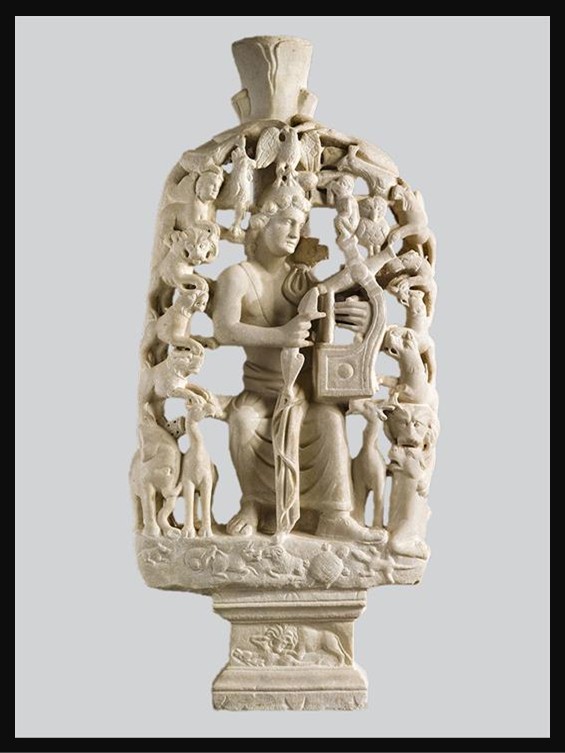
The Rotunda Ambo

Marble Rotunda Ambo from Thessaloniki
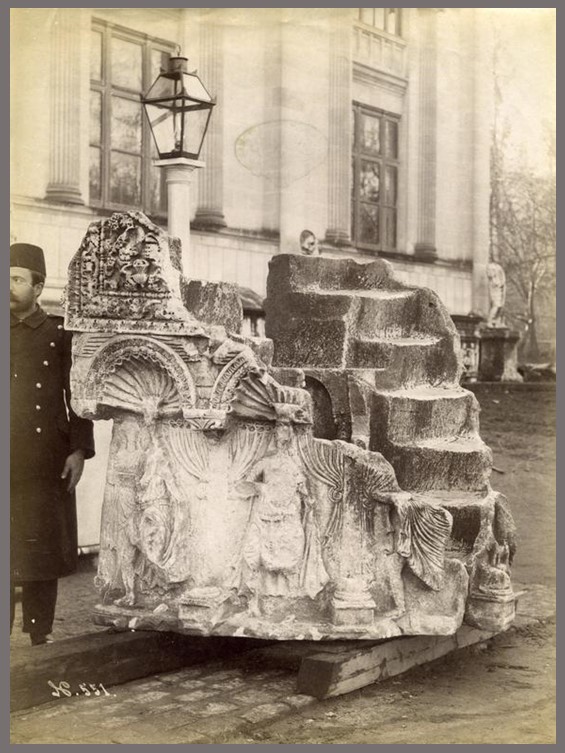
Rotunda Ambo, early 6th century, marble, originally from Thessaloniki, present location: Istanbul Archaeological Museum
Photo Credit: OMNIA http://www.omnia.ie/index.php?navigation_function=3&europeana_query=Arch%C3%A4ologisches+Museum&europeana_cursor=%2A&europeana_prev_cursor=%2A&dpla_nav_start=0&prev_obcnt=-807

“The world is a book and those who do not travel read only one page.” St. Augustine once said and the Rotunda Ambo, where many books were read, in front of many “travellers,” came to my mind.

As a ‘traveller,’ interested in Byzantine Art,  the Rotunda Ambo is a ‘page in my book’ I like to read about again and again. I imagine… a 6th-century pilgrim entering the great Rotunda of Thessaloniki for Vespers… uplifted and overwhelmed by its size and domed inner space, awe-struck by its shimmering mosaics, stirred by the opulence of the service, the ‘logos’ and the chanting, moved by the sculptural decoration on the walls of its impressive Ambo…

The most important monument of Thessaloniki, The Rotunda
The most important (my humble opinion) monument of Thessaloniki, The Rotunda, was constructed in the early 4th century AD, probably as a temple or as a mausoleum. Not long after, the Rotunda was turned into a Christian church, its interior decorated with wall mosaics of unique artistry and beauty. http://galeriuspalace.culture.gr/en/monuments/rotonta/

As a young student reading and ‘travelling’ through the pages of Ralph F. Hoddinott’s book of 1963, Early Byzantine churches in Macedonia and southern Serbia – A Study of the Origins and the Initial Development of East Christian Art, I was intrigued to enrich my ‘world book’ with stories and pictures and memories.  Many more ‘travels’ later, many more written pages, I take out Hoddinott’s book to read and further explore one specific monument of great importance,  the Rotunda Ambo of Thessaloniki!     http://macedonia.kroraina.com/en/rheb/index.htm

Marble Rotunda Ambo from Thessaloniki
Rotunda Ambo, early 6th century, marble, Istanbul Archaeological Museum
Photo copyright: Dick Osseman
https://pbase.com/dosseman/image/58466693

According to the Encyclopedia Britannica, an “Ambo…”, is “a raised stand formerly used for reading the Gospel or the Epistle, first used in early basilicas. Originally, the ambo took the form of a portable lectern. By the 6th century, it had evolved into a stationary church furnishing, which reflected the development and codification of the Christian liturgy…” We know that the position of each Ambo in an Early Christian Church, centrally placed or on the sides of the nave, varied consisting of “…raised platforms on three levels reached by steps and protected by railings. Each level was consecrated to a special part of the service.”     https://www.britannica.com/topic/ambo-church-architecture

The Rotunda Ambo, the only Early Christian sculptural piece to have survived, in fragments and quite battered, still impressive and beautiful, is now exhibited in the Museum of Antiquities in Istanbul while its marble base survives in Thessaloniki.  Dates suggested for the Rotunda Ambo vary, starting as early as the late 4th century. Most scholars, however, believe that the carving of the ornamental decoration of the ambo should date to the early 6th century.

Marble Rotunda Ambo from Thessaloniki

According to Hoddinott… “Below bands of delicately worked acanthus and vine motives, the ambo, in its original state, presented the Adoration of the Magi. Each figure is set individually beneath scalloped niches and between Corinthian columns, the three Magi are shown on one side of the ambo searching for the Christ Child, and on the other bringing Him their gifts. The Virgin, enthroned upon a round backed chair, holds the Child upon her knees. An angel introduces the Magi. Another figure, the upper part of which has been lost, represents a shepherd with his sheep around him and the skin of an animal over his shoulders. Eagles, or other large birds, their wings outstretched, occupy the spandrils between the scalloped niches.”

An interesting article for further reading…, by Nino Zchomelidse  The Epiphany of the logos in the Ambo in the Rotunda (Hagios Georgios) in Thessaloniki

For a PowerPoint on the Rotunda Ambo and a Collection of old photos, please… Click HERE!

Portrait Bust of a Woman with Scroll

Portrait Bust of a Woman with Scroll

Portrait Bust of a Woman with Scroll
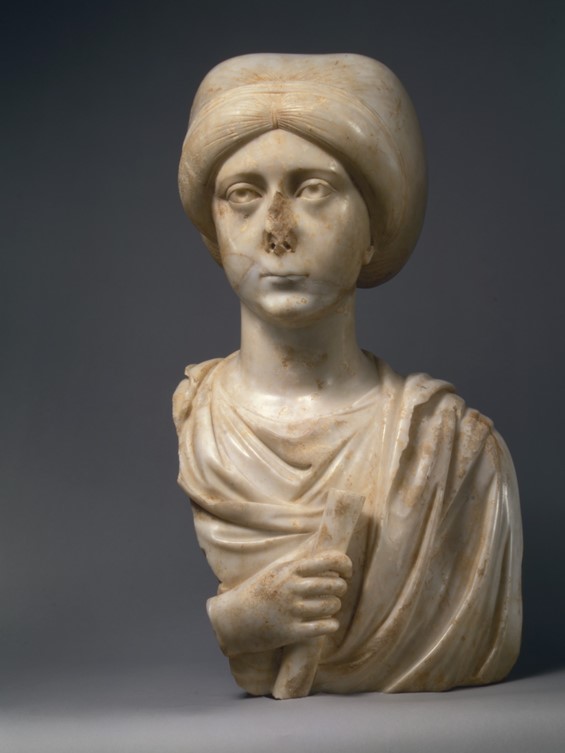
Portrait Bust of a Woman with Scroll, late 4th-early 5th century, Pentelic marble, 53 x 27.5 x 22.2 cm, the MET, NY
https://www.metmuseum.org/art/collection/search/468716

Portrait Bust of a Woman with Scroll is a Constantinopolitan in origin portrait of an aristocratic Lady, I find fascinating!

The MET’s portrait presents a woman of high rank, aristocratic, educated, sensitive and demure. She survived, self-possessed, centuries of Constantinopolitan destruction, fire and plunder, alone, to finally arrive at the MET without her companion… She originally stood next to her husband, both holding a scroll, wishing they were remembered as a sophisticated couple of learning and culture…

My imagination, as you can see, runs wild… I see them standing in front of their double portrait admiring the soft carving and the delicate contours of it. They look appreciative of the highly polished, alabaster like, finishing of the carving and approve the young master sculptor’s ability of fine quality workmanship. They are eager to commission a new set of statuettes presenting  Mythological Hercules, symbolic Hero of their new Christian faith. They are great patrons of the arts. Their estate in Constantinople is famous for its beauty and treasures. Their library is legendary. As they stand admiring their new acquisition, they are expecting two new manuscripts, a scroll of Joshua’s adventures, and another scroll on the Book of Psalms…

Portrait Bust of a Woman with Scroll

According to the Metropolitan Museum of Art “This sensitively carved portrait bust presents a mature woman with a thoughtful expression and piercing gaze; the scroll held in her right hand signals an appreciation for classical learning and marks her as a member of the elite. She wears a mantle, tunic, and head covering, typical dress for an aristocratic woman. Such head coverings did not come into fashion until the fourth century. The bust likely formed part of a commemorative display, perhaps documenting a public donation, or was used in a domestic setting.” https://www.metmuseum.org/art/collection/search/468716

For me, art history teacher, this Portrait, a superb example of the Late Antique – Early Christian work in sculpture, is an opportunity to discuss artistic developments of the period. This is the reason why I prepared the attached PowerPoint on Female Portraits of the Late Antique-Early Christian PeriodHERE!