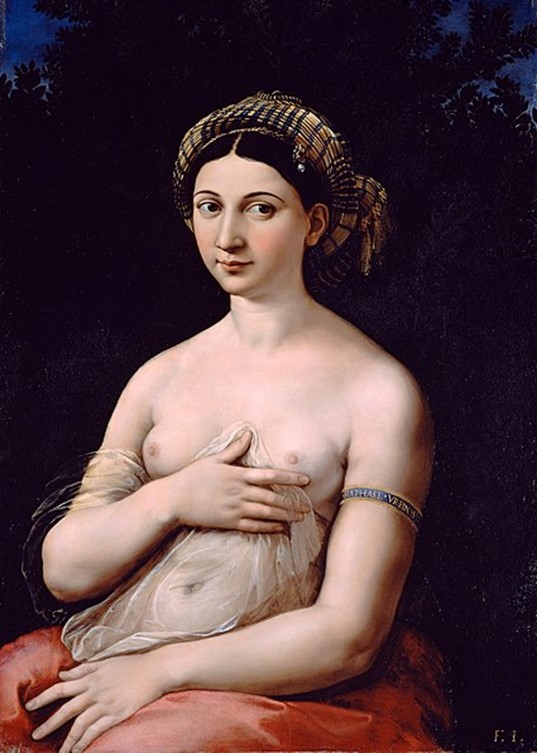
Portrait of a Woman – La Fornarina, about 1519–20, Oil on Panel, 85×60 cm, Galleria Nazionale di Arte Antica (GNAA), Palazzo Barberini, Rome, Italy
https://el.wikipedia.org/wiki/%CE%91%CF%81%CF%87%CE%B5%CE%AF%CE%BF:La_Fornarina,_por_Rafael.jpg

She has left Rome. For only the second time in history, Raphael’s La Fornarina, one of the most tantalising, most debated female portraits, has crossed the Atlantic. She is now at the Metropolitan Museum of Art in New York, as part of the landmark blockbuster Raphael: Sublime Poetry (March 29 – June 28, 2026). It is the perfect moment to return to the questions that have haunted art historians for five centuries. Who is she, really? And what did Raphael want us to think?
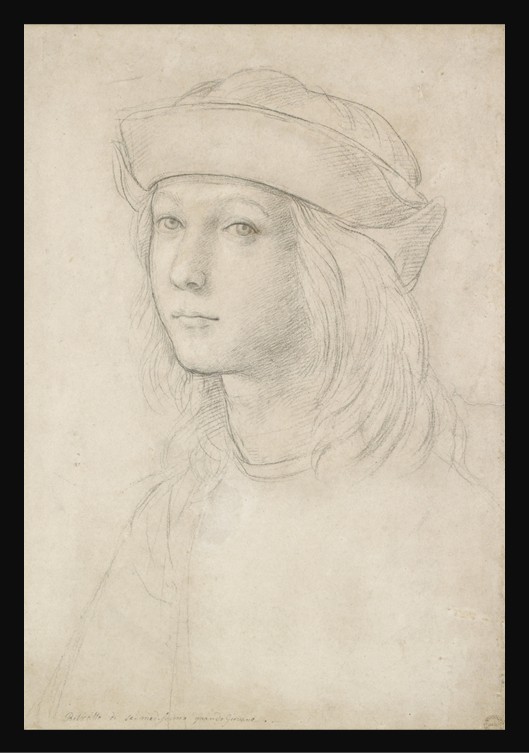
Portrait of a Young Boy (Presumed to Be a Self-Portrait), ca. 1500. Grayish black chalk, highlighted with white (now lost), on laid paper, 38.1×26.1 cm, The Ashmolean Museum, Oxford, UK
https://www.metmuseum.org/perspectives/raphael-a-life-in-nine-objects
The life of Raffaello Sanzio da Urbino was short, his work prolific, and his legacy immortal. This is how the National Gallery in London experts introduced their audience to the blockbuster Credit Suisse Exhibition on Raphael (9 April – 31 July 2022). But now the baton has passed across the ocean. Raphael: Sublime Poetry is the first comprehensive Raphael exhibition ever mounted in the United States, bringing together more than 200 of the artist’s greatest masterpieces, drawings, paintings, tapestries, and decorative arts, from public and private collections around the world. Lenders include the Louvre, the Vatican Museums, the Uffizi, the Prado, and the British Museum. It is, by any measure, a once-in-a-generation event. And at its heart: La Fornarina.
I want to return, first, to Giorgio Vasari… The liberality with which Heaven now and again unites in one person the inexhaustible riches of its treasures and all those graces and rare gifts which are usually shared among many over a long period is seen in Raphael Sanzio of Urbino, who was as excellent as gracious, and endowed with a natural modesty and goodness sometimes seen in those who possess to an unusual degree a humane and gentle nature adorned with affability and good-fellowship, and he always showed himself sweet and pleasant with persons of every degree and in all circumstances…
Ever since I saw La Fornarina at Palazzo Barberini in Rome, where she has lived since 1642, when the Barberini family first purchased her, and where she remains the collection’s most celebrated treasure, I was intrigued by her captivating beauty and her mysteries. Who is the beautiful woman who modestly tries to cover herself?
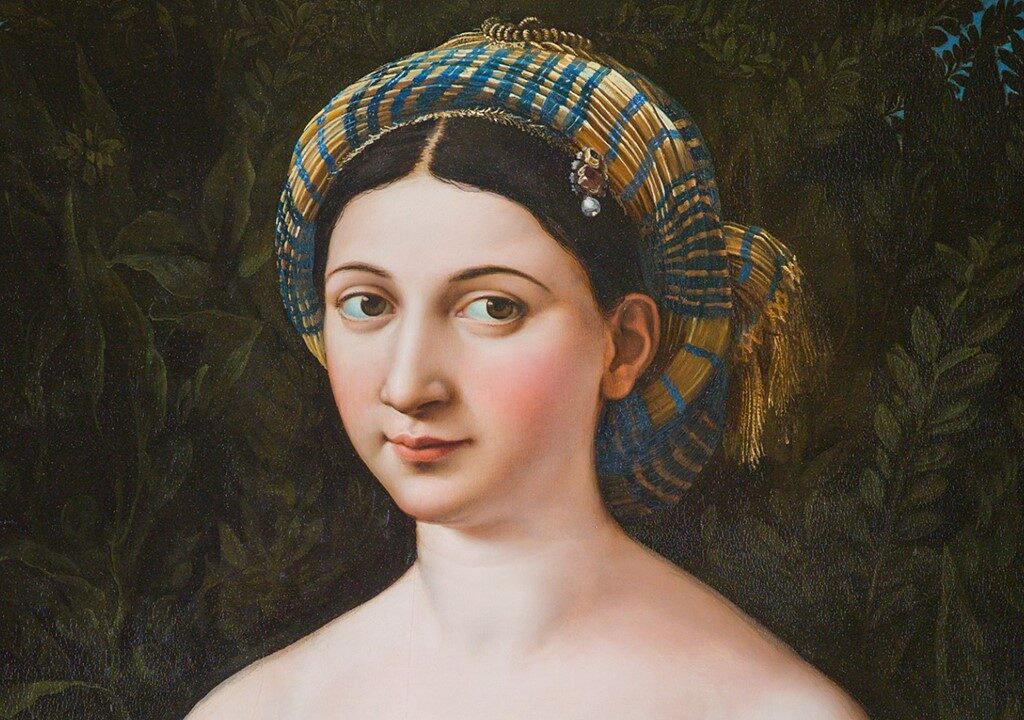
Portrait of a Woman – La Fornarina (detail of the face), about 1519–20, Oil on Panel, 85×60 cm, Galleria Nazionale di Arte Antica (GNAA), Palazzo Barberini, Rome, Italy- Foto di Mauro Cohen https://www.nationalgallery.org.uk/exhibitions/the-credit-suisse-exhibition-raphael/a-brief-introduction-to-raphaels-life-and-times
The Woman, the Lover, the Legend
Giorgio Vasari describes Raphael as a very amorous man, fond of women and always swift to serve them. This description “helps” Raphael enthusiasts identify the woman portrayed in La Fornarina with Margherita Luti, Raphael’s Roman lover, the daughter of a baker in Trastevere. Unfortunately, there is no description or record of any commission for such a painting at the time. There are, however, “hints” that supporters of this interpretation like to consider.
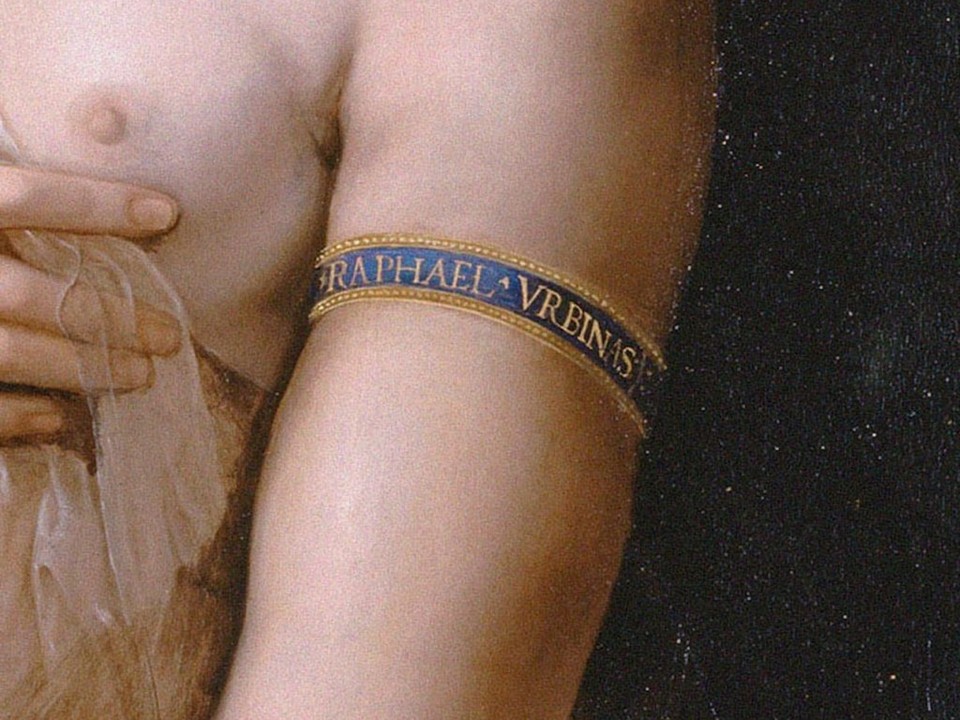
Portrait of a Woman – La Fornarina (detail of the Bracelet with Raphael’s signature), about 1519–20, Oil on Panel, 85×60 cm, Galleria Nazionale di Arte, Palazzo Barberini, Rome, Italy
https://palazzobarberinirome.com/fornarina-palazzo-barberini/
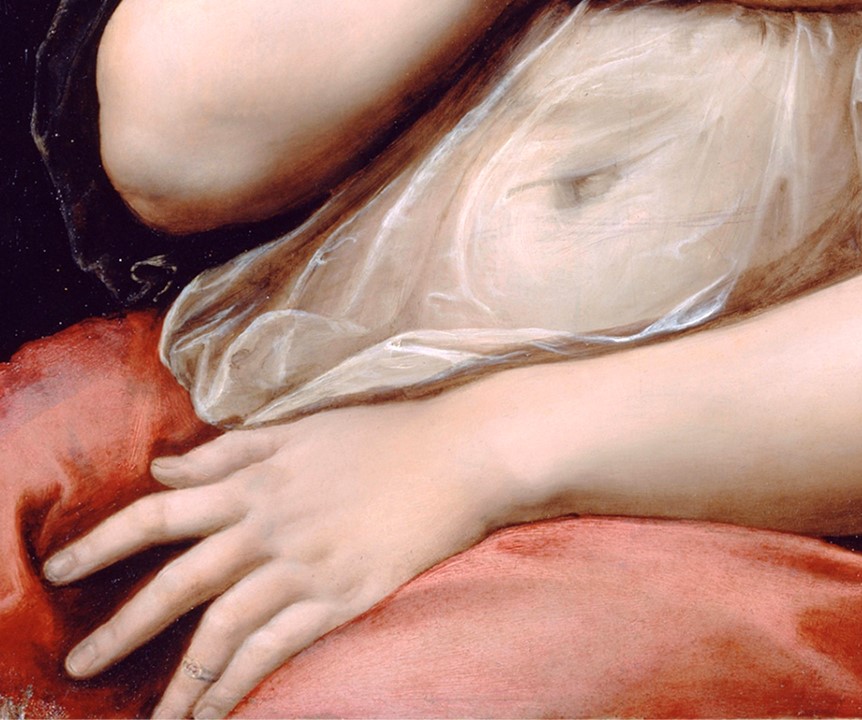
Portrait of a Woman – La Fornarina (detail of the ring she wears), about 1519–20, Oil on Panel, 85×60 cm, Galleria Nazionale di Arte, Palazzo Barberini, Rome, Italy
https://palazzobarberinirome.com/fornarina-palazzo-barberini/
Her right hand rests, gently, over her heart, holding her exposed breast. Her left hand, the hand of the heart, is adorned with a luxurious armband bearing the inscription ‘Raphael Urbinas,’ the painter’s signature. And her fourth finger is adorned with a ruby wedding ring, hidden under flesh coloured paint for almost five centuries, revealed only in 2001 when x-ray analysis was carried out on the painting. According to primary sources, Raphael died a young, unmarried man of 37, engaged at the time to a woman named Maria Bibbiena, the daughter of his patron Bernardo Dovizi. Could La Fornarina truly be the portrait of Margherita? There are hints, but no evidence.
Venus in Disguise
Then come the Palazzo Barberini experts, who offer a different reading entirely. They suggest that Raphael’s female portrait presents no other than the Goddess Venus herself. The position of her hands, one placed on her lap, the other on her breast, follows the classic statuary model of the ‘Venus Pudica’: a gesture of modesty which yet directs the viewer’s gaze to precisely what she seeks to conceal. Other symbols are to be found in the painting’s background: the myrtle bush, laurel, and branches of quince are sacred emblems of Venus, marriage, lust, and fertility. Plausible, but not decisive.
Raphael’s Possession, Forever
Finally, I keep returning to Rona Goffen’s article, Raphael’s Designer Labels: From the Virgin Mary to La Fornarina (Artibus et Historiae, Vol. 24, No. 48, 2003, pp. 132–135). Raphael, Goffen argues, tantalized, and still tantalizes, his audience with clues to the woman’s identity, but withholds her name. Whatever La Fornarina’s real name might have been, whatever personal and amorous considerations might have motivated Raphael, he painted her portrait as the embodiment of the beauty of his art: not universal, but idiosyncratic, individual, unmistakable for any other. Redefining beauty according to his own criteria, asserting his possession of her, whose image he created, Raphael asserted possession of art itself. And so, he signed La Fornarina without a date, because his possession is forever, his achievement immortal.
From Rome to New York, 2026
And so she travels again, five centuries on, still refusing to give her name. The MET’s Raphael: Sublime Poetry places the portrayal of women at the very centre of its vision. The exhibition pays particular attention to Raphael’s depictions of women, from his pioneering use of nude female models to his tender portrayals of the Madonna and Child, and incorporates recent scientific discoveries made using state-of-the-art technology. La Fornarina sits at the intersection of all these themes at once: she is at once sensual and spiritual, a mortal woman and an eternal goddess, signed but unnamed.
This post is a 2026 revisit of an article first published on teachercurator.com on April 26, 2022, inspired by the London National Gallery’s Raphael blockbuster of that year. Four years on, with La Fornarina now travelling to the Metropolitan Museum of Art in New York for Raphael: Sublime Poetry, the original questions feel more alive than ever, and the mystery remains gloriously unsolved. https://www.teachercurator.com/wp-admin/post.php?post=7912&action=edit
PowerPoint Presentation: Want to go deeper into Raphael’s world? Download the free presentation on his female portraits, Perfect for Art lovers, students, and educators.
Continue Exploring on Teacher Curator: Expand your understanding of Renaissance Art and Female Portraits with related articles: La Belle Nani by Paolo Veronese and Bernardo Bembo and La Bencina
Sources and further Reading: To dive deeper into the world of Raphael’s Renaissance Art… artist-biography.info, check La Fornarina’s presentation in the Palazzo Barberini e Gallerie Nazionali site… barberinicorsini.org and the article by Rona Goffen, Raphael’s Designer Labels: From the Virgin Mary to La Fornarina, Artibus et Historiae, Vol. 24, No. 48, 2003: jstor.org