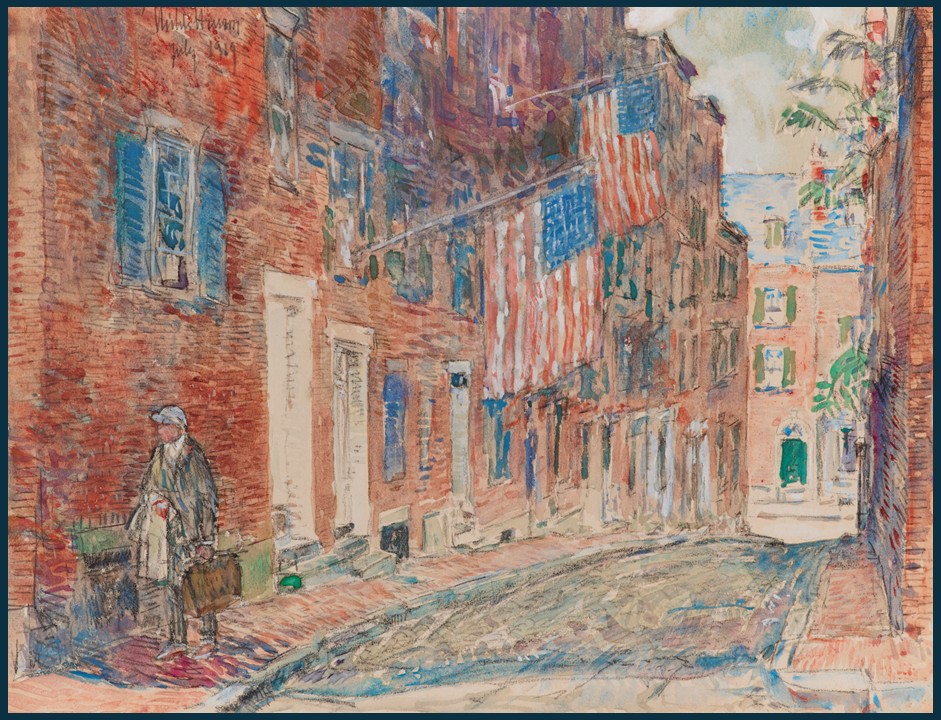
Acorn Street, Boston, July 1919, Mixed media on paper, 21 x 27.9 cm, Private Collection
https://www.christies.com/en/lot/lot-6570341?ldp_breadcrumb=back
‘Childe Hassam’s Acorn Street, Boston, July 1919: A Quiet Fourth of July Reflection’ explores how the American Impressionist transformed a narrow Boston street into a poetic postwar meditation on patriotism and nostalgia. Painted in 1919, the mixed-media work belongs to Hassam’s celebrated flag imagery while adopting a far quieter and more intimate tone than his famous Fifth Avenue scenes.
Painted just after the end of the First World War, the work presents a quiet street in Boston’s historic Beacon Hill neighborhood decorated with American flags. Unlike Hassam’s energetic Fifth Avenue parade scenes, this painting feels calm, reflective, and deeply personal. More than a century later, it still offers a meaningful image for the Fourth of July, one that connects patriotism with memory, history, and everyday American life.
Childe Hassam and American Impressionism
Childe Hassam was one of the leading figures of American Impressionism. Inspired by French Impressionist painters but committed to American subjects, Hassam focused on city streets, parks, coastal scenes, and changing light. His paintings often celebrated modern urban life while preserving a strong sense of atmosphere and emotion.
During World War I, Hassam created his famous ‘Flag Series,’ inspired by patriotic displays across New York City. These paintings showed avenues covered with American and Allied banners, expressing both national pride and wartime unity. Today, those works remain among the most recognizable images in American art.
Yet Acorn Street, Boston, July 1919 reveals a different side of Hassam’s patriotic vision. Instead of crowds and movement, he presents silence and stillness. The flags are present, but they do not dominate the scene. They appear naturally within the historic architecture of Beacon Hill, becoming part of the rhythm of the street itself.
Why Acorn Street Meant So Much to Hassam
Acorn Street was an important subject for Hassam because Boston played a major role in his artistic development. Before achieving national fame, the artist lived and worked in Boston during the early years of his career. The city’s historic neighborhoods, brick buildings, and narrow streets remained central to his visual imagination throughout his life.
Beacon Hill, with its cobblestone streets and Federal-style houses, represented a connection to early American history. Even today, Acorn Street is considered one of the most beautiful and historic streets in the United States. In Hassam’s painting, the neighborhood becomes more than a picturesque location. It becomes a symbol of continuity and national memory after the devastation of war.
Painted in 1919, the work reflects a moment when Americans were trying to recover from years of global conflict. Hassam’s quiet Boston street suggests stability, endurance, and renewal. The American flags hanging from the buildings feel less like political symbols and more like expressions of shared identity and hope.
The Artistic Style of Acorn Street, Boston, July 1919
The painting demonstrates Hassam’s mature Impressionist technique. Executed in mixed media on paper, the work combines loose brushwork, transparent layers of color, and textured surfaces. Rather than carefully outlining every architectural detail, Hassam allows light and atmosphere to shape the composition.
Sunlight flickers across the brick façades, windows, and cobblestones. Shadows dissolve into soft patches of color, creating a sense of movement within an otherwise quiet scene. This treatment of light gives the painting emotional warmth and immediacy.
The work is also surprisingly small, measuring only 21 by 27.9 centimeters. Its intimate scale encourages close viewing and quiet contemplation. Unlike monumental patriotic paintings designed for public spaces, Acorn Street, Boston, July 1919 feels personal and reflective, almost like a visual memory.
A Fourth of July Painting for Today
As Americans celebrate Independence Day in 2026, Hassam’s painting still feels remarkably relevant. It presents patriotism not as spectacle, but as attachment to place, history, and community. The flags do not overwhelm the composition. Instead, they exist alongside old brick houses, summer light, and the peaceful character of an American neighborhood.
That quiet patriotism may be exactly what makes the painting so enduring today. Hassam reminds viewers that national identity is often found in ordinary spaces: historic streets, familiar cities, and shared cultural memories. More than one hundred years after it was painted, Acorn Street, Boston, July 1919 continues to capture a timeless vision of America — reflective, resilient, and deeply connected to its past.
Discover a PowerPoint Presentation exploring Childe Hassam’s oeuvre and the development of American Impressionism in the early twentieth century.
Continue Exploring on Teacher Curator: Expand your understanding of Childe Hassam’s celebrated “Flag Series” with the related article The Fourth of July, 1916, and explore another Impressionist masterpiece in Poppies on the Isles of Shoals.
Sources and further Reading: To explore Childe Hassam’s Acorn Street, Boston, July 1919 and the wider ‘Flag Series,’ see Christie’s catalogue entry https://www.christies.com/en/lot/lot-6570341?ldp_breadcrumb=back and an overview of Hassam’s patriotic flag paintings at Red Tree Times https://redtreetimes.com/2014/07/03/hassams-flags/