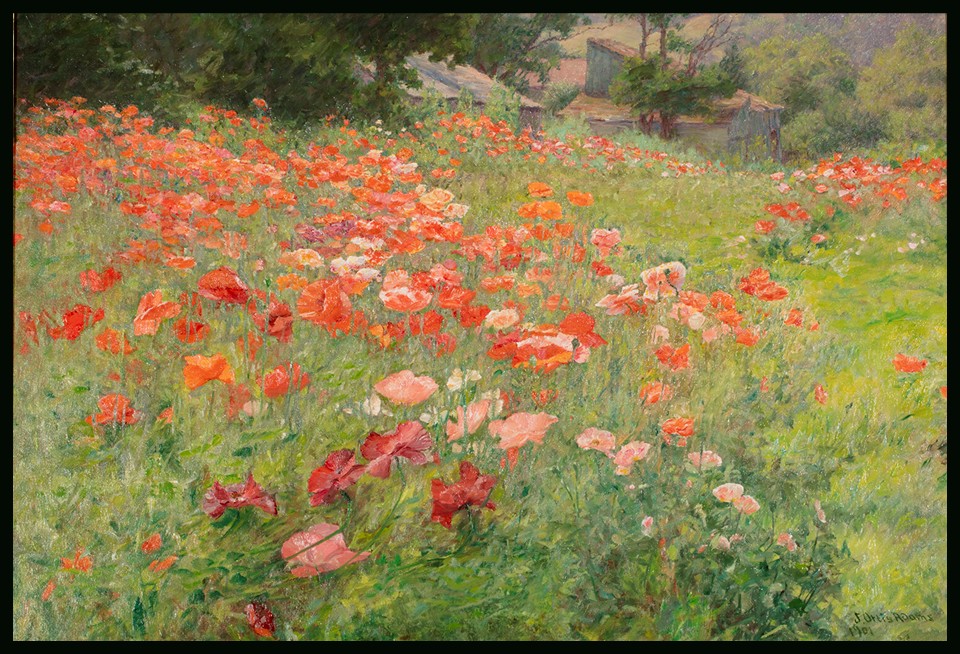
In Poppyland

John Ottis Adams, American Artist, 1851-1927
In Poppyland, 1901, Oil on Canvas, 55.9 x 81.3 cm, David Owsley Museum of Art, Ball State University Art Museum, IN, USA
https://www.bsu.edu/web/museumofart/exhibitions/past#accordion_impressionsoflove

John Ottis Adams’s In Poppyland, housed in the David Owsley Museum of Art captures the lush, dreamlike essence of a summer landscape steeped in both beauty and symbolism. With sweeping fields awash in crimson poppies, Adams evokes the mood of late summer, specifically August, the month associated with the poppy flower, known for its ties to both sleep and remembrance. The visual poetry of the scene finds a perfect echo in Antonio Bertolucci’s evocative verse… This is a year of poppies: our land / was brimming with them as May burned / into June and I returned— / a sweet dark wine that made me drunk. / From clouds of mulberry to grains to grasses / ripeness was all, in the fitting / heat, in the slow drowsiness spreading / through the universe of green… Like the poem, Adams’s painting invites us into a world suspended between wakefulness and reverie, where nature overflows with color, warmth, and memory. https://www.poetryfoundation.org/poetrymagazine/poems/54223/poppies

A prominent American Impressionist painter and key figure in the Hoosier Group, John Ottis Adams (1851–1927) was part of a collective of Indiana-based artists who helped shape Midwestern landscape painting in the late 19th and early 20th centuries. Born in Indiana, Adams studied art in London at the South Kensington School and later in Munich at the Royal Academy of Fine Arts, where he developed a solid foundation in academic realism. His time in Munich was formative, exposing him to rigorous training and a circle of fellow American expatriate artists. Upon returning to the United States, he settled in Indiana, where he dedicated much of his career to capturing the natural beauty of his home state. Adams was not only a painter but also a passionate educator, co-founding the Herron School of Art in Indianapolis and influencing generations of young American artists. He was married to Winifred Brady Adams, an accomplished still-life and portrait painter, and their shared artistic vision helped foster a creative environment that extended from their personal lives to the broader Indiana art community.

Aesthetically, Adams embraced a style that blended academic technique with Impressionist sensibilities, using light and color to evoke mood and atmosphere rather than strict realism. His landscapes often feature quiet riverbanks, pastoral meadows, and changing skies, rendered with loose, expressive brushwork and a harmonious palette that reflect his deep appreciation for nature’s subtleties. Adams’s compositions favor balance and serenity, drawing the viewer into meditative encounters with the natural world. In paintings like In Poppyland, he captured not just the visual essence of a place but its emotional resonance—offering scenes that feel both immediate and timeless, rooted in observation but elevated by poetic interpretation.

The painting In Poppyland is a luminous celebration of the American landscape, blending Impressionist technique with a deep, personal connection to nature. It presents a vivid field of blooming poppies under a bright summer sky, rendered with loose, expressive brushwork and a vibrant palette of reds, greens, and soft blues. Adams captures not only the visual richness of the scene but also its atmosphere, warm, drowsy, and gently swaying with life, inviting viewers into a moment of seasonal abundance and reverie. Created during a period when Adams spent time painting in rural Indiana and abroad, In Poppyland reflects both his European training and his commitment to elevating the native Midwest as a worthy subject of high art. The composition’s gentle rhythm and immersive color evoke a sense of timeless beauty, where nature’s quiet grandeur speaks through light, texture, and mood.

Poppies have always held a special kind of magic, bright, delicate, and full of meaning. In ancient Greek and Roman myths, they symbolized sleep, dreams, and even remembrance, and their vivid presence has continued to inspire artists through the ages. Adams’s In Poppyland, brings that symbolism to life in a way that feels both timeless and deeply personal. The painting draws us into a peaceful summer moment, filled with warmth, color, and quiet reflection. It reminds us how nature can speak to the heart, and how something as simple as a field of flowers can carry stories, memories, and beauty that stay with us long after we’ve looked away.

For a PowerPoint Presentation on John Ottis Adams’s oeuvre, please… Check HERE!

Bibliography: https://www.bsu.edu/web/museumofart/exhibitions/past#accordion_summer2019 and https://artsandculture.google.com/entity/john-ottis-adams/m0276lmv?hl=en
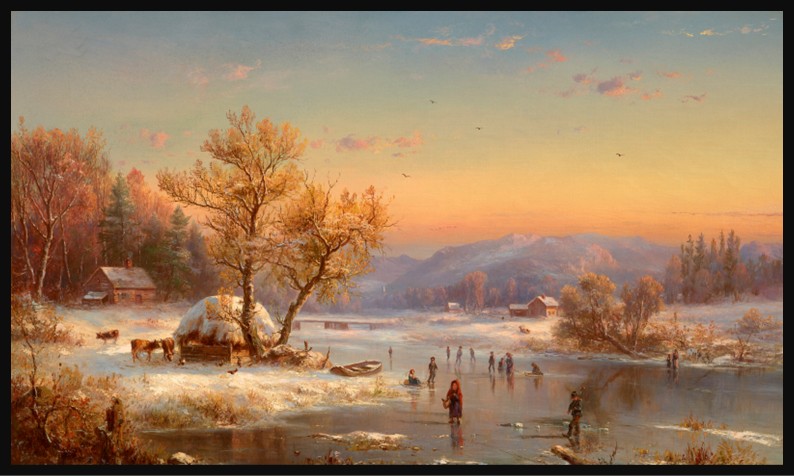
Jasper Francis Cropsey's of a Winter Evening in the Country.

Cropsey’s Winter Evening in the Country

Jasper Francis Cropsey's of a Winter Evening in the Country.
Jasper Francis Cropsey, American Artist, 1823-1900
Winter Evening in the Country, 1865, Oil on Canvas, 61 x 102.2 cm, Private Collection https://www.christies.com/en/lot/lot-6519595?ldp_breadcrumb=back#lot-essay

Jasper Francis Cropsey’s Winter Evening in the Country captures the serene stillness and frosty charm of a rural landscape wrapped in winter’s embrace, evoking the timeless imagery of Christina Rossetti’s poignant verse… In the bleak midwinter, frosty wind made moan, / Earth stood hard as iron, water like a stone; / Snow had fallen, snow on snow, snow on snow, / In the bleak midwinter, long ago… Cropsey, a master of the Hudson River School, imbues the scene with a poetic tranquility that mirrors Rossetti’s reflection on the stark beauty and quiet solemnity of winter. The painting’s soft, fading light against the glistening snow and frozen streams resonates with the deep reverence for nature and its cyclical rhythms, so beloved by 19th-century American Romanticism. Viewed through this lens, Winter Evening in the Country becomes not just a landscape, but a visual hymn to the season’s austere grace, much like Rossetti’s enduring words. https://www.poetryfoundation.org/poems/53216/in-the-bleak-midwinter

Jasper Francis Cropsey (1823–1900) was a celebrated American painter and architect, best known for his vivid and romantic depictions of the American landscape, particularly during autumn. Born in Staten Island, New York, Cropsey initially trained as an architect but soon turned to painting, inspired by the natural beauty of his surroundings. He became associated with the Hudson River School, a group of artists who celebrated the grandeur of America’s untamed wilderness. Cropsey’s artistic career flourished in both the United States and Europe, with his work frequently exhibited at prestigious institutions like the Royal Academy in London. Deeply rooted in a transcendental appreciation of nature, his art also carried patriotic undertones, reflecting an idealized vision of America’s expanding frontier during the 19th century.

The aesthetics of Cropsey’s oeuvre are characterized by a meticulous attention to detail, luminous colour palettes, and a romantic interplay of light and atmosphere. He had a particular affinity for autumnal landscapes, often portraying scenes with radiant foliage, expansive skies, and tranquil waterways, which became hallmarks of his style. Cropsey’s ability to balance naturalistic detail with an almost spiritual grandeur imbued his works with a sense of awe and serenity. His paintings often celebrate not only the beauty of nature but also its capacity to evoke contemplation and reverence. By blending realism with idealism, Cropsey’s art encapsulates the optimism and nationalism of the Hudson River School while inviting viewers into a profound communion with the natural world.

Jasper Francis Cropsey’s Winter Evening in the Country is a serene and evocative portrayal of a rural landscape enveloped in the stillness of winter. The painting captures a quiet countryside blanketed in snow, illuminated by the soft, fading light of dusk. Cropsey’s meticulous attention to detail is evident in the delicate rendering of the leafless trees, the snow-laden rooftops, and the icy stream that meanders through the composition. The warm glow emanating from the windows of the farmhouse contrasts gently with the cool blues and grays of the surrounding snow, creating a harmonious balance between warmth and chill. This idyllic scene reflects Cropsey’s mastery of light and atmosphere, drawing the viewer into a tranquil moment of reflection on the beauty of nature.

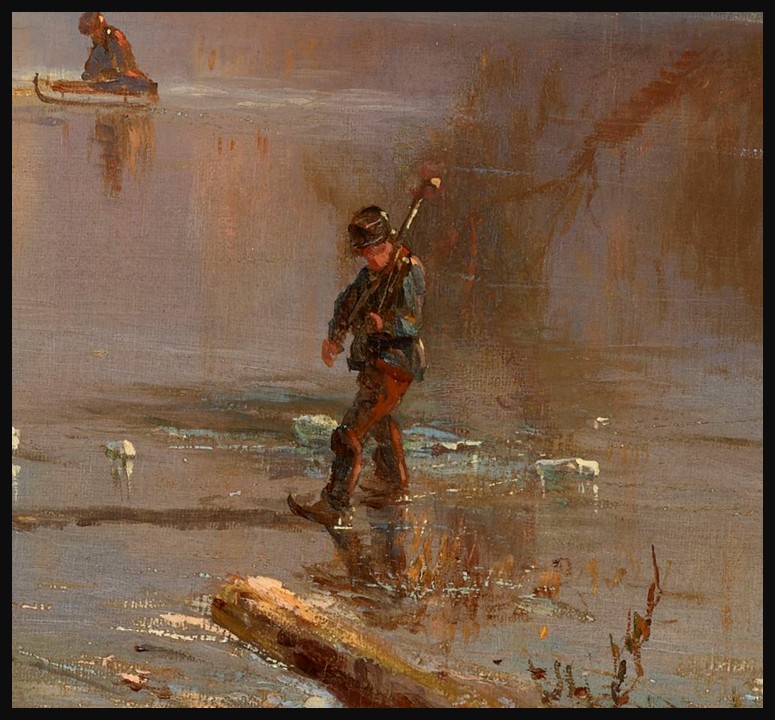
Jasper Francis Cropsey's of a Winter Evening in the Country (detail).
Jasper Francis Cropsey, American Artist, 1823-1900
Winter Evening in the Country (detail), 1865, Oil on Canvas, 61 x 102.2 cm, Private Collection https://www.christies.com/en/lot/lot-6519595?ldp_breadcrumb=back#lot-essay

Created during the aftermath of the American Civil War, Winter Evening in the Country subtly reflects the cultural and emotional climate of the time. The painting’s peaceful rural setting can be seen as a nostalgic yearning for unity and stability in the face of the nation’s recent turmoil. Amid the tranquil scene, a boy dressed as a Union soldier and carrying a rifle, is a poignant reminder of the war’s enduring presence in the collective memory of Americans. His inclusion in the idyllic landscape juxtaposes the serenity of the countryside with the lingering echoes of conflict. The untouched snow and the quiet countryside symbolize renewal and healing, suggesting a return to simplicity and the enduring strength of the American spirit. Cropsey’s choice to focus on the enduring beauty of the land, while subtly acknowledging the sacrifices of those who fought, underscores the Hudson River School’s broader mission to celebrate the natural world as a source of solace and hope. In this way, the painting becomes more than a pastoral winter scene; it is a quiet testament to resilience and optimism in the wake of national strife.

For a PowerPoint Presentation on Jasper Francis Cropsey’s Oeuvre, please… Check HERE!

Bibliography:https://www.nga.gov/collection/artist-info.1191.html

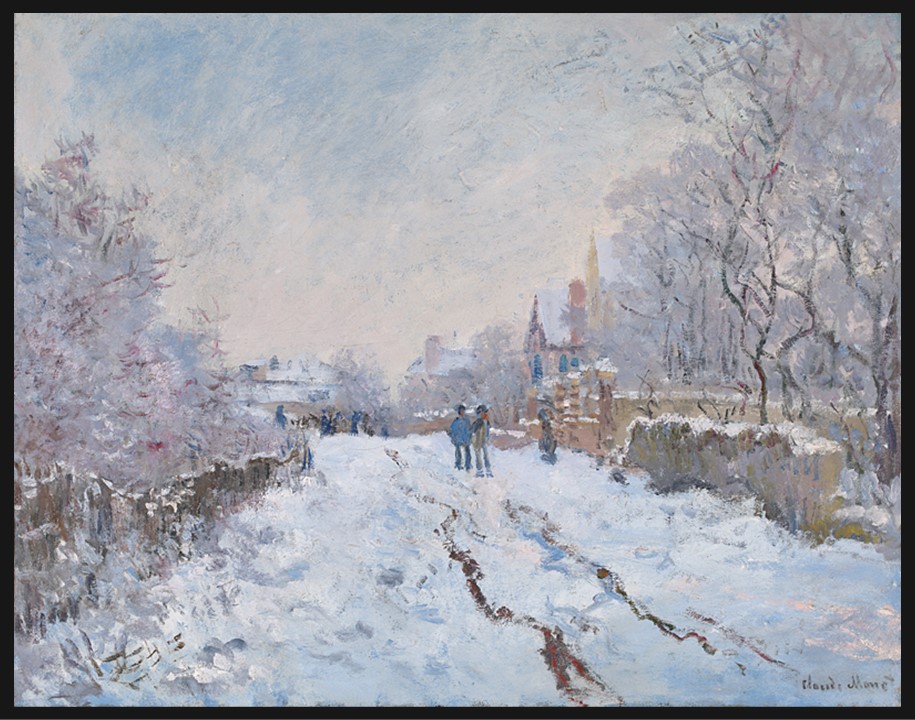
Claude Monet's painting of a Snow Scene at Argenteuil.

Snow Scene at Argenteuil

Claude Monet's painting of a Snow Scene at Argenteuil.
Claude Monet, French Artist, 1840 – 1926
Snow Scene at Argenteuil, 1875, Oil on Canvas, 71.1 × 91.4 cm, the National Gallery, London, UK https://www.nationalgallery.org.uk/paintings/claude-monet-snow-scene-at-argenteuil

Thomas Hardy’s poem Snow in the Suburbs and Claude Monet’s painting Snow Scene at Argenteuil share a common theme of how snow transforms and softens everyday environments, imbuing them with a quiet beauty. Both works capture the stillness that snow brings, turning ordinary settings into places of reflection… Every branch big with it, / Bent every twig with it; / Every fork like a white web-foot; / Every street and pavement mute: / Some flakes have lost their way, and grope back upward when / Meeting those meandering down they turn and descend again. / The palings are glued together like a wall, / And there is no waft of wind with the fleecy fall.    /    A sparrow enters the tree, / Whereon immediately / A snow-lump thrice his own slight size / Descends on him and showers his head and eye / And overturns him, And near inurns him, / And lights on a nether twig, when its brush / Starts off a volley of other lodging lumps with a rush.    /    The steps are a blanched slope, / Up which, with feeble hope, / A black cat comes, wide-eyed and thin; / And we take him in. https://poets.org/poem/snow-suburbs

In Hardy’s poem, snow gently covers the suburb, altering the familiar landscape and quieting the usual hustle of the city. He writes about how snow touches everything from roofs to cats, creating a peaceful, almost tender transformation. Similarly, Monet’s painting depicts the serene beauty of snow-covered streets and houses in Argenteuil, where soft light and gentle textures evoke a calm and meditative atmosphere. The quiet streets and the snow-laden environment appear untouched, giving a sense of tranquility. Both works express the delicate, transformative effect of snow. Hardy’s use of precise, quiet imagery mirrors Monet’s soft brushstrokes, each turning a mundane urban scene into something ethereal and profound, highlighting the interplay between nature and human environments during winter.

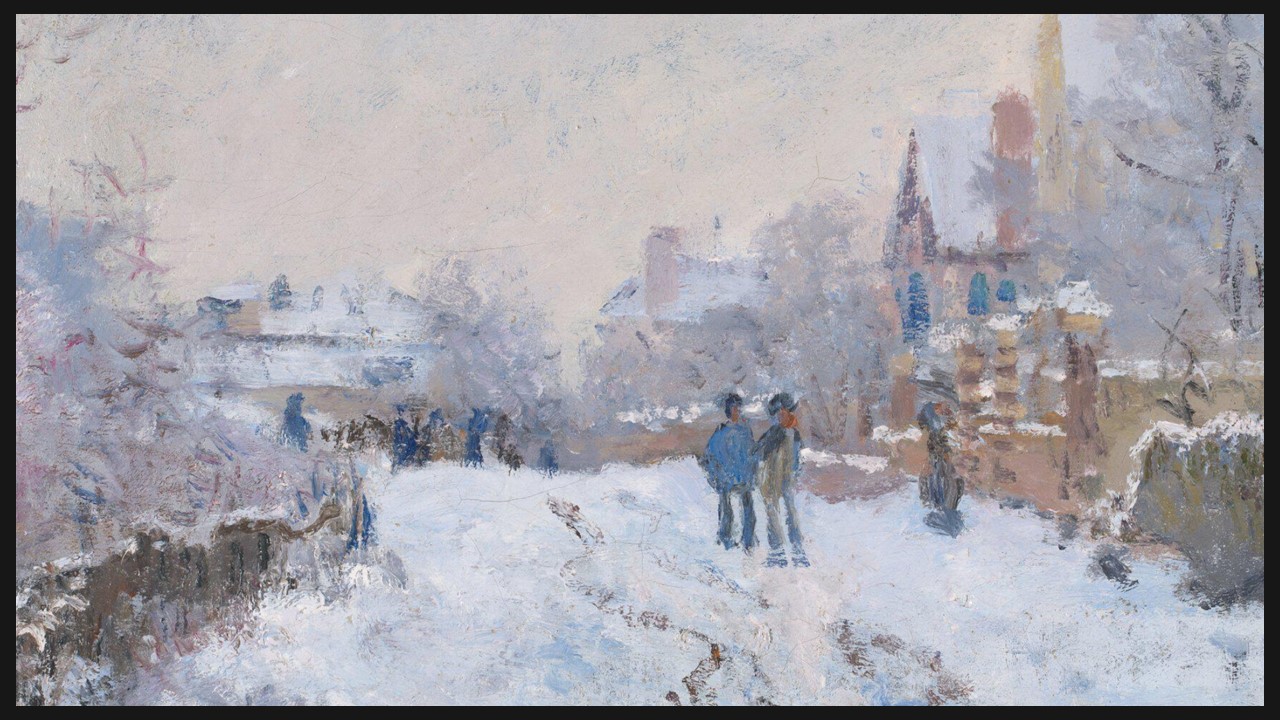
Claude Monet's painting of a Snow Scene at Argenteuil (detail).
Claude Monet, French Artist, 1840 – 1926
Snow Scene at Argenteuil (detail), 1875, Oil on Canvas, 71.1 × 91.4 cm, the National Gallery, London, UK https://www.nationalgallery.org.uk/paintings/claude-monet-snow-scene-at-argenteuil

Claude Monet lived in Argenteuil, a suburban town near Paris, from 1871 to 1878, a pivotal period in his artistic career. During these years, he fully embraced the Impressionist style, focusing on capturing the effects of light, colour, and atmosphere in outdoor settings. Argenteuil’s scenic landscapes, including the Seine River and its gardens, provided Monet with abundant inspiration. It was here that he painted some of his most famous works, including Snow Scene at Argenteuil and The Railway Bridge at Argenteuil, often depicting the natural beauty of the town with loose brushstrokes and vibrant colours. His home also became a gathering place for fellow Impressionists like Renoir and Manet, fostering the collaborative spirit that helped define the movement. Monet’s time in Argenteuil solidified his position as a leading figure in the development of Impressionism.

Monet painted several snow scenes during the winter of 1874-75 while living in Argenteuil, capturing the tranquil, muted beauty of the snow-covered suburban landscape. One of these canvases, showing the Boulevard Saint-Denis, depicts a quiet, snow-blanketed street near his home, with figures slowly making their way through the thick snow. The scene captures the foggy atmosphere of winter, where the distant buildings seem to fade into the mist, and the snowy road, marked by cart tracks, leads the viewer’s eye toward the horizon. Despite the serene and picturesque view, Monet subtly conveys the modernity of Argenteuil, a developing suburb of Paris, with newly built houses lining the boulevard, blending the timeless beauty of nature with the progression of urban life. These snow scenes reflect Monet’s mastery in depicting light and atmosphere, transforming a modern setting into a peaceful, almost dreamlike winter landscape.

For a Student Activity inspired by Claude Monet’s painting Snow Scene at Argenteuil, please… Check HERE!