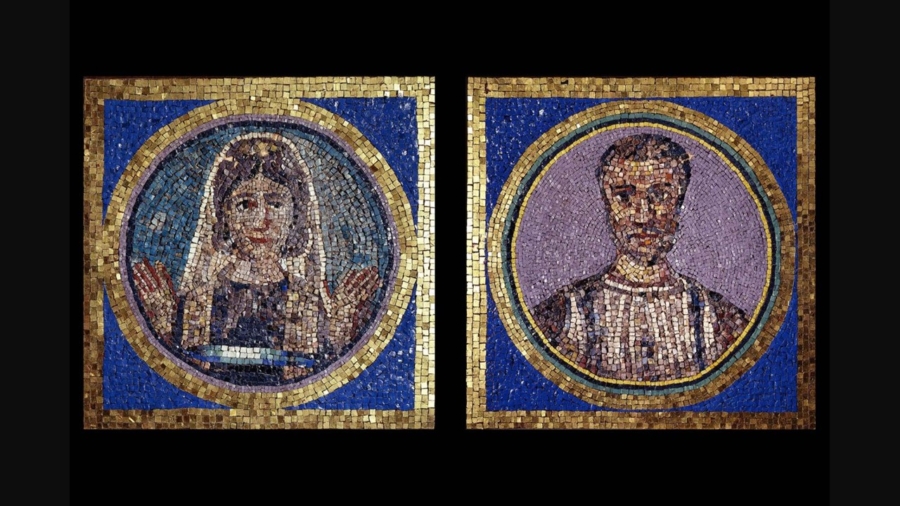
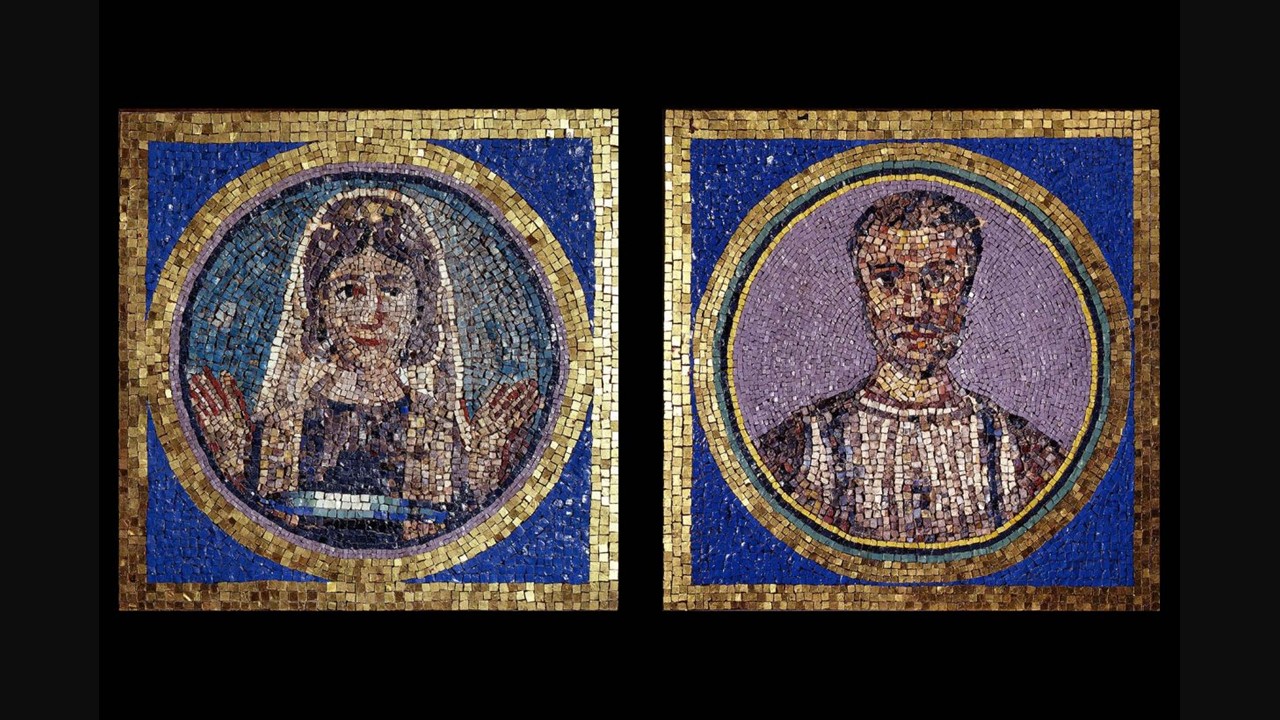
Left: Clypeus with portrait bust of Maria Simplicia Rustica, around 350 AD, glass paste mosaic, 64 x 64 cm, Musei Vaticani, Italy
https://catalogo.museivaticani.va/index.php/Detail/objects/MV.31584.0.0?lang=en_US
Right: Clypeus with portrait bust of Flavius Iulius Iulianus, about 350 AD, glass paste mosaic, 64 x 64 cm, Musei Vaticani, Italy
https://catalogo.museivaticani.va/index.php/Detail/objects/MV.31585.0.0?lang=en_US
What can two small mosaic portraits, known as Ciriaca’s Mosaics tell us about love, loss and remembrance nearly 1,700 years later? Quite a lot. The Wall Mosaics with the Portrait Busts of Maria Simplicia Rustica and Flavius Iulius Iulianus, now in the Museo Pio Cristiano of the Vatican Museums, offer an unusually intimate glimpse into the lives of two people in Late Antique Rome.
The mosaics once decorated the wall of a cubiculum, a burial chamber in the cemetery of Ciriaca in Rome. Unlike many ancient portraits, these two figures can be named. One is Maria Simplicia Rustica, the woman who had died. The other is her husband, Flavius Iulius Iulianus, who was still alive when the mosaics were created.
Two portraits, one story
At first glance, the two circular mosaics, known as clypei, look remarkably similar. Each contains a frontal portrait bust surrounded by a circular frame. Yet a small difference between them tells us something important.
Maria Simplicia Rustica raises her arms in the orans, or praying, position. This was a familiar gesture in early Christian art and identifies her as the deceased figure. Her portrait therefore becomes more than a likeness: she is presented as a Christian woman in prayer. Her husband, Flavius Iulius Iulianus, is shown without the orans gesture. He was still living when the decoration was made.
This simple visual distinction transforms the pair. We are looking at a wife remembered after death and a husband who was still there to remember her.
A portrait of remembrance
An inscription associated with the tomb recorded that Flavius Iulius Iulianus had dedicated the burial place to his deceased wife. Although the original inscription has not survived, it was recorded in the past and helps us understand the purpose of the portraits. The mosaics were therefore not simply decorative. They formed part of a carefully created memorial space.
There is something moving about this. The faces are formal and frontal, as we might expect from Late Antique portraiture, but behind them lies a very personal story. A husband commissioned a place where his wife could be remembered, and her image remained beside his own. The mosaics remind us that ancient funerary art was not only concerned with religious beliefs or social status. It could also express memory, affection and the desire to keep someone present.
Looking closely at the mosaics
The use of mosaic is significant. Tiny pieces of coloured stone and glass were carefully arranged to create the portraits and their surrounding decoration. The technique allowed artists to model faces, hair and clothing through subtle changes in colour and tone.
Yet these are not naturalistic portraits in the modern sense. Their frontal poses and idealised appearance belong to the visual language of Late Antiquity. The aim was not necessarily to reproduce every detail of an individual face. Instead, the portraits combine identity with symbolism. Maria’s praying gesture is particularly important. It connects her individual portrait with one of the most recognisable images of early Christian art: the believer standing in prayer.
From a Roman cemetery to the Vatican Museums
The mosaics were discovered in the 17th century during work connected with the cemetery of Ciriaca. Their removal from the burial chamber caused some damage, and both mosaics were subsequently restored and completed in places.
In 1918, Pope Benedict XV acquired them for the Museo Pio Cristiano, where they are preserved today. Their journey from a Roman burial chamber to a museum is part of their story. Removed from the quiet space for which they were created, the mosaics now invite a very different kind of encounter. We look at them as works of art and historical evidence, while remembering that they were originally created for people who knew Maria and Flavius personally.
Why these two portraits still matter
It is easy to think of Late Antique art as distant, formal or unfamiliar. These two mosaics offer another way of seeing it. Look at Maria Simplicia Rustica and Flavius Iulius Iulianus together and the centuries seem to become a little thinner. We know their names. We know that they were husband and wife. We know that one had died and the other had not. And we can still see the memorial they created.
Perhaps that is the quiet power of these mosaics. They were made to preserve a memory, and almost seventeen centuries later, they are still doing exactly that.
A Thought to Take Away
When we look at an ancient portrait, we often ask: Who was this person? With the mosaics of Ciriaca, we can go a little further and ask: Who remembered them, and why did their memory matter?
Classroom Activity: Bring Byzantine Mosaic Portraits to life in your classroom with this hands-on student activity inspired by the Mosaics of Cyriaca in the Musei Vaticani. Explore the Student Activity →
Continue Exploring on Teacher Curator: Expand your understanding of Byzantine Portraiture in Art with related articles: The Art of Portraiture during the Byzantine Period and Parallel Stories of Byzantine Imperial Portraits.
Sources and further Reading: To dive deeper into the world of Byzantine Portraiture, visit the Museo Pio Cristiano of the Vatican Museums: https://catalogo.museivaticani.va/index.php/Detail/objects/MV.31584.0.0?lang=en_US and https://catalogo.museivaticani.va/index.php/Detail/objects/MV.31585.0.0?lang=en_US