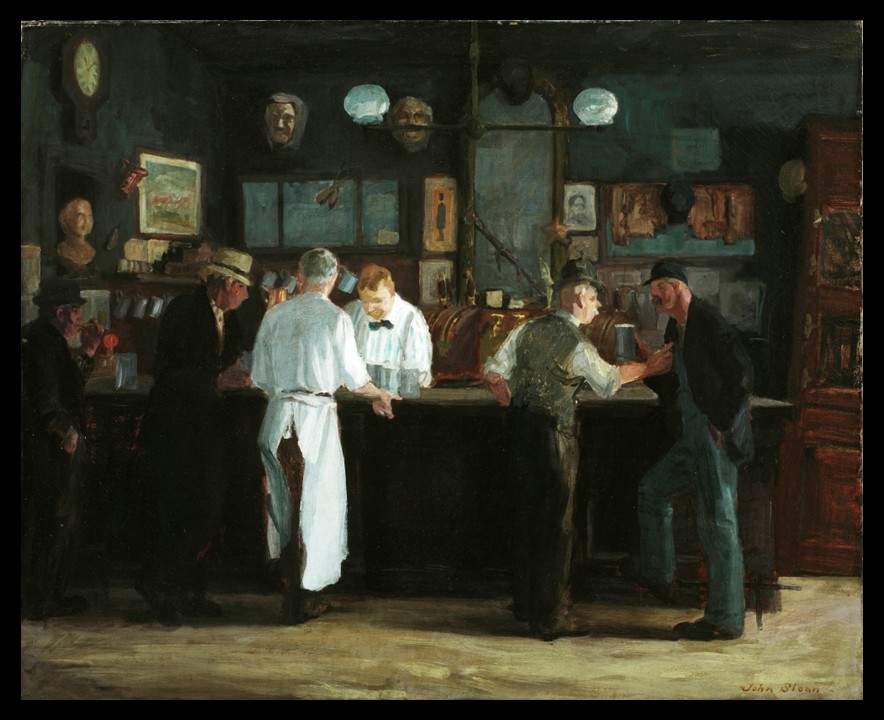
McSorley’s Bar, 1912, Oil on Canvas, 66 × 81.3 cm, Detroit Institute of Arts
https://dia.org/collection/mcsorleys-bar/61604
John Sloan’s McSorley’s Bar takes us into one of the most recognisable drinking establishments of early twentieth-century New York. Painted in 1912, the work presents the interior of McSorley’s Old Ale House on East 7th Street, where men gather around tables, drink, talk, smoke, and escape, for a while, the noise and pressures of the modern city. Rather than turning this everyday scene into something picturesque, Sloan gives us an intimate, lively, and distinctly urban view of New York life.
Sloan was one of the artists associated with the Ashcan School, a loosely connected group of American painters who became known for their interest in contemporary urban experience. Artists such as Robert Henri, George Bellows, William Glackens, and Everett Shinn rejected the idea that art needed to focus on grand historical subjects, elegant society, or idealised landscapes. They found compelling subjects in the streets, theatres, tenements, restaurants, sporting events, and neighbourhoods of New York.
Sloan’s New York is therefore a city of ordinary people and ordinary activities. In McSorley’s Bar, there is no heroic protagonist and no carefully arranged narrative. The men are absorbed in conversation and drink. Some look toward one another; others appear lost in their own thoughts. The scene feels spontaneous, almost as though Sloan has entered the bar and captured a moment without interrupting it.
Inside McSorley’s
McSorley’s Old Ale House had opened in 1854 and had already become an established New York institution by the time Sloan painted it. Its dark wooden interior, long history, and predominantly working-class clientele made it an ideal subject for an artist interested in the realities of city life.
Sloan was particularly familiar with New York’s neighbourhoods. He lived in Greenwich Village and frequently walked through the city, observing people and recording what he saw. His paintings often transform apparently insignificant moments into revealing images of modern urban culture.
In McSorley’s Bar, the composition places us surprisingly close to the customers. Tables and chairs crowd the foreground, while figures continue into the darker areas of the room. The limited space creates a feeling of intimacy but also of confinement. We are not looking at the bar from a safe distance; we seem to be sitting among the customers.
Sloan’s brushwork contributes to this impression. Forms are not described with meticulous precision. Instead, figures, furniture, walls, and objects emerge through energetic strokes and areas of colour. The subdued browns, ochres, greens, and blacks reinforce the atmosphere of the old interior, while small areas of light draw attention to faces, hands, shirts, and objects on the tables.
A Portrait of Masculine Social Life
One of the most striking aspects of the painting is its absence of women. This was not simply Sloan’s artistic choice. McSorley’s was historically a male-only establishment, and women were not permitted as customers until 1970. The painting consequently records a particular form of masculine social life. The bar is a place where men meet outside the domestic sphere: they drink together, exchange news, talk, argue, laugh, and spend time in one another’s company.
Sloan does not sentimentalise his subjects. Neither does he mock them. His interest lies in observing how people inhabit the city and create their own social spaces within it. The bar becomes a small social world, with its own rituals and rhythms.
The Modern City Seen from Within
By 1912, New York was changing rapidly. Immigration, industrialisation, new forms of transportation, department stores, theatres, skyscrapers, and expanding neighbourhoods were transforming the city. Artists associated with the Ashcan School responded to this changing environment by turning their attention toward everyday experience.
The artist’s achievement in McSorley’s Bar is partly that he makes ordinary life worth looking at. There is no spectacular event taking place. Yet the painting communicates something important about the character of the city: its crowds, its neighbourhood institutions, its social divisions, and the places where people could temporarily withdraw from the intensity of urban life.
John Sloan’s painting reminds us that urban history is not found only in buildings and streets. It is also found in the places where people gathered, talked, worked, relaxed, and shared their everyday lives.
PowerPoint Presentation: Ready to explore the theme further? Download the PowerPoint presentation on the Ashcan School of Painting and its artists. It is ideal for teaching, discussion, or independent learning. Get the PowerPoint →
Continue Exploring on Teacher Curator: Continue exploring the art of the Ashcan School with these related Teacher Curator articles: The Ironworkers’ Noontime and The Laughing Boy by Robert Henri. Together, they offer further insight into the Ashcan artists’ interest in everyday life, ordinary people, and the changing experience of modern urban America.
Sources and further Reading: For more information about John Sloan’s McSorley’s Bar, visit the Detroit Institute of Arts, which provides details about the painting, its subject, and its connection with the Ashcan School, https://dia.org/collection/mcsorleys-bar/61604. For a broader understanding of the Ashcan School, including its origins, principal artists, and distinctive approach to modern urban life, explore the Metropolitan Museum of Art’s essay The Ashcan School, https://www.metmuseum.org/essays/the-ashcan-school