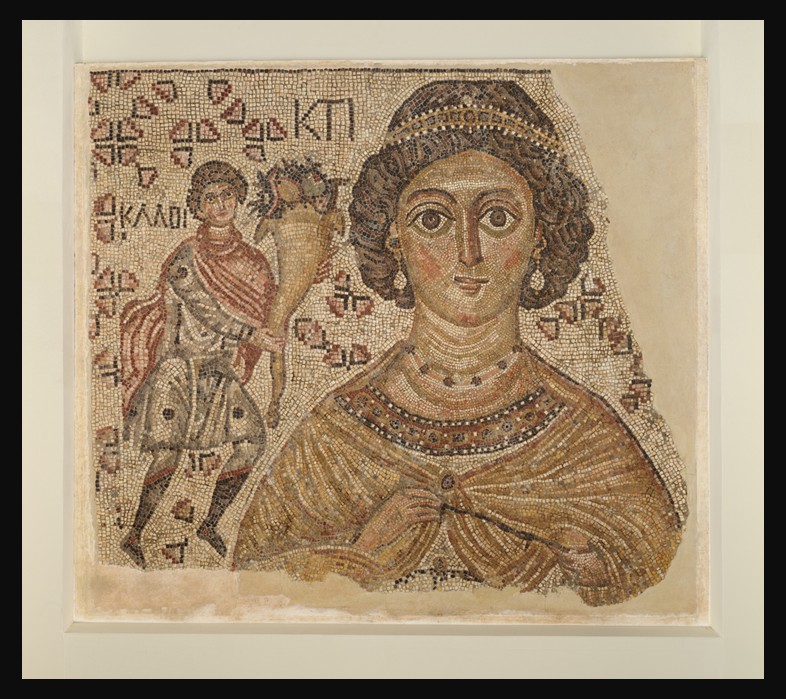
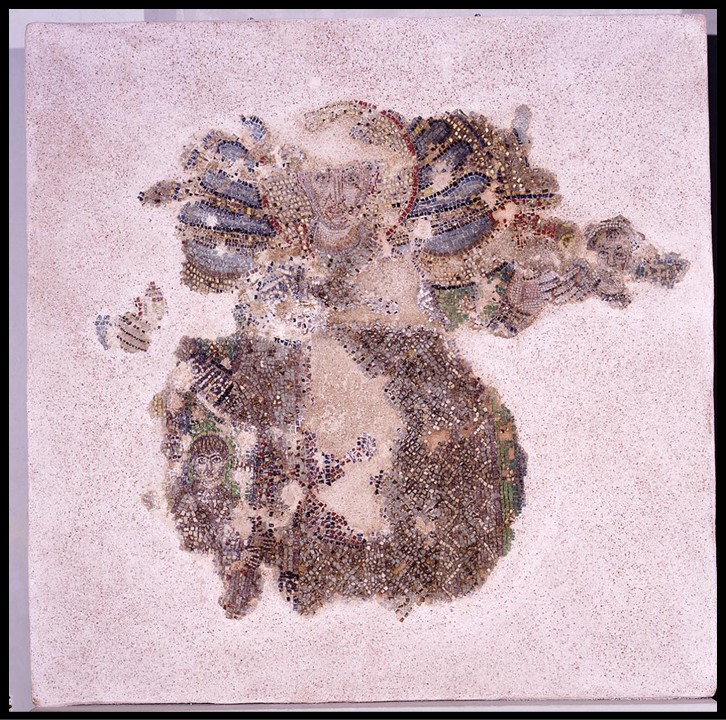
Byzantine floor mosaic fragment showing a richly bejeweled female figure holding a Roman measuring tool identified as Ktisis, the personification of generous foundation, with a partially visible male figure holding a cornucopia at left; made of marble and glass, ca. 500–550, Metropolitan Museum of Art, New York.

Ktisis

Ktisis
February 6, 2026 by Amalia Spiliakou with no comment ArchaeologyByzantine ArtEarly Christian ArtTeaching Resources Edit
Byzantine floor mosaic fragment showing a richly bejeweled female figure holding a Roman measuring tool identified as Ktisis, the personification of generous foundation, with a partially visible male figure holding a cornucopia at left; made of marble and glass, ca. 500–550, Metropolitan Museum of Art, New York.
Fragment of a Floor Mosaic with a Personification of Ktisis, 500–550, with modern restoration, Marble and Glass, 151.1 x 199.7 x 2.5 cm, the MET, NY, USA
https://www.metmuseum.org/art/collection/search/469960
Step into the symbolic world of Late Antiquity through this remarkable mosaic fragment portraying Ktisis, the ancient personification of creation, foundation, and civic generosity. With her richly ornamented garments, expressive gaze, and accompanying figure holding a cornucopia, she embodies the ideals of prosperity and well-ordered society. Once part of an elegant floor, this mosaic invites us to reflect on how art, mythology, and civic identity were woven seamlessly into daily life in the ancient Mediterranean.

At the center of the composition appears the personification of Ktisis, depicted frontally with large, expressive eyes that engage the viewer directly and lend the figure a commanding, almost iconic presence. Her softly modeled face is framed by carefully arranged curls and crowned with a jeweled headband, details that underscore refinement and elevated status. She wears a richly patterned garment fastened with an ornate necklace, the dense ornamentation and shimmering tesserae emphasizing dignity, wealth, and abundance. In her hand she holds a Roman copper tool called a foot ruler, a clear visual sign of engineering closely tied to her symbolic role. The Greek inscription naming Ktisis identifies her unambiguously, guiding the viewer’s interpretation of the scene. To the left, a smaller standing male figure advances toward her holding a cornucopia, the classical emblem of plenty; an inscription beside him identifies his role and further clarifies the allegorical program of the mosaic. Scholars have suggested that Ktisis was originally flanked symmetrically by a second small male figure on her right, now lost, which would have created a more balanced composition emphasizing abundance and benefaction on both sides. Even in its fragmentary state, the surviving figure establishes a subtle narrative exchange that reinforces themes of prosperity, order, and civic well-being while enlivening the scene.

In late antiquity, Ktisis embodied the concepts of foundation, creation, and benefaction. She was closely associated with the act of building and with the generosity of patrons who endowed structures for private or communal use. Her presence in a floor mosaic would have communicated prosperity, stability, and divine or civic favor, transforming the architectural space into a visual statement of success and legitimacy.

Stylistically, the mosaic reflects a transitional moment between classical naturalism and the emerging Byzantine aesthetic. Subtle modeling of the face coexists with an increasingly abstracted body and decorative emphasis on surface pattern. The shimmering marble and glass tesserae enhance the figure’s presence, while the frontal pose and enlarged eyes anticipate later Byzantine iconography.

As a floor mosaic, this image would have been encountered from above and at close range, integrated into the rhythm of daily movement. Walking across the figure of Ktisis reinforced her symbolic role: prosperity and benefaction quite literally underfoot, embedded in the fabric of the building itself. The mosaic thus functioned not only as decoration but as a constant visual assertion of order and well-being.

Seen today as a fragment and displayed vertically, the mosaic invites a different kind of engagement. Removed from its architectural setting, it becomes an object of focused contemplation rather than lived experience. Yet even in isolation, the figure of Ktisis continues to speak eloquently about late antique values, patronage, and the evolving language of Byzantine art.

For a Student Activity inspired by the Roman Foot Ruler, please… Check HERE!

For a PowerPoint Presentation of Activities created by my students, please… Check HERE!

Bibliography: https://www.metmuseum.org/art/collection/search/469960 and Dr. Evan Freeman and Dr. Anne McClanan, “Byzantine Mosaic of a Personification, Ktisis,” in Smarthistory, February 3, 2020, accessed December 11, 2025, from smarthistory https://smarthistory.org/byzantine-ktisis/ and https://www.youtube.com/watch?v=nsvOinFR1qs and Personifications of KTISIS in early Byzantine mosaics, by Rederic Lecut, and from Academia https://www.academia.edu/42068332/Personifications_of_KTISIS_in_early_Byzantine_mosaics

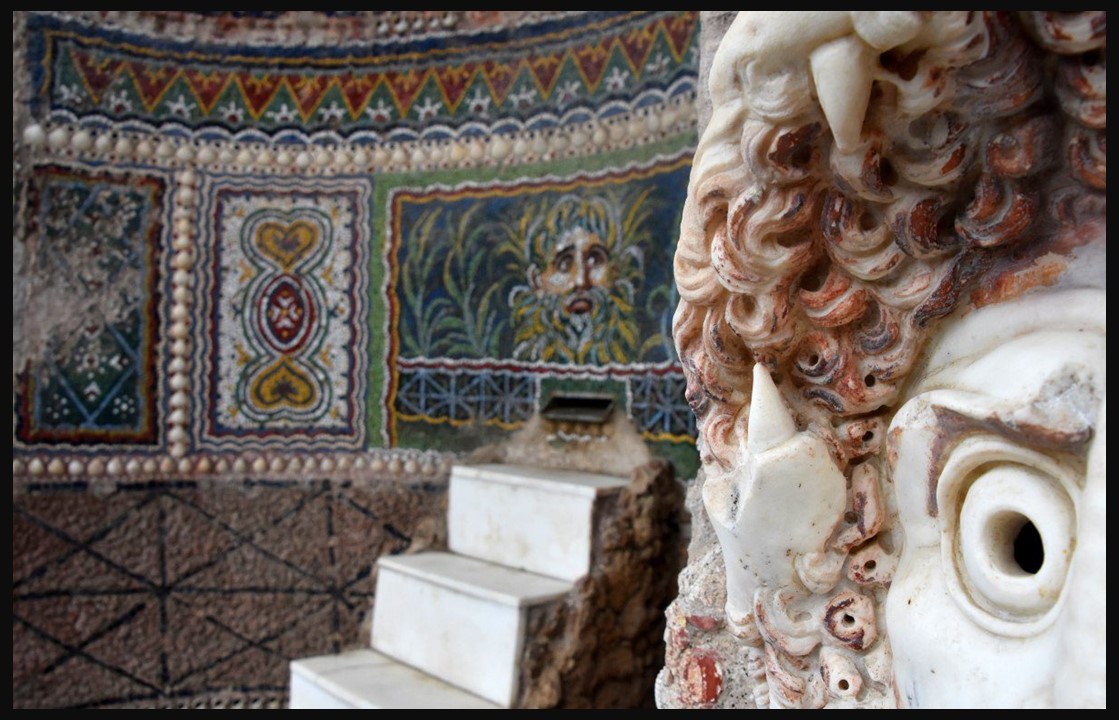
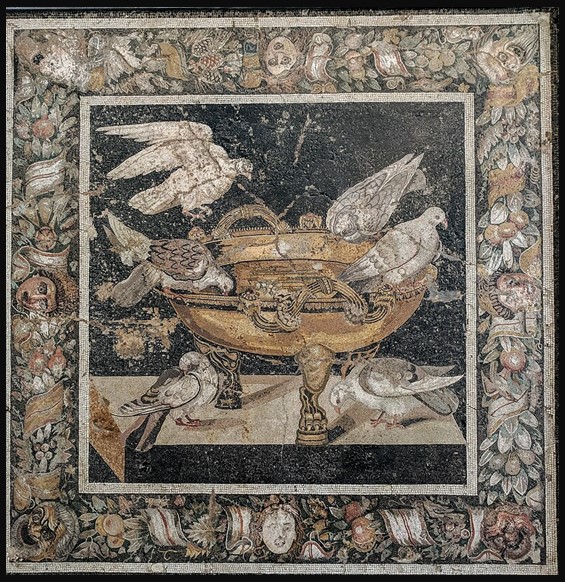
Mosaic Emblema with Doves on a Water Basin, Room ‘n’ House of Doves in Pompeii

House of the Doves in Pompeii

Mosaic Emblema with Doves on a Water Basin, Room ‘n’ House of Doves in Pompeii
Mosaic Emblema with Doves on a Water Basin, 1st century BC, Room ‘n’ House of Doves in Pompeii (Region VIII, 2-34), now in Naples Archaeological Museum, Italy https://commons.wikimedia.org/wiki/Category:Doves_drinking_at_a_golden_basin,_mosaic_(from_Pompeii)#/media/File:Doves_at_a_Basin,_Mosaic.jpg

The dove, revered across cultures and religions, stands as a powerful symbol of Peace, Purity, and Hope. With its gentle demeanor and graceful flight, the dove has been a timeless emblem of tranquility and reconciliation. In various ancient mythologies, the dove has been linked to goddesses of love and fertility, like Inanna/Ishtar in Mesopotamia, or Aphrodite in Greece, adding a dimension of divine love to its symbolism. The dove’s appearance in the biblical story of Noah’s Ark further solidified its association with peace and new beginnings, as it returned to Noah carrying an olive branch, signaling the end of the flood. In Christianity, it gained prominence as a symbol of the Holy Spirit, often depicted during significant moments like the baptism of Jesus. Beyond religious contexts, the dove has become a universal icon for peace movements and humanitarian causes, transcending borders and languages to convey a shared aspiration for harmony in the world. As we usher in the New Year, let the beautiful mosaic of Doves in the House of the Doves in Pompeii serve as a heartfelt message for peace and prosperity in the coming year! May the spirit of these doves inspire moments of serenity and abundance in your life as we embark on this fresh journey together.

The House of the Doves (Casa delle Colombe or Casa di V. Popidius) is a captivating ancient Roman residence located in the archaeological site of Pompeii. Situated in the southwestern part of the city (Regio VIII, 2-34), this well-preserved house offers a glimpse into the lifestyle of the Pompeian elite during the first century AD. The house derives its name from a stunning mosaic that adorns one of its rooms (Room ‘n’ in Plan), featuring six Doves in various poses, around a water basin. Its layout is typical of Roman homes, with a central atrium surrounded by rooms adorned with frescoes, mosaics, and other ornate decorations. The architectural and artistic elements found within the house provide valuable insights into the aesthetics and daily life of Pompeii’s ancient inhabitants, making it a fascinating destination for archaeologists, historians, and visitors alike.

The intricate Mosaic Emblema featuring three doves perched on the rim of a golden water basin supported by lion’s feet, with a fourth dove gracefully descending and two more resting on the shelf below, is just one among the numerous exquisite details that distinguish this particular residence. Unearthed during the March 1885 excavation season in Room ‘n,’ an oecus or triclinium located in the southeast corner of the house’s atrium, the impressive mosaic is currently on display at the Naples Archaeological Museum. https://mann-napoli.it/en/mosaici-2/

The room’s floor, hardly preserved today, was made of a white mosaic with small tesserae without any border. In the center, the Emblema with the Doves is believed to derive from a model by the famed mosaicist Sosus of Pergamon (εκ Περγάμου ψηφιδογράφος Σώσος), an artist discussed and much admired by Pliny the Elder.

Sosus of Pergamon, a renowned Hellenistic mosaicist, left an indelible mark on the ancient world with his extraordinary mosaic artworks. Pliny describes Hellenistic mosaic making and Sosus’s accomplishments as …Paved floors originated among the Greeks and were skilfully embellished with a kind of paintwork until this was superseded by mosaics. In this latter field the most famous exponent was Sosus, who at Pergamum created a greatly admired mosaic of a Dove… in the act of drinking, and throwing the shadow of its head upon the water; while other birds are to be seen sunning and pluming themselves, on the margin of a drinking-bowl. https://www.perseus.tufts.edu/hopper/text?doc=Perseus%3Atext%3A1999.02.0137%3Abook%3D36%3Achapter%3D60

While none of Sosus’s original works have withstood the test of time, his renown persists through the admiration of later artists and historians. His impact on the art of mosaic has created a lasting legacy, inspiring subsequent generations and enriching the intricate tapestry of Hellenistic artistic achievement. The question arises: is the Pompeiian Mosaic of Doves a reproduction of Sosus’s renowned Hellenistic mosaic? An affirmative response is quite likely.

Wishing you a joyous and fulfilling New Year filled with Harmony and Happiness!

Behold, I send you forth as sheep in the midst of wolves: be ye therefore wise as serpents, and harmless as doves (Matthew 10:16)… https://www.biblegateway.com/passage/?search=Matthew%2010%3A16&version=NIV

For a Student Activity, inspired by the beautiful mosaic of Doves in the House of the Doves in Pompeii, please… Check HERE!

A reference to the legendary Hellenistic Mosaicist Sosus (εκ Περγάμου ψηφιδογράφος Σώσος), can be accessed in a former Teacher Curator BLOG POST titled Heraklitos and the Asarotos Oikos Mosaic… https://www.teachercurator.com/art/heraklitos-and-the-asarotos-oikos-mosaic/

Mosaic Icon of Saint Demetrios at Sassoferrato, Mosaic Icon: 14th or 15th century, Ampulla: 13th or 14th century, Silver Frame: mid-15th century, Mosaic set into wax on a poplar board, paint, silver-gilt (frame), lead (ampulla), 24.3 X 16 cm, Museo Civico, Sassoferrato, Italy

Miniature Mosaic Icon of Saint Demetrios in Sassoferrato

Mosaic Icon of Saint Demetrios at Sassoferrato, Mosaic Icon: 14th or 15th century, Ampulla: 13th or 14th century, Silver Frame: mid-15th century, Mosaic set into wax on a poplar board, paint, silver-gilt (frame), lead (ampulla), 24.3 X 16 cm, Museo Civico, Sassoferrato, Italy
Mosaic Icon of Saint Demetrios at Sassoferrato, Mosaic Icon: 14th or 15th century, Ampulla: 13th or 14th century, Silver Frame: mid-15th century, Mosaic set into wax on a poplar board, paint, silver-gilt (frame), lead (ampulla), 24.3 X 16 cm, Museo Civico, Sassoferrato, Italy https://www.johnsanidopoulos.com/2015/11/a-14th-century-byzantine-icon-of-st.html

One of the inscriptions in the Miniature Mosaic Icon of Saint Demetrios in Sassoferratoinforms us that… This ampulla (at the top of the Icon), bears holy oil drawn from the well in which the body of the divine Demetrios reposes, which gushes here and accomplishes miracles for the entire universe and for the faithful… What a remarkable way to remember Saint Demetrios and celebrate his feast day!

In 1472, Niccolò Perotti (1430-1480), secretary to Cardinal Bessarion and archbishop of Siponto, donated to Sassoferrato, the city of his birth, a collection of reliquaries, including the Mosaic Icon of Saint Demetrios. That was a notable donation considering Niccolò Perotti’s position. As Cardinal Bessarion’s secretary, he was able to travel as far as Trebizond in the East, and acquire a collection of valuable reliquaries, manuscripts, and icons. It has been suggested that the Mosaic Icon of Saint Demetrios was gifted to Perotti by no other than Bessarion himself, known to be the owner of a collection of Late Byzantine Mosaic Icons… but there is no proof for this.  https://www.academia.edu/39903340/Displaying_an_Icon_The_Mosaic_Icon_of_Saint_Demetrios_at_Sassoferrato_and_its_Frame

The Museu Civico in Sassoferrato is fortunate to hold such an important and rare relic of the Palaiologan Renaissance, the final period in the development of Byzantine art. On a poplar board, slightly excavated at its center, rendered in micromosaic, stands Saint Demetrios, patron Saint of Thessaloniki. He is placed against a gold background and a tiled ground. He is in military garb, holds a lance with his righthand, and, with the left, a blue shield decorated with a heraldic white lion against a ground strewn with gold stylized flowers. Based on stylistic analysis, according to Martin Donnert,  the mosaic icon at Sassoferrato was executed in the 14th century as a typical work of Palaiologan art. This date is further confirmed by the radiocarbon analysis dating of the wooden support of the icon to 1279 ± 26 years, which gives a terminus post quem. Byzantium: Faith and Power (1261–1557), Evans, Helen C., ed., with essays by… https://www.metmuseum.org/art/metpublications/Byzantium_Faith_and_Power_1261_1557 pp. 231-233 and https://www.academia.edu/39903340/Displaying_an_Icon_The_Mosaic_Icon_of_Saint_Demetrios_at_Sassoferrato_and_its_Frame

Mosaic Icon of Saint Demetrios at Sassoferrato (details), Mosaic Icon: 14th or 15th century, Ampulla: 13th or 14th century, Silver Frame: mid-15th century, Mosaic set into wax on a poplar board, paint, silver-gilt (frame), lead (ampulla), 24.3 X 16 cm, Museo Civico, Sassoferrato, Italy
Mosaic Icon of Saint Demetrios at Sassoferrato (details), Mosaic Icon: 14th or 15th century, Ampulla: 13th or 14th century, Silver Frame: mid-15th century, Mosaic set into wax on a poplar board, paint, silver-gilt (frame), lead (ampulla), 24.3 X 16 cm, Museo Civico, Sassoferrato, Italy https://twitter.com/byzanzfreiburg/status/1151222386190180352

The ampulla at the top of the Icon’s frame is a wonderful rarity! It turns the Mosaic Icon into a precious reliquary of Saint Demetrios’s cult. The text, on the right side of the Icon’s frame, explains the reasons why the ampulla was added to the Icon’s composition. Prof. Martin Donnert clarifies that …Since the 12th century, the existence of miraculous oil (the Myron) connected with the cult of St Demetrios is well attested in the sources. He also adds that lead ampullae from the late 12th to the 14th centuries that contained the holy Myron for pilgrims to the saint’s tomb, called koutrouvia… were found at various places in northern Greece and the Balkans. One of these ampullae, a cherished relic in itself, is the one incorporated at the top of the icon frame… showing St Demetrios holding a cross on one side, and, on the opposite side, St Theodora, the second myron-giving saint of Thessaloniki. https://www.academia.edu/39903340/Displaying_an_Icon_The_Mosaic_Icon_of_Saint_Demetrios_at_Sassoferrato_and_its_Frame

The silver-gilt frame, dated during the mid-15th century is rich in information. A number of inscriptions within star-shaped cartouches, along with the imperial symbol of the double-headed eagle and the tetrabasileion, may indicate a distinguished member of the Palaiologan family, to be the original commissioner of the Icon. Furthermore, Prof Martin Donnert suggests Demetrios Palaiologos and the Palaiologoi of Montferrat! https://www.academia.edu/39903340/Displaying_an_Icon_The_Mosaic_Icon_of_Saint_Demetrios_at_Sassoferrato_and_its_Frame

For a Student Activity, please… Check HERE!

Interesting to read: The Historical Significance of the Mosaic of Saint Demetrius at Sassoferrato byA. A. Vasiliev, Dumbarton Oaks Papers, Vol. 5 (1950), pp. 29+31-39 (10 pages) https://www.jstor.org/stable/1291074