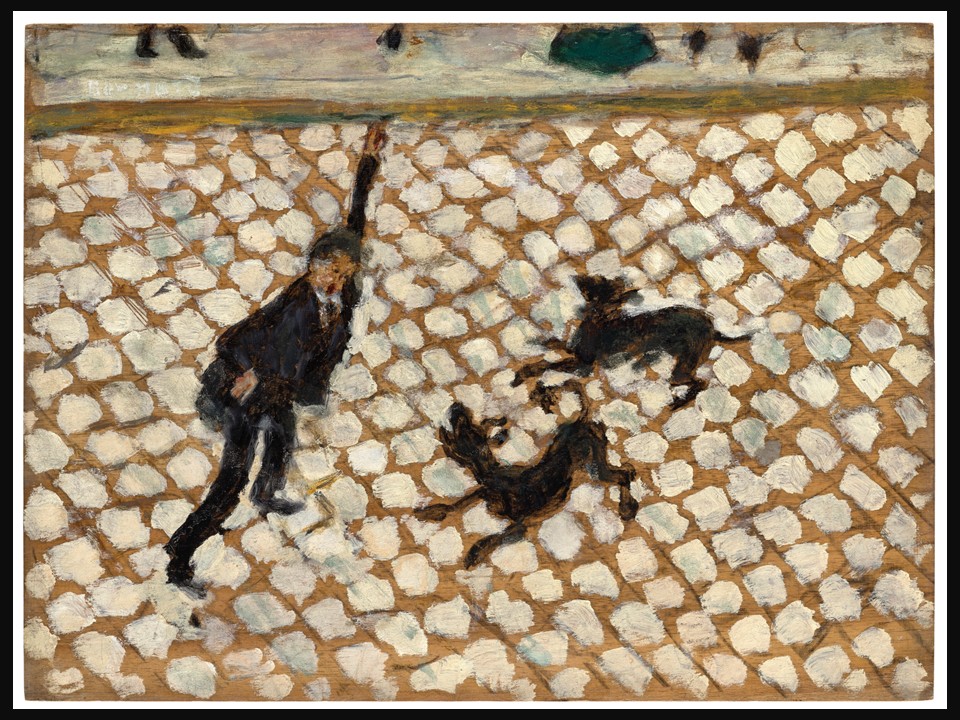
La Rue. Homme aux prises avec deux chiens, 1895, oil and black chalk on panel, 29.5 x 40 cm, Private Collection
https://www.christies.com/en/lot/lot-pierre-bonnard-1867-1947-6579651/
What might you notice if you looked at a Paris street from the level of two energetic dogs? In Pierre Bonnard’s Paris: A Walk with Two Unruly Dogs, painted around 1895, Bonnard transforms an ordinary street encounter into a lively experiment in viewpoint, movement and pattern. Instead of presenting Paris as a carefully composed cityscape, he invites us to experience it from an unusual, almost playful perspective—where two unruly dogs, a struggling figure and the bustling street come together in a moment of unexpected energy.
The small painting, measuring just 29.5 × 40 cm, shows a man struggling to control two dogs. Yet Bonnard does not give us a conventional street scene. Instead, he places us surprisingly close to the pavement, looking down at the action from an unusual, almost plunging viewpoint. The pedestrians are barely visible. Our attention is drawn instead to the man, the dogs and the patterned surface beneath them.
Look at the Street
At first, the pavement may seem like a simple background. Look again.
Bonnard fills much of the painting with paving stones. Rather than describing every stone realistically, he uses quick, simplified marks to create a rhythmic pattern. The pavement becomes almost as important as the people and animals walking across it.
This way of seeing was closely connected with Bonnard’s interest in Japanese woodblock prints. He had discovered Japanese art through Le Japon Artistique, published by Siegfried Bing between 1888 and 1891, and became fascinated by its unusual viewpoints, flattened spaces and decorative patterns.
For Bonnard, a painting did not have to describe the world exactly as the eye normally sees it. An ordinary street could become an arrangement of lines, shapes, movement and colour.
Watch the Dogs
Now look at the two dogs. They seem full of energy. Their bodies twist and stretch across the pavement while the man appears much less certain. His legs are stiff and his gesture suggests that he is struggling to keep control. The contrast is wonderfully expressive: the man tries to impose order; the dogs seem determined to escape it.
Dogs were a recurring subject in Bonnard’s work. He often kept them as companions and repeatedly included them in paintings, drawings and prints. For Bonnard and his friend Félix Vallotton, dogs could also suggest freedom and independence.
The dogs here are drawn with flowing, almost calligraphic lines. Their rhythmic forms contrast with the man’s awkward, rigid stance. It is a small moment of everyday life, but Bonnard gives it a sense of movement and humour.
A Very Modern Way of Seeing
Bonnard was a member of the Nabis, an avant-garde group of young artists who believed that painting could be decorative as well as descriptive. In La Rue, that idea is everywhere.
The pavement becomes a repeated motif. The viewpoint is unexpected. The figures are tightly cropped. The action appears almost frozen for a moment, as though Bonnard has captured a fleeting scene while walking through the city. Christie’s describes the painting as one of the most unusual works in Bonnard’s oeuvre, with virtually no direct equivalent in his work. It was probably observed around Montmartre, where Bonnard was living at the time.
Perhaps that is what makes this small painting so engaging. Bonnard does not need a grand historical subject. He simply notices something happening in the street. A man. Two dogs. A pavement. And suddenly, an ordinary walk becomes a painting about freedom, movement and the way we look at the world.
PowerPoint Presentation: Explore Pierre Bonnard ‘s oeuvre in depth, download the free PowerPoint presentation and bring the artist’s ‘stories’ into your classroom, lecture, or personal study. Download the Presentation →
Continue Exploring on Teacher Curator: Expand your understanding of Pierre Bonnard ‘s Art with Post-Impressionist related articles: Odilon Redon and Pandora’s Box and Suzanne Valadon
Sources and further Reading: To dive deeper into the world of Pierre Bonnard’s art, visit Christie’s site, where La Rue. Homme aux prises avec deux chiens was offered at Christie’s Paris in April 2026 as part of Dans l’intimité de Pierre Bonnard: Collection Claude Terrasse. The work, which had remained in Bonnard’s studio before passing by descent to previous owner, sold for €330,200: https://www.christies.com/en/lot/lot-pierre-bonnard-1867-1947-6579651/?utm_source=chatgpt.com and Learn more about the history, craftsmanship, and legacy of Pierre Bonnard from the official site of the National Gallery of Greece: https://www.nationalgallery.gr/en/artist/bonnard-pierre/