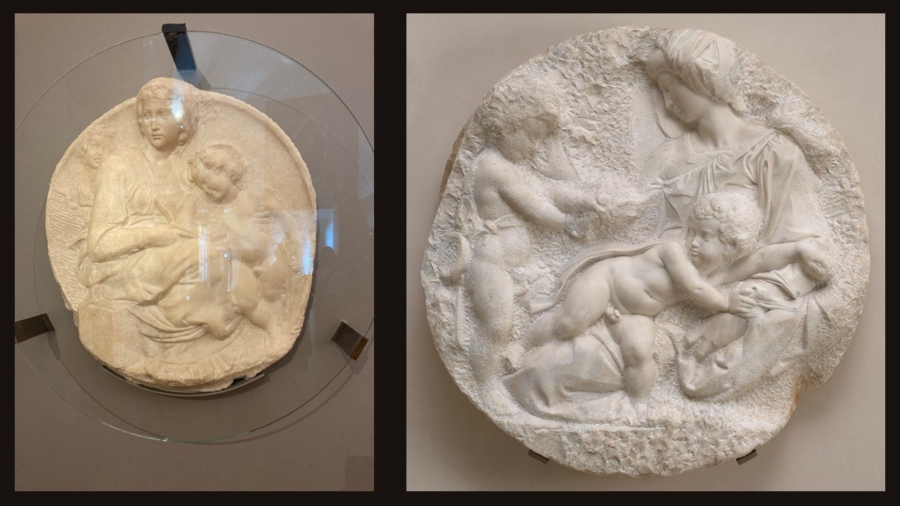
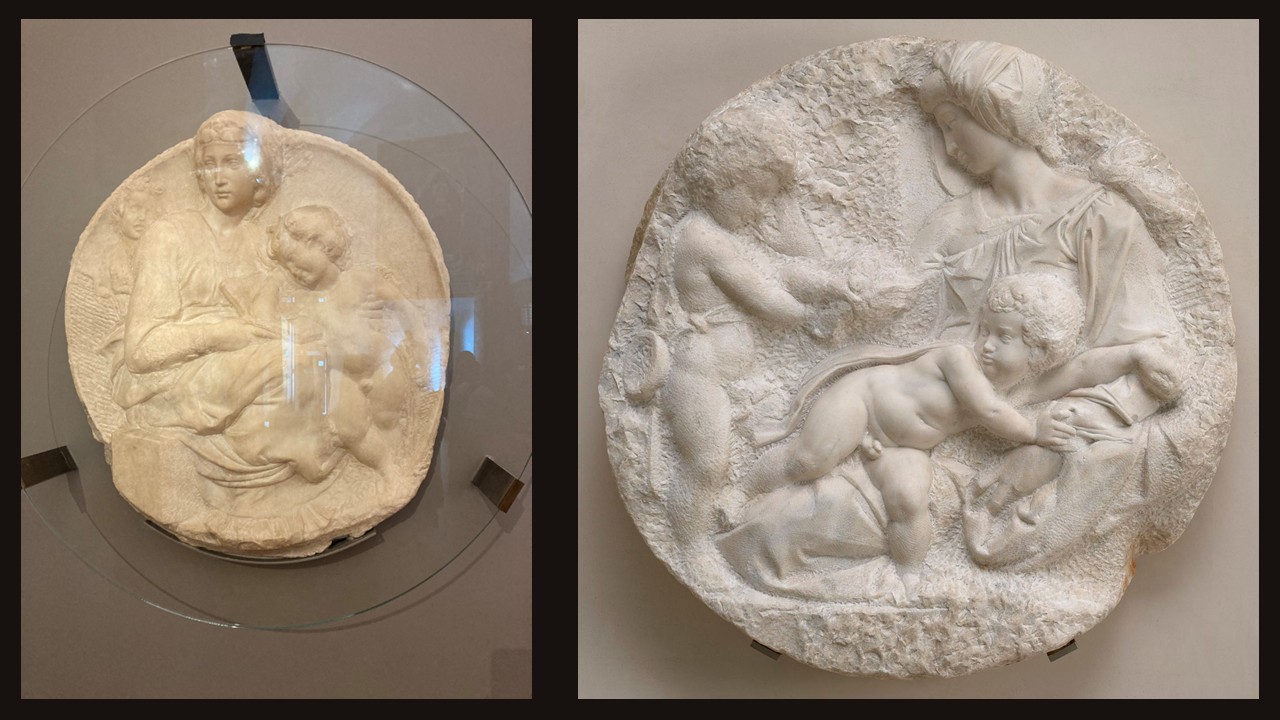
Pitti Tondo, c. 1503–1505, Marble, 82 cm, Museo Nazionale del Bargello, Florence, Italy – Photo Credit: Amalia Spiliakou, 2025
Taddei Tondo, ca. 1504-05, Marble, 1068 mm, Royal Academy of Arts, London, UK
https://www.royalacademy.org.uk/art-artists/work-of-art/the-virgin-and-child-with-the-infant-st-john
There’s something quietly radical about a circle. No corners, no hierarchy, just a continuous, democratic curve. And yet Michelangelo, working in Florence in the early 1500s, managed to fill that humble shape with drama, tenderness, and an almost unsettling psychological depth. Two of his marble roundels, the Pitti Tondo in Florence’s Bargello and the Taddei Tondo in London’s Royal Academy, survive today as twin windows into one of the most fertile periods of his career.
The Bargello’s Pitti Tondo: A Madonna Like No Other
Some works of art surprise us because they do not look quite like what we expect. Michelangelo’s Pitti Tondo, housed in the Museo Nazionale del Bargello in Florence, is one of them. At first glance, it is a familiar Renaissance subject: the Virgin Mary with the Christ Child. But the longer we look, the more we realise that this is not a gentle, traditional Madonna. It is a powerful and deeply human meditation on motherhood, love, and the future that awaits them both.
Created around 1503–1505 for the Florentine nobleman Bartolomeo Pitti, this marble roundel transforms the circular format into a space filled with emotion and movement. Mary sits with her back slightly turned, her monumental figure recalling the strength and dignity of an ancient Roman figure rather than the delicate beauty often associated with Renaissance Madonnas. The Christ Child leans against her knee, looking up at her with a quiet intensity, while the young St. John the Baptist appears in the background, emerging only partially from the marble.
This contrast is one of the most fascinating aspects of the work. Mary’s face is beautifully polished and complete; her veil, her brow, and her lowered gaze reveal Michelangelo’s extraordinary sensitivity. Yet below, the marble remains rough and unfinished. This is the artist’s famous non-finito, the unfinished, but here it feels less like something abandoned and more like a glimpse into the creative process itself. The figures seem to be slowly emerging from the stone, as if they are still becoming.
Perhaps the greatest mystery of the Pitti Tondo lies in Mary’s expression. She does not look at her son. Instead, her gaze turns inward, filled with quiet thought and a sense of something already understood. She seems to carry the knowledge of what lies ahead. In Michelangelo’s hands, the Madonna is no longer only a sacred image; she becomes a mother, a woman, and a deeply human presence.
The Taddei Tondo: Movement and Unease in London
Cross the Channel to the Royal Academy in London and you’ll find the Taddei Tondo, the only Michelangelo sculpture permanently housed in Britain. Also dating to around 1504–1506 and commissioned by Taddeo Taddei, it’s a near-contemporary of the Pitti, and yet the mood couldn’t be more different.
Here, everything is in motion. The Christ Child twists and recoils dramatically, almost tumbling off his mother’s lap, startled by a goldfinch held by the young St. John. That tiny bird carries enormous symbolic weight: the goldfinch, in Renaissance iconography, was a traditional symbol of the Passion, of Christ’s future suffering. The infant already flinches from his own fate.
Mary reaches out to steady him, her arm extended, her expression caught somewhere between calm and concern. Unlike the monumental stillness of the Pitti Virgin, she is reactive, pulled into the moment. The composition swirls; your eye moves around the circle restlessly, caught in the figures’ energy.
The Taddei is also unfinished, but differently so. The background and secondary figures are rougher, while the central group has more resolution. You can see the chisel marks, the grain of the marble. It gives the whole work a sense of immediacy, as if Michelangelo has just stepped away.
Two Tondi, One Conversation
Seen together, even in photographs, the Pitti and Taddei feel like two movements of the same piece of music. One slow, interior, monumental. The other urgent, kinetic, emotionally tangled.
Both were made while Michelangelo was also completing the David and beginning to think about the Sistine Chapel ceiling. You can feel that same appetite for the heroic body, the same fascination with psychological states that resist easy resolution. These aren’t simply devotional images. They’re explorations of what it means to know something terrible and carry on anyway.
The non-finito they share is no accident. Michelangelo famously believed the sculpture already existed inside the marble, his job was simply to liberate it. In both tondi, he liberates just enough. The rest he leaves to us.
If you ever find yourself in Florence, the Bargello’s Pitti Tondo is well worth seeking out, it tends to be overshadowed by the museum’s Donatellos, but it rewards slow looking. And if London is on your itinerary, the Taddei at the Royal Academy is one of those rare works that genuinely surprises people who thought they already knew Michelangelo. Sometimes the circle says everything.
PowerPoint Presentation: Ready to Dive Deeper? Download the PowerPoint presentation and explore all artworks by Michelangelo presenting the Madonna and Child at your own pace — ideal for sharing, discussing, or simply learning more. Get the PowerPoint →
Continue Exploring on Teacher Curator: Expand your understanding of Michelangelo’s sculpture with: Michelangelo’s Bacchus with Satyr
Sources and further Reading: Explore more https://www.royalacademy.org.uk/art-artists/work-of-art/the-virgin-and-child-with-the-infant-st-john and https://en.wikipedia.org/wiki/Pitti_Tondo