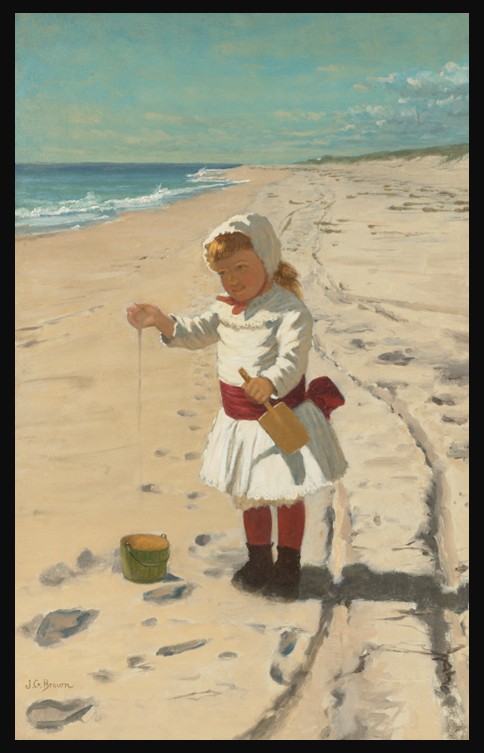
Playing in the Sand at Southampton Beach, 1879-1880, Oil on Canvas, 59.7 x 33 cm, Private Collection
https://www.christies.com/en/lot/lot-6570396?ldp_breadcrumb=back
A child plays in the sand, absorbed in a private little world, with the gray-gold sweep of a Long Island shoreline behind her. No audience. Just a kid, the artist’s young three or four-year-old daughter Mabel, being a kid. That simplicity makes this painting worth pausing on, because it’s almost an exception in John George Brown’s Paintings of Children. To see why, it helps to know what Brown spent most of his career actually painting.
Who Was John George Brown?
John George Brown (1831–1913) was born into a working-class family in Durham, England. His father apprenticed him to a glass-cutting trade, hoping to steer him away from art, it didn’t work. Brown studied art at night, first in Newcastle, then in Edinburgh, before emigrating to New York in 1853. He eventually trained at the National Academy of Design and married into a family that let him paint full-time.
By the mid-1870s, Brown had found the subject that would define his career: the working children of New York City.
The “Bootblack Raphael”
Bootblacks, newsboys, flower sellers, street musicians, Brown painted them so often and so successfully that he earned the nickname “the Bootblack Raphael.” His street children are almost always smiling, sturdy, and resourceful, dressed in charmingly tattered clothes that read as picturesque rather than genuinely destitute. Brown, who had grown up poor himself, pushed back against critics who assumed he painted these scenes purely because they sold. As he put it, he loved the boys he painted, “for I, too, was once a poor lad like them.”
That quote captures a real tension in his work. Brown clearly felt affection for his subjects, models he recruited off the streets and coaxed into smiling for hours. But he also had sharp business instincts. He purchased the copyrights to his most popular images so he could profit from decades of lithograph reproductions, some distributed with packaged tea. One single lithograph reportedly earned him $25,000 in royalties, making him one of the most commercially successful American painters of his era.
A Romanticized Version of Poverty
Here’s the catch for anyone using Brown’s work to learn about 19th-century history: his imagery is selectively idealized. His street children are never sick, hungry, or visibly foreign, even though real bootblacks and newsboys of Gilded Age New York were disproportionately immigrant children living in genuine hardship.
Brown offered wealthy patrons a version of poverty that was cheerful and reassuring, enterprising young “independent merchants” living out a Horatio Alger-style story ofcourage, rather than the grinding reality later documented by reformers like Jacob Riis. This makes Brown a rich case study in visual literacy: his paintings aren’t neutral records of the past, they’re market-savvy fictions dressed up as everyday realism.
The Other Brown: Country Children and Quiet Beaches
Brown didn’t paint city urchins exclusively. Especially through the 1870s, alongside his street scenes, he also painted an idealized country childhood, barefoot boys wading through brooks and picking berries in golden afternoon light, part of a broader postwar nostalgia for childhood as a symbol of innocence, shared by contemporaries like Winslow Homer and Eastman Johnson. After about 1880, Brown largely set this rural imagery aside and became known almost exclusively for the city urchin.
Playing in the Sand at Southampton Beach, dated right at that 1879–1880 turning point, sits closer to this quieter, pastoral mode than to his famous bootblack pictures. There’s no economic transaction here, no audience, no performance of cheerful poverty, just a child absorbed in play. That’s a rare thing to find in Brown’s catalogue, and worth noticing precisely because it’s so uncharacteristic.
John George Brown’s paintings of children offer a compelling lesson in how images shape public memory. His street scenes tell us less about the real lives of Gilded Age children than about what wealthy Victorian buyers wanted to believe about poverty. Placed side by side with a quieter work like Playing in the Sand at Southampton Beach, or with documentary photography from the same period, his paintings become a way to teach students how to read intention, audience, and bias into a work of art, not just its surface charm.
PowerPoint Presentation: Ready to Dive Deeper? Download the presentation and explore this topic at your own pace — ideal for sharing, discussing, or simply learning more. Get the PowerPoint →
Continue Exploring on Teacher Curator: Expand your understanding of John George Brown’s Art with related articles like John George Brown’s Sunshine
Sources and further Reading: To explore more works by John George Brown, visit the official website of Christie’s where valuable insight into 19th-century American painting and art traditions are presented. https://www.christies.com/en/lot/lot-6570396?ldp_breadcrumb=back. For additional information about the artist’s life, style, and contribution to American art, see Terra Foundation for American Art https://collection.terraamericanart.org/people/150/john-george-brown.