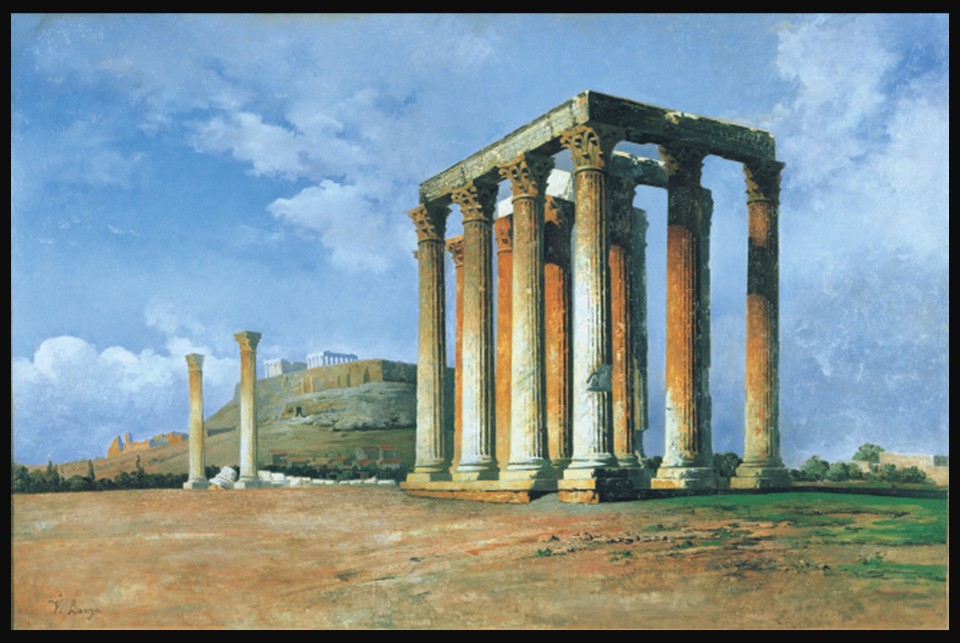
Columns of Olympian Zeus, Oil on canvas, 73×110 cm, The Averoff Museum of Μοdern Greek Art, Metsovo, Greece
https://www.averoffmuseum.gr/en/paintings/columns-olympian-zeus
Few images of Athens capture the tension between antiquity and modernity as strongly as Columns of Olympian Zeus by Vikentios Lanza: A 19th-Century Vision of Ancient Athens. In this painting, Vikentios Lanza presents the Temple of Olympian Zeus not as a complete monument, but as a powerful ruin. As a result, the work becomes more than a landscape. It becomes a reflection on time, memory, and cultural identity.
The viewer is immediately drawn to the towering Corinthian columns. They rise sharply against the sky. However, they are not intact. Instead, they appear fragmented and weathered. This contrast creates a strong visual tension between strength and loss. Rather than reconstructing the past, Lanza chooses to show what still exists in the present.
A Ruin as a Cultural Symbol
The Temple of Olympian Zeus in Athens was once one of the largest temples in the ancient world. By the 19th century, only a few massive columns remained. Therefore, the site became one of the most visually striking ruins in Greece.
For 19th-century artists, these ruins had meaning beyond archaeology. They symbolised cultural continuity and national identity. After Greek independence, ancient monuments were often used to connect modern Greece with its classical past. Lanza’s painting reflects this cultural context. He does not simply document the site. Instead, he interprets it. The temple becomes a space where history and modern perception meet.
The Artist Behind the View
Vikentios Lanza was born Vicenzo Lanza in Venice. He trained within European academic traditions. Later, he moved to Greece, where he developed his artistic career. He became associated with the Munich School tradition. This movement valued structure, clarity, and historical subjects. In particular, artists focused on realism combined with academic composition.
Lanza developed a strong interest in archaeological landscapes. He often painted ruins in and around Athens. Importantly, he avoided dramatic storytelling. Instead, he focused on careful observation and balanced composition.
In Columns of Olympian Zeus, this approach is clearly visible. The architecture is precisely rendered. At the same time, the scene remains atmospheric and calm. Therefore, the painting feels both accurate and reflective.
Light, Space, and Silence
The painting creates a strong sense of silence. There is no human activity in the scene. As a result, the viewer focuses entirely on space and structure.
Light plays a subtle role. It gently reveals the stone surfaces. It does not create dramatic contrast. Instead, it softens the entire composition. In addition, it enhances the feeling of calm stability. This restrained use of light reflects academic painting traditions of the 19th century. Artists aimed for balance and clarity. They avoided emotional exaggeration. Therefore, the painting feels controlled but deeply atmospheric.
Neohellenic Painting and the Munich Influence
Lanza’s work belongs to the broader Neohellenic art movement. This movement developed after Greek independence. Many artists studied in Munich. Therefore, the Munich School strongly influenced their style. These artists combined European academic training with Greek subject matter. They focused on history, landscape, and archaeology.
Ruins such as the Temple of Olympian Zeus became important subjects. They offered both visual drama and cultural meaning. As a result, they helped shape modern Greek visual identity. Lanza’s painting reflects this dual purpose. It is both structured and symbolic. It is precise, yet also reflective.
The painting’s legacy
Columns of Olympian Zeus by Vikentios Lanza: A 19th-Century Vision of Ancient Athens still resonates today. It speaks about how we interpret ruins and history. The painting raises an important question. Do we see ruins as endings, or as continuations? Lanza does not give a direct answer. Instead, he allows the viewer to decide. It encourages reflection on memory, time, and place. It shows how art shapes our understanding of history.
Through this work, Vikentios Lanza creates more than an architectural study. He builds a visual connection between past and present. The painting shows ruins not as loss, but as presence. In the end, the Temple of Olympian Zeus becomes more than a monument. It becomes a symbol of continuity. And importantly, it invites viewers to reconsider how history survives in visual form.
PowerPoint Presentation: Ready to Dive Deeper? Download the presentation and explore Vikentios Lanza’s oeuvre at your own pace, ideal for sharing, discussing, or simply learning more. Get the PowerPoint →
Continue Exploring on Teacher Curator: Expand your understanding of Modern Greek Archaeological Landscapes with related articles… Angelos Giallinas and Spyros Papaloukas and the Temple of Aphaia
Sources and further Reading: To explore more works by Vikentios Lanza, visit the official website of the Averoff Museum of Modern Greek Art in Metsovo, where important archaeological landscapes by the artist are exhibited. The museum offers valuable insight into 19th-century Greek painting and Neohellenic art traditions. https://www.averoffmuseum.gr/en. For additional information about Vikentios Lanza’s life, artistic style, and contribution to Greek art, see the artist profile provided by the National Gallery of Greece in Athens. The archive includes historical context, biographical details, and references to his major works. https://www.nationalgallery.gr/artist/lanza-vicenzo/