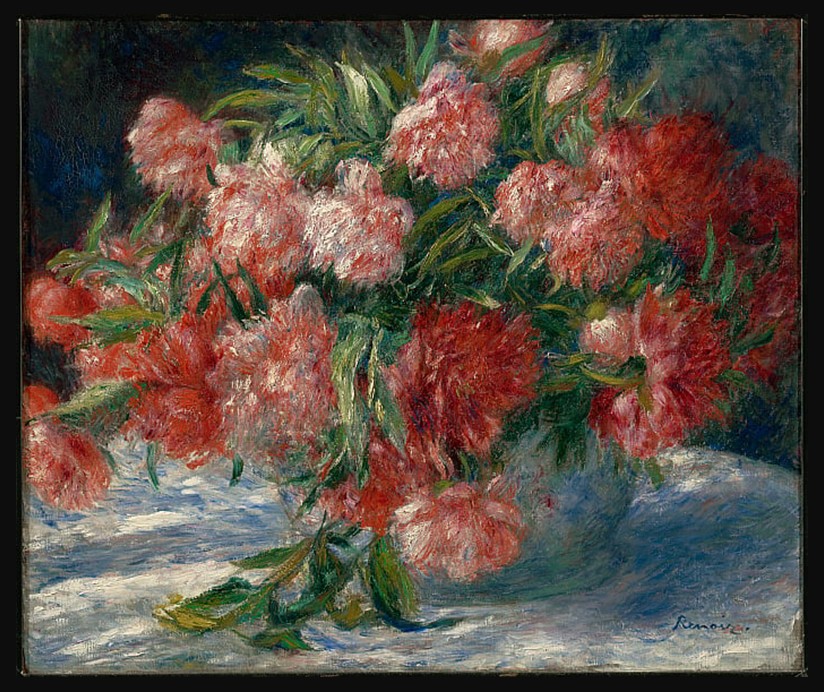
Peonies, c. 1880, Oil on Canvas, 55.3 x 65.7 cm, The Clark Art Institute, MA, USA
https://www.clarkart.edu/ArtPiece/Detail/Peonies?utm_source=chatgpt.com
In Pierre-Auguste Renoir’s Peonies, loose sprays of crimson and blush-pink blossoms tumble against a dark background, their petals catching light while soft blue shadows drift across a white tablecloth below. Painted around 1880, this modest still life captures a flower that, fittingly, carries its own quiet symbolism for the month of November: a bloom associated with honor, compassion, and a bashful, private kind of beauty, ideal for a season that turns our attention indoors and toward reflection.
The Peony: A Flower of Honor and Compassion
As we continue our journey through the year, pairing each month’s arrival with a flower captured on canvas, November brings us the peony, a bloom celebrated for centuries in art, medicine, and folklore. Native to Asia, Europe, and western North America, peonies were cultivated in China as early as the 7th century, prized both for their lush, ruffled blossoms and for their roots and seeds, long used in traditional medicine to ease pain and calm the nerves. In Chinese culture, the peony became known as the “king of flowers,” a symbol of wealth, honor, and romance often used to represent prosperity and a happy marriage.
The name “peony” comes from Greek mythology, tracing back to Paeon, a physician to the gods who was said to have used the plant to heal wounds sustained by Zeus. In the language of flowers that flourished during the Victorian era, peonies came to represent bashfulness and compassion, along with good fortune and a happy life; giving someone a bouquet of peonies was a way of wishing them prosperity and healing in equal measure. Their brief but spectacular bloom, usually only a few weeks each year, has also made them a gentle emblem of fleeting beauty, a reminder to notice loveliness while it lasts.
Renoir: Painting Flowers to Rest the Mind
Pierre-Auguste Renoir, one of the leading figures of French Impressionism, is best remembered for luminous, sun-dappled scenes of Parisian leisure, from dance halls to riverside boating parties. Yet alongside these ambitious figure paintings, Renoir turned again and again to a simpler subject: flowers, arranged loosely in vases or scattered across a table. He once told a friend that painting flowers rests his brain, since it let him experiment with color and paint handling without the pressure of pleasing a sitter or a patron. These quieter still lifes, made throughout the late 1870s and early 1880s, reveal an artist testing the very brushwork and palette that defined his more famous compositions.
Inside Renoir’s Peonies
Renoir’s Peonies shows the artist’s flower paintings at their most confident. Working with thin, translucent washes in some passages and thick, loaded strokes in others, he built up the sumptuous reds and pinks of the petals and the cool green of the foliage, letting the paint itself suggest the softness and slight disorder of real blossoms past their tidiest moment. The dark backdrop pushes the flowers forward, while the pale tablecloth catches touches of blue shadow, a favorite Impressionist device for rendering color and light as artists actually perceived them, rather than relying on traditional brown shading.
Looking closely at Peonies offers viewers a wonderful entry point into Impressionist technique: the visible brushstrokes, the bold use of complementary colors, and the freedom Renoir allowed himself when the subject was simply a bouquet on a table rather than a grand social scene. It’s a lovely reminder that some of an artist’s most experimental, honest work happens in the quiet, private corners of a career.
Classroom Activity: Bring Renoir’s Peonies to life in your classroom with this hands-on student activity exploring colour, composition, and the art of still life. Explore the Student Activity →
Continue Exploring on Teacher Curator: Discover more artworks that explore the beauty of flowers, gardens, and the changing seasons through the eyes of artists from different periods and cultures, Iris celebrated as the flower of February and James Holland’s Delphinium Watercolour.
Sources and further Reading: To explore Renoir’s Peonies and learn more about the painting, visit the official website of The Clark Art Institute, which provides information about the artwork, its history, and its place in the museum’s collection: https://www.clarkart.edu/ArtPiece/Detail/Peonies?utm_source=chatgpt.com. For additional information about Pierre-Auguste Renoir’s life, artistic development, and contribution to Impressionism, see the artist profile and timeline essay from The Metropolitan Museum of Art: https://www.metmuseum.org/essays/auguste-renoir-1841-1919?utm_source=chatgpt.com.