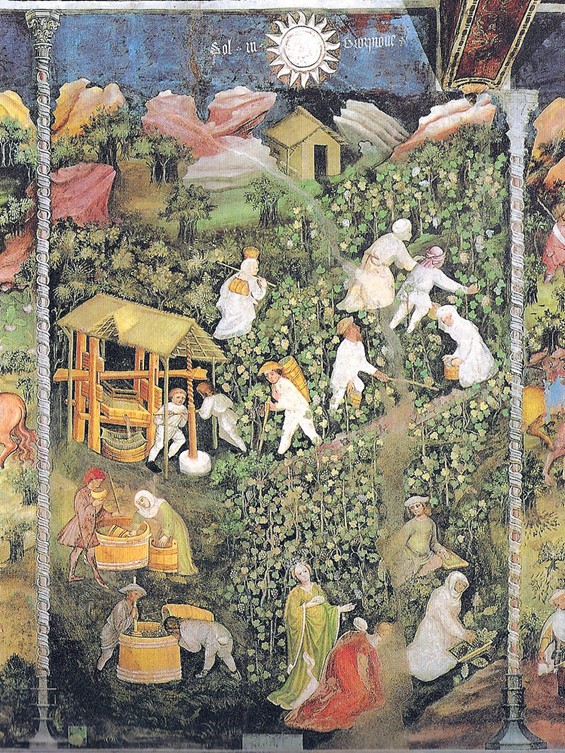
The Month of October, latest 1407, possibly by Maestro Venceslao, Torre Aquila, Castello del Buonconsiglio in Trento, Italy

The Month of October

The Month of October, latest 1407, possibly by Maestro Venceslao, Torre Aquila, Castello del Buonconsiglio in Trento, Italy
The Month of October, latest 1407, possibly by Maestro Venceslao, Fresco, Torre Aquila, Castello del Buonconsiglio in Trento, Italy

I’m not sure everyone has understood, October,  /  your great beauty:  /  in those fat vats, as large as a full stomach,  /  you brew must and inebriation, you brew must and inebriation.  /  On my mountains, like mournful birds,  /  mad clouds flee,  /  on my copper-tinged mountains  /  low clouds raise like smoke, low clouds raise like smoke.          –         Oh days, oh months that run away endlessly, /  my life is always similar to you,  /  different every year, yet the same every year,  /  a hand of tarot cards one never learns to play,  /  one never learns to play… writes for The Month of October Francesco Guccini in his Canzone dei dodici mesi.   https://lyricstranslate.com/el/canzone-dei-dodici-mesi-song-twelve-months.html

The Month of October fresco comes from Torre Aquila in the Castello del Buonconsiglio in Trento, Italy. It is part of an amazing fresco Cycle of the Twelve Months painted on the walls of the tower’s 2nd-floor main room and presents autumn at its best. This exceptional room, 6 x 5,8 x 3 m in size, was commissioned by Prince-Bishop George of Liechtenstein, as a quiet, atmospheric retreat, away from the rest of the Castello’s busy and noisy state quarters. Master Wenceslas, a Bohemian painter active in Trento since 1397, creates a rich October scene, full of natural beauty and pastoral activities. There is no doubt that Prince-Bishop George of Liechtenstein, looking at the October scene, was tasting his top-quality Trentino wine as well!

Torre Aquila, Castello del Buonconsiglio in Trento, Italy
Torre Aquila in Castello del Buonconsiglio in Trento, Italy and the Month of October fresco to the right of the picture…

October is a busy month for farmers in Trento and Master Wenceslas is documenting it in the best possible way. The scene is rich, dense and joyful… inspired by real-life but immensely beautified. The commissioner of this fresco, Prince-Bishop George of Liechtenstein wants to present the idea that his territories flourish under his good governance and prudent guidance. The painter, Master Wenceslas, understood this very well, and created an autumn scene of dazzling green colours, verve and dynamism!

The Month of October Torre Aquila scene is dedicated to wine making, from the very beginning of the process, picking up the grapes, to pressing, grape must preparation and tasting…

The Month of October, latest 1407, possibly by Maestro Venceslao, Torre Aquila, Castello del Buonconsiglio in Trento, Italy

The sun is bright and shining over the Trentino valleys, and well-tended rows of vines cover the painted scene, touching the colourful mountains at the very top. Trentino was at the time a famous wine-producing territory, and Master Wenceslas presents extensive vineyards, their branches heavy with grapes, ready to be harvested. Everyone must work hard… everywhere you look, there is a zeal for activity.

The first thing you notice are the Trentino peasants, men and women, all dressed in white robes assigned to different harvesting tasks. Some of them pick up clusters of white or red grapes while others carry them on their shoulders in large baskets. On the left side of the composition, a screw-press is in action. What a luxury! Only gentlemen of great wealth could afford such an item, let alone a screw-press large enough to require at least two people to operate it. Master Wenceslas was apparently quite familiar with pastoral activities like that because he renders the process with fine precision! We can only assume that as a European travelling artist, Master Wenceslas had acquired first-hand experiences and visions of such joyful harvest events… where… aristocrats and farmers can, for once, forget the worries of everyday life, and “work” together enjoying the small pleasures of life. 

For a Student Activity, please… Check HERE!

The Month of October, latest 1407, possibly by Maestro Venceslao, Torre Aquila, Castello del Buonconsiglio in Trento, Italy
The Month of September, latest 1407, possibly by Maestro Venceslao, Torre Aquila, Castello del Buonconsiglio in Trento, Italy

The Month of September

The Month of September, latest 1407, possibly by Maestro Venceslao, Torre Aquila, Castello del Buonconsiglio in Trento, Italy
The Month of September, latest 1407, possibly by Maestro Venceslao, Fresco, Torre Aquila, Castello del Buonconsiglio in Trento, Italy

And in September, O what keen delight!  /  Falcons and astors astors, merlins, sparrow-hawks;  /  Decoy-birds that shall lure your game in flocks;  /  And hounds with bells: and gauntlets stout and tight;  /  Wide pouches; crossbows shooting out of sight;  /  Arblasts and javelins; balls and ball-cases;  /  All birds the best to fly at; moulting these,  /  Those reared by hand ; with finches mean and slight;  /  And for their chase, all birds the best to fly; /  And each to each of you be lavish still  /  In gifts; and robbery find no gainsaying;  /  And if you meet with travellers going by,  /  Their purses from your purse’s flow shall fill;  /  And Avarice be the only outcast thing. The Month of September is a Sonnet by Folgore Da San Geminiano (c. 1250-1317), is translated by Dante Gabriel Rossetti in his book “Dante and His Circle,” (Roberts Brothers, Boston, 1893).    http://www.sonnets.org/folgore.htm

There is no way for the visitor of the beautiful Italian town of Trento to miss Castello del Buonconsiglio, this imposing, impressive and unique example of secular architecture! It is equally impossible for the Trento visitor not to explore the Castello, where, since the 13th century, the prince bishops of Trento resided and embellished with two Palazzos, an Italianate Park, a Gothic-Venetian Loggia and massive Towers.

Castello del Buonconsiglio

In 1973 the Castello became an Italian regional Museum of Art, known as Castello del Buonconsiglio Museum. This is where the Trento visitor can admire numerous art collections, ranging from paintings and manuscripts to period furniture and local archaeological finds. La piece-de-resistance among the Museum’s treasures is the so-called “Ciclo dei Mesi” in Torre Aquila.     https://www.trentino.com/en/highlights/castles/castello-del-buonconsiglio/

“Ciclo dei Mesi” is a favourite theme in the arts of the Middle Ages and the Early Renaissance. Often linked to the signs of the Zodiac, the Cycle of the Months is often perceived as a link between the work of man, the seasons of the year and God’s ordering of the Universe. As a theme, it recurred in the sculptural decorations of cathedrals and churches across Europe, in illuminated manuscripts like the popular Book of Hours, palace frescoes and, rarely, panel paintings.

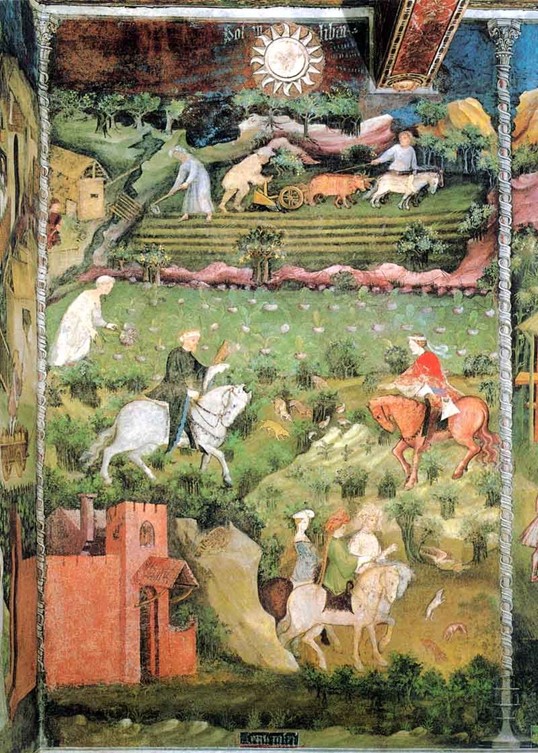
Trento’s September fresco panel in Torre Aquila is characteristic of Maestro Venceslao’s, the artist who painted the “Ciclo dei Mesi”, creative abilities. It is rich, colourful and informative. It tells us of how hard the Trentino farmers worked and how idle and pleasure-seeking its aristocrats were.

The Month of September, latest 1407, possibly by Maestro Venceslao, Torre Aquila, Castello del Buonconsiglio in Trento, Italy

The upper half of September’s composition depicts the typical agricultural activities of the month: the preparation of the land and the harvest of seasonal products.  At the very top, a shepherd watches over his sheltered flock, while three farmers across a bridged river plough a well-tended piece of land. The two men are dressed in short light tunics and lead the plough, pulled by a pair of oxen and a horse. The woman, on the other hand, dressed in a white robe but with bare feet works with the hoe along the perfectly traced lines of the furrows. The middle composition presents another peasant woman busy in collecting turnips. The white turnip was very popular at the time. Peasants cultivated turnips in vegetable gardens or in open fields in abundance as, along with cabbages, turnips were the indispensable food for the long winters of northern European territories.

The Month of September, latest 1407, possibly by Maestro Venceslao, Torre Aquila, Castello del Buonconsiglio in Trento, Italy

The Trentino aristocrats, however, in the lower half of the composition, are depicted still interested in their favourite entertainment: hunting with a hawk. The same red castle Maestro Venceslao painted in the August scene seems to be the residence of a group of three young aristocrats, galloping and ready to go hunting. A lady and two knights, surrounded by their dogs, are about to practice falconry with their well-trained hawks. They seem eager to join two more gentlemen, depicted higher up in the composition, who are already energetically hunting among the rocks and low bushes of the Trentino landscape. Who knows… they might of Folgore, the poet from San Gimignano, and his September poem on the pleasures of September hunting with birds of prey… 

A PowerPoint on Torre Aquila’s frescoes for the Months of August and September is… HERE!

The Month of August, latest 1407, possibly by Maestro Venceslao, Torre Aquila, Castello del Buonconsiglio in Trento, Italy

The Month of August

The Month of August, latest 1407, possibly by Maestro Venceslao, Torre Aquila, Castello del Buonconsiglio in Trento, Italy
The Month of August, latest 1407, possibly by Maestro Venceslao, Fresco, Torre Aquila, Castello del Buonconsiglio in Trento, Italy

“I am a reaper whose muscles set at sun-down. All my oats are cradled.  /  But I am too chilled, and too fatigued to bind them. And I hunger.  /  I crack a grain between my teeth. I do not taste it.  /  I have been in the fields all day. My throat is dry. I hunger  /  My eyes are caked with dust of oat-fields at harvest-time.  /  I am a blind man who stares across the hills, seeking stack’d fields of other harvesters. …” writes the African-American poet, Jean Toomer (1894—1967) and I think of The Month of August by Maestro Venceslao, in Torre Aquila, Castello del Buonconsiglio in Trento, Italy.     https://www.poetryfoundation.org/poems/53989/harvest-song

The Cycle of the Twelve Months is a favourite theme in the arts of the Middle Ages and the Early Renaissance. Often linked to the signs of the Zodiac, the Cycle of the Months is often perceived as a link between the work of man, the seasons of the year and God’s ordering of the Universe. As a theme, it recurred in the sculptural decorations of cathedrals and churches across Europe, in illuminated manuscripts like the popular Books of Hours, palace frescoes and, rarely, panel paintings.

The Month of August, latest 1407, possibly by Maestro Venceslao, Torre Aquila, Castello del Buonconsiglio in Trento, Italy

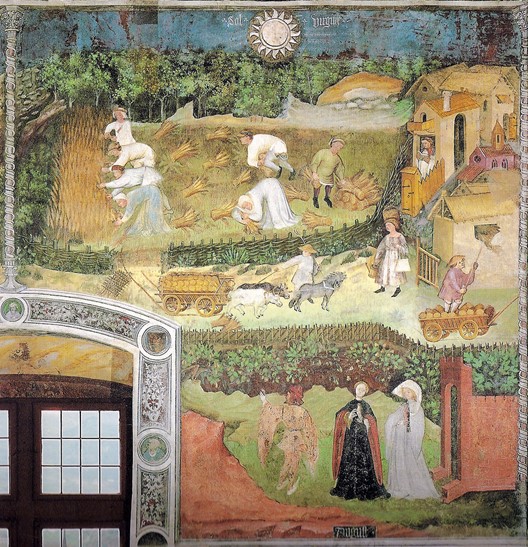
The fresco panels in Torre Aquila are rare and special. They document life in the Trentino area, with references to aristocratic pastimes throughout the year, or the peasant activities and duties to their masters. They also depict a vivid landscape, romanticized even then, from bare and covered with snow, to rich and fertile, to autumnal, covered with fallen leaves.

August is a special month for Trentino residents and Maestro Venceslao painted it to remind us. We can easily imagine Prince Giorgio di Liechtenstein relaxing in this special room, away from his noisy Court… and among his books and curios enjoy the perfect world that Maestro Venceslao created for him! What a treat!

The Month of August fresco is horizontally divided into three zones, the lower of which is dedicated, once more, to falconry, the European sport par excellence, for the aristocracy. The fresco depicts two elegant ladies, one dressed in light blue, the other in blue-black and a gentleman holding a long stick, ready to start hunting! They just came out of the crenellated door of a castle and they walk towards a wooded area, their hawks in hand, trained for hunting. August is a summer month of leisure and moments of falconry show privilege, power and social status.

The Month of August, latest 1407, possibly by Maestro Venceslao, Torre Aquila, Castello del Buonconsiglio in Trento, Italy

Defining Falconry, we would say that it is the “hunting of wild animals in their natural state and habitat by means of a trained bird of prey.” Falconry most probably began in Mesopotamia, or in western Mongolia. In Europe, and towards the latter part of his life, King Frederick II, a man of extraordinary culture, energy, and ability, wrote a decisive treatise on falconry titled De arte venandi cum avibus (“The Art of Hunting with Birds”) for the sport that “was probably introduced around AD 400, when the Huns and Alans invaded Europe from the east.” Apparently Falconry was an aristocratic sport enjoyed equally by men and women.     https://en.wikipedia.org/wiki/Falconry

Maestro Venceslao dedicates the biggest part of the August composition to the hard-working peasants of Trento. In the upper zone, the farmers have a lot to work on. It is harvest time, the landscape is turned to golden yellow and both men and women work hard, bending under the blazing sun, to scythe the crops, collect the ears, tie them in sheaves and arrange them in stacks. And this is not enough! Farmers still have to load their wagons with heavy grain, as depicted in the middle zone, and to transport their day’s hard work on the dirt road, to the neighbouring village, where they will store it in the local barn. The village is undoubtedly picturesque, with ocher-coloured houses, thatched roofs, and a small church, brightly coloured pink. My favourite vignette, the depiction of the village priest, standing on the rectory’s threshold intent on reading, oblivious to the commodity around him.     https://www.buonconsiglio.it/index.php/Castello-del-Buonconsiglio/monumento/Percorso-di-visita/Torri/Torre-Aquila

A PowerPoint on Torre Aquila’s frescoes for the Months of August and September is… HERE!

The Month of August, latest 1407, possibly by Maestro Venceslao, Torre Aquila, Castello del Buonconsiglio in Trento, Italy
The Month of May, possibly by Maestro Venceslao, Torre Aquila, Castello del Buonconsiglio in Trento, Italy

The Month of May

The Month of May, possibly by Maestro Venceslao, Torre Aquila, Castello del Buonconsiglio in Trento, Italy
The Month of May, latest 1407, possibly by Maestro Venceslao, Fresco, Torre Aquila, Castello del Buonconsiglio in Trento, Italy

“Fresh new rose Delighting Spring,    By field and stream,    Singing gaily,    I declare your rarity    – to the flowers.” by Guido Cavalcanti (between 1250 and 1259 – August 1300), the Italian poet, troubadour, and best friend of Dante Alighieri. https://www.poetryintranslation.com/PITBR/Italian/Italianpoetry.php

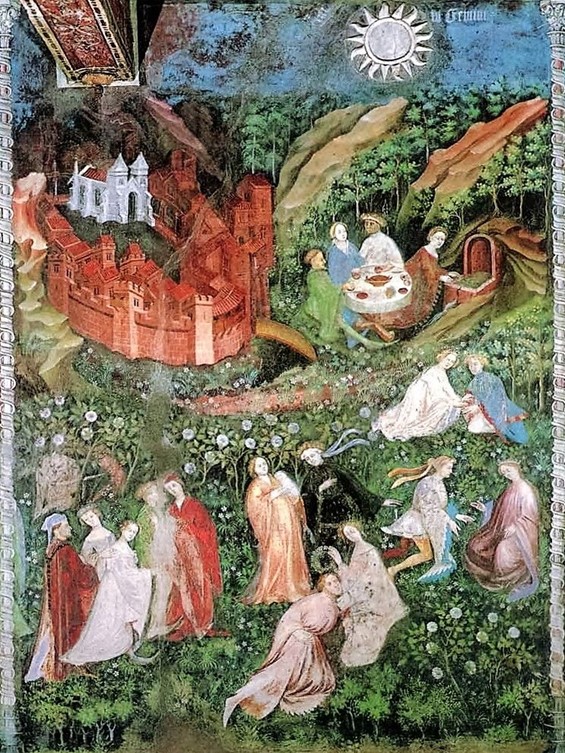
The Month of May fresco comes from the Torre Aquila in the Castello del Buonconsiglio, in Trento, Italy. It is part of an amazing fresco Cycle of the Twelve Months painted on the walls of the tower’s 2nd-floor main room. It was commissioned by Prince-Bishop George of Liechtenstein, who wanted to show life and prosperity in his “well-governed” territories. The painter of these remarkable frescoes, Master Wenceslas, understanding well what he was commissioned to do, created the best 15th-century advertising brochure for the Alpine city of Trento. The Month of May presents a bright spring scene, crowded with well-dressed aristocrats who, in the lush local countryside, serenely enjoy the splendours of their privileged life. 

Torre Aquila, Castello del Buonconsiglio in Trento, Italy

Master Wenceslas, a Bohemian painter active in Trento since 1397, creates an amazing May scene, full of natural beauty… the sun triumphs, nature is in full bloom, and roses are present wherever you see! This is the time for Trento peasants to rest after a busy April, preparing and sowing the fields, repairing or rebuilding the fences of the vegetable gardens.  Their duties accomplished by April 23, the feast of San Giorgio, as the custom dictates, they are out of the “picture.” The Month of May scene is dedicated to the local ladies and gentlemen and their idle aristocratic activities.

The Month of May, possibly by Maestro Venceslao, Torre Aquila, Castello del Buonconsiglio in Trento, Italy

Master Wenceslas paints a striking May scene introducing themes and focusing on details. A city on the upper left side of the panel, surrounded by bright red walls sets the tone… bright, elaborate, almost otherworldly. The white Gothic church within its Walls balances the effect and stands out, introducing one of the four main colours present in the composition, white, red, green and blue. Next to the walled city but connected with it through a bridge, two aristocratic couples are about to eat al fresco, as a circular white-clothed table displays an abundance of delicacies. What an amazing and luxurious “picnic” setting this is… rugged mountains, a deep dark green forest, and a well-constructed fountain of spring water! They sit comfortably and talk amicably around the table, dressed in their brightest and finest, while one of the ladies is about to fetch water from the spring. Is this vignette a reference to the Fountain of Youth, which, according to legend, could renew beauty and youth for eternity?

The Month of May, possibly by Maestro Venceslao, Torre Aquila, Castello del Buonconsiglio in Trento, Italy

The lower part of the composition is entirely devoted to the pleasures and amusements of courtly society. In a lush meadow filled with roses and wildflowers, gracious gentlemen and beautiful ladies gather, mostly in pairs, to celebrate spring and the month of love! A young man kneels, in an act of homage, in front of his lady, another bends his forehead to be crowned with a wreath of flowers, and couples talk intimately or hold hands, lovingly. They wear their finest multicoloured garments, jewelled crowns or wreaths of flowers. Men wear tight-fitting jackets with coloured socks, or large cloaks with frayed edges, women are dressed in tight-fitting overcoats. The most fashion-conscious wear the long-toed shoes that are furious in France. The Trento scene of May is cheerful, sunny, elegant and optimistic! http://italianocontesti.ru/il-calendario-medievale-torre-aquila-a-trento-maggio/ and https://www.discovertrento.it/en/citta-di-trento/eventi/dettaglio/-/dettaglio/Torre+Aquila-Buonconsiglio+Castle/569149#.Xqui86gzZPZ

For a PowerPoint, please… check HERE!

The Month of May, possibly by Maestro Venceslao, Torre Aquila, Castello del Buonconsiglio in Trento, Italy
The Forty Martyrs of Sebaste, 10th century AD Byzantine Ivory Panel

The Forty Martyrs of Sebaste

The Forty Martyrs of Sebaste, 10th century AD Byzantine Ivory Panel
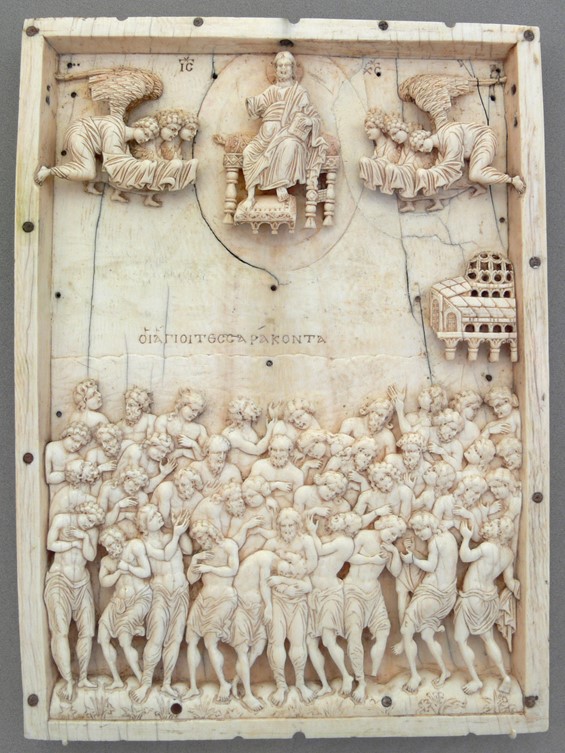
The Forty Martyrs of Sebaste, 10th century AD,  ivory relief panel from Constantinople, Museum für Byzantinische Kunst, BODE Museum, Berlin
https://history2701.fandom.com/wiki/The_Forty_Martyrs_of_Sebaste

The Forty Martyrs of Sebaste Ivory Icon at the BODE Museum in Berlin is a favorite of mine for making me think, reflect and compare.

First of all, I like the story of these 40 tough Roman soldiers, devoted to their faith, suffering… in the city of Sevaste, in Armenia, during the reign of Emperor Licinius, and under the presidency of Agricolaus, in the year 320 AD. Their story is beautifully told by MATHEW in http://dignareme.blogspot.com/2017/03/the-40-martyrs-of-sebaste.html
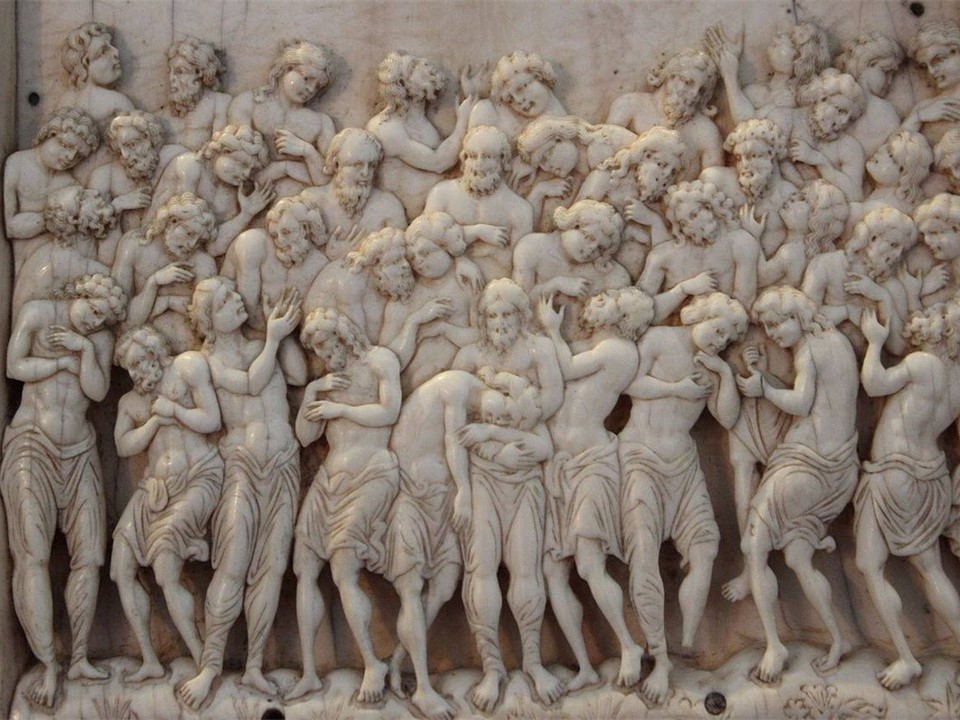
The Forty Martyrs of Sebaste, 10th century AD Byzantine Ivory Panel (detail)

Then, I like Byzantine Ivory Carving! What a magnificent medium in… small-scale. Byzantine Art is not only about monumental, awe-inspiring mosaics and frescoes. The aficionados of Byzantium find equal pleasure even more! in artifacts of smaller scale, like luxurious ivories, silverware, glassware, and jewelry, even humble pottery and woodwork.

I am fascinated by Ivory itself. One only has to imagine the caravans or the galleys bringing to Constantinople African elephant tasks, the anticipation of the artisans ready to put their expertise into practice, and the eagerness of the buyers as they consider one more coveted possession. During the 10th and the 11th centuries, Byzantine Ivories were popular among the City’s aristocrats and highly prized as Imperial gifts to foreign dignitaries.

Meticulously carved, ivory icons, consular diptychs, or pyxides, enchant us today with their beauty. “The allure of this substance is easily understood: its smooth, tactile quality and creamy color made it ideal for the creation of” amazing works of art, just like the Icon of the Forty Martyrs of Sevaste in the BODE Museum.
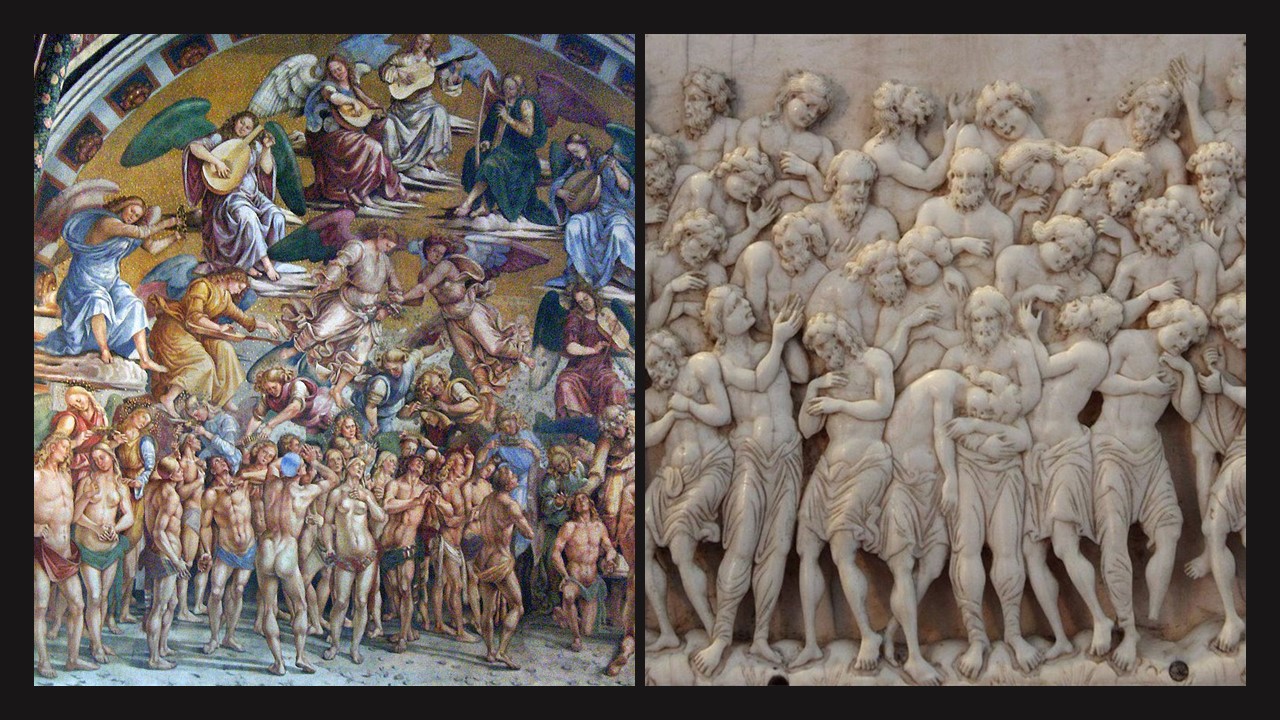
The Forty Martyrs of Sebaste, 10th century AD Byzantine Ivory Panel and Luca Signorelli's fresco painting of Paradise
Fresco painting by Luca Signorelli (1499) of Paradise, Orvieto Cathedral, Orvieto, Umbria
The Forty Martyrs of Sebaste, 10th century AD,  ivory relief panel from Constantinople, Museum für Byzantinische Kunst, BODE Museum, Berlin

Is this amazing carving a case of Byzantine Renascence? The depiction of forty agonizing bodies, winding and twisting, reminds me of Signorelli’s fantasia of Paradise and Hell in Orvioto’s Cathedral, in the Capella of San Brizio.  Are there missing links connecting these two masterpieces I don’t know about? Whatever the answer is, the BODE Ivory Icon is a strategic player in the equation. https://www.metmuseum.org/toah/hd/ivor/hd_ivor.htm and http://www.travelingintuscany.com/art/lucasignorelli/sanbriziochapel.htm

For a “Similarities and Differences” Student Activity, please… check HERE!
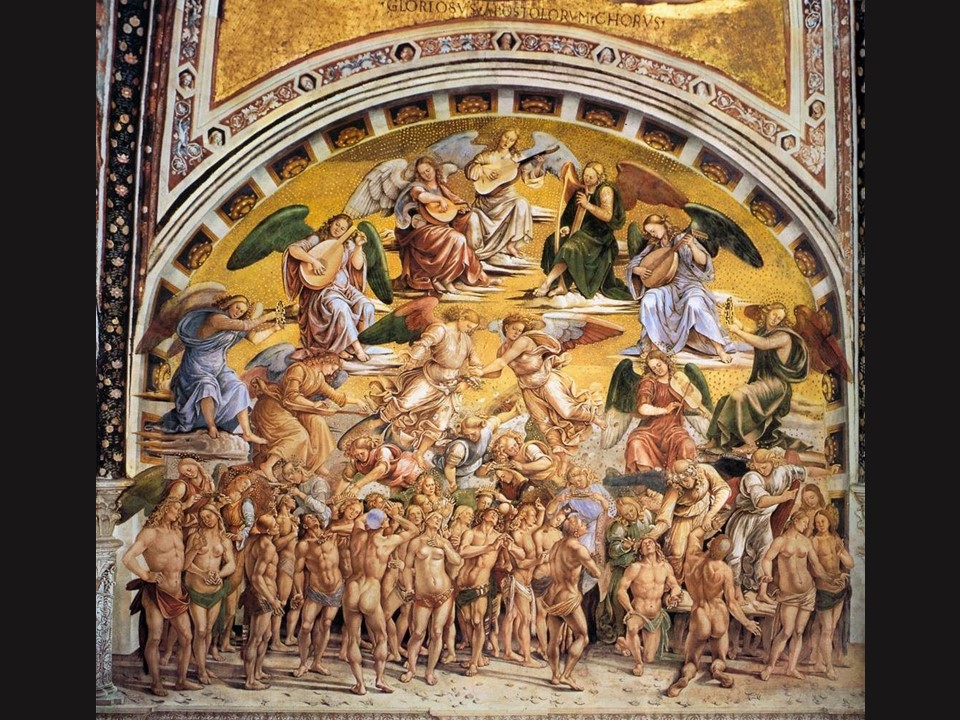
Luca Signorelli, Paradise
Fresco painting by Luca Signorelli (1499) of Paradise, Orvieto Cathedral, Orvieto, Umbria
The Month of February fresco, possibly by Maestro Venceslao, in Torre Aquila, Castello del Buonconsiglio in Trento, Italy

The Month of February

The Month of February fresco, possibly by Maestro Venceslao, in Torre Aquila, Castello del Buonconsiglio in Trento, Italy
The Month of February, late 14th century-latest 1407, possibly by Maestro Venceslao, Fresco, Torre Aquila, Castello del Buonconsiglio in Trento, Italy

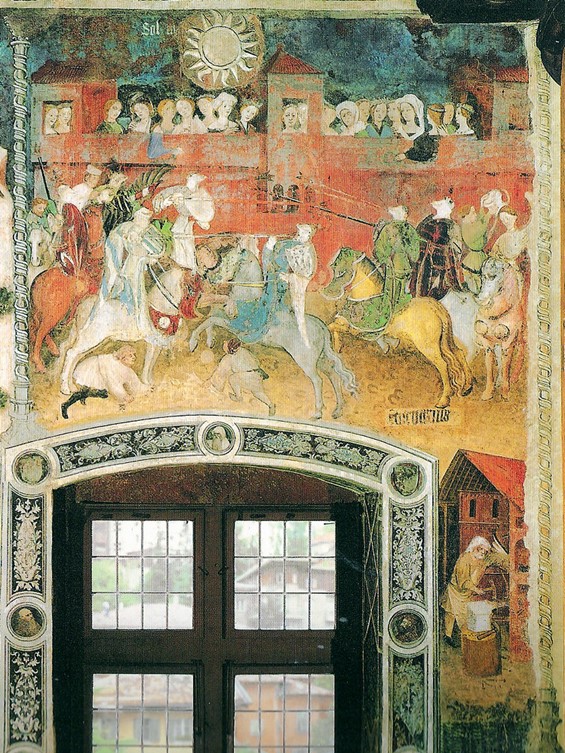
The Month of February fresco comes from Torre Aquila in the Castello del Buonconsiglio, in Trento, Italy. It is part of an amazing fresco Cycle of the Twelve Months painted on the walls of the tower’s 2nd-floor main room and presents the quintessential game of chivalry…

Is there among you any gentleman who for the love of his lady is willing to try with me some feat of arms? If there should be any such, here I am, quite ready to sally forth completely armed and mounted, to tilt three courses with the lance, to give three blows with the battle axe, and three strokes with the dagger. Now look, you English, if there be none among you in love. … and so Gauvain Micaille, the gallant Frenchman squire from Beauce, a gentleman of tried courage, who had advanced himself on his own merit, without any assistance from others, jousts for the honour of France showing his courage and bravery… https://uts.nipissingu.ca/muhlberger/FROISSART/GAUVAIN.HTM

The February fresco at Torre Aquila presents an impressive and festive Tournament where Jousting is the protagonist of the day. The Trento artist, maybe Maestro Venceslao, using warm tones of orange and ochre, organizes a two parts composition. The background presents Trento Ladies sitting behind an elaborate, purpose-built, parapet. They are finely dressed and adorned with elaborate headdresses, crowns, and wreaths, talking to each other, full of excitement… maybe contemplating, even debating whom they are going to favor! The Knights, fully armored and carrying their cotes-of-arm are depicted in the art of Jousting, their goal, to show gallantry and honour, their hope to attract the attention of “their” Lady and get a token of her favor… a veil, a ribbon, a wreath!

The Month of February fresco, possibly by Maestro Venceslao, in Torre Aquila, Castello del Buonconsiglio in Trento, Italy (detail)

According to Wikipedia: “Jousting is a martial game or hastilude between two horsemen wielding lances with blunted tips, often as part of a tournament. The primary aim was to replicate a clash of heavy cavalry, with each participant trying hard to strike the opponent while riding towards him at high speed, breaking the lance on the opponent’s shield or jousting armor if possible, or unhorsing him. The joust became an iconic characteristic of the knight in Romantic medievalism. The participants experience close to three and a quarter times their body weight in G-forces when the lances collide with their armor.” https://en.wikipedia.org/wiki/Jousting#CITEREFColtman1919

The Trento fresco for February has another interesting genre scene. In the narrow space between the room’s window and the staircase, the artist included a vignette of an older blacksmith toiling hard in his workshop. Let’s not forget this is a fresco cycle of the Labors of the Months, illustrating the activities of aristocrats and peasants, every month, throughout the year!

For a PowerPoint, please… check HERE!