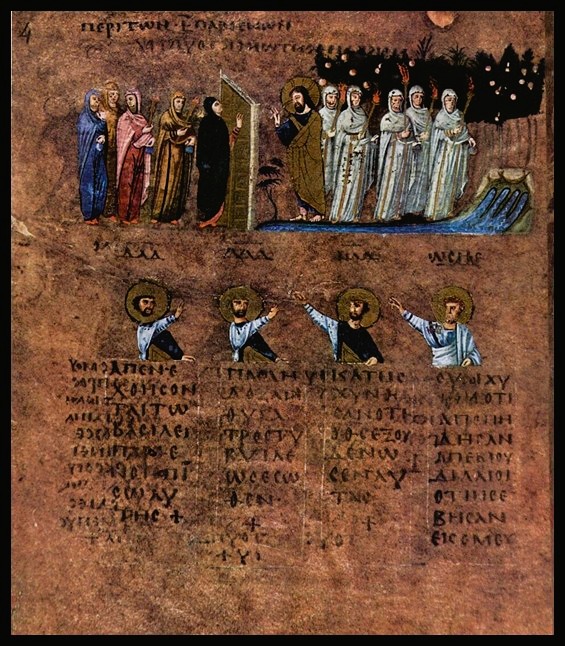
The 6th-century illuminated Gospel Book Codex Purpureus Rossanensis (Rossano Gospels) page showing the Parable of the Ten Virgins in purple-dyed parchment with gold and silver inks, held at the Diocesan Museum, Rossano, Italy.

Codex Purpureus Rossanensis

The 6th-century illuminated Gospel Book Codex Purpureus Rossanensis (Rossano Gospels) page showing the Parable of the Ten Virgins in purple-dyed parchment with gold and silver inks, held at the Diocesan Museum, Rossano, Italy.
Rossano Gospels or Codex Purpureus Rossanensis, The parable of the ten virgins, 6th-century, Illuminated manuscript Gospel Book, Diocesan Museum, Rossano, Italy
https://commons.wikimedia.org/wiki/File:Meister_des_Evangeliars_von_Rossano_002.jpg

Few works of early Christian art capture the interplay of narrative, symbolism, and material splendor as vividly as the sixth-century Codex Purpureus Rossanensis, known as the Rossano Gospels. Its purple-dyed parchment, inscribed in silver and gold, sets the stage for a series of luminous miniatures, among which the depiction of the Parable of the Ten Virgins stands out. The miniature demonstrates a sophisticated use of spatial composition, color, and gesture to convey the contrast between the wise and foolish virgins, transforming a biblical parable into a visually compelling meditation on vigilance and readiness. Waiting with Lamps Aflame reflects this synthesis of artistry and theology, offering viewers both aesthetic and spiritual insight as they contemplate Easter 2026.

A Royal Gospel in Purple and Gold

Created in the 6th century, probably in the eastern Mediterranean world, the Codex Purpureus Rossanensis is one of the oldest surviving illuminated manuscripts of the New Testament. Its pages are dyed a deep imperial purple, a colour reserved in antiquity for royalty, and its sacred text is written in silver and gold ink. Containing the Gospels of Matthew and Mark, the manuscript is both a theological treasure and a masterpiece of early Christian art. Today it is preserved in the Cathedral Museum of Rossano in southern Italy and is recognized by UNESCO as part of the Memory of the World Register. Yet beyond its historical prestige, the codex speaks in images that remain spiritually urgent.

The Parable of Watchfulness

The Parable of the Ten Virgins tells of ten young women waiting for the arrival of the bridegroom. Five are wise, bringing extra oil for their lamps. Five are ‘foolish’, unprepared for delay. When the bridegroom finally arrives at midnight, only the prepared enter the wedding feast. The door is shut. The parable concludes with a solemn warning: “Watch therefore, for you know neither the day nor the hour.” In the liturgical tradition of Holy Week, especially in the Orthodox services of Holy Tuesday, this parable is read as a call to spiritual vigilance. Christ is the Bridegroom. Humanity waits. The question is not whether He will come, but whether we will be ready.
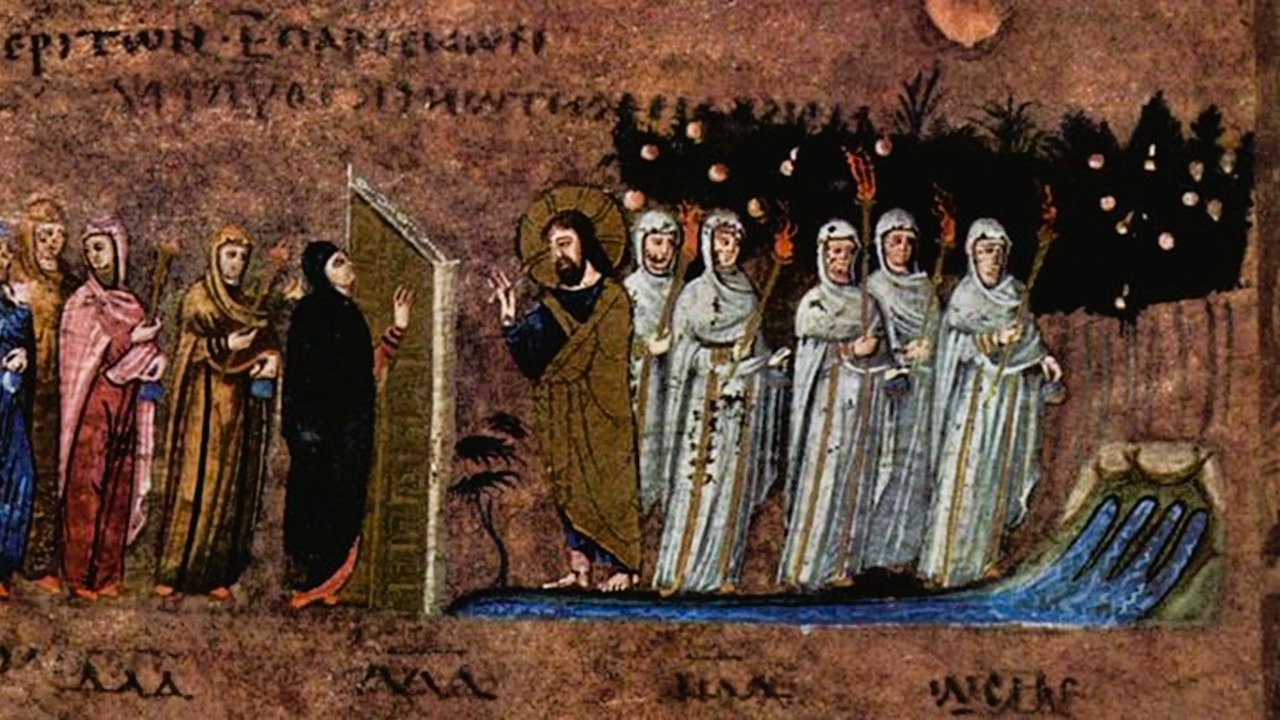
Detail of the 6th-century illuminated Gospel Book Codex Purpureus Rossanensis (Rossano Gospels) page showing the Parable of the Ten Virgins in Rossano, Italy.
Rossano Gospels or Codex Purpureus Rossanensis, The parable of the ten virgins (detail), 6th-century, Illuminated manuscript Gospel Book, Diocesan Museum, Rossano, Italy
https://grace.allpurposeguru.com/2024/03/the-parable-of-the-wise-and-foolish-virgins-a-warning/

Light and Division in the Rossano Miniature

In the Rossano Gospels, this parable unfolds across a richly coloured miniature structured around a central architectural door. On one side stand the five unprudent ladies. Their garments are vibrant, yet their lamps are dark. Their gestures suggest movement and urgency, but they approach a closed door, too late. The absence of flame is striking: the torches they carry are extinguished, visually reinforcing their lack of preparation. On the other side stand the five wise ladies. Clad in luminous white, they hold torches crowned with flame. Their posture is composed, serene. Light radiates from their lamps, visually echoing Christ’s own identity as the Light of the World. The door near them is not a barrier but a threshold. The artist uses contrast, dark and light, colour and white, stillness and anxiety, not simply to illustrate the Gospel story, but to interpret it. The painting becomes theology in colour.

An Image for Our Own Vigil

What makes the Rossano Gospels so powerful is that they do not merely preserve Scripture, they invite contemplation. The purple pages, once associated with imperial authority, now proclaim a different kingship: that of the risen Christ. The silver and gold letters shimmer like reflected candlelight, drawing the reader into sacred time.

In this Easter season, the miniature of the Ten Virgins offers more than historical beauty. It offers a spiritual mirror. To live as a Christian is to live in hopeful expectation, not anxious waiting, but watchful trust. The oil in the lamp becomes a symbol of prayer, mercy, faithfulness, love, all that sustains the flame.

As we celebrate the Resurrection in 2026, we might pause before this sixth-century image and ask ourselves: Are we merely standing at the door, or are we ready to enter the feast?

For a PowerPoint Presentation of the Codex Purpureus Rossanensis, please… check HERE!

Sources
Archdiocese of Rossano–Cariati, Codex Purpureus Rossanensis, available at: https://www.artesacrarossano.it/eng/details_works.php?IDo=36
Google Arts & Culture, Admire the Rossano Gospels’ Miniatures of the New Testament, available at: https://artsandculture.google.com/story/admire-the-rossano-gospels%E2%80%99-miniatures-of-the-new-testament-unesco-memory-of-the-world/9wXBYc45V5WHdA?hl=en
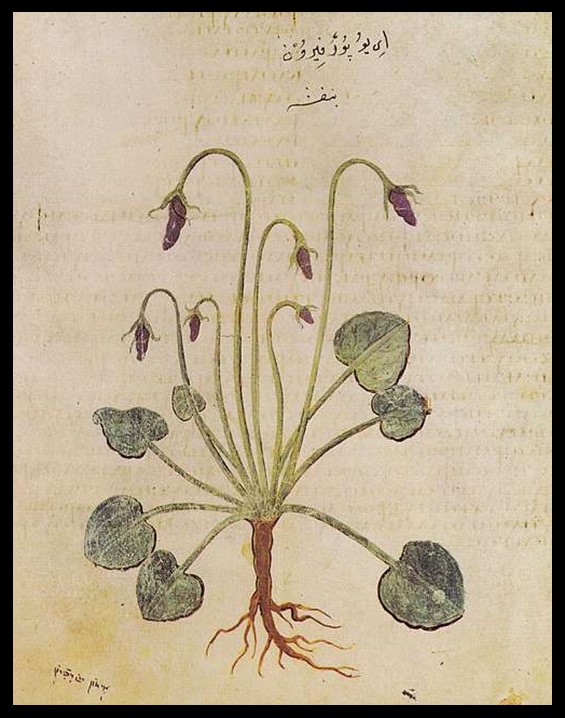
Sweet Violet, Vienna Dioscurides

Sweet Violet

Sweet Violet, Vienna Dioscurides
Sweet Violet, Vienna Dioscurides, Folio 148v, about 515 AD, Byzantine Greek Illuminated Manuscript of De Materia Medica by Pedanius Dioscurides, vellum folios measure 37 by 30 cm, Österreichischen Nationalbibliothek, Vienna https://jenikirbyhistory.getarchive.net/topics/vienna+dioscurides?page=2

“The Vienna Dioscurides is a Byzantine Greek illuminated manuscript copy of “Medical Material” by Dioscorides, which was created in 515 AD. It is a rare surviving example of an illustrated ancient scientific and medical text… The original “De Materia Medica” or “On Medical Material” was first written between 50 and 70 CE by Pedanius Dioscorides. It is a pharmacopeia of medicinal plants and was widely read and used for more than 1,500 years… This specific manuscript copy was created in the Byzantine Empire’s capital, Constantinople, for the byzantine imperial princess, Anicia Juliana. She was the daughter of Anicius Olybrius, who had been one of the last Western Roman Emperors… The manuscript was presented to the princess in gratitude for her funding the construction of a church… The dedication miniature portrait of Anicia Juliana is the oldest surviving dedication portrait in a book…” I find it hard to encapsulate the manuscript’s significance more effectively. The Manuscript’s Folio 148 verso presenting Sweet Violet is my favourite!   https://joyofmuseums.com/ancient-manuscripts-and-historically-influential-books/vienna-dioscurides/

This manuscript serves as one of my chosen ‘canvases’ for celebrating the arrival of each month. My goal for 2025 is to present twelve artworks—one for each month of the year—featuring exquisite depictions of flowers that beautifully convey their essence, symbolism, and historical importance. This initiative is more than just a tribute to flowers; it serves as a personal invitation to pause each month and appreciate the harmonious relationship between nature and art. Join us as we uncover how artists have woven the language of flowers into their work, using them to convey themes of love, purity, resilience, and more, allowing us to experience the beauty of each month in a fresh and vibrant way.

With a rich history spanning over two millennia, Sweet Violet is imbued with deep meaning and symbolism, making it a cherished choice for various occasions. As the flower of the month for February, its delicate fragrance and subtle beauty captivate the senses, while its association with love, modesty, and remembrance ensures that Sweet Violet remain a timeless floral favorite.

Sweet Violets (Viola odorata), known for their delicate fragrance and dainty blooms, have a storied history in botany that spans thousands of years. Originating in Europe and parts of Asia, they were among the earliest flowers to be cultivated for both medicinal and ornamental purposes. The ancient Greeks and Romans revered the Sweet Violet, using it in herbal remedies, perfumes, and even as a symbol of love and modesty. In medieval times, its medicinal properties were documented in early botanical texts, where it was praised for its ability to soothe headaches, respiratory issues, and inflammation. Renowned botanists, including Pedanius Dioscorides, highlighted the violet’s therapeutic virtues in works like De Materia Medica. Over the centuries, the Sweet Violet has maintained its place in botanical studies as a plant of both scientific and cultural significance, admired for its beauty, fragrance, and enduring symbolism.

The name Sweet Violet derives from its botanical classification, Viola odorata, which highlights both its genus and its defining characteristic—its fragrance. The genus name Viola is rooted in Latin, adopted from the ancient Greek word ion, which referred to violets and was associated with myths and poetic traditions. The epithet odorata translates to ‘fragrant’ or ‘sweet-smelling’ in Latin, emphasizing the flower’s delicate and appealing scent. In Greek mythology, violets were linked to figures like Io, a mortal transformed into a heifer by Zeus, for whom the gods caused violets to bloom as a food source. Over time, the name sweet violet became synonymous with modesty, purity, and love, encapsulating the flower’s gentle beauty and enduring fragrance.

Folio 148 verso of the Vienna Dioscurides features a stunning depiction of the Sweet Violet (Viola odorata), a testament to the manuscript’s masterful blend of scientific accuracy and artistic beauty. The page showcases the violet’s delicate blossoms, rendered in soft shades of purple and violet, with meticulous attention to the gentle curvature of the petals and the fine detail of the green leaves. The naturalistic portrayal reflects the Byzantine artists’ commitment to capturing the essence of the plant, both as a botanical specimen and as an object of aesthetic admiration. The composition is harmonious and balanced, with the violets depicted in their natural form, seemingly alive on the page. Beyond its visual appeal, the illustration exemplifies the manuscript’s role as both a practical pharmacopeia and a work of art, celebrating the beauty of nature through precise lines, subtle color palettes, and elegant simplicity. This folio, like many others in the Vienna Dioscurides, elevates the scientific depiction of plants to a level of timeless artistic achievement.

For a PowerPoint Presentation on the Vienna Dioscuridis, please… Check HERE!