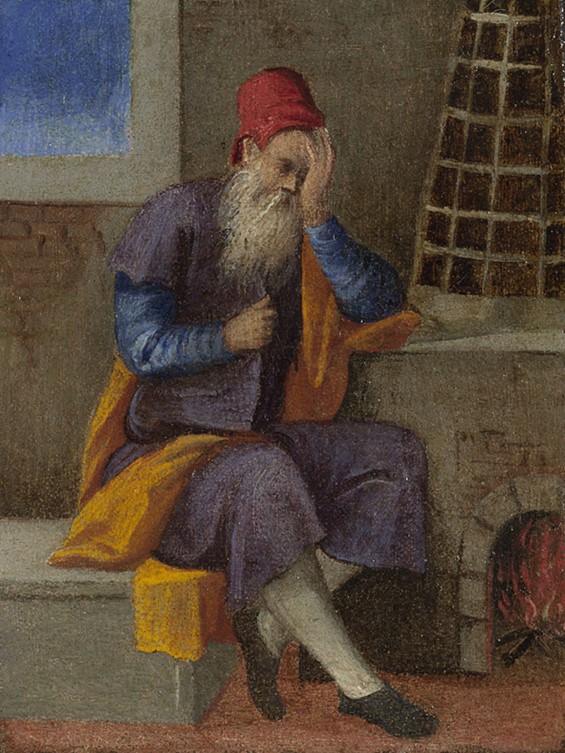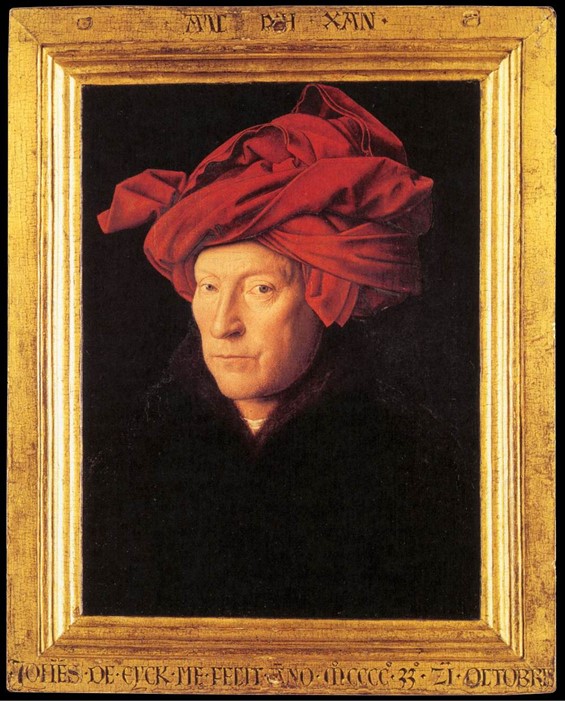
Portrait of a Man (Self Portrait?), 1433, oil on wood, 25,5 x 19 cm, National Gallery, London
https://www.wga.hu/frames-e.html?/html/e/eyck_van/jan/01page/13turban.html
When the time comes for me to introduce my students to Jan van Eyck’s oeuvre I start with his remarkable motto, Als Ich Can – As well as I can, inscribed in large Greek letters on the upper part of the frame of his Self-Portrait? at the National Gallery in London. Humble words… but appreciate how subtly they draw attention to his extraordinary skills as a painter. Where can you go wrong Teaching with Jan van Eyck? https://www.nationalgallery.org.uk/paintings/jan-van-eyck-portrait-of-a-man-self-portrait
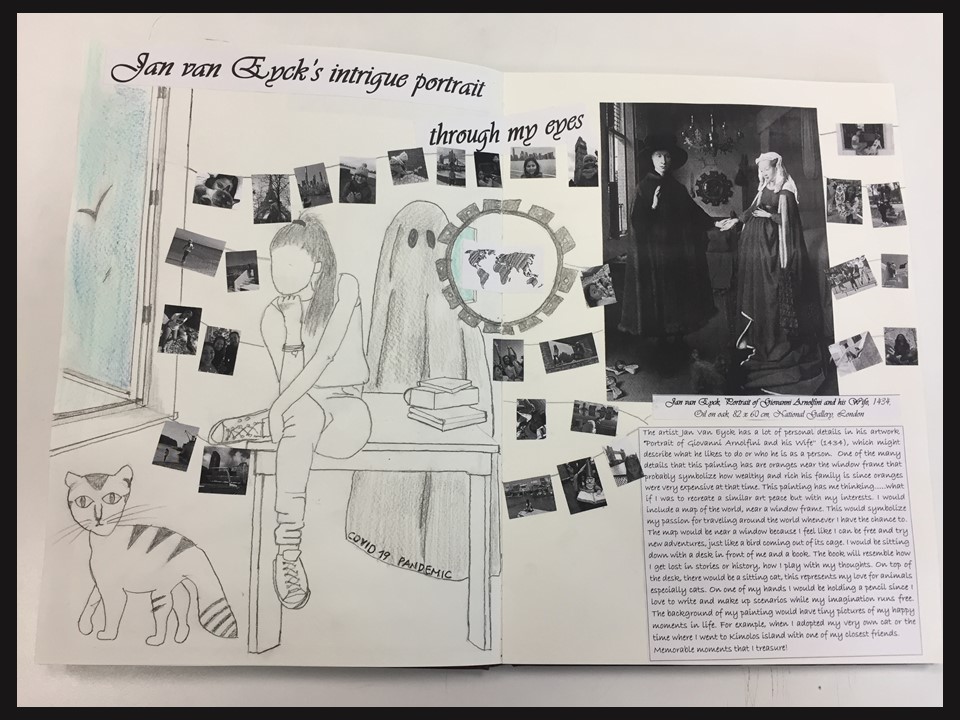
“Jan van Eyck is credited with originating a style of painting characterised by minutely realistic depictions of surface effects and natural light. This was made possible by using an oil medium, which allowed the building up of paint in translucent layers, or glazes.” These three lines by the National Gallery in London embody the essence of van Eyck’s painting style and technique. I like to read it to my students emphasizing his contribution to Western European Art. Information about his training and his life is scarce, we do know, however, that he was a member of the gentry class and that by 1425 he lived in Bruges and Lille as court painter to Philip the Good, Duke of Burgundy. We also know that in 1428 he travelled to Portugal to paint Philip the Good’s future wife, Isabella of Portugal. https://www.nationalgallery.org.uk/artists/jan-van-eyck
“Hubrecht van Eyck, the most famous painter ever known, started this work of art; his brother Jan, who was second in the art, finished the task at the request of Joos Vijd. With this verse the donor consigns the work to your charge on May 6th 1432. Admire what they have done for you”. The famous inscription on the frame of the Ghent Altarpiece sets off my Jan van Eyck PowerPoint Presentation and lets my students admire what they (Hubrecht and Jan) have done for us.
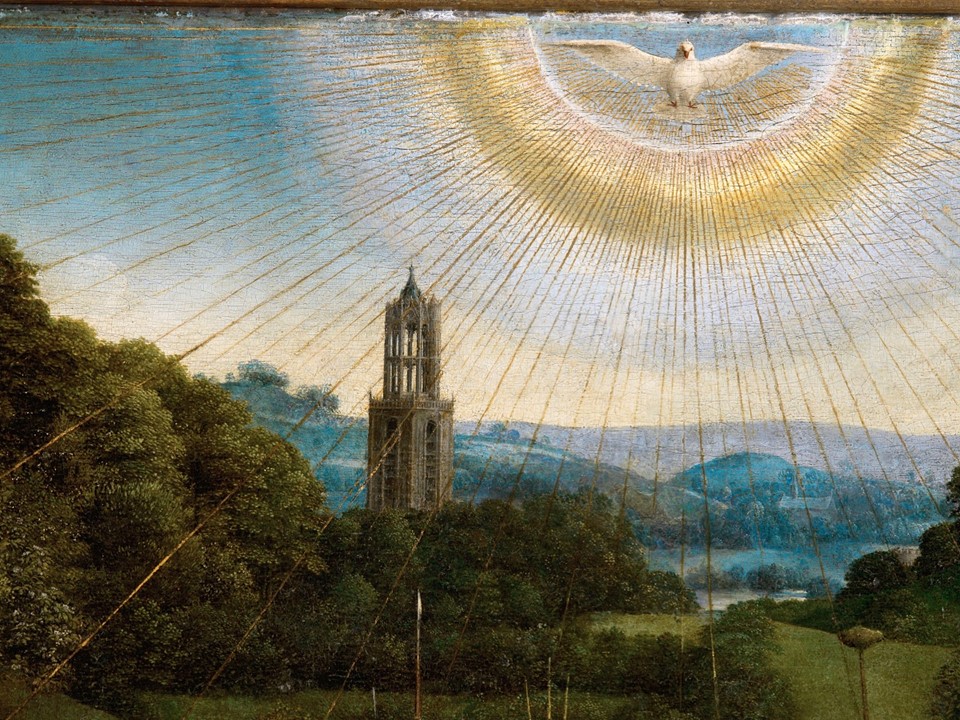
https://artsandculture.google.com/asset/the-ghent-altarpiece-adoration-of-the-mystic-lamb-detail-of-the-holy-spirit-in-the-guise-of-a-dove-hubert-and-jan-van-eyck/MwEFlDeCLbw9RQ
Introducing a former BLOG POST at the 2020 Ghent Museum of Fine Arts Exhibition, titled Van Eyck – An Optical Revolution, I further discuss with my students his painting characteristics: 1. How he perfected the Oil Technique by adding siccatives. With oil paints, he created rich, deep, lustrous colours, flawless golden tones, and amazing life-like textures. 2. How Observation of reality is key to Jan’s Art. For example, his portraits are lifelike to the minutest detail, his depiction of nature and natural phenomena are credible and authentic, his art seems like it’s competing with reality itself! 3. How Observation of Reality is key to Jan’s Art. For example, his portraits are lifelike to the minutest detail, his depiction of nature and natural phenomena are credible and authentic, his art seems like it’s competing with reality itself! 3. How Observing and Painting Optical Light Phenomena shows an artist deeply interested “in the painting of light, so crucial to his optical revolution.” Scholars believe that Jan van Eyck “not only gathers practical but also theoretical knowledge in order to reproduce the effects of light.” https://vaneyck2020.be/en/the-optical-revolution/ and https://www.teachercurator.com/art/van-eyck-an-optical-revolution/
Teaching with Jan van Eyck… Online References PowerPoints and Activities…
For the List of ONLINE References on Jan van Eyck’s oeuvre, TeacherCurator put together, please… Click HERE!
For my PowerPoint on the Ghent Altarpiece, please… Click HERE! https://www.teachercurator.com/wp-content/uploads/2021/02/Twith-JvanE-Ghent2-PP.pptx. List of Slides and Photo Credits for the Ghent Altarpiece PowerPoint, please… Click HERE!
For my PowerPoint on Jan van Eyck’s Oeuvre, please… Click HERE! List of Slides and Photo Credits for Jan van Eyck’s Oeuvre PowerPoint, please… Click HERE!
I always feel confident discussing an artist with my students when I prepare my Steps to Success Lesson Plan Outline…
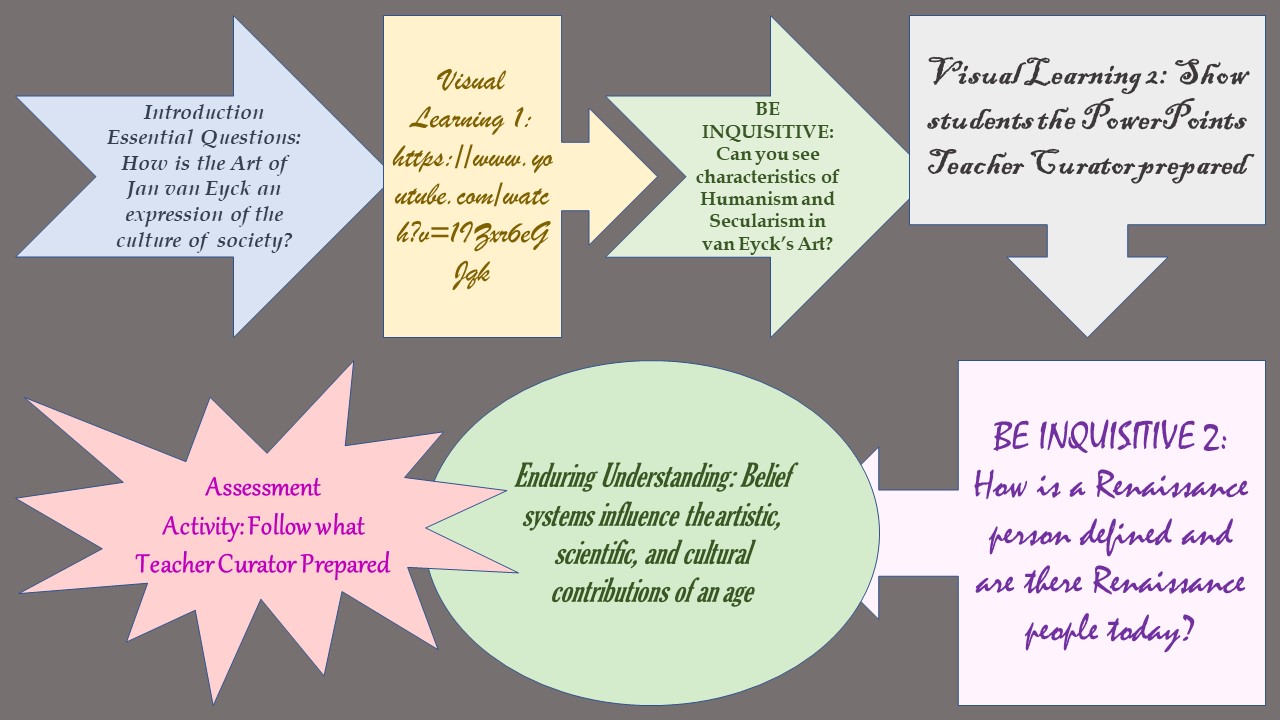
For High School level Student Activity, please… Click HERE!
For a RWAP (Research-Writing-Art-Project), please… Click HERE!
I hope that teaching with Jan van Eyck will prove easy and helpful. Do you think it justifies my BLOG name TeacherCurator?