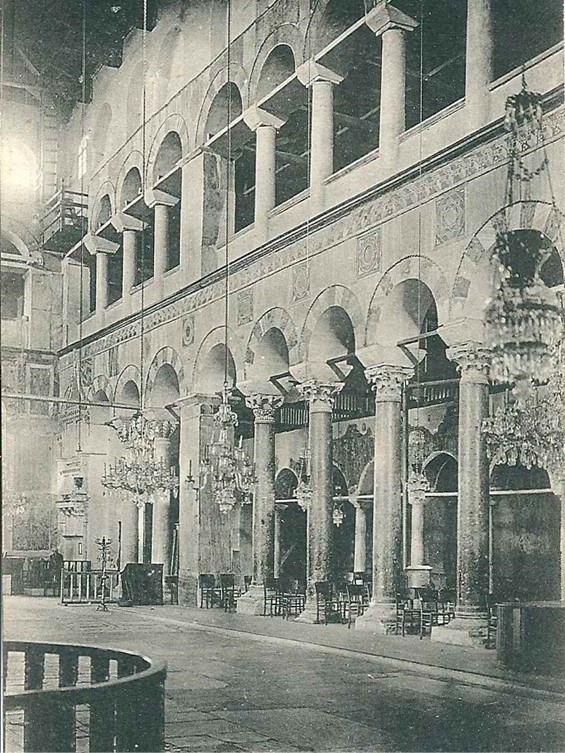
Konstantinos Maleas’s Religious Scene reflects early 20th-century engagement with Thessaloniki’s newly uncovered Byzantine mosaics, especially the Enthroned Virgin, a visual tradition also documented by Walter S. George during his 1907–1909 studies for the British School at Athens.
The Laughing Boy by Robert Henri
Frans Hals’s lively, spontaneous brushwork profoundly influenced modern painters like Édouard Manet, Vincent van Gogh, and Robert Henri, who admired his “modern” immediacy, especially in expressive portraits such as The Laughing Boy.
Happy Birthday Miss Jones by Norman Rockwell
Celebrating World Teachers’ Day, this post pairs Yehuda Amichai’s reflective poem with Norman Rockwell’s Happy Birthday Miss Jones, honoring teachers’ enduring influence, creativity, and commitment to learning across generations.
Monemvasia by Konstantinos Maleas
Maleas’s Monemvasia — held in the Bank of Greece’s remarkable 3,000-piece collection — captures the rugged, historic beauty of a Byzantine city legendarily founded with just one entrance to the sea.
Salvador Dali or Pavlos Samios
Samios’s Awaiting and Dalí’s Figure at the Window — two figures dreaming beyond their frames — beautifully echo George Eliot’s vision of souls yearning outward toward the largeness of the world.
Garden in Corfu by Angelos Giallinas
Angelos Giallinas, a master of atmospheric landscape painting, captured Corfu and Mediterranean scenes with luminous sensitivity, blending precise draftsmanship with the delicate spontaneity of watercolour.
Odilon Redon and Pandora’s Box

Pandora, 1910/1912, oil on canvas, 143.5 x 62.9 cm, NGA, Washington DC, USA https://www.nga.gov/collection/art-object-page.46531.html#bibliography
It is nature also who orders us to obey the gifts she has given us. Mine have led me to dreams; I submitted to the torments of imagination and the surprises she gave me under my pencil; but I directed and led those surprises in accordance with the laws of the organism of art which I know, which I feel, with the single goal of producing in the spectator, by sudden attraction, the whole evocation, and the whole enticement of the uncertain within the confines of thought… writes Odilon Redon in his journals To Myself: Notes on Life, Art, and Artists… and I think of Odilon Redon and Pandora’s Box in Washington DC, at the National Gallery. https://www.goodreads.com/author/quotes/288740.Odilon_Redon
Odilon Redon is one of my favourite artists. As a student, I knew little of him. As a young teacher of Art History I hardly ever used his work… until, preparing for a Lesson Plan on the Myth of Pandora, I rediscovered his Pandora painting at the NGA and the Museum’s wonderful suggestions for Student Activities. My students responded positively to his imaginary world… and I was hooked!

Self-Portrait, 1880, oil on canvas, 33.3×52 cm, Palais des Beaux-Arts de Lille, France https://www.wikiart.org/en/odilon-redon/self-portrait-1880
I like how Odilon’s work is described at ARTSY… “Known for his unique blend of artistic naturalism and symbolic subject matter, Odilon Redon was highly influential among the late 19th century French avant-garde circle. Working in charcoal, pastel, oil, and lithography, Redon created imaginative scenes that, while often based in the supernatural, were nonetheless executed in a highly representational manner. Redon considered this descriptive accuracy essential, writing “every time that a human figure does not give the illusion that it is … about to come out of the picture frame to walk, act or think, the drawing is not a truly modern one.” Redon was influenced by the poetry of Charles Baudelaire and Stéphane Mallarmé and admired by the painters Gustave Moreau and Gustave Klimt—as such he is often remembered as a Symbolist, though Redon preferred autonomy and never actually considered himself part of the group.” What more could I add… https://www.artsy.net/artwork/odilon-redon-ari
My students and I are captivated by the Myth of Pandora and the elusive way Odilon presents her story… Off-centre, Pandora stands in front of an atmospheric background, misty and hazy, luminous, ethereal and a touch, mysterious. The power of the artist’s mind creates organic forms, indistinct and intangible. The colours the artist uses are subtle, understated, yet joyous, warm and earthy. The box in Pandora’s hands is small, easily discerned buts not ostentatious… http://www.hellenicaworld.com/Art/Books/en/BeyondTheVisibleTheArtOfOdilonRedon.html

The Creation of Pandora, 460BC-450 BC, Attic Red Figure Calyx krater, attributed to the Niobid Painter, Archaic period, British Museum https://www.britishmuseum.org/collection/object/G_1856-1213-1
The myth of Pandora is beautifully told by the experts of the National Gallery of Art in Washington DC… According to Greek mythology, in the beginning the earth was free from toil and misery. The land was covered with flowers and the rivers flowed with milk and honey. Earth was inhabited only by men, who had been created by Prometheus. He made them of clay and modeled them after the gods, which angered Zeus, the king of the gods. When Prometheus offended Zeus again by stealing fire from heaven to give to man, Zeus exacted revenge. He ordered Hephaestus, the god of the forge, to create Pandora, the first woman. The gods gave her many traits including beauty, curiosity, charm, and cleverness. Hence her name “Pandora,” meaning “all gifted” or, alternately, “a gift to all.” Before he left Pandora on earth, Zeus handed her a beautiful box saying, “This is my own special gift to you. Don’t ever open it.” As Zeus anticipated, Pandora’s curiosity got the best of her, and she opened the box, ending earthly paradise. From the small chest flew troubles and woes—sorrow, disease, vice, violence, greed, madness, old age, death—to plague humankind forever. However, Zeus did not realize that hope had been secretly added to the box by Promethesus. When Pandora opened the box and released trouble and woe into the world, hope was there to help people survive. https://www.nga.gov/education/teachers/lessons-activities/origin-myths/pandora.html
For interesting Student Activities, please click and explore the NGA site… https://www.nga.gov/education/teachers/lessons-activities/origin-myths/pandora.html
The myth of Pandora’s box by Iseult Gillespie at TEDEd is worth exploring… https://ed.ted.com/lessons/the-myth-of-pandora-s-box-iseult-gillespie
For a PowerPoint on the Myth of Pandora Teacher Curator prepared, please… Click HERE!

Pandora, 1914, oil on canvas, 143.5 x 62.2 cm, the MET, NY https://www.metmuseum.org/art/collection/search/437383
Clean Monday Feast

Clean Monday Feast, 1950, oil on wood, 125×78, Municipality of Rhodes Museum of Modern Greek Art
https://paletaart.wordpress.com/2012/08/06/%CE%B2%CE%B1%CF%83%CE%B9%CE%BB%CE%B5%CE%AF%CE%BF%CF%85-%CF%83%CF%80%CF%8D%CF%81%CE%BF%CF%82-spyros-vassiliou-1903-1985/#jp-carousel-4424
Could Isaiah (Isaiah 1:1–20) introduce us to the theme of Clean Monday with his Old Testament verses? “Wash yourselves; make yourselves clean; remove the evil of your doings from before my eyes; cease to do evil, learn to do good; seek justice, rescue the oppressed, defend the orphan, plead for the widow. Come now, let us argue it out, says the Lord: though your sins are like scarlet, they shall be like snow; though they are red like crimson, they shall become like wool. If you are willing and obedient, you shall eat the good of the land; but if you refuse and rebel, you shall be devoured by the sword; for the mouth of the Lord has spoken.” Are the following Matthew verses (Matthew 6:14–21) indicative of the Greek Orthodox festive, springtime atmosphere of Clean Monday? “When ye fast, be not, as the hypocrites, of a sad countenance: for they disfigure their faces, that they may appear unto men to fast. Verily I say unto you, They have their reward. But thou, when thou fastest, anoint thine head, and wash thy face, that thou appear not unto men to fast, but unto thy Father which is in secret…” I like to think that the painting Clean Monday Feast by Spero Vassiliou embodies Matthew’s recommendations and presents the glorious Greek Clean Monday at its best! https://bible.oremus.org/?passage=Isaiah%201:1%E2%80%9320&version=nrsv and https://bible.oremus.org/?passage=Matthew%206:14%E2%80%9321&version=nrsv
Austerity and Affluence… two words that best describe, in my humble opinion, Vassiliou’s painting Clean Monday Feast in the Municipality of Rhodes Museum of Modern Greek Art. Let me explain…
Austerity… in the green, tripod, metal table, centrally displayed, full of traditional νηστίσιμα(fasting foods) humble delicacies that mark the beginning of Lent… for the day, Clean Monday, when relatives and friends celebrate the upcoming period of humility, self-criticism and mutual forgiveness. Vassiliou’s green coloured table displays a piece of Lagana, the unleavened popular bread of the day, Throubes, sun-dried black olives, crunchy spring onions, the grocer’s halva with tasty almonds, the heart of tender lettuce, a deep yellow plate full of crisp, local “greens,” a white plate with salty, but so tasty red fish roe, and retsina, the Greek resinated white wine, popular in Greece for at least 2,000 years.
Affluence… in the love the artist held for the simple things of everyday life, insignificant at first sight, yet eloquent, meaningful and deeply moving for all the initiates of Greek Clean Monday rituals. Spero Vassiliou’s family tradition for Clean Monday was to invite his friends for a day’s feast on the roof(ταράτσα) of his house, below the Acropolis of Athens! The 1950 painting, titled Clean Monday Feast, is glowingly colourful, brightly sunny, gloriously festive!

Spero Vassiliou “studied painting at the “School of Arts” (later Athens School of Fine Arts) from 1921 to 1926. He was among the students who struggled for the reorganization of the School and who attended the studio of the newly elected professor, Nikos Lytras.” An active member of the Greek Artists Association, Vasiliou put together solo exhibitions as early as 1929, participated in creating stage design and costumes for about 140 plays, and won the prestigious Academy of Athens Award for designing the frescoes in the church of Saint Dionysius Areopagites in Athens. By the late 1940s, Vassiliou was an active member of the Greek intelligentsia representing a style linked to surrealism or pop art with a dominant dose of “aspects of contemporary Greek life in a picturesque and vivid way, sometimes inspired by folklore forms…” http://dp.iset.gr/en/artist/view.html?id=1080

https://www.rodos-palace.gr/discover-rhodes/510/Museums-and-Antiquities/
The painting Clean Monday Feast by Spero Vassiliou is part of the Collection of the Municipality of Rhodes Museum of Modern Greek Art. The driving force behind the creation of the Municipality Museum was Andreas Ioannou, “a distinguished scholar of modern Greek art, writer and prefect of Dodecanese.” He foresaw the leading role Rhodes could play as a cultural center of international fame and decided, back in the 1950s, to create an emblematic Museum of Modern Greek Art. “For this reason he came in contact with the leading Greek artists, acquired their emblematic works and housed them in the historic building of Symi Square at the entrance of the Medieval City of Rhodes, which is now a UNESCO World Heritage Site.” https://www.mgamuseum.gr/el/to-mouseio/
Today, the Municipality Museum has 4 very distinct Art Galleries. The original Historic Building on Symi Square is the center where Engravings of the 19th – 20th centuries, Publications and Posters will be exhibited. The “Nestorideion Melathron” houses the Museum’s permanent collection of 20th century Modern Greek Art, including Vassiliou’s Clean Monday Feast. The Modern Art Centre, situated at the main thoroughfare in the Medieval Town “Palaio Syssitio,” has been chosen as the center for the first permanent exhibition dedicated to the famous and characteristic Rhodesian Ceramic Art. Finally, in 2010, the Museum inaugurated a new center dedicated to the cultural activities of the island. https://www.mgamuseum.gr/el/to-mouseio/
Get enthused by Spero Vassiliou’s Painting Clean Monday Feast and prepare a Student Activity inspired by the depicted Kites! Use a List of ONLINE sites to find out what best suits your students! Click HERE!
Matisse and Jazz
Matisse’s Jazz — bold, improvisational, electric with colour — mirrors the music it celebrates. Two dazzling pochoirs in Athens invite us to feel rhythm through cut paper and pigment.
Watercolours by Howard Carter
Before discovering Tutankhamun’s golden tomb, Howard Carter was a teenage tracer painting Egyptian hieroglyphs in watercolour — his artist’s eye forever shaping one of archaeology’s greatest discoveries.