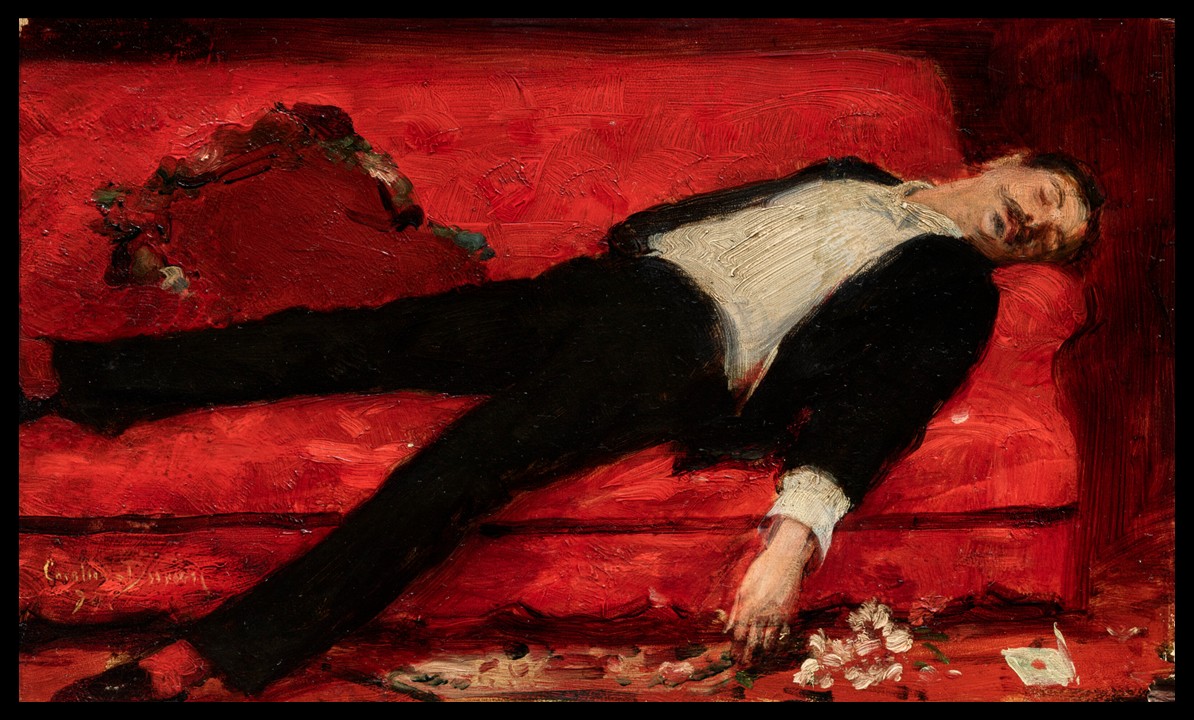
The Letter, 1889 (?), Oil on Canvas, 18×30 cm, Private Collection
https://www.christies.com/en/lot/lot-6554862?ldp_breadcrumb=back
A letter lies torn open on the floor. Besides it, a bouquet, discarded, not placed. On the sofa above them, a young man has collapsed into the cushions, eyes closed, one arm surrendered to gravity. Something has happened in this room. Carolus-Duran’s The Letter and the Reveler is asmall 1889 oil painting that asks more than it answers, and that is precisely what makes it unforgettable.
One Scene, Two Stories
The painting has travelled under two names. On the reverse of the canvas, inscriptions record both The Letter and The Reveler, as if even those closest to the work couldn’t agree on what they were looking at. And that ambiguity is not a flaw. It is the painting’s whole point. Look again at the bouquet. In the story of the reveler, those flowers are the remnants of a festive night: bought on a whim, carried home, dropped without ceremony by someone who made it through the door and no further. The letter? A bill, perhaps. A party invitation already answered in person. Nothing dramatic.
But in the story of the broken-hearted, everything changes. The bouquet was meant as a gift, for someone who never received it, or who refused it. The letter brought news that emptied the room of its air. The man on the sofa is not sleeping off champagne. He is somewhere else entirely, unreachable. The composition refuses to decide between these readings. That is what makes it linger.
Carolus-Duran and the Influence of Édouard Manet
Carolus-Duran is remembered today primarily as a portraitist, the elegant, sought-after painter of Parisian high society, and later the influential teacher of John Singer Sargent. But this small painting of the Letter and the Reveler reveals a different side of the artist: one drawn to the ordinary, the unguarded, the upstaged.
That instinct connects directly to his friendship with Édouard Manet (1832–1883), whom he met in the early 1860s. The two men genuinely inspired one another, though art history, with its appetite for tidy oppositions, would later position them as rivals. The looser, more spontaneous brushwork visible in The Letter carries Manet’s directness: a willingness to paint life as it falls, not as it poses. By 1889, the year this painting was likely executed, Manet had been dead for six years. But his influence remained present in exactly this kind of scene: interior, unidealized, morally open-ended.
Why The Letter Feels So Intimate
Part of what makes The Letter so affecting is its scale. At 18×30 cm, this is not a painting designed to dominate a wall or impress a salon. It is intimate in the truest sense, the kind of work you lean toward rather than step back from.
The spontaneity of the execution reinforces this. Carolus-Duran is not building toward a grand statement. He is catching something: a moment of aftermath, a room mid-breath. The paint moves quickly across the canvas. The sofa is suggested more than described. The figure is heavy with the weight of whatever has overcome him. This is Carolus-Duran the observer, not the portraitist of Marguerite Stern (whose stately 1889 portrait now hangs in the Petit Palais in Paris), but the painter slipping between the cracks of official commissions to record what Parisian life actually looked like when no one was performing.
The Question the Painting Leaves You With
The attribution of Carolus-Duran’s The Letter and the Reveler was recently confirmed by the specialists Brame & Lorenceau following a physical examination of the work, adding a pleasing detective-story quality to a painting already full of mysteries. But the central mystery remains unresolved, and deliberately so. A letter on the floor. A bouquet no one wanted, or no one received. A man beyond reach on a sofa. Which story do you believe?
PowerPoint Presentation: Ready to Dive Deeper? Download the presentation and explore Carolus-Duran’s oeuvre at your own pace, ideal for sharing, discussing, or simply learning more. Get the PowerPoint →
Continue Exploring on Teacher Curator: Expand your understanding of 19th century Academic Art: The First Kiss of Sunlight and John George Brown’s Sunshine
Sources and further Reading: Christie’s presentation of Carolus-Duran’s painting The Letter: https://www.christies.com/en/lot/lot-6554862?ldp_breadcrumb=back and the Eeclectic Light Company Carolus-Duran: Portraits and pupils 1 https://eclecticlight.co/2017/02/16/carolus-duran-portraits-and-pupils-1/