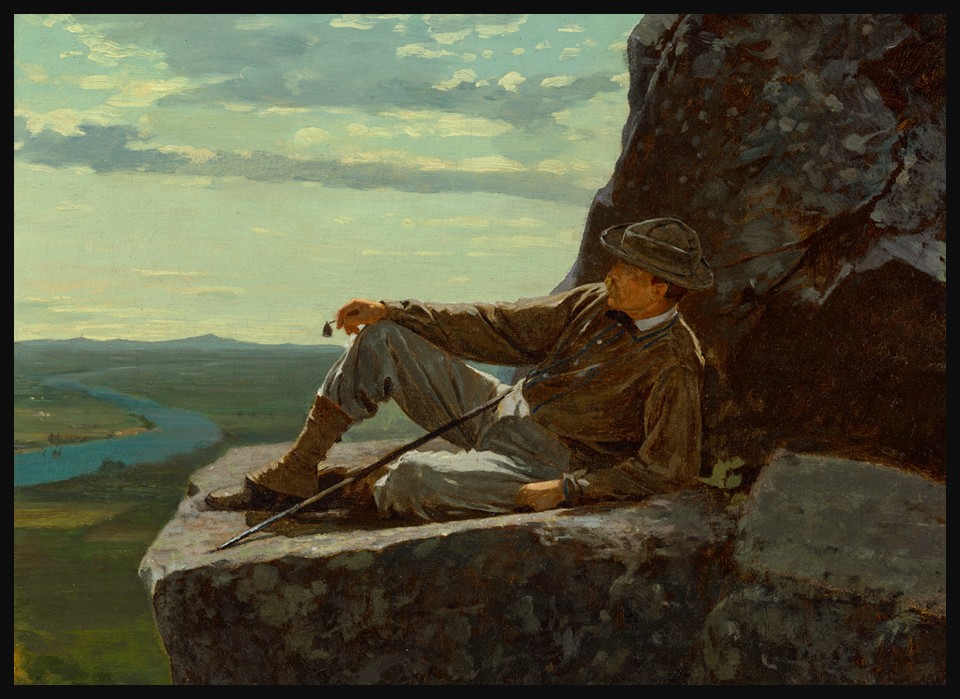
A Mountain Climber Resting, 1869, Oil on Canvas, 26.7 x 36.8 cm, Private Collection
https://www.christies.com/en/lot/lot-6569220?ldp_breadcrumb=back
In 1869, the American painter Winslow Homer created a small but striking oil painting titled A Mountain Climber Resting. At first glance, the scene seems simple: a lone hiker lies back comfortably on a rocky summit, gazing across a vast mountain landscape. Yet this quiet moment captures an important shift in the way Americans thought about nature, leisure, and national identity in the late nineteenth century.
The painting was inspired by Homer’s visit to the White Mountains of New Hampshire, one of the most popular tourist destinations in the United States during the nineteenth century. Travelers were drawn to the dramatic scenery of peaks and valleys, especially around Mount Washington, the region’s highest summit. By the 1860s, visiting the mountain had become easier than ever: roads, hotels, and even the newly opened Mount Washington Cog Railway made the journey accessible to growing numbers of tourists. The White Mountains therefore represented not only the beauty of American wilderness but also the rise of a new culture of leisure travel.
Earlier American landscape painters, particularly those associated with the Hudson River School, had emphasized the grandeur and spiritual power of nature. Artists such as Thomas Cole and Albert Bierstadt created sweeping panoramas that placed the viewer before the vastness of the natural world. Homer’s approach in A Mountain Climber Resting is different. Rather than presenting an empty wilderness, he places a human figure directly within the landscape. The climber becomes the focal point of the painting, inviting us to consider not only the scenery but also the experience of encountering it.
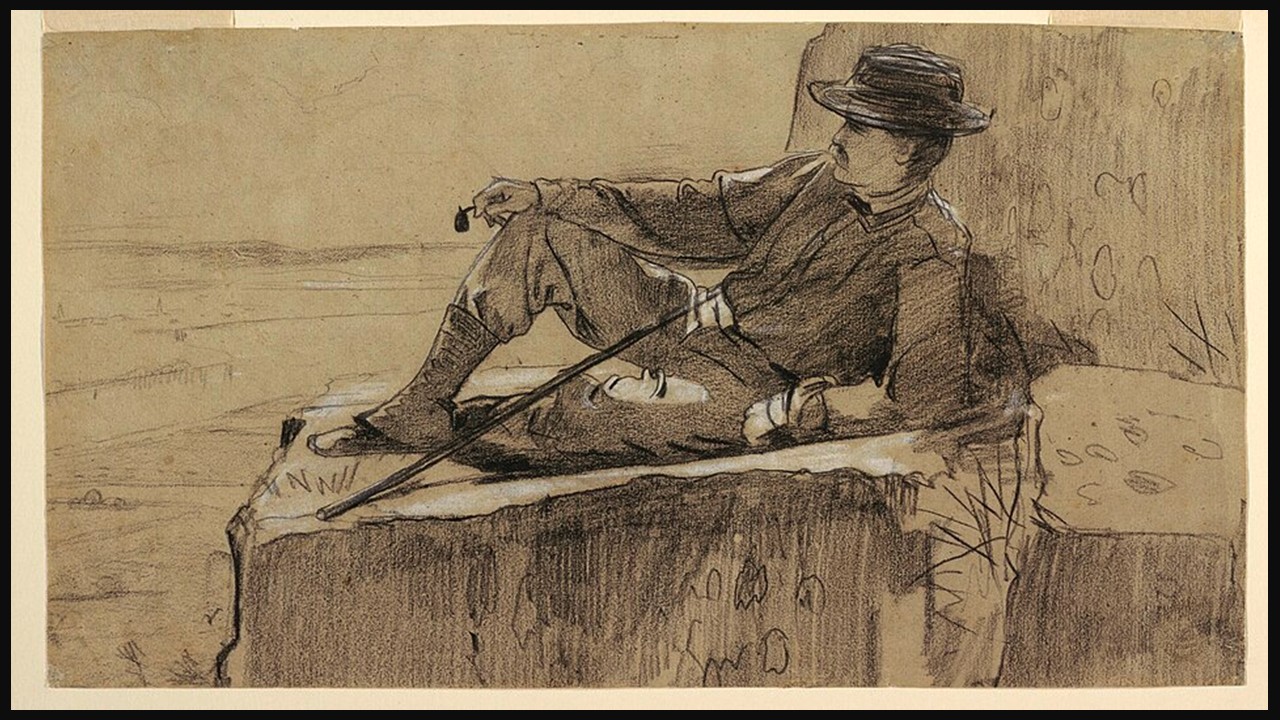
A Mountain Climber Resting, 1868-9, Black and white crayon on brown laid paper, 19.5 x 35 cm, Cooper Hewitt, Smithsonian Design Museum
https://commons.wikimedia.org/wiki/File:Drawing,_Study_for_%22Mountain_Climber_Resting%22,_1868%E2%80%9369_(CH_18175509).jpg
.jpg)
The man stretches out confidently on the rocky summit, pipe in hand, pausing to enjoy the view below. His relaxed posture suggests both physical effort and quiet satisfaction. He has reached the top and now takes time to contemplate the landscape around him. In this sense, the painting captures one of the emerging leisure activities of the late nineteenth century: recreational hiking and mountaineering. For many Americans, climbing mountains was becoming a way to experience nature more directly, transforming wilderness from a distant spectacle into a place of personal adventure.
Seen in this light, Homer’s solitary climber can also be read as a symbol of the American spirit in the years following the Civil War. The figure stands alone against the vastness of nature, embodying ideals of independence, resilience, and self-reliance. These qualities had long been associated with the American frontier, and Homer’s painting subtly transfers them to the mountainous landscapes of the northeastern United States.
At the same time, the work hints at the artistic direction Homer would pursue later in his career. The rocky foreground and the figure are carefully defined, while the distant landscape becomes softer and more atmospheric. This contrast between detail and broad, simplified forms anticipates the powerful landscapes Homer would paint in the following decades.
Although modest in size, A Mountain Climber Resting captures a fascinating moment in American cultural history. It reflects the growing popularity of tourism, the changing relationship between people and nature, and the enduring appeal of the lone individual contemplating the vast American landscape. Through a quiet scene of rest at the summit, Homer offers a thoughtful meditation on what it meant to explore—and to belong to… the American wilderness.
For a PowerPoint Presentation of Winslow Homer’s oeuvre, please… Check HERE!
Bibliography: Christie’s presentation of the painting A Mountain Climber Resting https://www.christies.com/en/lot/lot-6569220?ldp_breadcrumb=back