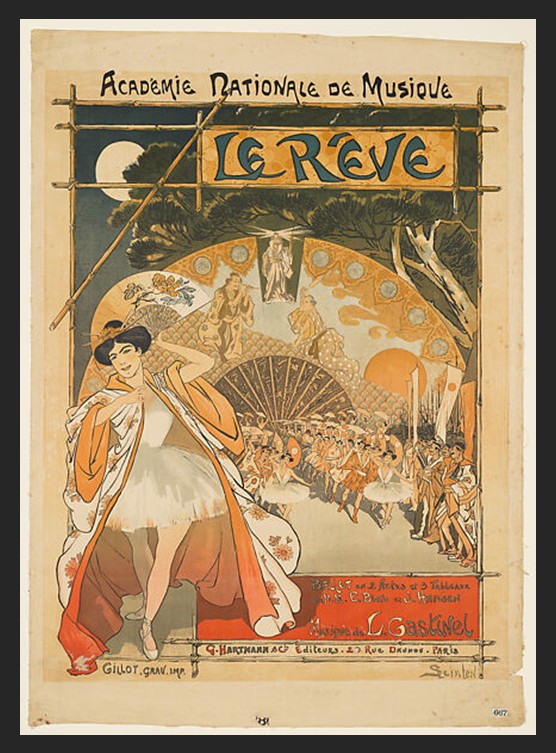
Le Rêve (Académie Nationale de Musique), 1890, Photo relief print (gillotage), 89×63.7 cm, the MET, NY, USA
https://www.metmuseum.org/art/collection/search/788347
In the final decades of the nineteenth century, Paris was captivated by all things Japanese. From ceramics and textiles to woodblock prints, Japanese art profoundly influenced European artists, giving rise to the artistic movement known as Japanism. One striking example is Théophile-Alexandre Steinlen’s Le Rêve (Académie Nationale de Musique), created in 1890, a poster that combines innovative printing, theatrical advertising, and a romantic vision of Japan. Today, this remarkable work is part of The Metropolitan Museum of Art in New York.
A Poster for the Paris Opera
At first glance, Le Rêve appears to transport viewers into a dreamlike Japanese landscape. A graceful dancer, dressed in a flowing kimono layered over a Western ballet tutu, stands before a large decorative folding fan. Behind her, a full moon, pine tree, and bamboo frame complete the serene composition.
The poster was created to advertise Le Rêve, a ballet composed by Léon Gastinel and performed at the Académie Nationale de Musique, better known as the Paris Opéra, in 1890. Although the ballet was supposedly set in sixteenth-century Japan, it reflected the European imagination more than authentic Japanese culture. Like many works of the period, it presented an idealized vision shaped by fascination rather than firsthand knowledge.
Steinlen Before Le Chat Noir
Although Théophile-Alexandre Steinlen (1859–1923) is best remembered today for his iconic Le Chat Noir poster and his sensitive depictions of Parisian street life, Le Rêve represents an important stage in his artistic development.
Here, Steinlen demonstrates his ability to simplify forms into elegant silhouettes, balance decorative patterns with clear composition, and create an image that is both visually striking and immediately memorable. These qualities would soon make him one of the leading poster artists of the Belle Époque.
The Influence of Japonisme
By 1890, Japanese ukiyo-e prints had become a major source of inspiration for European artists. Their bold outlines, flattened perspective, asymmetrical compositions, and decorative use of colour offered a refreshing alternative to traditional academic painting.
Steinlen incorporated many of these characteristics into Le Rêve. The large folding fan, delicate bamboo stalks, moonlit background, and simplified forms all echo Japanese aesthetics. Yet the work also reveals how nineteenth-century Europe often blended authentic Japanese motifs with Western theatrical fantasy. The dancer’s costume—combining a kimono with a classical ballet tutu—is a perfect example of this cultural fusion. Rather than depicting Japan itself, the poster reflects how Japan was imagined in Belle Époque Paris.
Charles Gillot and the Art of Printing
The poster also celebrates a remarkable achievement in printing technology. It was printed by Charles Gillot, whose family developed the innovative photo-relief process known as “gillotage.”
This technique used photography to transfer an artist’s drawing onto a metal relief printing plate, allowing images to be reproduced with exceptional clarity while keeping production costs relatively low. Gillotage enabled artists like Steinlen to preserve the expressive quality of their original drawings while producing posters in large quantities. Advances such as these transformed posters from simple advertisements into collectible works of art, helping define the visual culture of the Belle Époque.
Why Le Rêve Still Matters
More than a theatrical advertisement, Le Rêve captures a fascinating moment in European art history when artistic innovation, technological progress, and global cultural exchange intersected. The poster reminds us that cultural encounters are often complex. While it reflects genuine admiration for Japanese art, it also illustrates how foreign cultures were frequently reinterpreted through a European lens.
Today, it offers valuable insight into both the creative excitement and the limitations of nineteenth-century artistic imagination. Beautifully designed and historically rich, Steinlen’s Le Rêve remains an outstanding example of how a poster can transcend its original purpose to become a lasting work of art.
Classroom Activity: Bring Japanism Art to life in your classroom with this hands-on student activity inspired by ‘Le Rêve’, Théophile-Alexandre Steinlen’s print. Explore the full Student Activity →
Continue Exploring on Teacher Curator: Expand your understanding of Japonism in Art with related articles: Impressionism and Japonism and Variations in Flesh Colour and Green.
Sources and further Reading: For readers interested in learning more about Japonism, the Metropolitan Museum of Art offers excellent resources. Explore Théophile-Alexandre Steinlen’s Le Rêve (Académie Nationale de Musique) (1890) in the Museum’s online collection https://www.metmuseum.org/art/collection/search/788347, and read the MET’s comprehensive essay on the origins, development, and lasting influence of Japonism in 19th-century art https://www.metmuseum.org/essays/japonisme.