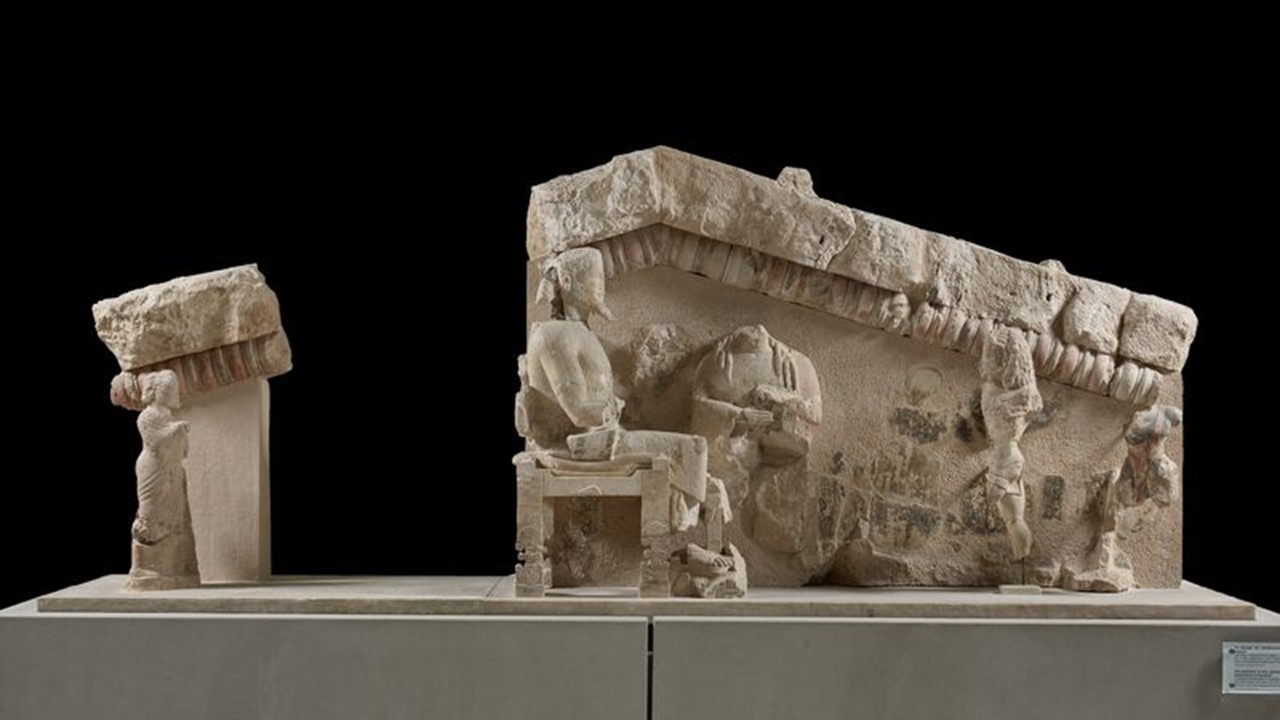
Hail, lord, son of Zeus!” — so opens Homeric Hymn 15, perfectly capturing the divine glory of Herakles, whose Apotheosis Pediment now greets us from the Acropolis Museum.
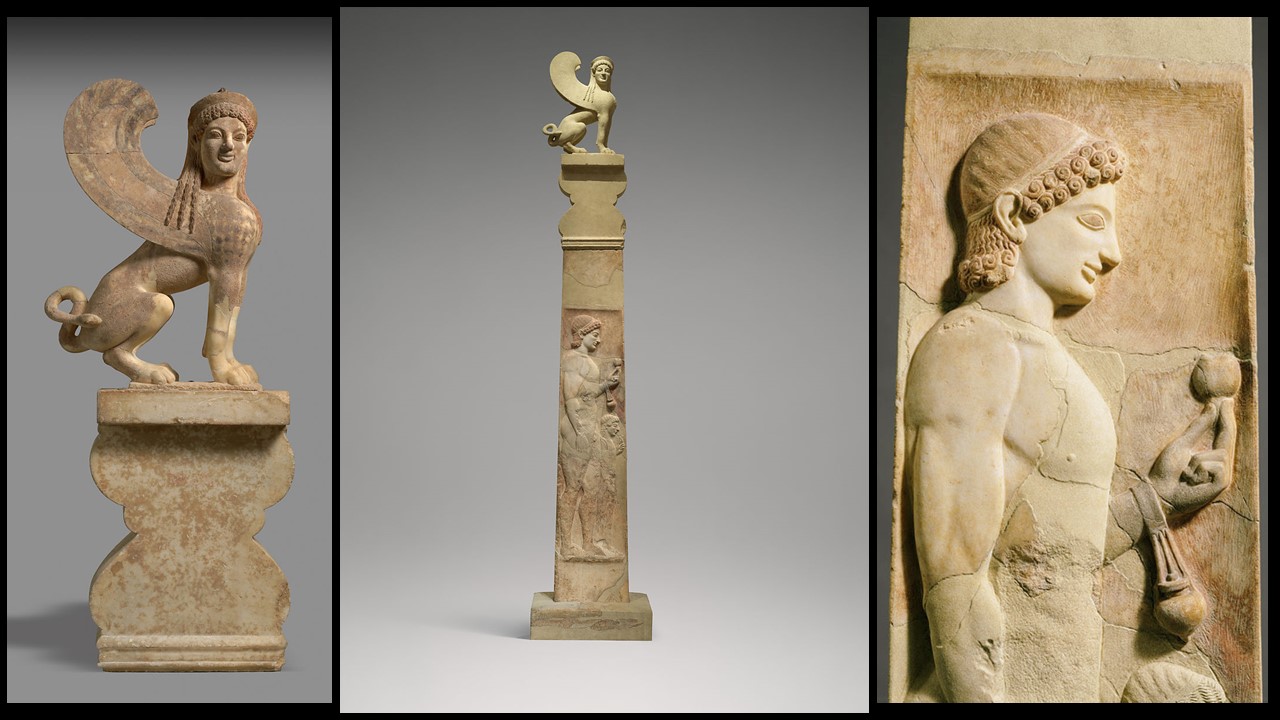
Grave Stele of a Youth and a little Girl
Standing 4.23 meters tall, brilliantly painted, the MET’s Archaic grave stele of Megakles — crowned by a sphinx — remains antiquity’s most complete surviving monument of its kind.
Peplos Kore
The Peplos Kore, discovered in the Acropolis “Perserschutt,” is a richly painted Archaic Greek statue of a young woman whose formal pose, elaborate drapery, and uncertain identity—possibly a votive figure or goddess like Artemis—reflect early experimentation with representation, colour, and sacred imagery in Greek sculpture.
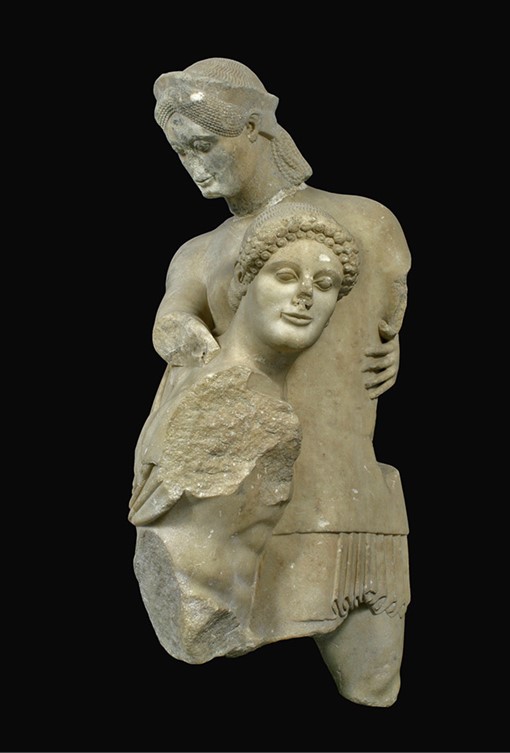
Theseus and Antiope
The Theseus and Antiope pediment sculpture from Eretria (late 6th century BC) captures a pivotal Archaic moment of abduction, blending emerging naturalism with restrained emotional tension in early Greek monumental sculpture.
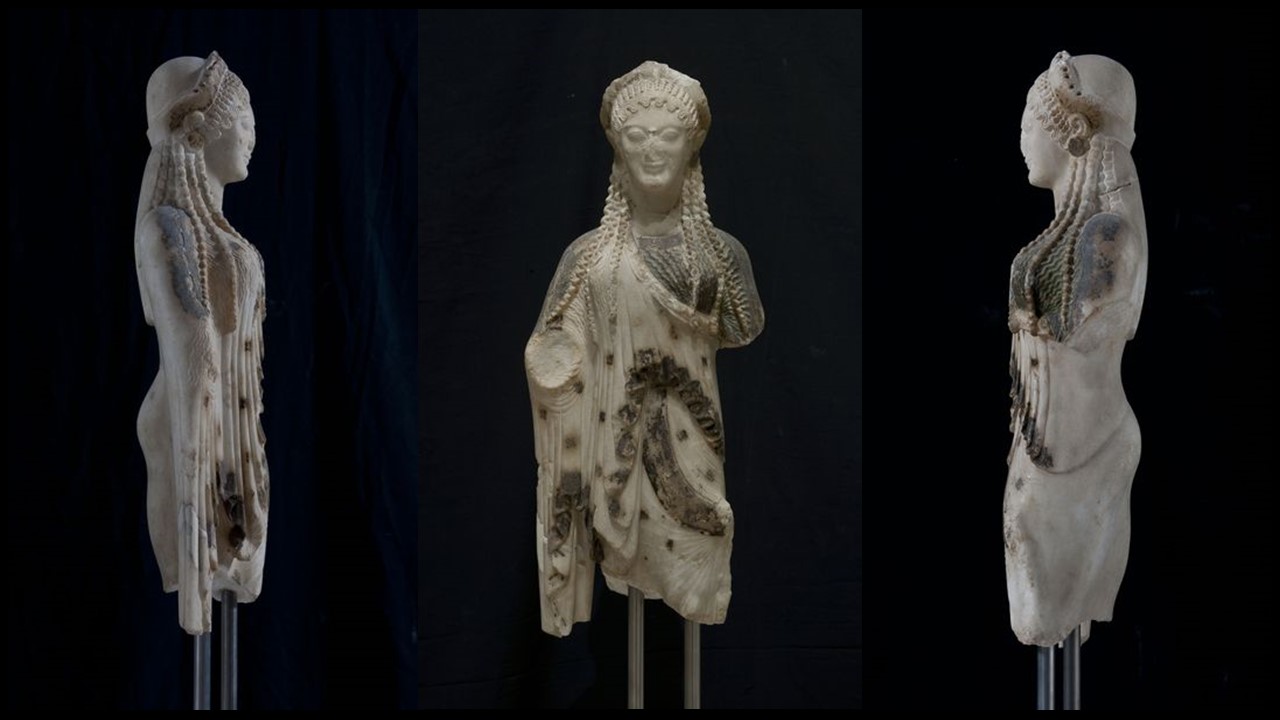
“Κάλλος” and the Kore from Chios
The “Kore from Chios,” displayed in the Kallos exhibition at the Museum of Cycladic Art, embodies Archaic Greek ideals of beauty (kallos) as a unity of physical elegance, refined drapery, and inner virtue.
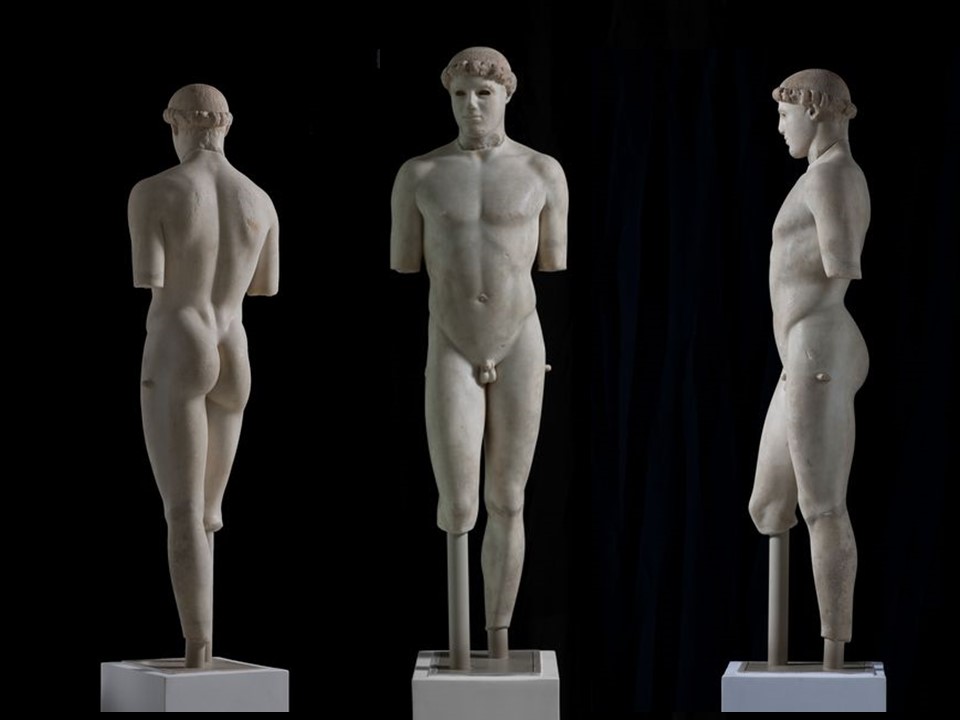
Teaching with the Kritios Boy

Teaching with the Kritios Boy is a set of student activities and worksheets inspired by an awe-inspiring work of art created by a remarkable artist, a daring creator, and an amazing innovator! According to the Acropolis Museum experts, The statue’s torso was found in 1865-1866 southeast of the Parthenon, while the head in 1888 near the south walls of the Acropolis. It is one of the most important works of ancient Greek art and the most characteristic of the so-called “Severe Style”. Archaeologists have dubbed it the “Kritios Boy”, after the name of the sculptor believed to have created it. The “Kritios Boy” is depicted standing in the nude. He supports his weight on his left leg, while the right one remains loose, bent at the knee, in the characteristic posture of the “Severe Style”. His expression is solemn and his eyes, which were originally crafted from another material, have not survived. His hair follows the shape of his scalp and is tightly gathered around a ring with a few scattered strands falling on his temples and the nape of his neck. Traces of red dye are preserved on his hair. The attribution of this statue to the sculptor Kritios is based on the similarities it presents with the statue of Harmodios from the bronze group of the Tyrannicides, a work of Kritios in collaboration with Nesiotes. This group, known to us today through marble copies of the Roman period, was erected in the Ancient Agora of Athens. Who does this statue portrays, however, is not known. Some scholars believe he represents a young athlete, the winner of an event in the celebration of the Greater Panathenaia. Others claim he depicts a hero, most likely Theseus. Moreover, they link the dedication of the statue on the Acropolis with the activities of 476/5 BC, when Kimon transferred Theseus bones from the island of Skyros to Athens. https://www.theacropolismuseum.gr/en/youth-statue-kritios-boy

Teaching with the Kritios Boy References, PowerPoint, and Activities…
For a List of ONLINE References on the Kritios Boy TeacherCurator put together, please… Click HERE!
For my PowerPoint on the Kritios Boy, please… Click HERE!
I always feel confident discussing an artist with my students when I prepare my Steps to Success Lesson Plan Outline…

For Student Activities (3 Activities), please… Click HERE!

Aristodikos Kouros, 510-500 BC, Marble from the island of Paros, Height: 1.9 m, National Archaeological Museum, Athens, Greece http://nam.culture.gr/portal/page/portal/deam/virtual_exhibitions/EAMS/EAMG3938
Kritios Boy, 480 BC, Marble from the island of Paros, Height: 116.7 m, Acropolis Museum, Athens, Greece https://www.theacropolismuseum.gr/en/youth-statue-kritios-boy
I hope, Teaching with the Kritios Boy, will prove easy and helpful. Do you think it justifies my BLOG name Teacher Curator?

https://gr.pinterest.com/pin/682436149758725905/
Aristodikos Kouros (face), 510-500 BC, Marble from the island of Paros, Height: 1.9 m, National Archaeological Museum, Athens, Greece https://arthistorykmg.omeka.net/items/show/106
Kritios Boy (face), 480 BC, Marble from the island of Paros, Height: 116.7 m, Acropolis Museum, Athens, Greece http://ancientrome.ru/art/artworken/img.htm?id=5960
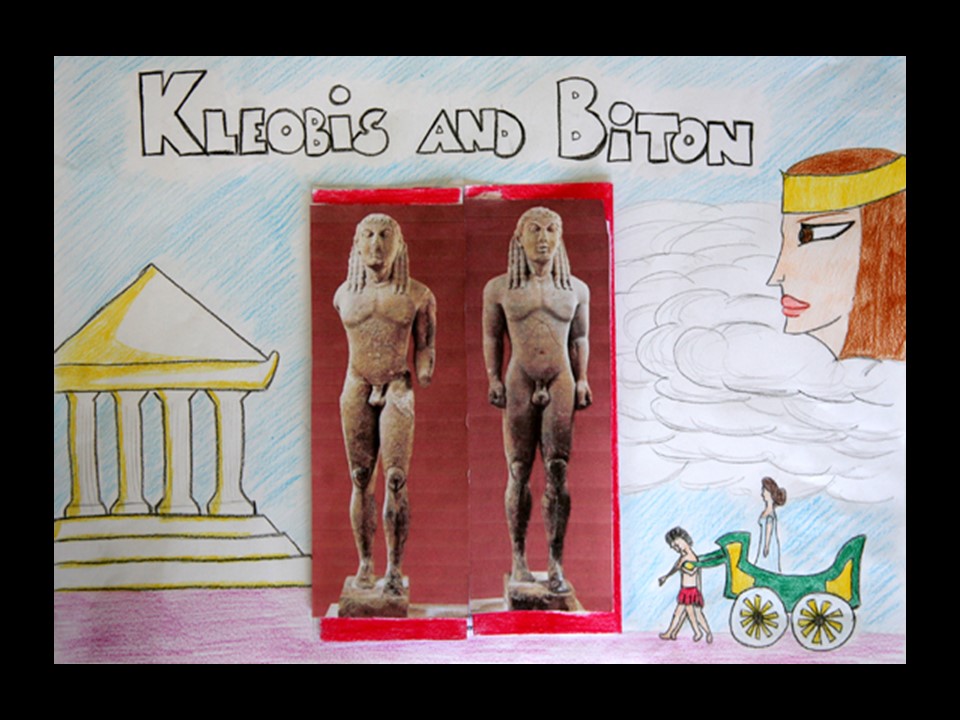
Cleobis and Biton

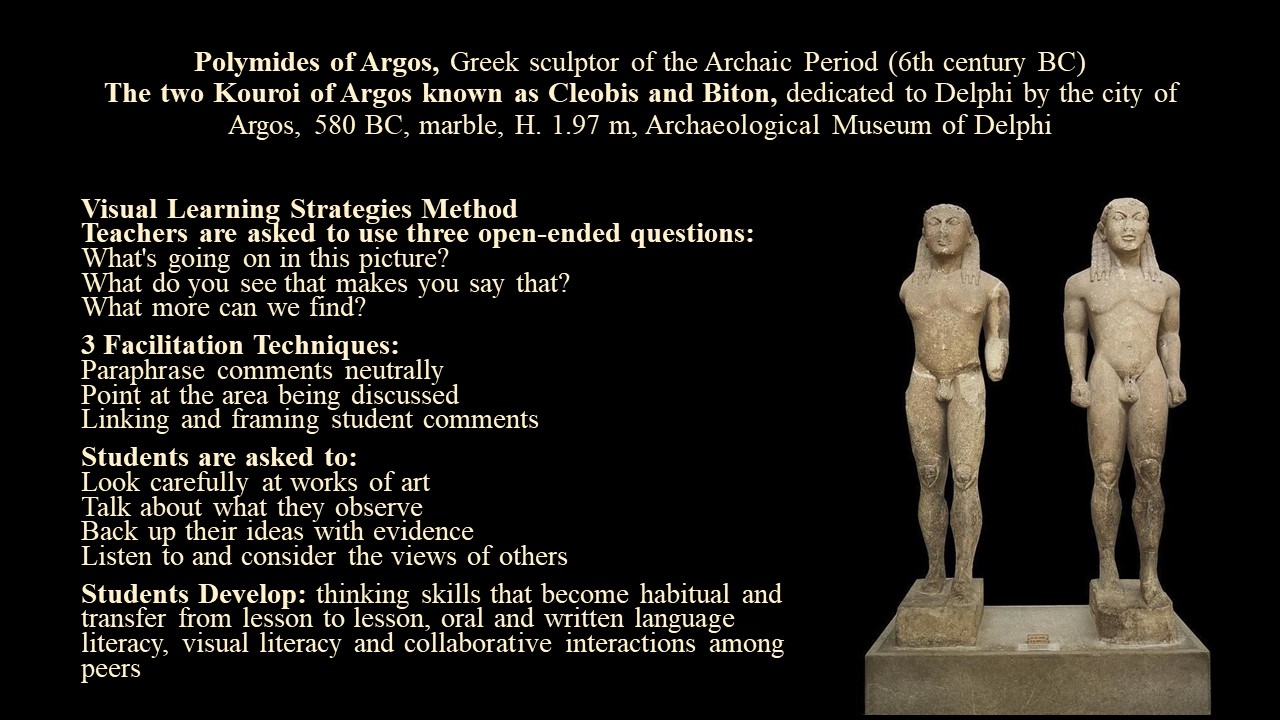
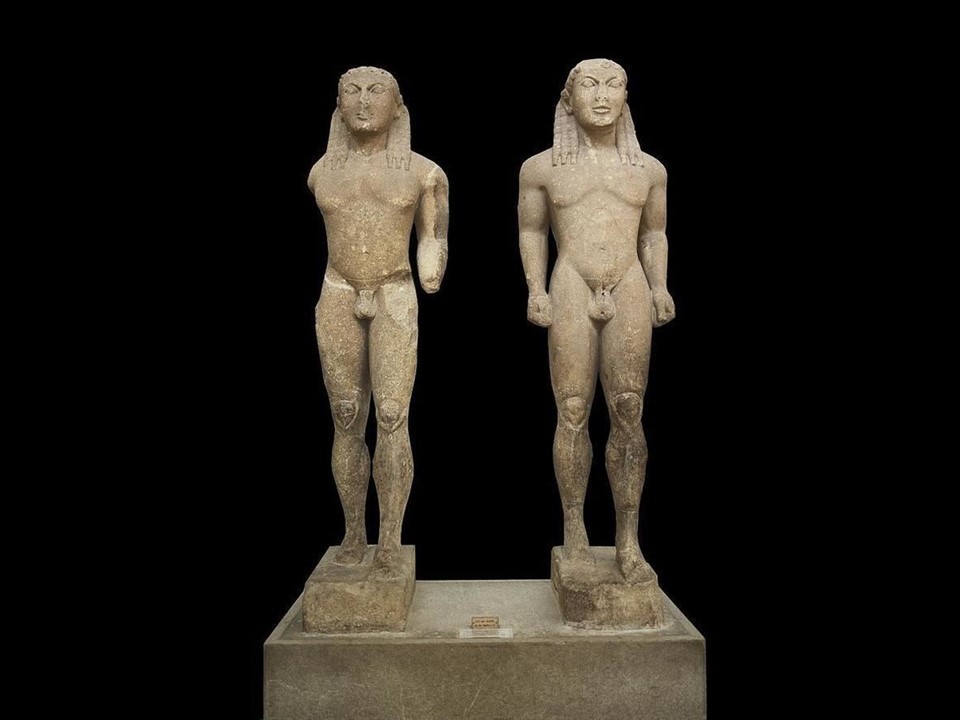
The two Kouroi of Argos, known as Cleobis and Biton, dedicated to Delphi by the city of Argos, 580 BC, marble, H. 1.97 m, Archaeological Museum of Delphi
https://alchetron.com/Kleobis-and-Biton
“Cleobis and Biton,” according to Herodotus “were of Argive stock, had enough to live on, and on top of this had great bodily strength. Both had won prizes in the athletic contests, and this story is told about them: there was a festival of Hera in Argos, and their mother absolutely had to be conveyed to the temple by a team of oxen. But their oxen had not come back from the fields in time, so the youths took the yoke upon their own shoulders under constraint of time. They drew the wagon, with their mother riding atop it, traveling five miles until they arrived at the temple. When they had done this and had been seen by the entire gathering, their lives came to an excellent end, and in their case the god made clear that for human beings it is a better thing to die than to live. The Argive men stood around the youths and congratulated them on their strength; the Argive women congratulated their mother for having borne such children. She was overjoyed at the feat and at the praise, so she stood before the image and prayed that the goddess might grant the best thing for man to her children Cleobis and Biton, who had given great honor to the goddess. After this prayer they sacrificed and feasted. The youths then lay down in the temple and went to sleep and never rose again; death held them there. The Argives made and dedicated at Delphi statues of them as being the best of men.” What a story… http://www.perseus.tufts.edu/hopper/text?doc=Perseus%3Atext%3A1999.01.0126%3Abook%3D1%3Achapter%3D31 and https://www.jstor.org/stable/4476541?read-now=1&refreqid=excelsior%3A696d910b4f58214d895c34828b1f43ce&seq=3#page_scan_tab_contents
The two statues affectionately called The Twins of Argos hold me in fascination! They were sent to Delphi by the Argives back in the early 6th century BC… the first monumental commemorative monument to grace Apollo’s sanctuary. Many, resplended monuments followed… but the Kouroi of Cleobis and Biton forever bedazzle us with their monumentality and grace.
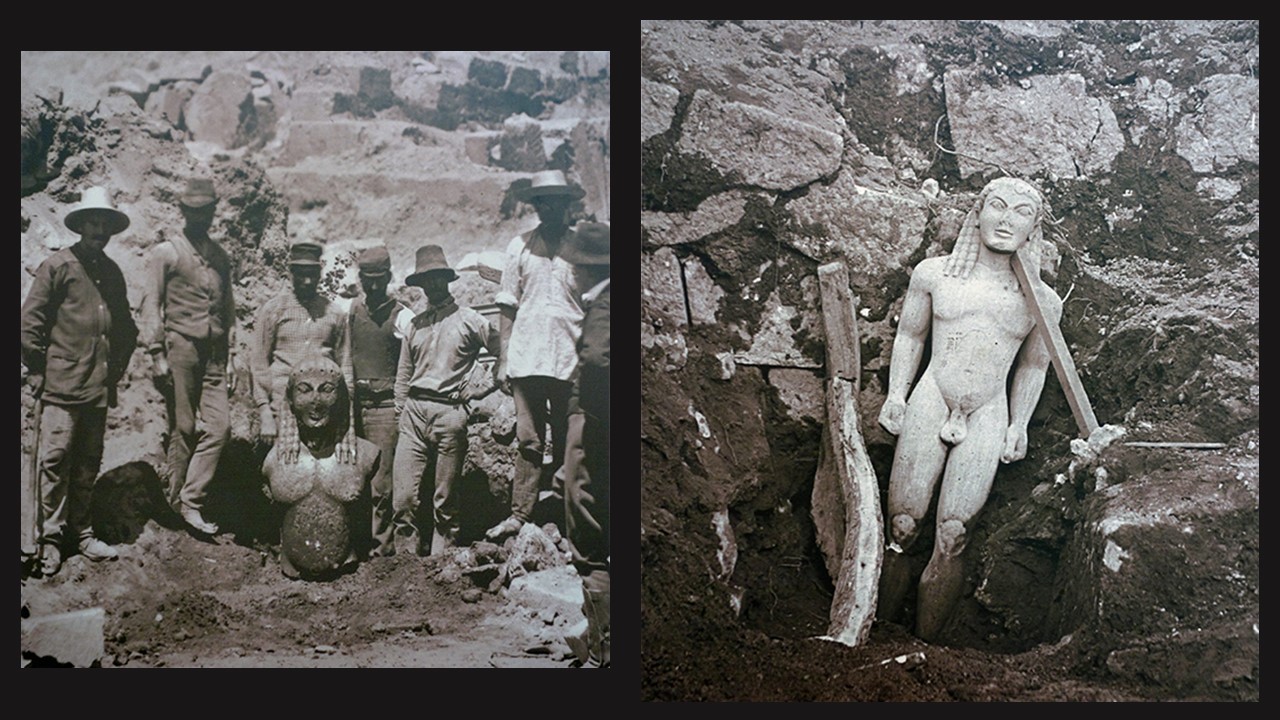
Archaeologists excavating Cleobis, 1894
https://www.khanacademy.org/humanities/ancient-art-civilizations/greek-art/daedalic-archaic/a/the-kouroi-of-kleobis-and-biton
The Twins of Argos were excavated in Delphi by French archaeologists in 1893 and 1894. The discovery of two extremely similar statues of idealized nude male youths is a rare find of the kouros type. Like other kouroi, they are “naked except for boots, which distinguish them from images of Apollo and may mark them as travellers. They are stockily built, short though over-life-size, with broad shoulders and broad faces… The round eyes are set within curving upper and lower lids, the entire eye unit cut deeply into the head beneath heavy brows. The mouth is full. The large ears are set far back at the side of the head; the lobe is a flat disk. The transition between the front and sides of the head is very abrupt. A single row of large disk-like curls line the forehead. The rest of the hair, emphasizing the flat top of the head, is combed and then subdivided into large bead-like elements. In back the hair springs out from beneath the double cord which holds it in place, at the top of the ears and, again, at the base of the neck. Each of the tendrils, front and back, is neatly finished with a tie… The abdomen is defined linearly… The round knees are set off by incision as well as by modeling. The arms are held close to the body, the clenched hands securely attached to the thighs, the thumbs facing outward…” http://www.perseus.tufts.edu/hopper/artifact?name=Delphi%2C+Kleobis+and+Biton&object=Sculpture
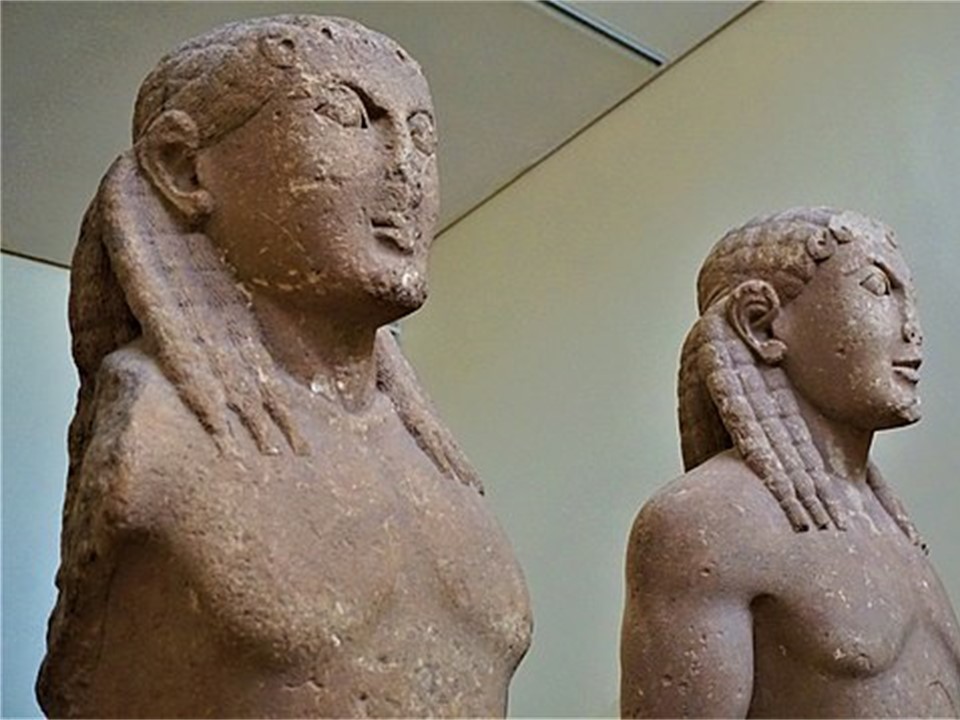
The two Kouroi of Argos, known as Cleobis and Biton (detail), dedicated to Delphi by the city of Argos, 580 BC, marble, H. 1.97 m, Archaeological Museum of Delphi
https://www.khanacademy.org/humanities/ancient-art-civilizations/greek-art/daedalic-archaic/a/the-kouroi-of-kleobis-and-biton
To introduce my students to ancient Greek Archaic Art and the Kouros Brothers from Argos, Cleobis and Biton, I use the Inquiry-based teaching method known as Visual Thinking Strategy introduced by Abigail Housen and Philip Yenawine which “uses art to teach visual literacy, thinking, and communication skills—listening and expressing oneself. Growth is stimulated by looking at artworks of increasing complexity, answering developmentally based questions, and participating in peer-group discussions carefully facilitated by teachers.” Philip Yenawine, Visual Thinking Strategies: Using Art to Deepen Learning Across School Disciplines, 2013 https://www.amazon.com/Visual-Thinking-Strategies-Learning-Disciplines-ebook/dp/B00XO20380

For a student “RWAP”, (RWAP stands for Research – Writing – Art – Project), please… Check HERE!
Areskon is my Name and I am an Actor

Photo Credit: Kostas Papantoniou https://www.amth.gr/en/exhibitions/highlights
O man, with your wonderful dower, / O woman, with genius and grace, / You can teach the whole world with your power, / If you are but worthy the place. / The stage is a force and a factor / In moulding the thought of the day, / If only the heart of the actor / Is high as the theme of the play. … No matter what role you are giving, / No matter what skill you betray, / The everyday life you are living, / Is certain to colour the play./ The thoughts we call secret and hidden / Are creatures of malice, in fact;/ They steal forth unseen and unbidden, / And permeate motive and act. Ella Wheeler Wilcox (1850-1919) was an American author and poet who wrote THE ACTOR…an appropriate, in my humble opinion, introduction to our new POST… Areskon is my Name and I am an Actor. http://www.ellawheelerwilcox.org/poems/pactor.htm https://en.wikipedia.org/wiki/Ella_Wheeler_Wilcox
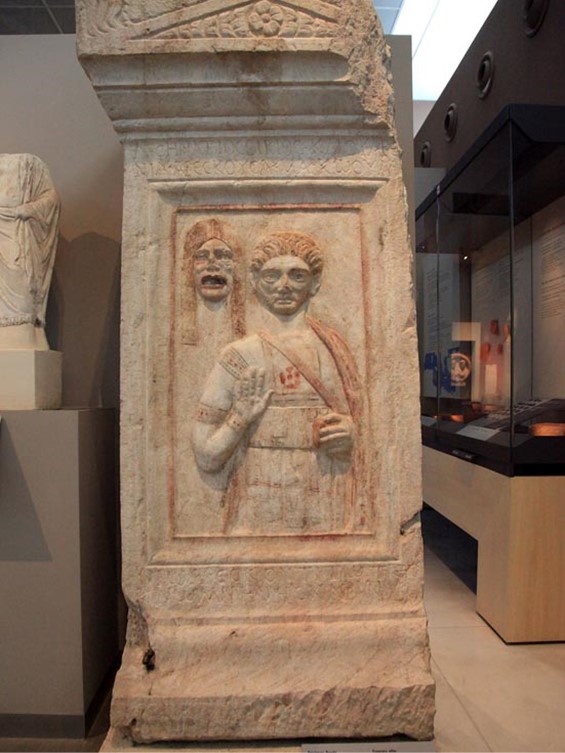
Marcus Varinius Areskon… I seek him out every time I visit the Archaeological Museum of Thessaloniki. I introduce him to my students every time I guide them around this wonderful “shrine” of the Muses… and yet I know so little about him. An inscription introduces himself. Carved above his portrait and under it, the epitaph inscription reads… Λ(ούκιος) Σηνάτιος Οἴκιος καὶ Οὐαρε | νία Ἀρέσκουσα Μάρκῳ Οὐαρ[ε] | νίῳ Ἀρέσκοντι τῷ τέ | κνῳ μνήμης χάριν Lucius Senatius (probably an unknown member of the family) and Var(e)inia Areskousa to her son Marcus Var(e)inius Areskon in memory… I am intrigued… can the portrait of a young man and an inscription help us unravel the knot? https://www.amth.gr/en/exhibitions/highlights
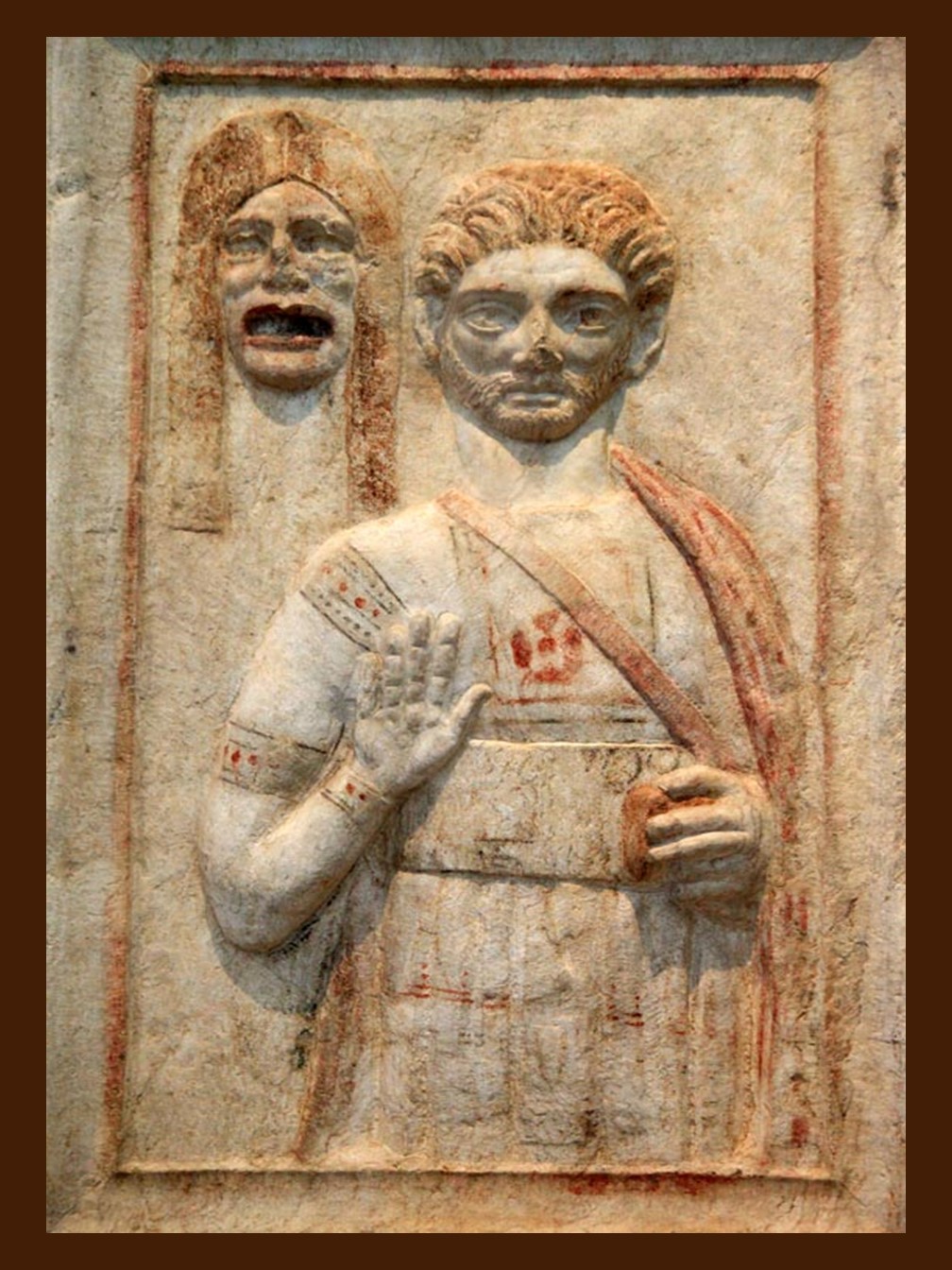
Areskon was the son of Var(e)inia Areskousa, he was related? to Lucius Senatius, he was Roman, he lived in Thessaloniki, and he died painfully young. This beautiful funerary memorial, in marble and vividly painted, the colours remain remarkably well-preserved, testifying to the economic ability of the family to honour their young demised member with a worthy memorial. https://m.flickr.com/photos/69716881@N02/50914350016/in/faves-36551225@N05/
Areskousa and Areskon, mother and son, members of a popular family of actors, were probably entertainment “stars” of the time. This is what their names connotate (Areskon/Areskousa= one who pleases, who is popular). The mother was probably an actress of the popular mime theatre, while the son managed to elevate himself and become a young, versatile tragic actor of fame and fortune. His funerary monument is a proper testament to his popularity and wealth.
The portrait on his rectangular funerary altar shows him en face, upright, attired in military gear. His right hand is raised in salutation, the left seems to hold a sword? In the upper left corner of the composition, still beautifully coloured, a mask, worn by male actors for a female theatrical role, identifies the male portrait as an actor of versatile abilities.
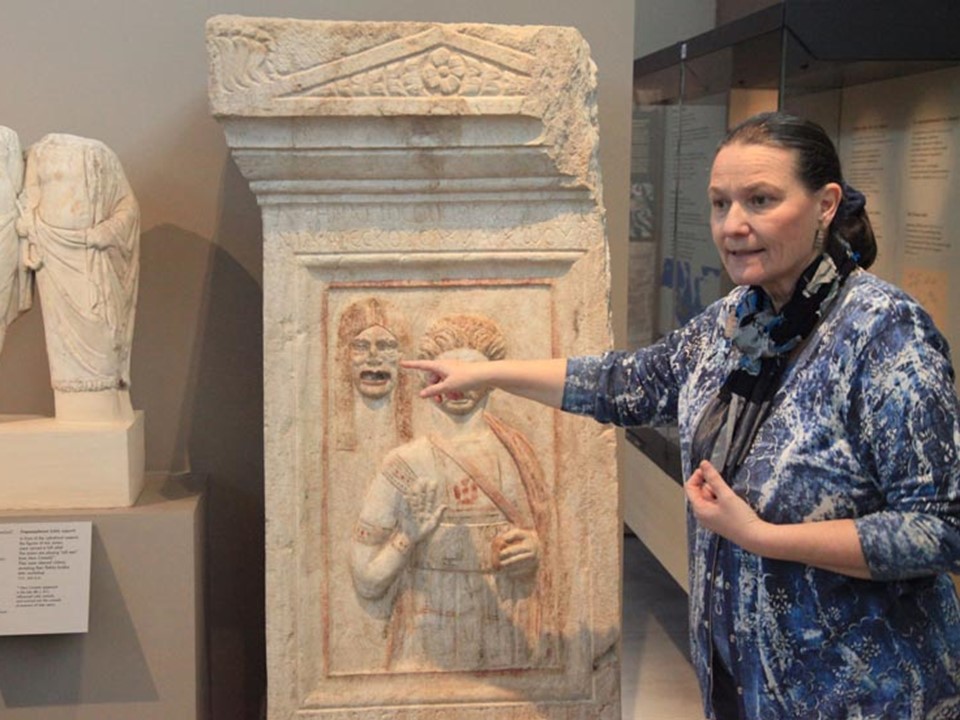
The Portrait of Areskon is shown in the middle of a simple yet elegantly proportioned structure described by the Museum archaeologists as a funerary altar. It is simply framed, sits on a pedestal and is crowned by an inscribed pediment with a central rosette, leaves and stylized acroteria. It was discovered near the eastern fortification walls of Thessaloniki, almost embedded in an apartment building of modern times. Today, exhibited in the Archaeological Museum of Thessaloniki, it is considered one of the Museum’s highlights!
For a PowerPoint presenting a School Trip to the Archaeological Museum of Thessaloniki and the Funerary Altar of Areskon, please… Check HERE!
For a StudentActivity, please… Check HERE!
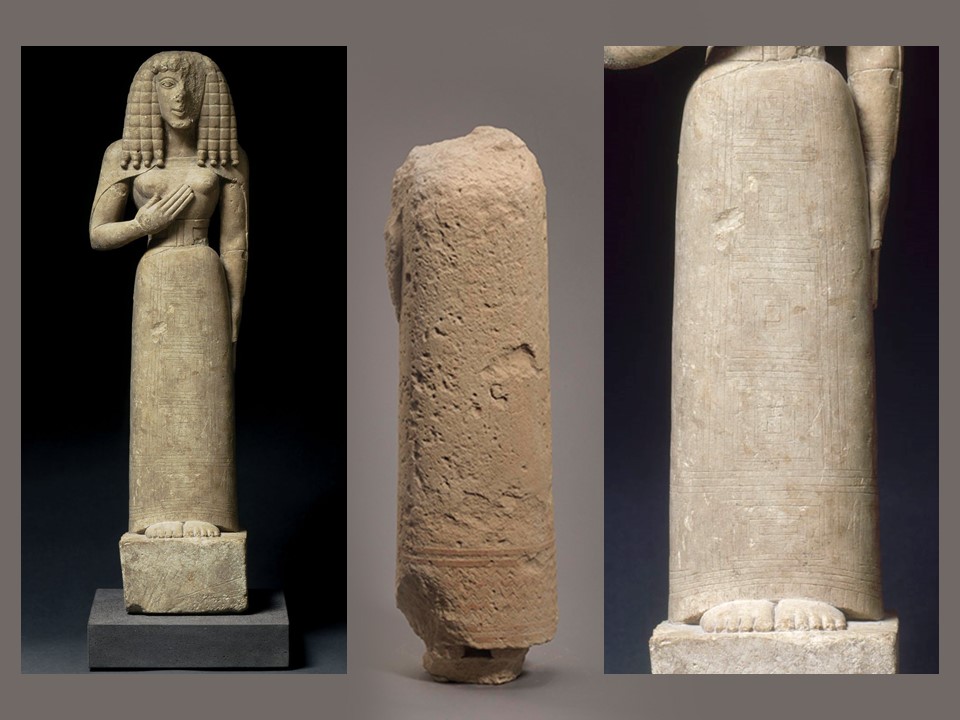
Daughters of Eleutherna

Daughter of Eleutherna, 7th century BC, limestone statuette, the surviving height of 60 cm, so a total of about one meter, Museum of Ancient Eleutherna
https://www.akg-images.com/archive/Dame-d%E2%80%99Auxerre-2UMDHUH75U8W.html
http://en.mae.com.gr/exhibits.html
https://burgondiart.wordpress.com/2015/02/19/la-mysterieuse-dame-dauxerre-est-elle-vraiment-bourguignonne/
The two statues Professor Nicholas Chr. Stampolidis, so affectionately calls Daughters of Eleutherna, hold me in fascination… “Crete was obviously the most important centre and it is the place where most of the stone sculptures of the Daedalic style originate. In contrast to the works that were directly influenced by oriental standards, the Daedalic sculptures depict mostly feminine forms. They are characterized by a complete frontality, and are represented with the hands placed on the thighs, with the hair combed into horizontal layers that were considered to be wigs -the known layered wig-like hair- usually with their head quite broadened and with clothes without folds. These elements can be seen in the known “Auxerre Kore”, who wears the characteristic large belt and her clothes are decorated with engravings and painted with a geometric pattern…” and, I would like to add, the badly damaged lower part of another Daedalic Kore at the Museum of Ancient Eleutherna. Foundation of the Hellenic World – http://www.fhw.gr/chronos/04/en/culture/321arts_sculp_daedalic.html

Back on December 1, 2004, until September 1, 2005, the Daughters of Eleutherna were exhibited side by side in a Museum of Cycladic Art Exhibition, titled, ELEUTHERNA, whose purpose was to bring together “…the results of systematic excavations conducted by the University of Crete at the site of ancient Eleutherna over the past 20 years… (and) to demonstrate the continuity of human presence and habitation in a city from the Early Bronze Age (3rd millennium BC) to the Middle Ages (12th-13th c. AD), that is, a period of some 4500 years.” This exhibition marked the beginning of a new Lesson Plan for ancient Greek Archaic Art! https://cycladic.gr/en/page/eleutherna

This Lesson Plan uses the Inquiry-based teaching method known as Visual Thinking Strategy introduced by Abigail Housen and Philip Yenawine which “uses art to teach visual literacy, thinking, and communication skills—listening and expressing oneself. Growth is stimulated by: looking at artworks of increasing complexity, answering developmentally based questions, and participating in peer-group discussions carefully facilitated by teachers.” Philip Yenawine, Visual Thinking Strategies: Using Art to Deepen Learning Across School Disciplines, 2013 https://www.amazon.com/Visual-Thinking-Strategies-Learning-Disciplines-ebook/dp/B00XO20380

8 Steps to a Lesson Plan Success

Prepare by Reading… https://www.ancient-origins.net/artifacts-other-artifacts/lady-of-auxerre-0010215 and https://www.louvre.fr/en/oeuvre-notices/statue-woman-known-lady-auxerre and https://www.tovima.gr/2008/11/24/culture/h-epistrofi-mias-kyrias/ and http://en.mae.com.gr/museum.html
Introduction Essential Questions: How do we communicate thoughts and feelings in the visual arts? – How do the arts of each period reflect the values of the culture? and Goals: Help students understand the importance of Daedalic Art in the development of Ancient Greek Sculpture – Assist students to connect the past with the present
Visual Learning PP: Show students what PP “teachercurator” has prepared, please… Click HERE!
Be Inquisitive 1: Ask Visual Learning Strategy Questions… and conduct a constructive conversation
Visual Learning Video: Show students the following Video titled “HALL B: THE LADY OF AUXERRE” directed by Andonis Theocharis Kioukas for the Museum of Ancient Eleutherna http://en.mae.com.gr/films.html
Be Inquisitive 2: Ask Questions… on the information provided by the Video on the Lady of Auxerre
Enduring Understanding: Daedalic Sculpture was the 1st step in the development of Ancient Greek Sculpture.
Assessment Activity: For an RWAP Activity, please… Check HERE! (RWAP stands for Research-Writing-Art-Project)

Nearchos the Potter

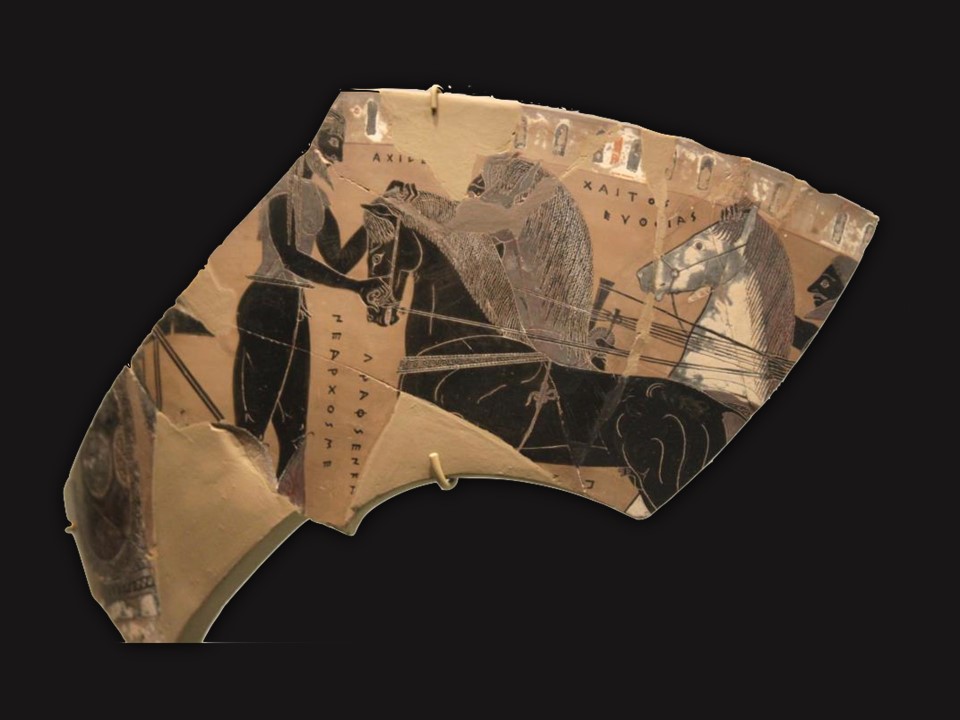
Archaic Black-Figure Terracotta fragment of a Kantharos (drinking cup) by Nearchos, Archaic – ca. 550 BC, 15,5 cm, National Archaeological Museum, Athens
Antenor Kore, 525-500 BC, Parian Marble, Acropolis Museum, Athens
In the words of Simonides of Ceos, “Painting is silent poetry, and poetry is painting with the gift of speech.” (Quoted by Plutarch, De Gloria Atheniensium 3.346f). I wonder if Nearchos, the celebrated Athenian painter and potter, was a poet at heart!
Looking at Attic Black-Figure pottery, you get the impression that sometime during the second quarter of the 6th century, an artistic revival takes place. The artists of the time, pottery makers and pottery painters show an exquisitely refined technique and draughtsmanship of a very high order indeed. Among them, Nearchos, potter and vase painter, stands at the very top.
Nearchos comes from Attica and is considered today a great master of the Black-Figure style. His career as a potter most probably started as a student in the workshop of Kleitias and Ergotimos, the famous creators of the François Vase. He lived and prospered in Athens, sometime between 570 and 555 BC, where he established a flourishing workshop. He raised two sons, Tleson and Ergoteles, who trained to become famous potters themselves. Later in his life, established, respected and wealthy, a “poet” at hart, he commissioned a beautiful Kore for the Acropolis of Athens, and acquired further admiration and fame.

A small ostracon of a Kantharos vase in the National Archaeological Museum at Athens was my introduction to his artistic abilities. I like how precise, dense and detailed his “incisions” are in depicting contour details and how the use of colour, white and purple enhances his composition. I also feel for the depicted story, the dialogue between Achilles and his god-sent horses… his fierce admonition “Xanthus and Balius, Podarge’s famous foals, this time think of a way to bring your master back alive when the fight is done, not leave him dead on the field, as you did brave Patroclus” and Xanthus’s devastating answer “This once, mighty Achilles, we will save you, yes, even though the hour of your doom draws nigh, nor indeed will we be the cause of your death even then, rather a mightier god and relentless Fate…” (Iliad, Rhapsody Τ) https://www.poetryintranslation.com/PITBR/Greek/Iliad19.php#anchor_Toc239246279

The small Aryballos at the MET is another Nearchos favourite of mine. This is a small, “intimate” item of great ergonomic qualities. Imagine… admiring it as it comfortably fits the palm of your hand, filled with your chosen perfumed oil! The shape is perfectly balanced and the design is rowdy and exotic… pygmies fighting cranes, satyrs, Hermes, Perseus and two tritons! Think… your new aryballos will be the talk of your fellow athletes in your favourite Palestra!!! https://www.metmuseum.org/art/collection/search/252451

The Antenor Kore was found, battered and in several fragments, during the 19th century excavations on the Athenian Acropolis, in the so-called Perserschutt, the “Persian debris” level. It is a late Archaic statue of a young girl, her long, auburn hair beautifully groomed in locks and curls, dressed in chiton and an Ionian Peplos, adorned with jewelry, smiling, happy to honour goddess Athena. Fragments of a Pentelic marble statue base identify Nearchos the Potter as the donor and Antenor, son of Eumares as the sculptor. The dedicatory inscription, translated, reads: Nearchos the potter dedicated this work as an offering to Athena / Antenor the son of Eumares made the statue.
If you still wonder whether Nearchos, the celebrated Athenian painter and potter, was a poet at heart! My answer would emphatically be… YES! https://museum.classics.cam.ac.uk/collections/casts/antenor-kore and https://www.theacropolismuseum.gr/sites/default/files/antinor_gr_0.pdf
For a student-friendly Activity Worksheet on Learning from Ancient Greek Pottery… Click HERE!