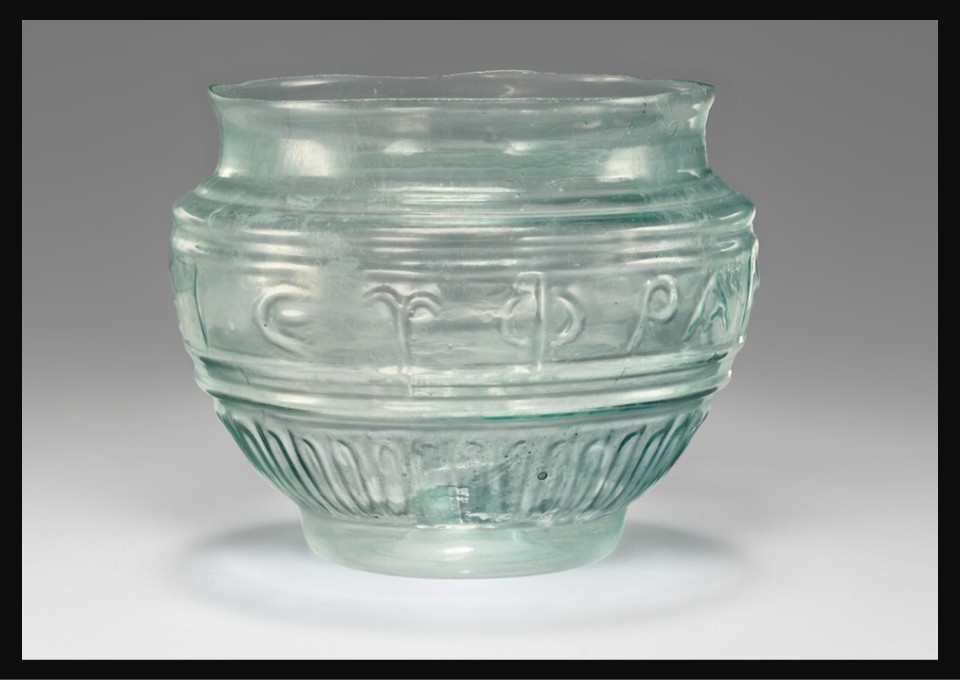
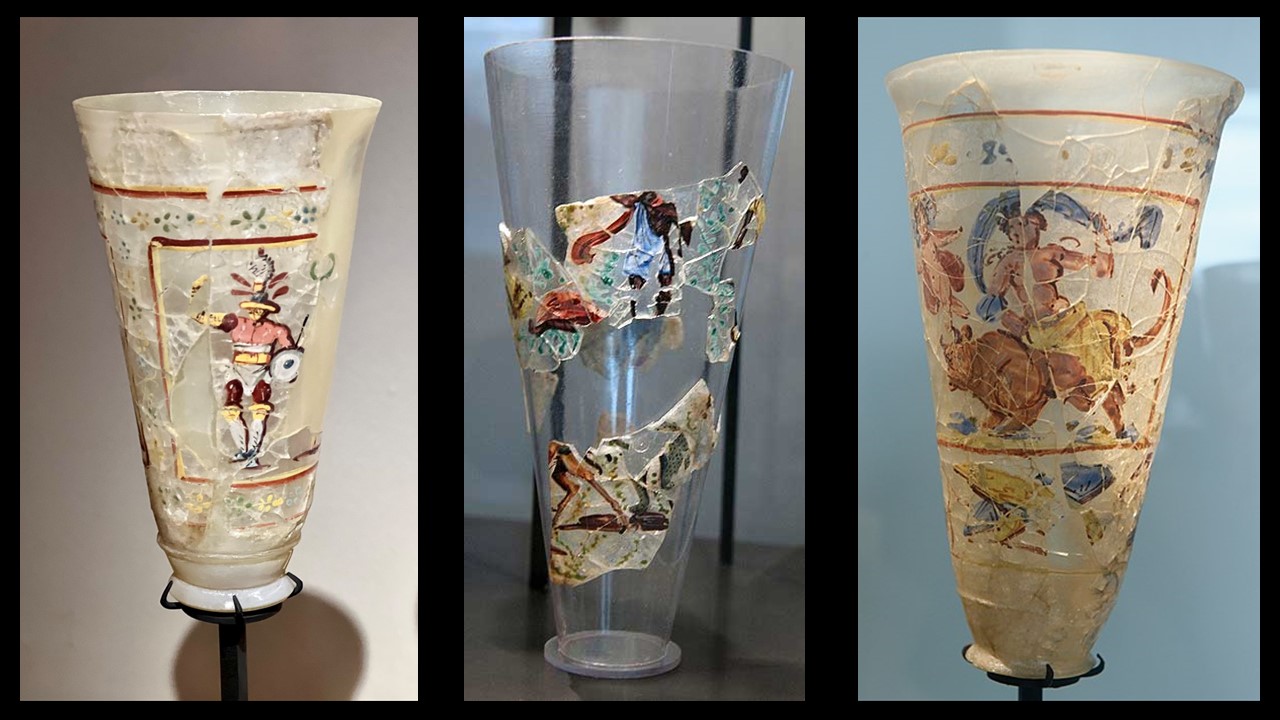
Three Roman enameled Glass Vases in the Collection of the Guimet Museum, Paris, France

Roman Enameled Glass

Three Roman enameled Glass Vases in the Collection of the Guimet Museum, Paris, France
Goblet with a Gladiator, Begram Hoard, 1st century AD, Enameled Glass, Height:  cm, Guimet Museum, Paris, France https://twitter.com/AntiokhosE/status/1615092377340846089
Vase fragment depicting African Hunt, Begram Hoard, 1st century AD, Enameled Glass, Guimet Museum, Paris, France https://depts.washington.edu/silkroad/museums/mg/begram.html
Goblet with the abduction of Europe, Begram Hoard, 1st century AD, Enameled Glass, Height: 16 cm, Guimet Museum, Paris, France https://commons.wikimedia.org/wiki/File:Goblet_Abduction_of_Europa_Begram_Hoard_Guimet_MG21228_n01.jpg

The earliest glass vessel decorated with enameling, write the Corning Museum experts, dates from about 1425 BC. It successfully combines one of humankind’s oldest creative urges (the desire to draw on things) with one of the most advanced technologies of the ancient world (glassmaking). Interestingly, and surprisingly, the next step in decorating with enameling takes fourteen centuries to occur. The absence of enameling on Greek and Hellenistic glass, with no surviving artifacts or documentary descriptions, up until now, directs us to assume that both the concept of this type of decoration and the means to realize it were simply lost and long-awaited rediscovery. All changed during the early decades of the 1st century AD. The gap was bridged, and the technical challenges were achieved. The creation of luxurious Roman Enameled Glass vessels started and lasted over a period of about 300 years. https://www.cmog.org/article/enameled-glass-vessels-1425-bce-1800-decorating-process

Roman enameled glass artifacts fascinate me. They showcase a unique combination of glass craftsmanship and enamelwork, resulting in stunning decorative pieces. While I am not an expert in glass, I am eager to learn. The Corning Museum of Glass website provides valuable information on enameled glass, so allow me to address some questions, starting with “What” and “How.” A valuable addition will be the PowerPoint presentation I have compiled, featuring significant examples of Roman enameled glass artifacts from museums around the world… Click HERE! and judge for yourselves!  https://home.cmog.org/ and https://www.cmog.org/article/enameled-glass-vessels-1425-bce-1800-decorating-process

What is Enameled Glass? Enameled glass is a type of glass that has been decorated with a layer, or more, of colored or opaque vitreous enamel. Enamel is a powdered glass material that is mixed with pigments or metallic oxides to achieve various colors and effects. The enameling process involves applying the enamel powder onto the surface of the glass and then heating it in a low-temperature muffle kiln (about 965°-1300°F or 500°-700°C). This heat fuses the enamel to the glass, creating a durable and permanent bond. Sometimes, several firings are required to fuse the different colors of an elaborately enameled object. https://allaboutglass.cmog.org/definition/enamel and Objects and Techniques | The Techniques of Renaissance Venetian Glassworking (cmog.org)

Why did artists use the Enameled Glass technique? Enameled glass is often used for decorative purposes due to its ability to add color, pattern, and texture to glass surfaces. It can be found in various applications, such as art glass, stained glass windows, decorative panels, glassware, and architectural elements. The enamel coating on the glass can be transparent, allowing light to pass through, or opaque, blocking the transmission of light. The choice of enamel color, texture, and design can be customized to suit specific aesthetic preferences or design requirements.

How did Enameled Glass develop, chronologically up and including the Renaissance period, in Europe? A. Roman Period: The discovery of glassblowing during the Roman period made glass affordable and widely available for ordinary domestic purposes. However, the Romans also produced some of the most lavish luxury glass ever made. This is also the time when luxurious glass enamel originated as well. B. 5th – 12th Century AD: The Early Middle Ages saw less advancement in Enameled Glass in Europe due to the fall of the Western Roman Empire and societal changes. There’s evidence, however, of continuous tradition in the Byzantine Empire. C. Late Medieval Period: The first major revival of enameled glass occurred during the late Medieval period. This is also when we see the first instances of stained glass windows in churches, which used enamel for detailed painting and shading. Venice, and the island of Murano to be specific, became the greatest European Glass-making center. D. Renaissance Period: The development of enameled glass greatly increased during the Renaissance. In Venice/Murano, the most important center for glassmaking, artists developed new enameling techniques that allowed for greater detail and more vibrant colours. https://www.cmog.org/article/enameled-glass-vessels-1425-bce-1800-decorating-process

How can Roman Enameled Glass production be described aesthetically? The aesthetic effects of Roman artifacts made from enameled glass can be described as opulent, vibrant, and intricate. These effects were intended to showcase the wealth, status, and refined taste of their owners. The combination of glass and enamel craftsmanship resulted in a unique fusion of materials, creating objects that exuded beauty and sophistication.

Bowl fragments depicting Combat Scenes, Begram Hoard, 1st century AD, Enameled Glass, Guimet Museum, Paris, Franc
Bowl fragments depicting Combat Scenes, Begram Hoard, 1st century AD, Enameled Glass, Guimet Museum, Paris, France https://twitter.com/SusanRahyab/status/1554483598748749824/photo/4

The vibrant colors used in Roman enameled glass, achieved through the application of enamel, added a sense of liveliness and richness to the artifacts. The various shades of blues, greens, yellows, reds, and whites created a visually dynamic and eye-catching effect. The colors were often complemented by the addition of gilding or gold leaf, further enhancing the luxurious appearance of the pieces.

The Bird Cup, 20-50 AD, Enameled Glass, Civic and Archaeological Museum, Locarno, Switzerland
The Bird Cup, 20-50 AD, Enameled Glass, Civic and Archaeological Museum, Locarno, Switzerland https://hls-dhs-dss.ch/it/articles/002115/2010-03-30/

The intricate scenes found in Roman enameled glass artifacts showcased the high level of skill and attention to detail of the artisans. Geometric designs, floral motifs, organic patterns, and figurative compositions were meticulously executed, creating a sense of complexity, visual depth, delicacy, and refinement to the overall design.

The layered and multicolored effects, achieved by applying enamel in successive layers, added a sense of dimensionality and complexity to the artifacts. The juxtaposition of different colors and patterns created a captivating visual interplay, drawing the viewer’s attention and enhancing the overall aesthetic appeal.

The aesthetic effect of Roman enameled glass production also reflects the broader artistic sensibilities of the Roman Empire. It embodies the fusion of influences from various cultures, including Hellenistic, Egyptian, and Near Eastern, resulting in a unique and eclectic style that was distinctively Roman.

For a PowerPoint, please… Check HERE!

Blue Glass Amphoriskos with cupids gathering grapes from the Villa of the Mosaic Columns in Pompeii

Blue Glass Amphoriskos from Pompeii

Blue Glass Amphoriskos with cupids gathering grapes from the Villa of the Mosaic Columns in Pompeii
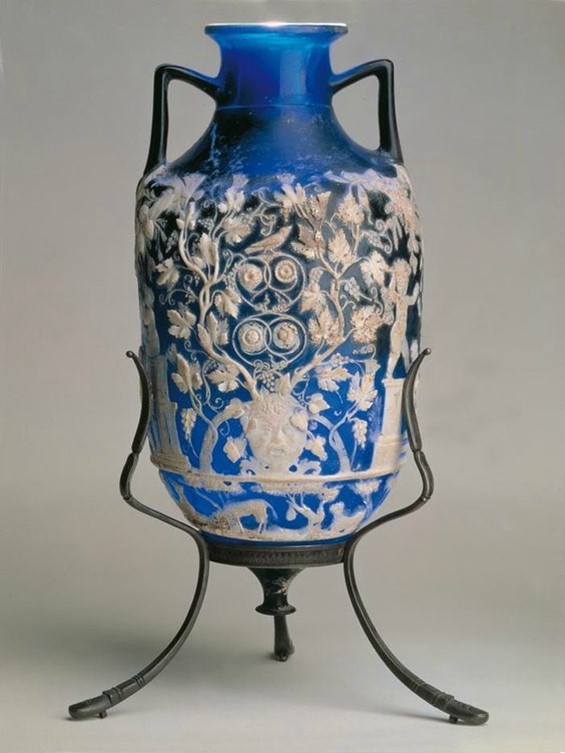
Blue Glass Amphoriskos with cupids gathering grapes from the Villa of the Mosaic Columns in Pompeii, between circa 1 and circa 79 AD, Cameo Glass, Naples Archaeological Museum

“Ah, happy, happy boughs! that cannot shed  /   Your leaves, nor ever bid the Spring adieu;  /  And, happy melodist, unwearied,  /  For ever piping songs for ever new;  /  More happy love! more happy, happy love!  /  For ever warm and still to be enjoy’d,  /  For ever panting, and for ever young;  /  All breathing human passion far above,  /  That leaves a heart high-sorrowful and cloy’d,  /  A burning forehead, and a parching tongue.” Wrote John Keats in his famous Ode to a Grecian Urn… What about the Blue Glass Amphoriskos from Pompeii we will discuss todaywho is going to do justice to it?     https://www.poetryfoundation.org/poems/44477/ode-on-a-grecian-urn

The Portland Vase and Blue Glass Amphoriskos with cupids gathering grapes from the Villa of the Mosaic Columns in Pompeii
Portland Vase, between circa 1 and circa 25 AD, Cameo Glass, H. 24 cm, Diam. 17.7 cm, British Museum
Glass Amphoriskos with cupids gathering grapes from the Villa of the Mosaic Columns in Pompeii, between circa 1 and circa 79 AD, Cameo Glass, Naples Archaeological Museum

The Portland Cameo Vase might be famous for its chic et simple design, but the Pompeiian Cameo Amphorisko is chic but definitely not simple!  It is luxuriously rich, elaborately designed, lavishly ornate, ostentatious, sumptuous… yet elegant in a “Baroque” way! The Classicist I admires the Portland Vase… my Hellenistic psyche, however, is all for the Pompeian Amphorisko!

It was the 29th of December 1837 and the archaeological site of Pompeii was visited by King Ferdinand II of Naples and Sicily. What a lucky day for the excavators and the visiting King… a rare Blue Glass Cameo Vase, regarded today as one of the most important treasures of the Naples National Archaeological Museum, was discovered in the area of the enclosed, small, funerary garden of the Villa of the Mosaic Columns. I do not know how true this story is… but the Romantic me likes it! https://www.interno16holidayhome.com/2019/02/22/discovering-the-blue-vase-of-pompeii/  The correct date for the discovery of the Blue Glass Amphorisko is probably 1834 as sited on the Naples Archaeological Museum site. However hard I searched Internet sources, I found little more…   https://www.museoarcheologiconapoli.it/en/room-and-sections-of-the-exhibition/metal-ivory-and-glass-objects/

The area in Pompeii where the Blue Glass Amphoriskos was discovered
The area where the Blue Glass Amphoriskos was discovered.

The Pompeian Blue Glass Amphoriskos is a very rare example of ancient cameo glass. This is a type of luxurious vessel inspired by intricate Hellenistic relief-cut gems, extremely popular during the period of the Augustan and Julio-Claudian periods, from 27 B.C. to 68 AD. Based on lengthy research by David Whitehouse of the Corning Museum of Glass, there are only 15 extant vessels and about 200 fragments of Cameo Glass in Museums and private collections today. The Romans created Cameo vessels, large wall plaques, and small jewellery items, using craftsmen of the finest technical skills, as highly expensive items of luxury for the Roman aristocracy.      https://www.bbc.com/culture/article/20130916-mystery-of-a-missing-masterpiece     and     https://www.metmuseum.org/toah/hd/rcam/hd_rcam.htm

The Corning Museum of Glass describes a Roman Cameo piece of Glass as “an object with two or more layers of different colours; the top layer is partly cut away to fashion decoration in low relief against a background of contrasting colour. Most Roman examples are made with two layers, usually white over blue. However, fragments of vessels exist with more than two layers, and sometimes as many as five.”     https://www.cmog.org/set/reflecting-antiquity-cameo?id=1376

Blue Glass Amphoriskos with cupids gathering grapes from the Villa of the Mosaic Columns in Pompeii

The Pompeian Blue Glass Amphoriskos is luxuriously decorated with Dionysiac scenes, particularly scenes of grape harvest. “On one side, a cupid is pouring rich grapes into a vat, where another cupid is intent on wine-pressing. The scene is framed by two low wide columns, on which two cupids are sitting while they accompany the grape harvest playing the syringe and the double flute. On the opposite side stands a klinos (bed), where are lying two cupids, one of which is playing the lyre, while on the other two columns a cupid picks grapes, and the other is holding a bunch in the hand and a basket already full on the head.” Between these two scenes, depicted is a Dionysiac “mask” with grapes, tendrils and birds! At the very bottom of the Vase, the artist who created this amazing Blue Glass Amphorisko masterfully presents a series of animals feeding on grass and shrubs, in between white, thin, horizontal, lines. What an accomplishment on a small scale!   https://www.museoarcheologiconapoli.it/en/room-and-sections-of-the-exhibition/metal-ivory-and-glass-objects/

For a PowerPoint on the Villa of the Mosaic Columns, please… click HERE!