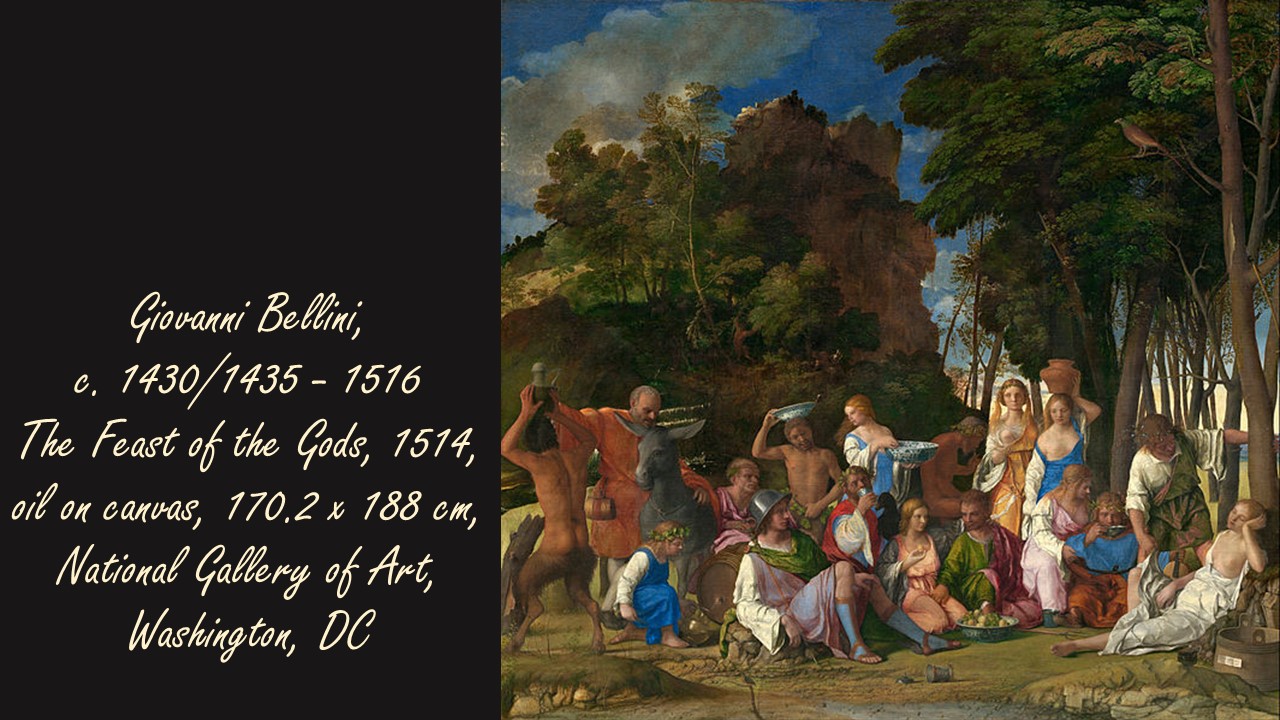
Feast of the Gods by Giovanni Bellini

Feast of the Gods

Feast of the Gods by Giovanni Bellini
https://en.wikipedia.org/wiki/The_Feast_of_the_Gods#/media/File:Feastofthegods.jpg

The Feast of the Gods is the story of a Renaissance Patron of the Arts, three Master Painters and a… very special Room, the camerino d’alabastro (alabaster study) of the Ferrara Castle.

The story starts with the desire of Duke Alfonso d’Este to decorate his studiolo, the camerino d’alabastro, with a series of bacchanals, mythological paintings that celebrate Bacchus and Venus, the gods of wine and love. Alfonso’s private studiolo in Ferrara was his retreat, where he would collect, exhibit and admire his collection of ancient medals, antique statuettes, and mythological paintings, celebrating the delights of nature and love. It was a very private place, only a handful of people ever saw while the Duke was still alive. Soon after he died, the room was disassembled, the paintings were taken to Rome, ending up in Washington DC, London, and Madrid.

For his first bacchanal, Alfonso turned to Giovanni Bellini, the Venetian master, who “very old, but still the best there is” as Albrecht Dürer said in one of his letters, was famous at the time for his “luminous color that would be the glory of Venetian painting for centuries to come.” The Feast of the Gods, Bellini’s creation, turned to be a very unique painting. Bellini, reluctant at first, accepted the Duke’s invitation and drawing inspiration from Ovid’s Poems, created “a wooded pastoral setting, in which the gods, with Jupiter, Neptune, and Apollo among them, revel eating and drinking, attended by nymphs and satyrs.” The painting has all the characteristics of Bellini’s excellence: brilliant colors, lush pastoral setting, an engaging story and an ambiance of sensuality.

The painting was completed in 1514 but a few years later Alfonso commissioned two artists, Dosso Dossi and Titian, to rework parts of the painting’s landscape background. Dosso Dossi changed parts of the landscape on the left side and added a pheasant resting on bright foliage at the upper right part of the painting. Then, Bellini’s student, Titian, added his own alterations. He reworked Dosso’s alterations adding the dramatic, mountainous backdrop that can be seen now, leaving only Dosso’s pheasant intact. The painted figures and decorative elements of the painting were untouched and remain Bellini’s own. There is, however, an enigma and further questions! “Did Alfonso, an amateur painter who was reported to fancy pheasants, paint the bird himself? Did Alfonso “picture” himself in another way as well? Some evidence suggests that Feast of the Gods contains cryptic references to the duke’s marriage to Lucrezia Borgia, perhaps even portraits of the couple.” https://www.nga.gov/collection/highlights/bellini-titian-the-feast-of-the-gods.html and https://www.nga.gov/collection/art-object-page.1138.html
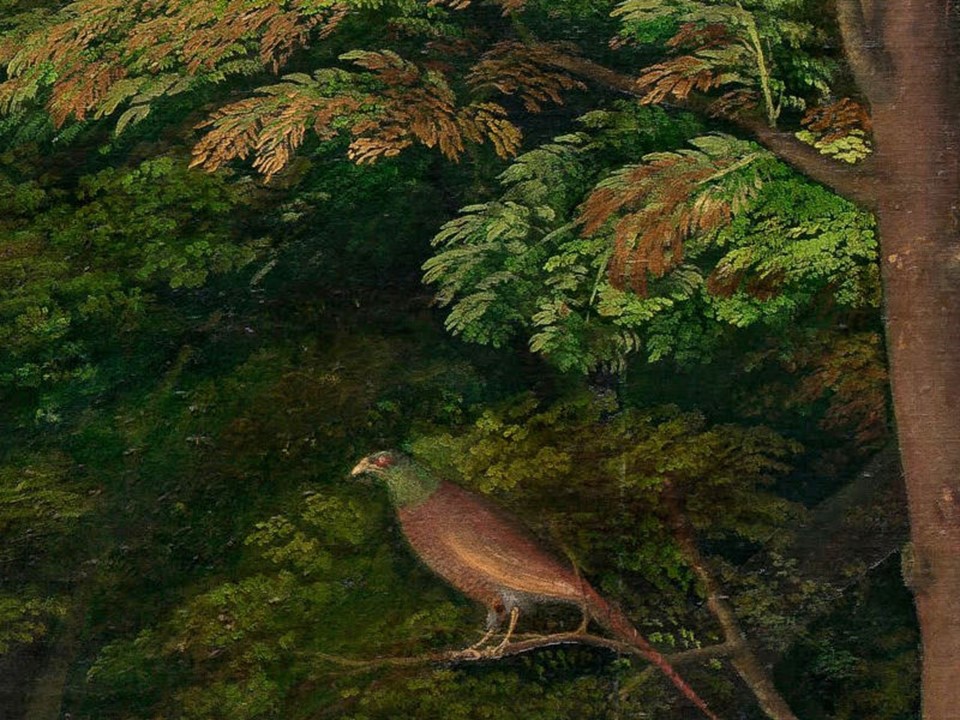
Feast of the Gods by Giovanni Bellini (detail)
https://en.wikipedia.org/wiki/The_Feast_of_the_Gods#/media/File:Giovanni_Bellini_and_Titian_-_The_Feast_of_the_Gods_-_Detail-_trees_&_pheasant.jpg

Many scholars believe that Alfonso’s studiolo was the finest of its kind, a shining jewel box! The first commission went to the elderly Giovanni Bellini and the Feast of the Gods (NGA Washingon DC) was the result. Michelangelo and Raphael were also commissioned to create works of art for the Duke’s studiolo but their commissions never materialized.   With Bellini’s death in 1514, Titian, and the Duke’s court artist, Dosso Dossi, stepped in to complete this ambitious project. Dosso Dossi’s painting was destroyed centuries ago, but Titian’s Bacchus and Ariadne (National Gallery, London) The Worship of Venus (Museo del Prado, Madrid) and the Bacchanal of the Andrians (Museo del Prado, Madrid) still survive to tell us their story. https://www.theguardian.com/uk/2003/feb/08/artsandhumanities.arts1

For Student Activity, please… check HERE!
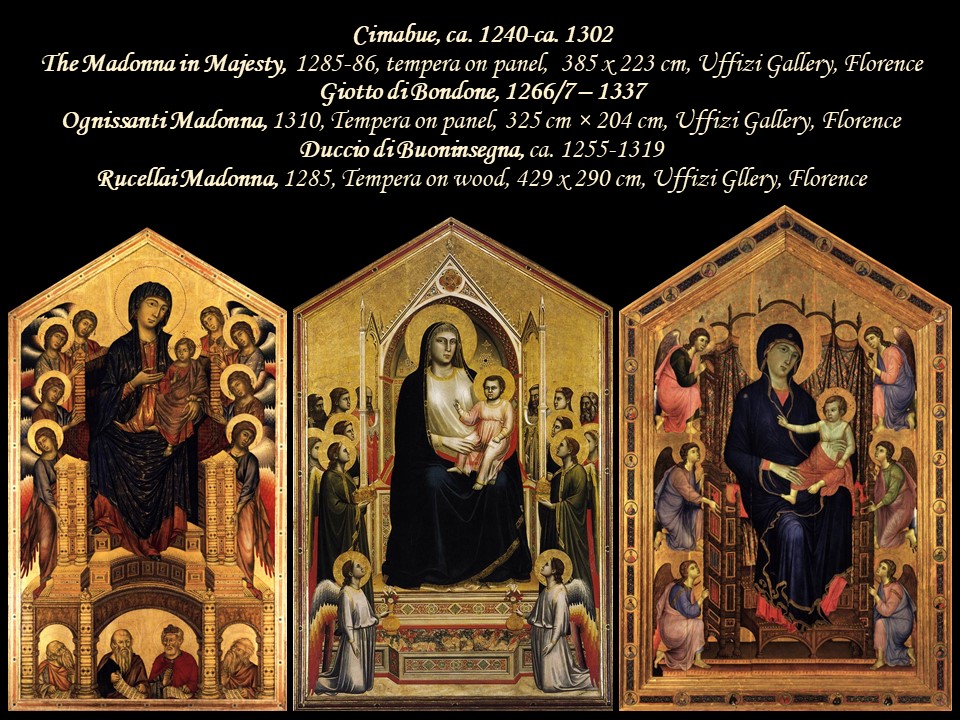
Three monumental paintings by Cimabue - Giotto - Duccio in the Uffizi Gallery in Florence.

Cimabue – Giotto – Duccio

Three monumental paintings by Cimabue - Giotto - Duccio in the Uffizi Gallery in Florence.

Cimabue – Giotto – Duccio, how important are they? You simply have to visit the Uffizi Gallery in Florence, Hall 2 to be more specific, stand in front of these three monumental panels and allow their masters to take you on a trip to the late 13th, early 14th century revolutionary Italian Painting.

According to Giorgio Vasari,“…instead of paying attention to his literary studies, Cimabue, as if inspired by his nature, spent the whole day drawing men, horses, houses and various other fantasies in his books and papers.” Cenni di Pepo, known as Cimabue, is recognized as the last painter of the Italo-Byzantine style. Yet. he is credited to step forward in moving his art towards achieving the first hint of naturalism, paving the way for the next generation of great Italian masters.

O vanity of human powers, how briefly lasts the crowning green of glory, unless an age of darkness follows! In painting Cimabue thought he held the field but now it’s Giotto has the cry, so that the other’s fame is dimmed. Writes about Giotto, the poet Dante in Canto XI of his Purgatorio, and he is so right. Giotto creates “a new kind of pictorial space with an almost measurable depth” and figures that are “volumetric rather than linear” expressing “varied and convincingly human rather than stylized” emotions. Justifiably, Giotto is considered the father of modern European painting. https://www.metmuseum.org/toah/hd/iptg/hd_iptg.htm

“Duccio, painter of Siena and much esteemed, deserved to carry off the palm (of an inventor in the Arts) from those who came many years after him…” writes Giorgio Vasari in his book The Lives of the Most Excellent Painters, Sculptors, and Architects. Today, Duccio Duccio is considered to bring through his art elegance, lyricism, and spirituality along with spatial complexity and refined use of colours.

There are two Uffizi Gallery sites you simply need to visit: https://www.visituffizi.org/halls/hall-2-of-giotto-and-the-13th-century/ and https://www.virtualuffizi.com/13th-century-and-giotto-room.html

For a student Activity, my Grade 9 Art History students enjoy… click HERE!

A PowerPoint on the three Madonnas is… HERE!

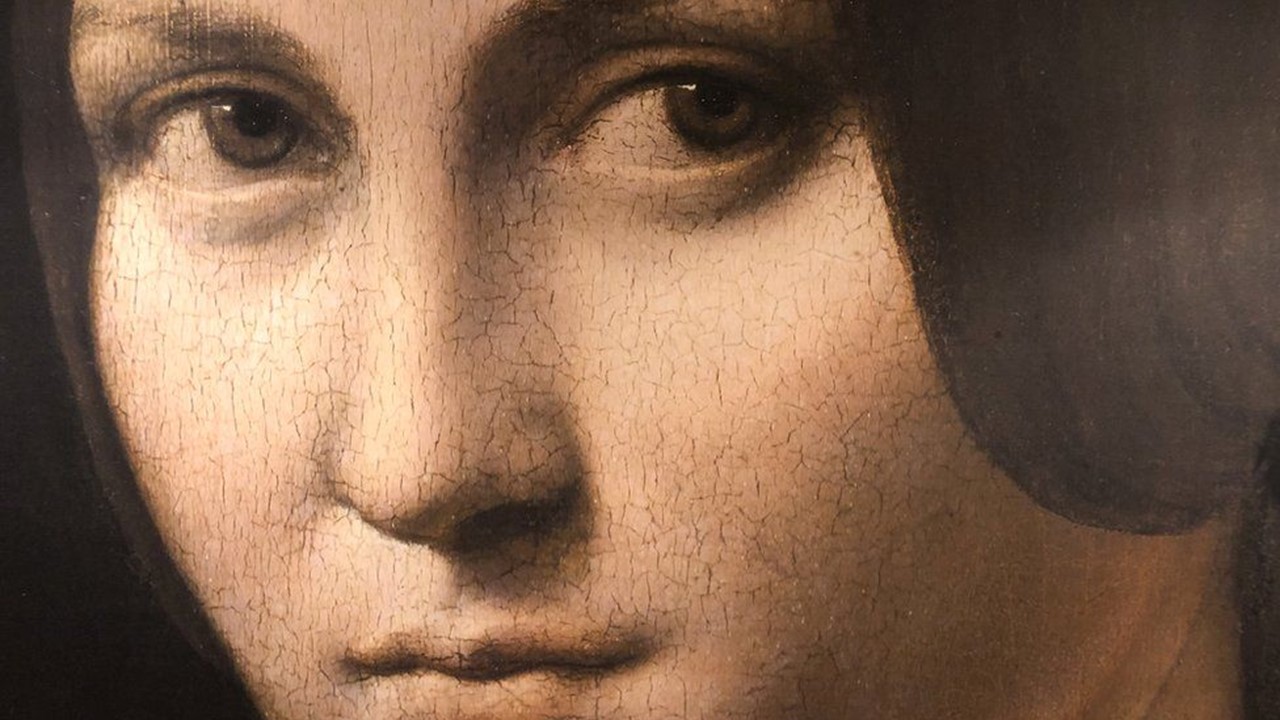
Leonardo's La Belle Ferronnière (detail)

Leonardo da Vinci

Leonardo's La Belle Ferronnière (detail)
La Belle Ferronnière (detail), 1495 – 1499, oil on wood, 62 cm × 44 cm, Louvre Museum, Paris Photo Copyright: https://www.bbc.com/news/world-europe-50127095
…and her mesmerizing eyes

Five hundred years ago, one of the greatest Renaissance Homo Universalis passed away at the Château du Clos Lucé, in the Loire Valley. The Louvre Museum, wishing to commemorate the fifth centenary of the artist’s death, organizes an International Retrospective Exhibition on Leonardo da Vinci and his oeuvre. https://www.louvre.fr/en/expositions/leonardo-da-vinci

The Louvre Museum in Paris holds the largest collection in the world of the artist’s paintings, five of the fourteen to seventeen paintings now attributed to Leonardo, as well as 22 drawings. This collection is the core of the Retrospective that will also present “the latest research findings, critical editions of key documents and the results of the latest analysis carried out in laboratories or during recent conservation treatment by the Louvre.” https://www.louvre.fr/en/leonardo-da-vinci

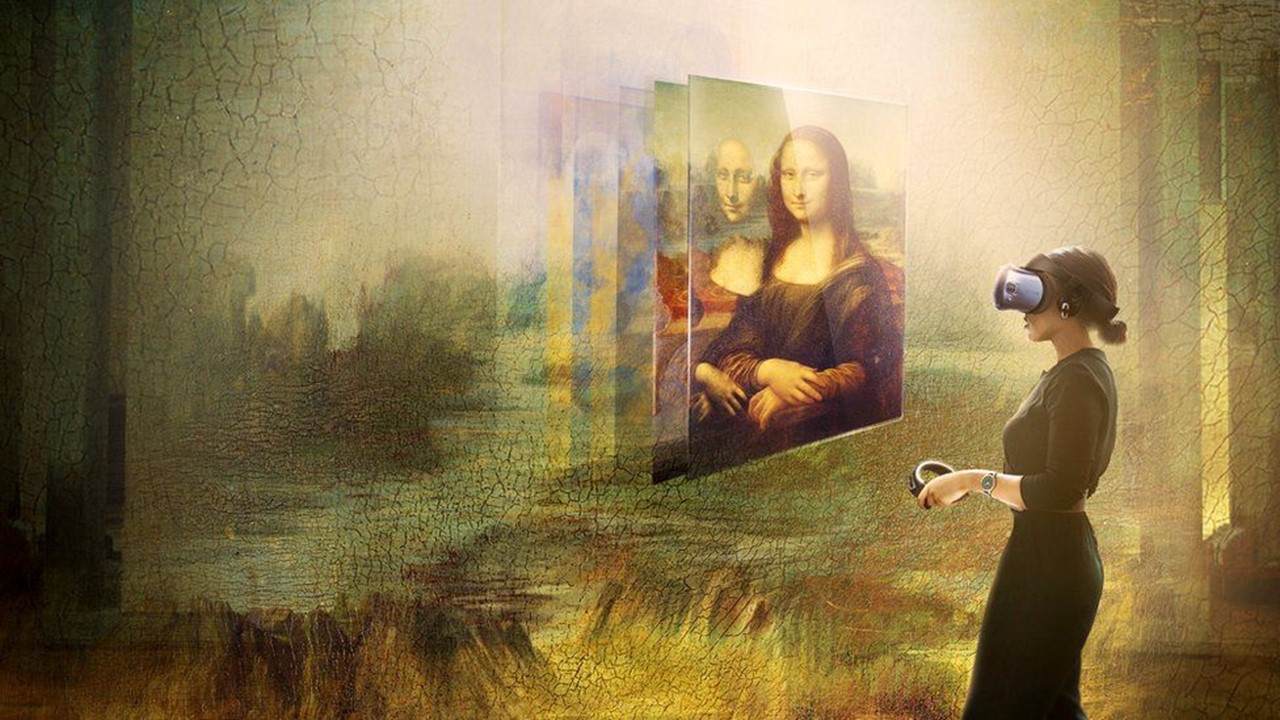
A unique feature that the Exhibition presents to its visitors is the Virtual Reality experience for the Mona Lisa painting, the first of its kind at the Louvre. Virtual Reality enables visitors to go through the glass-case that protects the Mona Lisa and see minute details within the painting invisible otherwise to the naked eye. https://arts.vive.com/us/articles/projects/art-photography/mona_lisa_beyond_the_glass/ and https://www.youtube.com/watch?v=Au_UpzhzHwk

The PowerPoint I use for my Art History class on the artist… is HERE!

Virtual Reality and the Mona Lisa painting
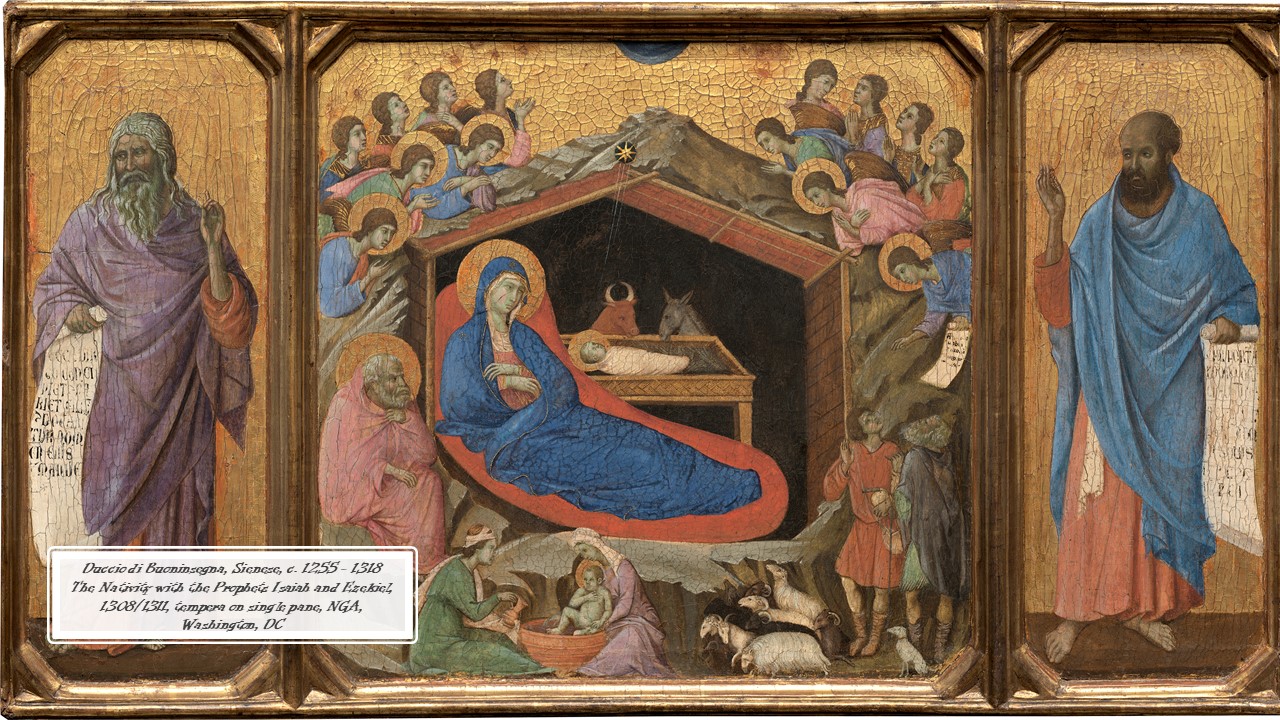
Duccio di Buoninsegna's Nativity with the Prophets Isaiah and Ezekiel.

Renaissance Triptych… fresh

Duccio di Buoninsegna's Nativity with the Prophets Isaiah and Ezekiel.
Duccio di Buoninsegna, Sienese, c. 1255 – 1318
The Nativity with the Prophets Isaiah and Ezekiel, a component of the original Maestà, 1308/1311, tempera on a single panel, NGA, Washington, DC

Renaissance Triptych… fresh is a RWAP (Research-Writing-Art-Project) designed for my high school elective class on Art History. It touches upon Sienese 14th century Art, Duccio, the great master of the time, his most important oeuvre, the Maestà altarpiece, and Triptych Icons.

The Merriam-Webster Dictionary defines Triptych as “a picture (such as an altarpiece) or carving in three panels side by side.” It further defines Triptych as having Greek roots. “Triptych derives from the Greek triptychos (“having three folds”), formed by combining tri- (“three”) and ptychē (“fold” or “layer”),” and it continues “although triptych originally described a specific type of Roman writing tablet that had three hinged sections, it is not surprising that the idea was generalized first to a type of painting, and then to anything composed of three parts.” https://www.merriam-webster.com/dictionary/triptych

Wonderful information on Duccio’s Maestà can be accessed at https://www.nga.gov/collection/art-object-page.10.html and basically https://www.nga.gov/collection/highlights/duccio-the-nativity-with-the-prophets-isaiah-and-ezekiel.html

“On the day on which it was carried to the Duomo, the shops were locked up . . . and all the populace and all the most worthy were in order next to the said panel with lights lit in their hands, and then behind were women and children with much devotion; and they accompanied it right to the Duomo . . . sounding all the bells in glory out of devotion for such a noble panel as was this.” Anonymous mid-14th-century description of a procession to carry Duccio’s Maestà from the artist’s studio to the Siena Cathedral (L. A. Muratori, Rerum italiarum scriptores (Bologna, 1931–1939), xv/6, 90

The Renaissance Triptych… fresh RWAP is… HERE!

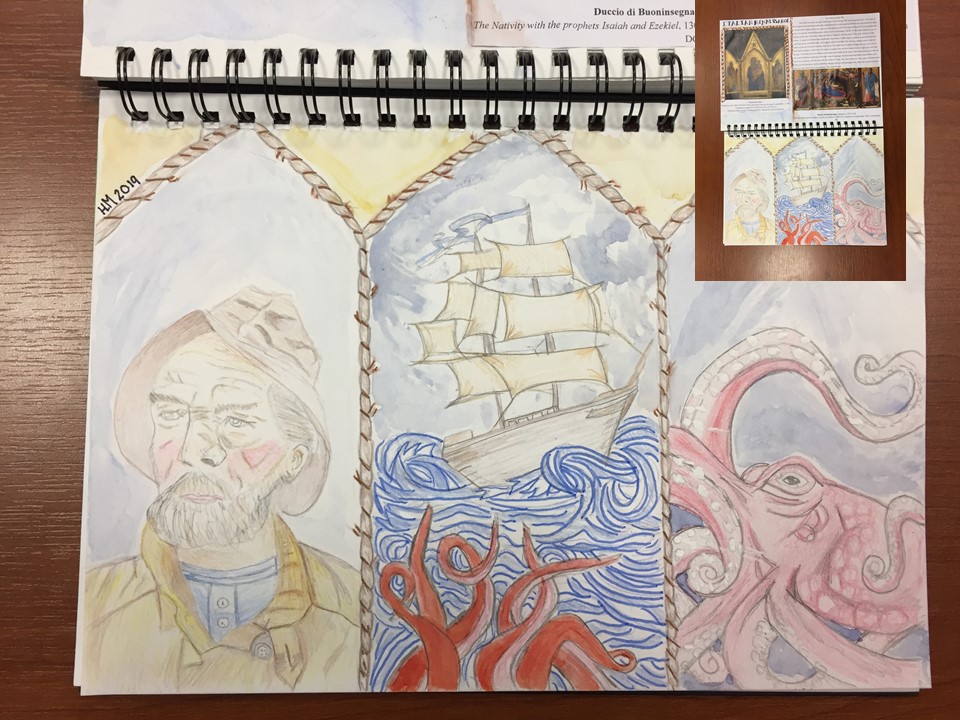
For a PP on Student work inspired by Renaissance Triptych… fresh RWAP, please… check HERE!

Student work inspired by Duccio di Buoninsegna's Nativity with the Prophets Isaiah and Ezekiel.