https://heraklionmuseum.gr/en/collections/#collections
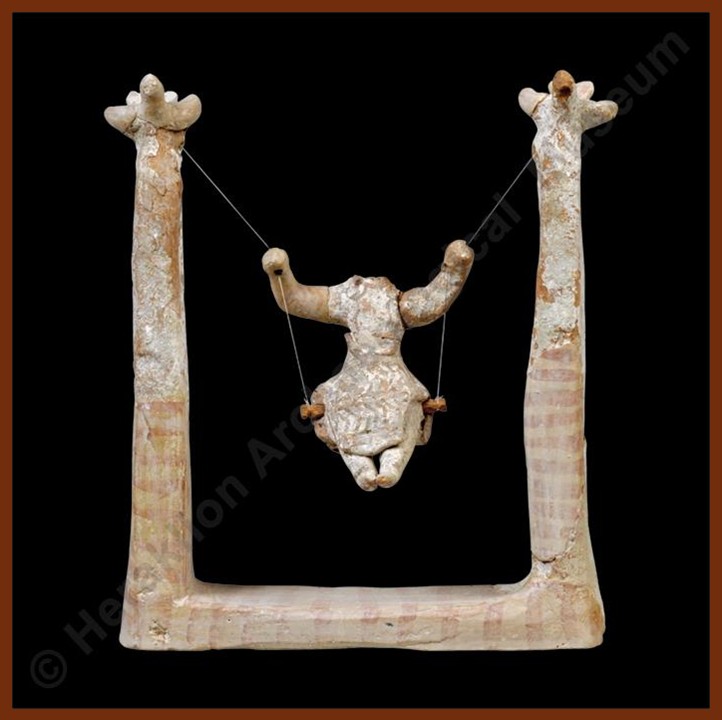
Among the treasures of the Heraklion Archaeological Museum in Crete, few objects stop visitors quite like the Minoan Swing, a tiny clay figurine, barely six centimeters tall, of a woman in mid-flight on a swing. Fired from clay over 3,500 years ago and dating to the Neopalatial period (1700–1450 BC), this remarkable sculpture captures something almost no ancient artefact attempts: a private, joyful, utterly human moment. Small enough to hold in your palm, it carries a meaning that resonates across millennia.
What Is the Minoan Swing?
The Swing belongs to the Neopalatial period of Minoan civilisation (1700–1450 BC), the golden age when the great palace at Knossos reached its fullest splendour and Minoan culture flourished across the Aegean. It is a complete clay scene: two upright posts, crowned with birds, support a crossbar, and from it hangs a female figure gripping the ropes. The entire composition, frame and person together, stands just 15.5 cm tall, with the figure itself measuring only 6.3 cm.
What makes it so unusual is that it is not merely a figurine but a sculpted moment. The artist captured movement, the slight lean of the body, the angle of the legs, in a way that feels surprisingly modern. In the Heraklion Archaeological Museum, it sits quietly among more dramatic objects, easy to overlook, impossible to forget once noticed.
Ritual or Play? What Scholars Think
Archaeologists have debated whether The Swing is purely playful or carries ritual significance. The two possibilities are not mutually exclusive. Swinging appears in later Greek religious practice, notably in the Athenian festival of the Aiora, where young women swung on ropes in rites connected to fertility and the renewal of life. The gesture of suspension, of briefly leaving the ground, may have carried symbolic weight beyond recreation.
Yet one need not reach for symbolism to feel the object’s power. Its most striking quality is its ordinariness, or rather, its extraordinary ordinariness. Whoever shaped this figure understood not just anatomy but feeling. It is a record of pleasure, as direct as any photograph.
The Minoans Behind the Clay
The Minoans left no deciphered written language. We cannot read their thoughts. But objects like The Swing close some of the distance. The Neopalatial Minoans were people of enormous sophistication, their palace drainage systems, their frescoes of leaping dolphins and blue monkeys, their faience jewelry and administrative complexity all point to a society that had moved well beyond the merely functional.
The Swing is part of that same impulse: the human need not only to record what matters, but to capture what feels good. The person who shaped this figure, likely a woman, given what we know of Minoan craft and religious practice, though we cannot be certain, knew what it felt like to swing. She or he made something that anyone, in any century, recognizes immediately.
Visiting the Heraklion Archaeological Museum
The Heraklion Archaeological Museum holds the greatest collection of Minoan art in the world. The Bull-Leaping Fresco, the Snake Goddesses, the Phaistos Disc, these are justly famous. But make time also for the quieter cases, the small terracottas and clay groups that tend to be overlooked beside the spectacular. The Swing is in there somewhere, small enough to miss. Extraordinary enough to stop you entirely.
Classroom Activity: Bring Minoan history to life in your classroom with this hands-on Student Activity inspired by the Minoan Swing at the Heraklion Archaeological Museum. Explore the full Grade 6 Student Activity →
Continue Exploring on Teacher Curator: Expand your understanding of Minoan art and ancient Aegean civilisations with The Bee Goddess of Eleutherna
Sources and further Reading: Minoan Nativity Scene? The Ayia Triada Swing model and the three-dimensional representation of Minoan divine epiphany, in Annuario della Scuola Archeologica di Atene 91, 2013, pp. 175-207, by Nicola Cucuzza https://www.academia.edu/20378122/Minoan_Nativity_Scene_The_Ayia_Triada_Swing_model_and_the_three_dimensional_representation_of_Minoan_divine_epiphany_in_Annuario_della_Scuola_Archeologica_di_Atene_91_2013_pp_175_207 and Heraklion Archaeological Museum https://heraklionmuseum.gr/en/collections/#collections