https://www.theacropolismuseum.gr/en/spinning-top
There are objects in museums that stop you in your tracks the moment you enter the room. The Acropolis Museum in Athens has many of them, the Caryatids, the Parthenon frieze, the Kritios Boy, and then, there are the objects in the cases you almost walk past. Small things. Quiet things. Things without a masterpiece label. Case 1 in the Gallery of the Acropolis Slopes holds one of those quiet things: a small clay object, 12.7 centimeters tall, dated to somewhere between 800 and 760 BC. The museum simply calls it a Spinning Top. Nobody actually knows what it is. That mystery is where this story begins. But before we get to the unknown, look at the object itself.
Geometry as a Visual Language
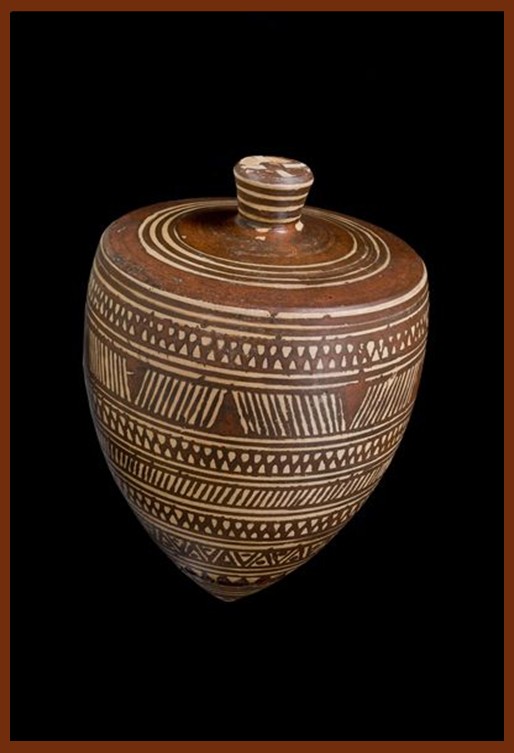
The body is elongated and pointed, tapering to a tip. The upper surface is flat, marked with concentric circles radiating outward from a central raised knob. Below that, the clay body is divided into horizontal zones, each carrying a different motif from the Geometric decorative vocabulary: triangles, dots, diagonal lines, wavy lines, arranged with a precision that feels almost architectural.
What strikes many viewers, and what is easy to miss in a photograph, is how contemporary this object looks. The strict geometry, the horror vacui discipline of filling every surface zone with a different linear pattern, the restrained palette of terracotta and dark slip: this is decoration that would not look out of place on a studio ceramics shelf today, or in a mid-twentieth century design catalogue. The Geometric Period artists of Attica were not, of course, proto-Modernists. But they shared with later abstract traditions a conviction that line, repetition, and proportion could carry enormous visual weight, that you did not need figurative imagery to make something that compels the eye.
This is worth sitting with, especially for enthusiasts of art. The Geometric Period (roughly 900–700 BC) is underrepresented in most ‘curricula’, overshadowed by the more dramatic figurative work of the Archaic and Classical periods. Yet it represents one of the most rigorous and coherent decorative systems in the ancient world, a visual language developed with real intellectual consistency across an entire workshop tradition. This small object is a working example of that language at its most concentrated.
The Question the Museum Won’t Answer
And now the mystery, the Acropolis Museum’s own entry states it plainly: The object’s original use remains unidentified. Most possibly it was an actual spinning top’. That ‘most possibly’ is doing a great deal of scholarly work. The form is suggestive, elongated, pointed at the base, with a knob on top that a finger or cord could engage to set it spinning. The concentric circles on the upper surface would have created a visual effect in motion. The hypothesis is reasonable. But it cannot be confirmed.
The object was found in 1961 during excavation of the Angelopoulos plot on the Acropolis slopes, recovered from Burial 3, where it had been placed as a funerary offering alongside eight other intact ceramic vessels. That burial context is itself a complication. An object resembling a toy found in a grave does not automatically tell us it was a child’s plaything, or that the burial was a child’s at all. It might have been a ritual object. A small container. A votive offering of a form we no longer recognise. The function has simply not survived the millennia.
This kind of open question is one of archaeology’s most honest gifts to those of us who work with objects and images. It resists the tidy story. It asks us to hold several possibilities at once and to be comfortable in the not-knowing area, which is, for educators and art enthusiasts alike, a far more interesting place to stand than certainty.
Why This Object Belongs on Your Radar
There is something in the combination of this object’s visual confidence and its interpretive silence that feels genuinely rare. If you visit the Acropolis Museum, find Case 1 in the Gallery of the Acropolis Slopes. Look at it for longer than you think you need to. Notice the way the zones of decoration stack, different rhythms in each register, the whole held together by the logic of the form beneath. Notice how the knob at the centre of the upper surface anchors the concentric circles like a fixed point around which the whole object seems to want to turn.
Nearly three thousand years later, it still holds your eye. That is its own kind of mastery.
Classroom Activity: Bring Ancient Greek Pottery to life in your classroom with this hands-on student activity inspired by the Attic Spinning Top at the Acropolis Museum, in Athens, Greece. Explore the Student Activity →
Continue Exploring on Teacher Curator: Expand your understanding of Attic Pottery with related articles like Nearchos the Potter and Weaving in Ancient Greece
Sources and further Reading: To explore more on Weaving and Ancient Greek Spinning Tops, visit the official website of the Acropolis Museum in Athens, Greece https://www.theacropolismuseum.gr/en/spinning-top.