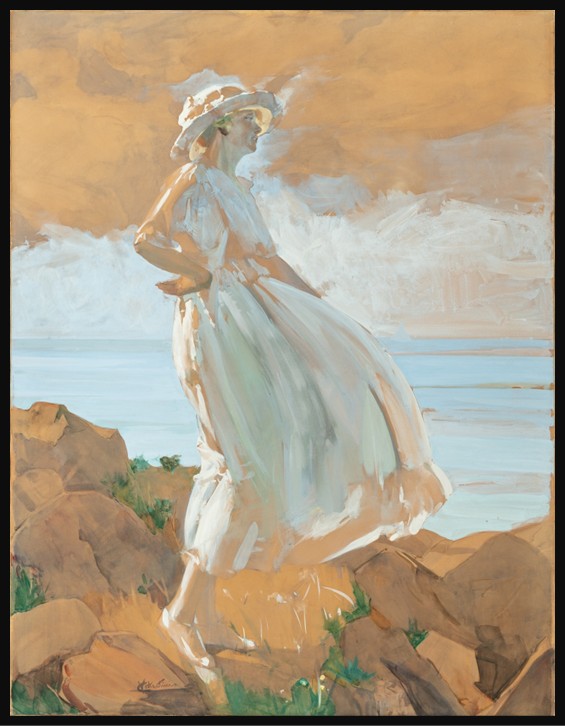
On the Cliff (Madame Costantini), 1936,Gouache on paper laid down on canvas, 138,7 x 106,2 cm, Private Collection
https://www.christies.com/en/lot/lot-3993425
Virgilio Costantini’s On the Cliff was painted in 1936 at a moment of hard-won confidence. By that time, the Sicilian-born artist had spent three decades building a reputation in Paris, a city that demanded everything of its immigrant painters and offered recognition only sparingly in return. Born in Cefalù in 1882, Costantini had risen from academic training in Palermo and Venice to become an Associate of the Société Nationale des Beaux-Arts, earning international praise for works such as Le Cerisier. On the Cliff reflects the assurance of an artist at the height of his powers, combining Mediterranean luminosity with the atmospheric elegance of Parisian painting.
Virgilio Costantini, a Sicilian painter in Paris
Costantini began his training in Palermo under sculptor Mario Rutelli and painter Francesco Lojacono, before spending a year at the Academy of Fine Arts in Venice. Venice opened his eyes to light. Paris, which he settled in around 1906, gave him ambition. There he came under the influence of Lucien Simon, and through him absorbed the fluid brushwork and atmospheric looseness of a tradition that ran from John Singer Sargent back through Anders Zorn. His first biographer, Marcel Valotaire, noted the comparison to both artists, and it holds. Costantini shared their gift for treating paint as light made solid, for catching the shimmer of fabric and skin in a single, seemingly careless stroke.
Yet Costantini also absorbed something quieter from James Abbott McNeill Whistler and Albert Moore, a sensitivity to tonal harmony, to the careful orchestration of rose, grey, coral and flesh tones into something that feels almost musical. That refinement is visible everywhere in his best portraits, and nowhere more so than in On the Cliff.
Why On the Cliff Is a Landmark Work by Virgilio Costantini
The first thing to understand about Virgilio Costantini’s On the Cliff is its scale. At 138.7×106.2 cm, this is not an intimate cabinet painting but an ambitious, nearly monumental work. And it is made in gouache, a medium that, at this size, demands absolute sureness of hand. Gouache dries quickly, corrections are visible, and the opacity that makes it so vivid also makes overworking it fatal. The fact that Costantini pulled it off, that the surface reads as fresh and breathing rather than laboured, is itself a demonstration of mastery.
The figure of Madame Costantini is rendered with the ease of someone painted often and loved well. The artist had become increasingly interested, in these years, in the freshness and transparent effects of watercolour, and he translated that sensitivity into his larger works: layers of tone, some muted and pale, others more vibrant, applied to achieve a specific tonal effect rather than a descriptive one. The result is a figure who feels present in light, not merely documented in it.
On the Cliff enjoyed notable visibility during the artist’s lifetime. The painting was exhibited at the 1936 International Exhibition of Paintings at the Carnegie Institute in Pittsburgh, one of the most prestigious international exhibitions of its era. It was also shown at the Royal Institute of Painters in Water Colours in London, further demonstrating the international reach of Costantini’s reputation during the interwar period. Such exhibition histories remind us how interconnected the art world had become by the early twentieth century, with artists, collectors, and institutions moving works across Europe and America in an increasingly cosmopolitan cultural network.
Today, painter Costantini remains less widely known than some of his contemporaries, yet paintings such as On the Cliff reveal an artist of considerable sophistication. His work occupies a fascinating threshold between academic refinement and modern atmosphere, between the luminosity of the Mediterranean and the elegance of Parisian painting. More than a simple coastal image, On the Cliff becomes a meditation on balance, fragility, and stillness, a moment suspended between sea and sky.
For a PowerPoint Presentation titled Virgilio Costantini: 12 Paintings, please Check… HERE!
Sources and further Reading: To be candid, dedicated scholarly articles on Costantini freely accessible online are genuinely scarce. Here is what is available: Virgilio Constantini: quotazioni, vita e opere del pittore https://www.valutazionearte.it/artisti/virgilio-costantini/ and Wikipedia https://fr.wikipedia.org/wiki/Virgilio_Costantini