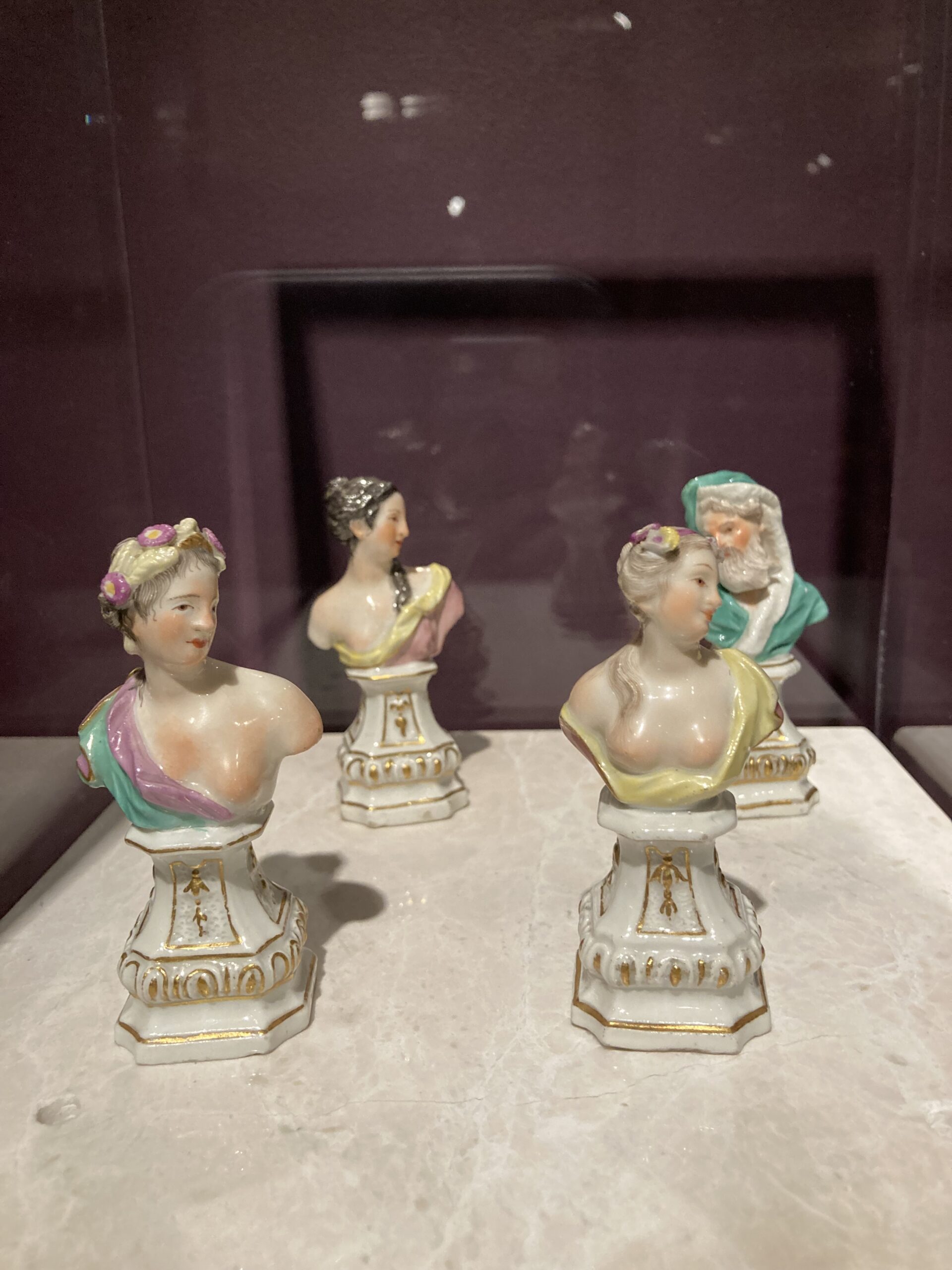
Personification of the Four Seasons, circa 1755, Hard Paste Polychrome Porcelain, Musei Capitolini, Pinacoteca Capitolina Cini, Rome, Italy – Photo Credit: Amalia Spiliakou, February 18, 2024, ‘Meanings’. Personifications and Allegories from Antiquity to Today Exhibition, Acropolis Museum, Athens, Greece
Today, on the summer solstice, the sun reaches its zenith, and somewhere in a quiet gallery of the Musei Capitolini in Rome, four small porcelain busts stand in their eternal procession. Spring, Summer, Autumn, Winter: rendered, around 1755, in hard-paste porcelain, they measure no more than a few centimeters tall, yet they carry within them the full weight of the European artistic imagination. The Four Seasons Allegory in Meissen Porcelain is my new Post on what it meant to capture time itself in fire and clay.
The Birth of Meissen Porcelain in Europe
For centuries, Europeans coveted Chinese and Japanese porcelain, that luminous, translucent ware that seemed to defy the limits of clay and fire. The secret of its making was jealously guarded. Then, in 1708, the alchemist Johann Friedrich Böttger, working under the patronage of Augustus the Strong of Saxony, cracked the formula, and produced the first true hard-paste porcelain in Europe, ending a century of imitation.
By the mid-eighteenth century, Meissen had become the envy of European courts. Its wares, decorated with polychrome enamels applied over the glaze and fired in a muffle kiln, achieved a brilliance and precision unmatched on the continent. The Four Seasons set, in the Collection of the Musei Capitolini in Rome, exemplifies the manufactory at its peak: the faces modelled with astonishing delicacy, the drapery alive with colour, the pedestals gilded with rococo ornament.
The Four Seasons and Meissen Porcelain
Each bust is a carefully coded image, legible to any educated eighteenth-century viewer. The language of allegory was then a common currency, inherited from antiquity and refined through centuries of artistic convention.
Spring is the The flowering maiden – Pale hair adorned with spring blossoms, yellow-green drapery, the colours of new growth. Youth, freshness, and the promise of abundance. In classical tradition she echoes Flora, goddess of flowers.
Summer is the harvest queen – Flowers still crown her, but the drapery shifts to lilac and green, richer, warmer. She represents fullness, warmth, and the height of the year’s powers. Today she stands at her apogee.
Autumn is the dark-braided beauty – Dark, braided hair, a departure from Spring and Summer’s lighter tones, signals ripeness and approaching melancholy. The pink and gold drapery hints at harvest bounty before the turning.
Winter is the hooded elder – Strikingly, Winter is rendered as a bearded old man, the only male figure. This follows ancient iconography: Winter as Saturn or Boreas, the north wind, hooded, still, withdrawn. This is the iconography of the year in its old age.
The pedestals, too, are significant: identical in form, white porcelain with gilt rococo ornament, they unite the four seasons as equal parts of an unbroken cycle. No season is diminished. Each rests on the same ground.
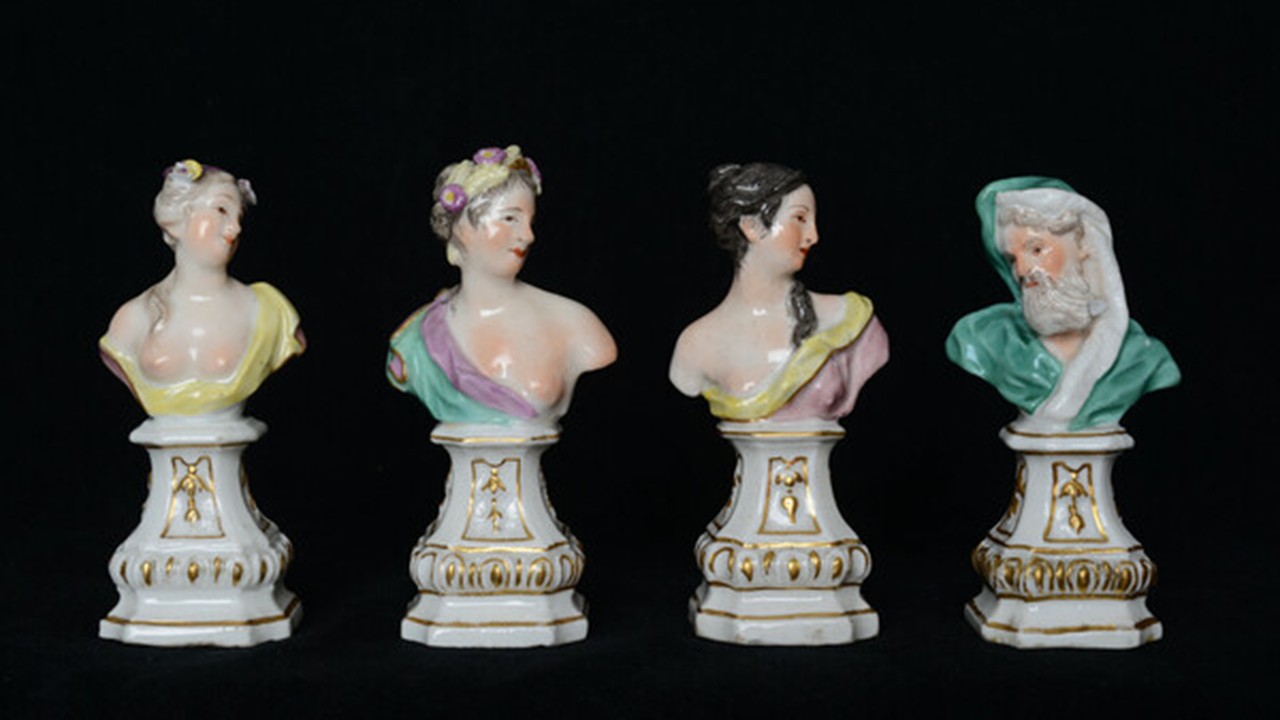
Personification of the Four Seasons, circa 1755, Hard Paste Polychrome Porcelain, Musei Capitolini, Pinacoteca Capitolina Cini, Rome, Italy
https://www.lifo.gr/culture/eikastika/noimata-i-nea-ekthesi-sto-moyseio-tis-akropolis
The Four Seasons Theme in Western Art
The allegory of the Four Seasons is among the oldest and most persistent themes in Western art. From Roman floor mosaics to Baroque ceiling frescoes, from Vivaldi’s concerti to Arcimboldo’s fantastical composite portraits, in which human faces are assembled from fruits, vegetables, and flowers corresponding to each season, artists have returned again and again to this fundamental rhythm of the natural world. The subject speaks to something irreducible in human experience: the turning of the year, the passage of time, the inevitability of change.
Meissen’s porcelain busts of around 1755 stand firmly within this tradition, translating an ancient theme into the intimate, luxury medium of the eighteenth century, objects designed not for public devotion, but for private contemplation on a collector’s shelf.
On this summer solstice, the second figure in the quartet stands at the height of her year. Visit her, and her companions, at the Pinacoteca Capitolina Cini, Rome.
Looking for a creative classroom idea? Discover a hands-on student activity inspired by the iconic Meissen Porcelain figurines of the Four Seasons. Explore the full Student Activity…
Continue Exploring on Teacher Curator
Expand your understanding of Meissen artistry and allegorical themes with related articles: A Meissen Figurine of La Chocolatière and Triumph of Neptune and the Four Seasons
Sources and further Reading: To dive deeper into the world of European porcelain and decorative arts, visit the Cini Gallery at the Capitoline Museums, featuring exceptional European and Oriental porcelain collections: https://www.museicapitolini.org/it/percorsi/percorsi_per_sale/pinacoteca_capitolina/galleria_cini_porcellane_europee_e_orientali and Learn more about the history, craftsmanship, and legacy of Meissen porcelain directly from the official manufactory: https://www.meissen.com/en/manufaktur-ubersicht