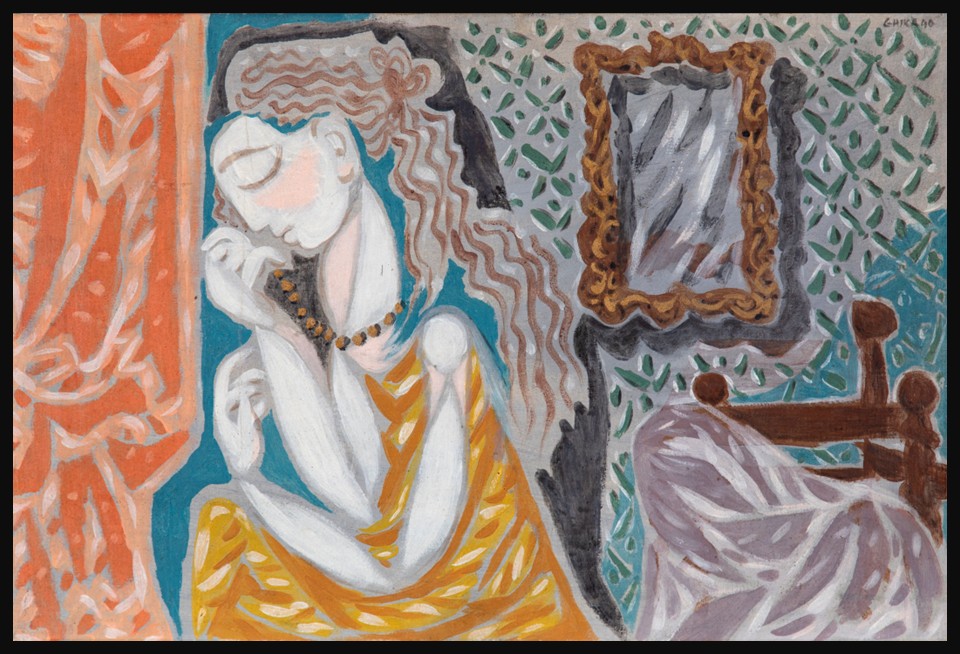
Interior with Woman and Mirror, 1940, oil on canvas, 40 x 60 cm, Private Collection
https://www.bonhams.com/auction/31745/lot/34/nikos-hadjikyriakos-ghika-1906-1994-femme-dans-un-interieur-avec-miroir/
There are paintings that stop you mid-step. Nikos Hadjikyriakos-Ghika’s Interior with Woman and Mirror is one of them. Luminous, stylish, charged with youthful vivaciousness, it radiates the particular energy of the Paris ateliers at their very peak. Stand in front of it long enough and you can almost smell the turpentine. But there is a great deal more going on beneath that gorgeous surface than first meets the eye. This painting is a conversation, between Ghika and his Parisian contemporaries, between a young woman and her reflection, between influence and reinvention. Let’s take a closer look.
Ghika and the Paris School: Absorbing, Appropriating, Reinventing
Nikos Hadjikyriakos-Ghika (1906–1994) is widely considered the most important Greek modernist painter of the twentieth century. And one of the reasons he holds that title is precisely his relationship with Paris, not imitation, but genuine creative dialogue. As Dr. Tsikouta-Deimezi has noted, Ghika was singular among Greek artists in the depth and sophistication with which he engaged the Paris school. He did not simply borrow, he assimilated, questioned, and ultimately reinvented. The influences of Braque, Léger, and above all Picasso are visible in his work, but always filtered through something distinctly his own. That synthesis is exactly what makes Interior with Woman and Mirror so fascinating to unpack.
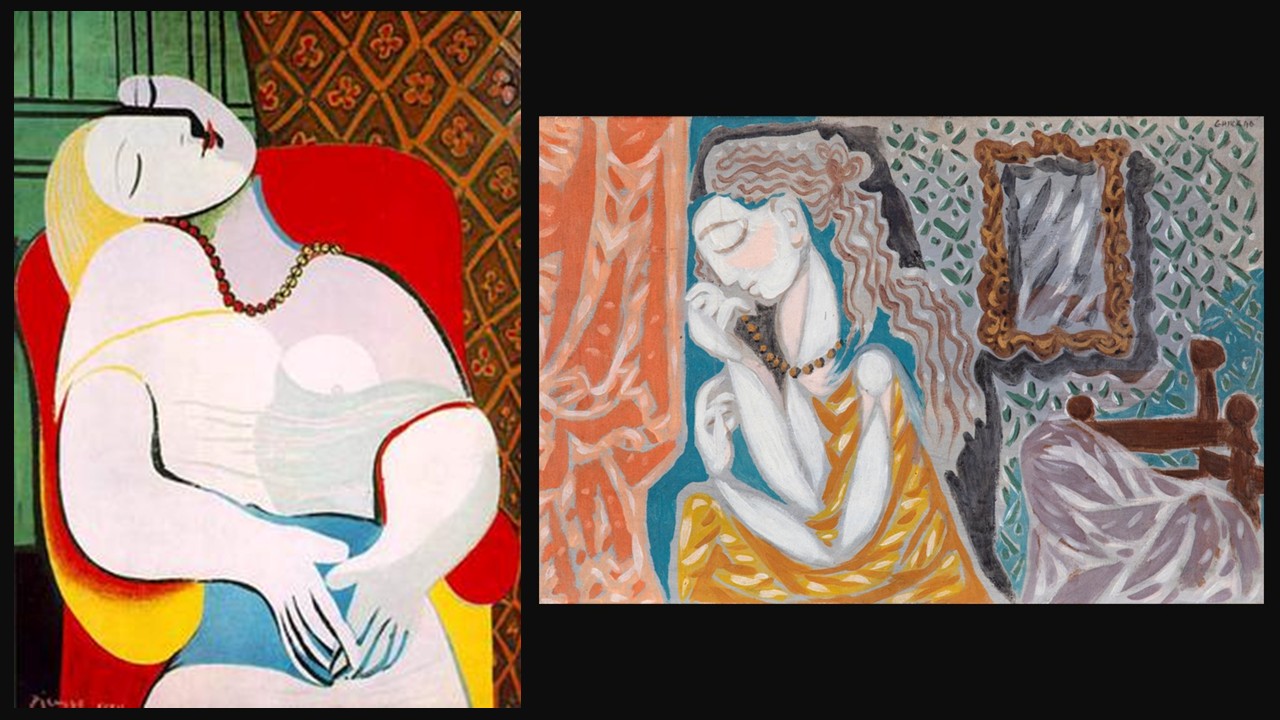
Le Rêve, oil on canvas,1932, 130×97, Private Collection
Nikos Hadjikyriakos-Ghikas, Greek, 1906-1994
Interior with Woman and Mirror, 1940, oil on canvas, 40 x 60 cm, Private Collection
https://www.bonhams.com/auction/31745/lot/34/nikos-hadjikyriakos-ghika-1906-1994-femme-dans-un-interieur-avec-miroir/
https://en.wikipedia.org/wiki/Le_R%C3%AAve_(Picasso)
Picasso’s Shadow: The Closed Eyes and the Sleeping Muse
Look carefully at the young woman at the centre of the composition. Her eyes are closed, lowered, an image of quiet, interior reverie. It is a detail that feels both intimate and deeply considered. And it is not coincidental. Scholars have identified a clear connection to Picasso’s iconic Le Rêve (1932), once part of the Ganz collection in New York, one of the most celebrated images of a sleeping, dreaming woman in all of modern art. Ghika’s debt to this work is visible not just in the motif of the closed eyes, but in the broader handling of the figure: the stylisation of the limbs, the flattening of form, the way the body becomes almost decorative in its rendering.
The motif clearly captivated him. Three years after completing this painting, he returned to it in his Sleeping Woman, now held in the Benaki Museum, Ghika Gallery collection in Athens. It is the kind of repetition that signals genuine obsession, an idea an artist keeps circling because it hasn’t quite been exhausted yet.
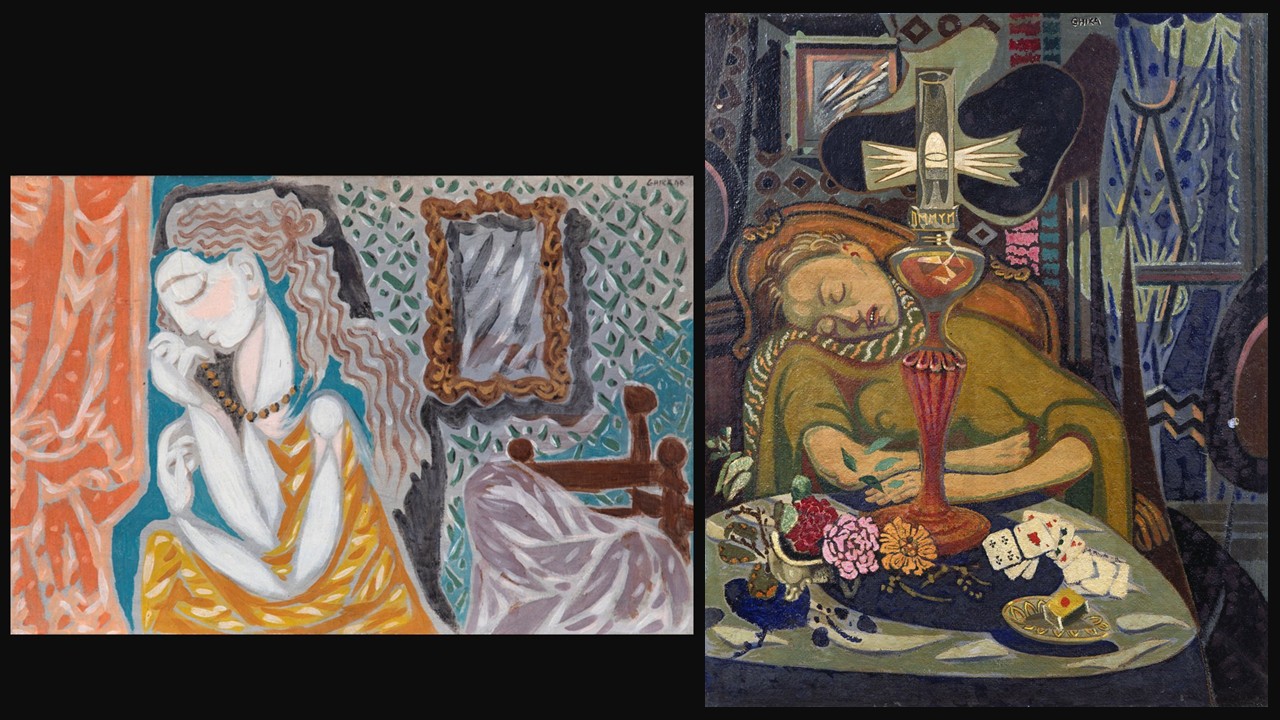
Interior with Woman and Mirror, 1940, oil on canvas, 40 x 60 cm, Private Collection
Sleeping woman, 1997, Terracotta, 0,4×0,33 m, Benaki Museum – Ghika Gallery, Athens, Greece
https://www.bonhams.com/auction/31745/lot/34/nikos-hadjikyriakos-ghika-1906-1994-femme-dans-un-interieur-avec-miroir/
https://www.benaki.org/index.php?option=com_collectionitems&view=collectionitem&id=110992&Itemid=&lang=en
The Mirror as Metaphor: Duality, Beauty, and Reflection
Then there is the mirror, and this is where the painting becomes philosophically rich. The mirror has a long, storied history in art, from Van Eyck’s convex globe in the Arnolfini Portrait to Velázquez’s Venus at her Mirror, to the Symbolists’ endless play with reflection and identity. It is almost always there to do more than show a reflection: it doubles, it reveals, it questions. In Ghika’s hands, the mirror becomes a device to explore what Moraiti calls the dual nature of beauty. There is the woman as she is, and there is her reflection, and the space between those two versions is where meaning lives. Is the mirror showing truth, or distortion? The real, or the ideal?
A Painter Between Two Worlds
What strikes me most about Interior with Woman and Mirror is how fully at home it feels in two places at once. It belongs to the visual language of 1930s Parisian modernism, cubist-inflected, formally adventurous, indebted to Picasso, and yet it carries something that is unmistakably Ghika’s: a warmth, a sensuality, a certain Mediterranean light that Picasso, for all his brilliance, rarely achieved.
Ghika’s achievement was not to copy the Paris school, but to be genuinely transformed by it, and then to paint his way back out, toward something new. That is a rare thing. And it is why, standing in front of this painting, you feel you are looking at two worlds at once: Paris in the 1930s, and a Greece that was quietly, confidently finding its place in the modern world. If you haven’t yet encountered Ghika’s work in person, the Benaki Museum, Ghika Gallery in Athens is the place to start. The paintings reward slow looking, and slow looking, as this one proves, always pays off.
Classroom Activity: Bring Ghika’s painting to life in your classroom with this hands-on student activity. Explore the Student Activity →
Continue Exploring on Teacher Curator: Expand your understanding of Women in Art with an article on Picasso: Mother and Child by Pablo Picasso (Blog Post). Teacher Curator Blog, 7 May 2022.
Sources and further Reading: Information on Ghika’s painting Interior with Woman and Mirror is available at: https://www.bonhams.com/auction/31745/lot/34/nikos-hadjikyriakos-ghika-1906-1994-femme-dans-un-interieur-avec-miroir/ and the Benaki Museum, Ghika Gallery in Athens https://www.benaki.org/index.php?option=com_buildings&view=building&id=17&Itemid=526&lang=en