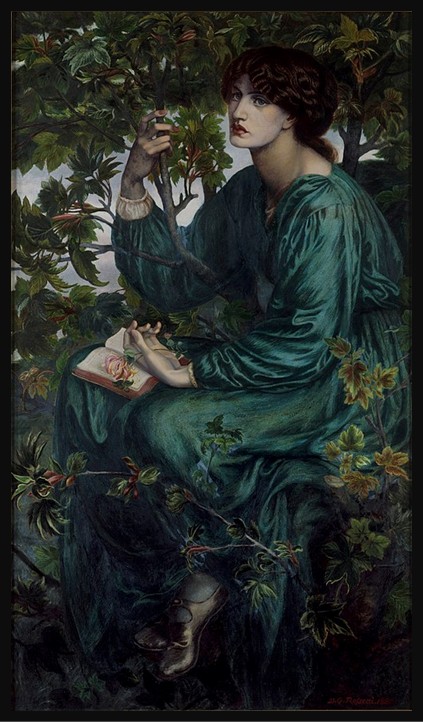
The Day Dream, 1872-8, Pastel and black chalk on tinted paper, 104.8 × 76.8 cm, Ashmolean Museum, Oxford, UK https://www.dropbox.com/sh/uf2hslku4m1ekmv/AADeYM9gsbAVhyxdpXIGQcA5a?dl=0&preview=1+CAPTIONS.pdf
July is honeysuckle month. In the Victorian language of flowers, honeysuckle signified devoted love, the kind that twists, clings, and quietly persists. In 1880, Dante Gabriel Rossetti placed a sprig of it into the hand of the woman he had loved for more than two decades, shaping one of his most recognisable late works: The Day Dream.
The Painting
The Day Dream, now housed in the Victoria and Albert Museum, is among Rossetti’s final major paintings, and one of his most immersive. The canvas is saturated in green: foliage, silk, and filtered summer light dissolve into a single atmosphere. Unlike many of his later, more tightly framed compositions, the figure is shown full-length, suspended within the branches of a sycamore tree. She does not meet our gaze. Instead, she seems absorbed elsewhere—withdrawn into a private interior world.
The painting was commissioned in 1879 by the collector Constantine Alexander Ionides for 700 guineas. Rossetti reworked it extensively, later writing (with characteristic self-assurance) that it would be… as good a thing as I ever did. He even specified how it should be displayed, the height, the direction of light, revealing how carefully he controlled not just the painting, but its viewing conditions.
The Model: Jane Morris
The figure is Jane Morris, born Jane Burden, whose image became inseparable from the Pre-Raphaelite aesthetic. She first entered Rossetti’s orbit in 1857, during preparations for the Oxford Union murals. She was not trained as a model, but her presence, arresting, unconventional, and difficult to categorise, shifted the visual language of the movement.
Her elongated features, heavy-lidded gaze, and abundant, sculptural hair appear again and again in Rossetti’s work: in Proserpine, in Astarte Syriaca, in numerous drawings and variations that seem less like repetitions and more like returns. By 1880, their relationship had endured for over two decades. It was emotionally intense, intermittently distant, and never easily defined.
Jane was married to William Morris, Rossetti’s friend and collaborator, yet she occupied a different, more ambiguous role in Rossetti’s life and art. The honeysuckle, then, is not incidental. It is both symbol and trace, of attachment, of duration, perhaps even of entanglement.
Looking Closely
The composition invites slow looking. The sycamore branches curve around Jane’s body, echoing the classical idea of the dryad, a tree nymph inseparable from her environment. Her green silk dress merges almost imperceptibly with the surrounding leaves, softening the boundary between figure and setting. Above her, small breaks in the canopy reveal fragments of pale blue sky. The world continues beyond the frame, but she has stepped away from it.
A book rests loosely in her lap, unattended. In her hand, the honeysuckle stem slackens, on the verge of falling. Rossetti underscores this moment in the sonnet he wrote to accompany the painting… She dreams; till now on her forgotten book / Drops the forgotten blossom from her hand.” It is a small, exact observation, attention slipping, the physical world loosening its hold. For a painting so lush and still, it carries a surprising emotional charge.
Why It Stays With You
What gives The Day Dream its lasting power is not simply its biography, though that is compelling, but its focus on interiority. Jane is not posed for us. She is not performing beauty. She is absorbed, unreachable. That kind of inwardness is difficult to paint without losing presence. Rossetti manages both.
If you find yourself in London, the Victoria and Albert Museum holds the work in its collection. It rewards time. Stand with it a little longer than feels necessary, the experience unfolds slowly, much like a daydream itself.
Have you seen The Day Dream in person? What stayed with you, the colour, the stillness, or the sense of distance?
PowerPoint Presentation: We’ve put together a presentation to help you go deeper into Rossetti’s Day Dream at the Victoria and Albert Museum. Download it, share it, and make it your own. Download the Presentation →
Continue Exploring on Teacher Curator: Discover more blog posts on Flowers of the Month in Art with related articles… Hukosai’s Iris- The Flower of February and Pink Sweet Peas II
Sources and further Reading: The Day Dream by Rossetti in the Vctoria and Albert Museum: https://collections.vam.ac.uk/item/O14962/the-day-dream-oil-painting-rossetti-dante-gabriel/ and The Rossetti Archive-University of Virginia The Day-Dream: https://rossettiarchive.iath.virginia.edu/docs/7-1880.s259.raw.html