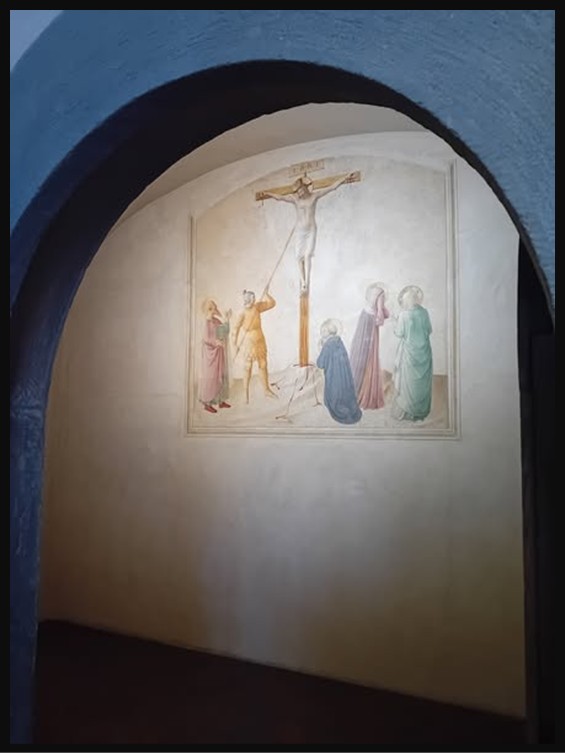
Crucifixion with the Virgin Mary with Martha, and Saints Mark, Dominic and Longino, 1440-1442, Fresco, Convent of San Marco, Cell 42, Florence, Tuscany, Italy
Photo Credit – Petros Dimitrakopoulos, 2025
At the Convent of San Marco in Florence, behind the plain door of a small monastic cell, Fra Angelico painted a Crucifixion that speaks in a whisper rather than a shout. Created in the early 1440s for the private room of a young Dominican friar, this fresco was never meant for crowds or ceremony, but for the quiet rhythm of daily prayer. Its stillness, simplicity, and emotional clarity draw the viewer into close, personal reflection on Christ’s suffering, an approach that feels especially resonant at Easter, when Fra Angelico’s story of the Passion invites not only remembrance, but inward contemplation.
Who was Fra Angelico, and how did a humble friar become one of the defining painters of the Renaissance? Fra Angelico, born Guido di Pietro around 1395, was a Dominican friar as well as one of the most gifted painters of the early Renaissance. He entered the Dominican Order at Fiesole and later lived in Florence, where his artistic life unfolded alongside his religious vocation. For him, painting was not simply a profession but a form of devotion — a way to teach, inspire, and deepen prayer. His contemporaries admired not only his skill but also his character; Giorgio Vasari later wrote that he could not take up his brush without first praying.
Artistically, Fra Angelico stood at a turning point in European art. He embraced the new Renaissance interest in natural light, believable space, and human emotion, yet he used these innovations in the service of spiritual clarity rather than dramatic display. His frescoes at San Marco, painted for the private meditation of Dominican friars, show how profoundly he understood the purpose of sacred images: not to impress the eye, but to move the soul. In this way, the “humble friar” became one of the defining painters of the Renaissance, an artist whose greatness lies as much in quiet intensity as in technical brilliance.
Where was this Crucifixion meant to be seen, and by whom? That purpose becomes especially clear in the setting of one of his most moving works. The Crucifixion discussed here is found not in a public church but in Cell 42 at the Convent of San Marco in Florence, a small room once used by a young Dominican novice. Painted around 1440–1442, during the Medici-sponsored renovation of the convent, the fresco was intended as a daily companion for prayer. These walls were not galleries but spiritual training grounds, where friars learned to contemplate Christ’s suffering in silence and solitude. In such a space, Fra Angelico’s art fulfilled its deepest aim: to draw the viewer inward, turning a simple room into a place of profound encounter.
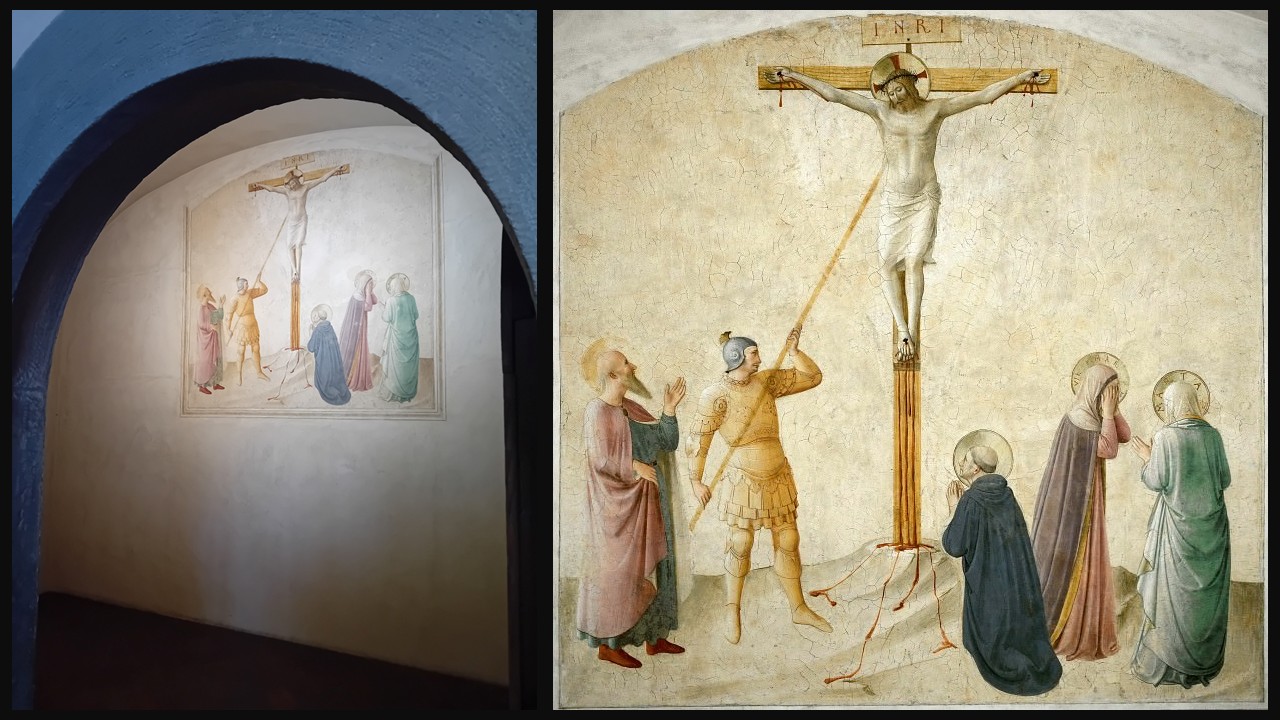
Crucifixion with the Virgin Mary with Martha, and Saints Mark, Dominic and Longino, 1440-1442, Fresco, Convent of San Marco, Cell 42, Florence, Tuscany, Italy
Photo Credits – Left: Petros Dimitrakopoulos, 2025, Right: https://gallerix.org/storeroom/217683978/N/8229/
How does Fra Angelico tell the story of the Crucifixion within this quiet, pared-down scene? Fra Angelico tells the story of the Crucifixion with remarkable restraint, using clarity rather than complexity to convey its emotional and spiritual depth. Christ hangs at the center of the composition, isolated against a pale, almost empty background that removes any distraction of landscape or crowd. This stillness focuses attention entirely on his body and sacrifice. The vertical flow of blood from his wounds, running down the wood of the Cross to the ground below, forms a stark visual path that connects heaven and earth — a quiet but powerful sign of suffering offered for humanity.
Beneath the Cross, a small group of figures models different ways of responding to this moment. The Virgin Mary stands in sorrowful composure, her grief inward and dignified. Nearby are St. Mark, St. Dominic, and St. Martha, saints connected to preaching, contemplation, and service. The Roman soldier Longinus pierces Christ’s side, a moment of violence that becomes, in Christian thought, a moment of revelation. Through these restrained gestures and balanced spacing, Fra Angelico transforms the wall into a visual meditation, where silence, posture, and gaze speak as powerfully as dramatic movement.
Standing before Fra Angelico’s story of the Passion fresco, or even imagining it from afar, we are invited into the same kind of attentive stillness that shaped the prayer of the young friar who once slept in Cell 42. Fra Angelico’s Crucifixion does not overwhelm us with drama or spectacle; instead, it asks us to slow down, to remain, and to look with compassion. At Easter, when the story of suffering and hope stands at the heart of the Christian calendar, this quiet wall painting reminds us that transformation often begins in silence. In the simplicity of a monastic cell, the Passion becomes not only an event to remember, but a mystery to contemplate, one that continues to speak softly across the centuries.
For a Student Activity of Fra Ageico’s story of the Passion frescoin Cell 42 at the Convent of San Marco in Florence, please… check HERE!
Bibliography: from Art in Tuscany http://www.travelingintuscany.com/art/fraangelico/conventodisanmarco.htm and from the Lives of the Artists by Giorgio Vasari in http://www.travelingintuscany.com/art/giorgiovasari/lives/fragiovannidafiesole.htm