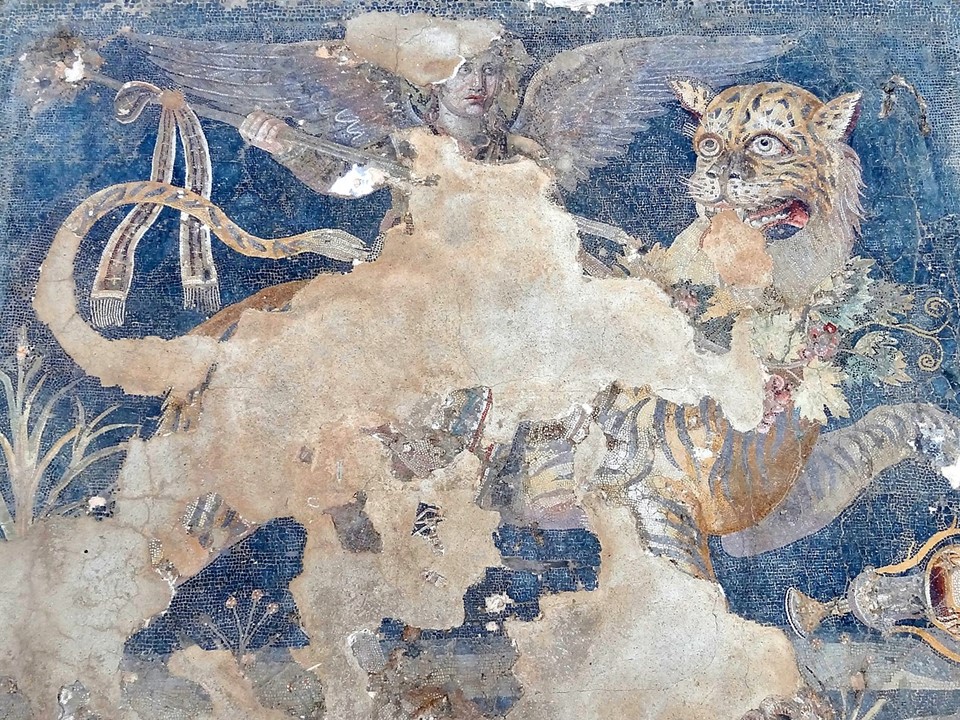
House of Dionysus, Epiphany of Dionysus, 2nd century BC, Mosaic, Delos Island, Greece

The Epiphany of Dionysus Mosaic in Delos

House of Dionysus, Epiphany of Dionysus, 2nd century BC, Mosaic, Delos Island, Greece
House of Dionysus, Epiphany of Dionysus, 2nd century BC, Mosaic, Delos Island, Greece https://en.wikipedia.org/wiki/Mosaics_of_Delos#/media/File:Delos_Museum_Mosaik_Dionysos_05.jpg

In Euripides’s Bacchae, it is Teiresia’s role, addressing Pentheus, to introduce Dionysus to the audience, just like the Epiphany of Dionysus Mosaic in Delos does… visually! …You have a rapid tongue as though you were sensible, but there is no sense in your words… [270] This new god, whom you ridicule, I am unable to express how great he will be throughout Hellas. For two things, young man, [275] are first among men: the goddess Demeter—she is the earth, but call her whatever name you wish; she nourishes mortals with dry food; but he who came afterward, the offspring of Semele, discovered a match to it, the liquid drink of the grape, and introduced it [280] to mortals. It releases wretched mortals from grief, whenever they are filled with the stream of the vine, and gives them sleep, a means of forgetting their daily troubles, nor is there another cure for hardships. He who is a god is poured out in offerings to the gods, [285] so that by his means men may have good things! http://www.perseus.tufts.edu/hopper/text?doc=Perseus%3Atext%3A1999.01.0092%3Acard%3D266

House of Dionysus, Epiphany of Dionysus (Detail), 2nd century BC, Mosaic, Delos Island, Greece 
House of Dionysus, Epiphany of Dionysus (Detail), 2nd century BC, Mosaic, Delos Island, Greece  https://www.greece-is.com/why-mykonos-became-a-muse-for-the-worlds-most-discerning-travelers/

There is no easy way to describe God Dionysus. The Homeric Hymns 26 on Dionysus is, I believe, a wonderful introduction… [1] I begin to sing of ivy-crowned Dionysus, the loud-crying god, splendid son of Zeus and glorious Semele. The rich-haired Nymphs received him in their bosoms from the lord his father and fostered and nurtured him carefully [5] in the dells of Nysa, where by the will of his father he grew up in a sweet-smelling cave, being reckoned among the immortals. But when the goddesses had brought him up, a god oft hymned, then began he to wander continually through the woody coombes, thickly wreathed with ivy and laurel. And the Nymphs followed in his train [10] with him for their leader; and the boundless forest was filled with their outcry.    /    And so hail to you, Dionysus, god of abundant clusters! Grant that we may come again rejoicing to this season, and from that season onwards for many a year. The Homeric Hymns 26 on Dionysus is, I believe, a wonderful introduction! https://www.perseus.tufts.edu/hopper/text?doc=Perseus%3Atext%3A1999.01.0138%3Ahymn%3D26 

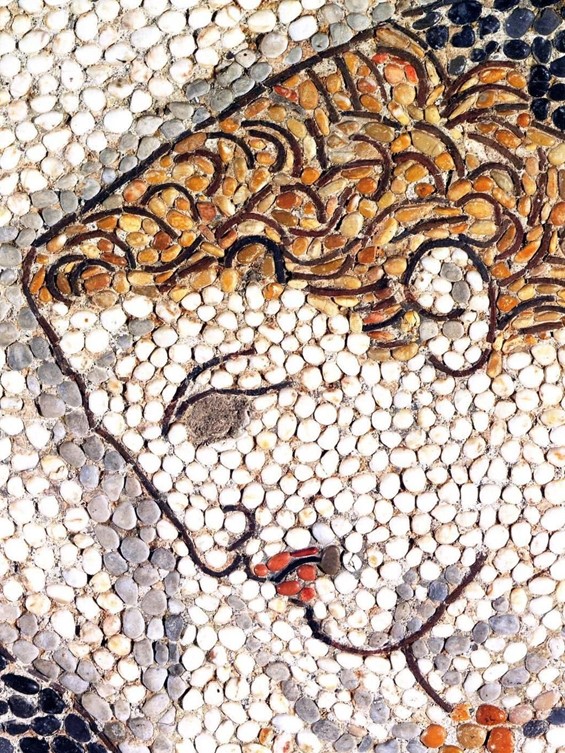
House of Dionysus, Epiphany of Dionysus (Face Close Up), 2nd century BC, Mosaic, Delos Island, Greece
House of Dionysus, Epiphany of Dionysus (Face Close Up), 2nd century BC, Mosaic, Delos Island, Greece https://en.wikipedia.org/wiki/Mosaics_of_Delos#/media/File:Face_of_Dionysos_(detail),_mosaic_of_the_House_of_Dionysos,_Delos,_Greece,_2nd_century_BC.jpg

The Epiphany of Dionysus Mosaic in Delos shows the God exactly as Homer describes him… splendid, thickly wreathed with ivy and laurel, god of abundant clusters of grapes! An anonymous 2nd century BC mosaicist, created on the island of Delos, at the House of Dionysus to be exact, a stunning mosaic emblema depicting Dionysus in all his glory. Against a black background, the God of wine and theater, ivy-crowned, wings outstretched, holding with his right hand a ribboned thyrsus like he is holding a spear, is shown on the back of a tiger that wears a necklace wreath of vines and grapes around its neck. They seem to ride within the boundaries of a landscape mosaic composition of plants, a beetle, and a kantharos-type cup. Is Dionysus depicted coming back from India, magnificently winged like a daemon? It would be nice if we were certain.

The mosaic in the House of Dionysus is one of the finest examples of Opus Vermiculatum. The tesserae used for carrying it out, measuring about one-millimeter square, were made of glass, faience, terracotta, and natural stones. Their small size made it easier for the mosaicist to produce a realistic figured scene, shading, known to the Greeks as skiagraphia, for three-dimensionality, and a sense of illusionism. The name and origin of the mosaicist are a mystery. The name and origin of the owners of the so-called ‘House of Dionysus’ in Delos is a mystery as well. Today, the House of Dionysus stands out from afar thanks to its huge marble columns that surround the courtyard where the Epiphany of Dionysus Mosaic, one of the most exquisite creations of the Hellenistic art of mosaic-making was placed, for all visitors, to admire.

For a PowerPoint on God Dionysus, please… Check HERE!

House of Dionysus, Epiphany of Dionysus (Detail of Panther), 2nd century BC, Mosaic, Delos Island, Greece
House of Dionysus, Epiphany of Dionysus (Detail of Panther), 2nd century BC, Mosaic, Delos Island, Greece https://en.wikipedia.org/wiki/Mosaics_of_Delos#/media/File:Delos_Museum_Mosaik_Dionysos_09.jpg
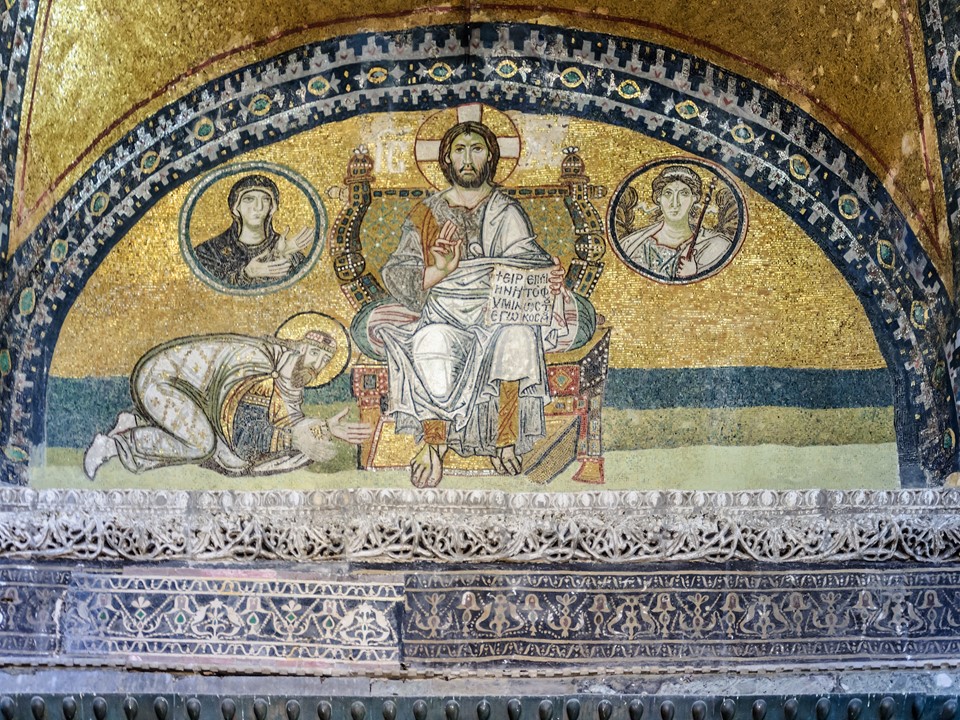
The Enthroned Christ and Emperor Leo VI the Wise, around the year 920, mosaic decorating the lunette over the Imperial Door in the Narthex of Hagia Sophia, the Great Church of the Byzantine Empire, Istanbul, Turkey

The Enthroned Christ and Emperor Leo VI the Wise

The Enthroned Christ and Emperor Leo VI the Wise, around the year 920, mosaic decorating the lunette over the Imperial Door in the Narthex of Hagia Sophia, the Great Church of the Byzantine Empire, Istanbul, Turkey
The Enthroned Christ and Emperor Leo VI the Wise, around the year 920, mosaic decorating the lunette over the Imperial Door in the Narthex of Hagia Sophia, the Great Church of the Byzantine Empire, Istanbul, Turkey https://www.pallasweb.com/deesis/inner-outer-narthex-hagia-sophia.html

I like what the late Professor Nicolas Oikonomides wrote about the Byzantine mosaics in the vestibule and the narthex of the Great Church of Hagia Sophia… The imperial mosaics of Saint Sophia, beyond their artistic value, are of considerable historical importance… and… mosaics were made in the hope that they would survive ad saecula saeculorurn. Consequently, although representing a particular scene, or event, or idea that prevailed at the time of their composition, they were also supposed to bequeath their presumably understandable message to future generations. I am reading his article, Leo VI and the Narthex Mosaic of Saint Sophia, follow his steps, and learn interesting facts about the Enthroned Christ and Emperor Leo VI the Wise, the mosaic decorating the lunette over the Imperial Door of the Great Church. Dumbarton Oaks Papers, Vol. 30 (1976), pp. 151+153-172 (26 pages) https://www.jstor.org/stable/1291393 and http://archive.eclass.uth.gr/eclass/modules/document/file.php/SEAD336/Oikonomides-Leo%20VI.pdf

In 1930 Thomas Whittemore, an American scholar, archaeologist, and restoration expert founded the Byzantine Institute of America and in 1931 took over the responsibility of recovering the mosaics of Hagia Sophia after receiving the approval of the founder of the Turkish Republic, Kemal Ataturk, who turned Hagia Sophia into a museum four years later. 1n 1933 Whittemore uncovered and restored the mosaic decorating the lunette over the Imperial Door of Hagia Sophia. This mosaic, featuring the enthroned Christ in the center, a Byzantine Emperor in a prostrate position to his right, Whittemore identified him as Leo VI the Wise, and two medallions presenting the Mother of God and the Archangel Gabriel, is most unusual-a hapax in Byzantine art, according to Nicolas Oikonomides.  https://greekreporter.com/2020/07/14/the-american-who-restored-hagia-sophias-ancient-mosaics-to-their-former-glory/ and The Mosaics of St. Sophia at Istanbul by Thomas Whittemore, American Journal of Archaeology, Vol. 42, No. 2 (Apr. – Jun. 1938), p 220 https://www.jstor.org/stable/499667?read-now=1&refreqid=excelsior%3A6760f2942e2ab709e12081a284c41584&seq=3#page_scan_tab_contents and file:///C:/Users/aspil/OneDrive/Blog/Byzantium%20Mosaics/Leo%20the%20Wise%20Oikonomides.pdf

Byzantinologists agree that the Hagia Sophia Mosaic over the Imperial Door (Christ and Emperor Leo VI, the Wise) is to be dated to the second half of the ninth century or the beginning of the tenth. There is a disagreement, however, over the meaning of the whole composition, on which Oikononides gives an explanation I find interesting. file:///C:/Users/aspil/OneDrive/Blog/Byzantium%20Mosaics/Leo%20the%20Wise%20Oikonomides.pdf page 154

The Enthroned Christ and Emperor Leo VI the Wise (detail), around the year 920, mosaic decorating the lunette over the Imperial Door in the Narthex of Hagia Sophia, the Great Church of the Byzantine Empire, Istanbul, Turkey
The Enthroned Christ and Emperor Leo VI the Wise (detail), around the year 920, mosaic decorating the lunette over the Imperial Door in the Narthex of Hagia Sophia, the Great Church of the Byzantine Empire, Istanbul, Turkey https://el.m.wikipedia.org/wiki/%CE%91%CF%81%CF%87%CE%B5%CE%AF%CE%BF:Detail_of_the_Imperial_Gate_mosaic_in_Hagia_Sophia_showing_Leo_VI_the_Wise.jpg

Prof. Nicolas Oikonomides presents, I believe, a very persuasive argument over the meaning of the composition. He stresses the idea of how unique and unusual the theme of an emperor prostrating himself in front of Christ is in Byzantine imperial iconography and questions… Is the depicted Emperor exhibiting extreme humiliation or repentance? Oikonomides is in favor of repentance over humiliation. To support his case, he recalls that the initial meaning of the Greek word μετάνοια is repentance. He also recalls that since early Byzantine times, the same term, μετάνοια. is used by Orthodox Greeks to mean prostration, because prostration was-and still is, an act of penance, a normal way for the Orthodox Greeks to show repentance. He then compares the Emperor depicted in the Hagia Sophia mosaic to famous manuscript illuminations depicting the Repentance of David, the Biblical King, and he concludes that the Hagia Sophia mosaic of an Emperor in a prostrate position shows a repentant emperor. file:///C:/Users/aspil/OneDrive/Blog/Byzantium%20Mosaics/Leo%20the%20Wise%20Oikonomides.pdf Pages 154-158

For a Student Activity, please… Check HERE!

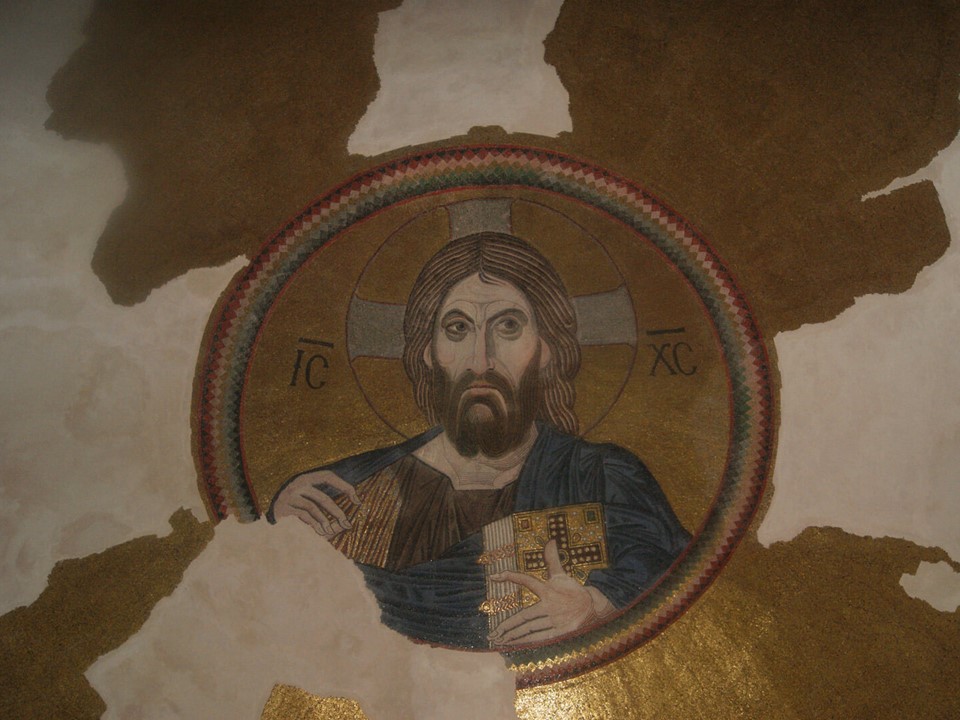
Daphni Monastery Pantocrator Mosaic, 11th century, Attica, Greece

Christ Pantocrator in the Byzantine Monastery of Daphni

Christ Pantocrator in the Byzantine Monastery of Daphni… whose great eyes, dark and exorbitant and cast almost furtively over one shoulder, at total variance with His right hand’s serene gesture of blessing and admonition, spell not only pain but fear, anguish and guilt, as though He were in flight from an appalling doom. The only fit setting for such an expression is the Garden of ! Gethsemane; but this is a Christ-God in His glory, the All-Powerful One. It is tremendous, tragic, mysterious and shattering… writes Patrick Leigh Fermor in his travel book Mani. Travels in the Southern Peloponnese of 1958. https://patrickleighfermor.org/tag/mani/ and https://www.biblio.com/mani-by-fermor-patrick-leigh/work/20200

The sight of the Pantocrator image at Daphni is indeed breathtaking, and I particularly like Fermor’s use of adjectives… tremendous, tragic, mysterious, and shattering! Whether Fermor was right or not in his description… whether the Daphni Pantocrator survives today exactly as it was created by the anonymous 11th century Byzantine master… is not easy to answer, but was expertly addressed by Robin Cormack in his 2009 article Rediscovering the Christ Pantocrator at Daphni. Professor Cormack takes his reader on a wonderful journey as he “deciphers” the secrets of this amazing mosaic and the wondrous ways of mosaic restoration. Journal of the Warburg and Courtauld Institutes, Vol. 71 (2008), pp. 55-74 (20 pages) Published By: The University of Chicago Press https://www.jstor.org/stable/20462776?read-now=1&refreqid=excelsior%3Aefe48f19a158ab3c7526e9941fbf2d9f&seq=20

Visiting the Daphni Monastery has always been a wonderful experience! Built on the slopes of Mount Egaleo in the grove of Haidari, next to the ancient Athenian Ιερά Οδό (Sacred Road) that connected Athens with Eleusis, the site of the eponymous Eleusinian Mysteries, lies the Byzantine Monastery of Daphni. It is only interesting that the Monastery was built on the location of the ancient sanctuary of Apollo Daphnaios, destroyed during the invasion of the Goths in 395 AD. Unfortunately, of the old temple only one Ionic column still remains in the colonnade of the narthex, while the rest were removed by Lord Elgin in the 19th century. http://odysseus.culture.gr/h/2/eh251.jsp?obj_id=1514

Daphni Monastery (Katholiko NE View), 11th century, Attica, Greece
https://www.efada.gr/%CE%91%CF%81%CF%87%CE%B1%CE%B9%CE%BF%CE%BB%CE%BF%CE%B3%CE%B9%CE%BA%CE%BF%CE%AF-%CE%A7%CF%8E%CF%81%CE%BF%CE%B9-%CE%9C%CE%BD%CE%B7%CE%BC%CE%B5%CE%AF%CE%B1/%CE%9C%CE%BF%CE%BD%CE%AE-%CE%94%CE%B1%CF%86%CE%BD%CE%AF%CE%BF%CF%85

According to the Greek Ministry of Culture (ΟΔΥΣΣΕΥΣ site), the first monastic community at Daphni was organized during the 6th century AD and was enclosed by strong defensive walls, almost square in plan. The catholicon was a three-aisled basilica which stood in the center of the courtyard. Along the inner NE side of the walls, two-storied buildings were constructed, containing the cells of the monks. A reception hall and a second block of cells were attached on the north wall of the enclosure. http://odysseus.culture.gr/h/2/eh251.jsp?obj_id=1514

What we see today is the 2nd phase of development and construction, dating from the 11th century (around 1080). The Monastery’s Katholikon is a cross-in-square church of the octagonal type, surmounted by a broad and high dome. It has a narthex, formed as an open portico… The exonarthex was constructed a little later, in the early 12th century and the chapel to the west was added in the 18th century… The porch with the three pointed arches in the west facade of the narthex was added in the 13th century by the Frankish monks and certainly points to western influence… The walls of the church are built in the simple cloisonne masonry with poor brick decoration, restricted on the windows… The monastery is protected by a square enclosure fortified with towers and ramparts, with two entrance gates on its east and west sides. http://odysseus.culture.gr/h/2/eh251.jsp?obj_id=1514

For a Student Activity, please… Check HERE!

For an interesting Video on the Daphni Monastery, please Check… https://www.archaeology.wiki/blog/video/daphni-monastery/

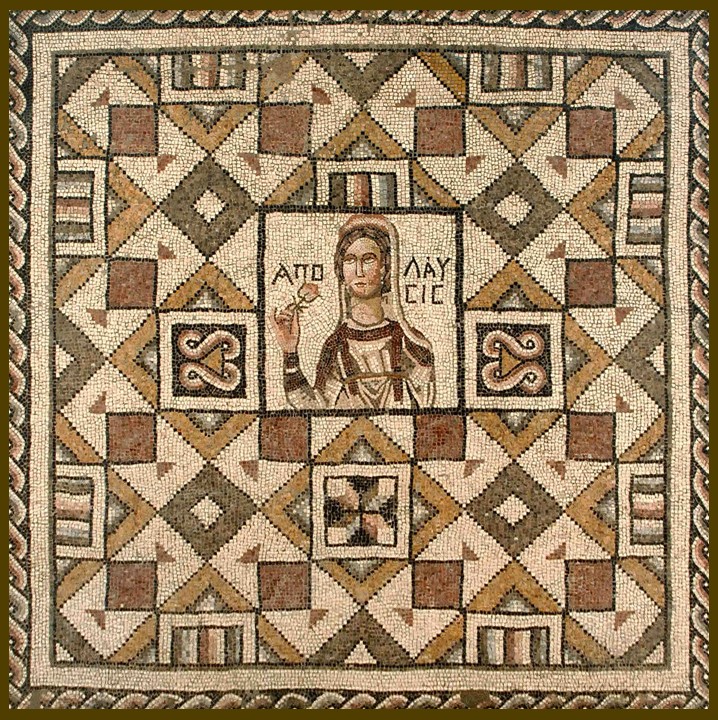
Floor Mosaic with Bust of Apolausis/Enjoyment (Baths of Apolausis, Pool Room West of the Frigidarium), late 4th century-early 5th century, Mosaic on Mortar, 98x266 cm, Dumbarton Oaks, Washington, DC, USA

Apolausis the personification of Enjoyment

Floor Mosaic with Bust of Apolausis/Enjoyment (Baths of Apolausis, Pool Room West of the Frigidarium), late 4th century-early 5th century, Mosaic on Mortar, 98x266 cm, Dumbarton Oaks, Washington, DC, USA
Floor Mosaic with Bust of Apolausis/Enjoyment (Baths of Apolausis, Pool Room West of the Frigidarium), late 4th century-early 5th century, Mosaic on Mortar, 98×266 cm, Dumbarton Oaks, Washington, DC, USA
http://museum.doaks.org/objects-1/info?query=Portfolios%20%3D%20%222606%22&sort=0&page=2

I have always said and felt that true enjoyment can not be described… said Jean Jacques Rousseau… but at the vestibule of the Dumbarton Oaks Museum, Enjoyment has a face… the Floor Mosaic with Apolausis the personification of Enjoyment welcomes visitors since its doors opened to the public in 1941and I can not think of a better way to welcome you to the New Year!  May 2022 be a Year of pure Enjoyment! https://www.stresslesscountry.com/enjoyment-quotes/

Floor Mosaic with Bust of Apolausis/Enjoyment (Baths of Apolausis, Pool Room West of the Frigidarium), late 4th century-early 5th century, Mosaic on Mortar, 98x266 cm, Dumbarton Oaks, Washington, DC, USA
Floor Mosaic with Bust of Apolausis/Enjoyment (Baths of Apolausis, Pool Room West of the Frigidarium), late 4th century-early 5th century, Mosaic on Mortar, 98×266 cm, Dumbarton Oaks, Washington, DC, USA
http://museum.doaks.org/objects-1/info?query=Portfolios%20%3D%20%222606%22&sort=0&page=2

Antioch on the Orontes, the modern-day city of Antakya in Turkey, was founded near the end of the fourth century BC by Seleucus I Nicator, one of Alexander the Great’s generals and successors to his Empire. It flourished and prospered, rivaling even the city of Alexandria in Egypt, as the capital of the Seleucid Empire until 63 BC, when the Romans took control in Syria. Called the cradle of Christianity, Antioch, a great military, and economic metropolis with a population of about 250,000 people became the hub of both Hellenistic Judaism and early Christianity. The city’s decline started during the Byzantine–Sassanid War of 602–628 and continued during the Umayyad period as Antioch found itself on the frontline of the conflicts between two hostile empires, the Byzantine,  and the rising realm of the Arabs. In 1268 the Baibars (Mamluks of Egypt),  besieged Antioch, capturing the city on May 18, marking, thus, the end of its history. https://vrc.princeton.edu/archives/collections/show/7 and https://en.wikipedia.org/wiki/Antioch

Between 1932 and 1939, archaeological excavations of Antioch, its wealthy suburb Daphne, and the port city of Seleucia Pieria, were undertaken under the direction of the “Committee for the Excavation of Antioch and Its Vicinity”, which was made up of representatives from Princeton University, the National Museums of France, the Baltimore Museum of Art, the Worcester Art Museum, and later (1936),  Mr. and Mrs. Bliss, founders of the Dumbarton Oaks Research Library and Collection. Archaeologists unearthed magnificent public and private buildings, and …over three hundred mosaic pavements. The Syrian Government agreed that in return for their contributions, the institutions and the donors to the excavation project would receive archaeological finds like the Apolausis Floor Mosaic. https://vrc.princeton.edu/archives/collections/show/7 and https://www.getty.edu/publications/romanmosaics/catalogue/excavations-antioch/ and http://museum.doaks.org/objects-1/info?query=Portfolios%20%3D%20%222606%22&sort=0&page=2

Excavation Photo showing the Mosaic of Apolausis, Bath of Apolausis – Pool Room West of the Frigidarium, Antioch, Syria, 1938 Antioch Expedition Archives, Department of Art and Archaeology, Princeton University No. 4082
Plan of the Bath of Apolausis, based on an original excavation drawing (Stillwell, 1941, plan 5)
Excavation Photo showing the Mosaic of Apolausis, Bath of Apolausis – Pool Room West of the Frigidarium, Antioch, Syria, 1938 Antioch Expedition Archives, Department of Art and Archaeology, Princeton University No. 4082
Plan of the Bath of Apolausis, based on an original excavation drawing (Stillwell, 1941, plan 5)
https://www.getty.edu/publications/romanmosaics/catalogue/excavations-antioch/#&gid=1&pid=4
https://www.getty.edu/publications/romanmosaics/catalogue/excavations-antioch/#&gid=1&pid=2

The Bath of Apolausis, a small public building that originally served an agricultural complex or group of country villas on the eastern side of the plain of Antioch, at the foot of Mount Silpios was richly decorated with floor mosaics and wall frescoes. Today, the mosaics discovered in this small Bath-House are shared between the Getty Museum (Mosaic Floor with Animals), the Hatay Museum (Sotiria/Salvation Floor Mosaic), and the Dumbarton Oaks (Apolausis/Enjoyment Floor Mosaic). https://www.getty.edu/art/collection/objects/103452/unknown-maker-panel-from-a-mosaic-floor-from-antioch-central-panel-part-of-70ah96-roman-syrian-about-ad-400/ and https://www.youtube.com/watch?v=spir8xGciQo and http://museum.doaks.org/objects-1/info?query=Portfolios%20%3D%20%222606%22&sort=0&page=2

Floor Mosaic with Bust of Apolausis/Enjoyment (Baths of Apolausis, Pool Room West of the Frigidarium), late 4th century-early 5th century, Mosaic on Mortar, 98x266 cm, Dumbarton Oaks, Washington, DC, USA
Floor Mosaic with Bust of Apolausis/Enjoyment (Baths of Apolausis, Pool Room West of the Frigidarium), late 4th century-early 5th century, Mosaic on Mortar, 98×266 cm, Dumbarton Oaks, Washington, DC, USA
http://museum.doaks.org/objects-1/info?query=Portfolios%20%3D%20%222606%22&sort=0&page=2

The personification of Apolausis/Enjoyment, after which the bath was named, decorated the bottom of a large pool with an apsidal end accessed through a doorway on the west side of the octagonal Hall/Frigidarium. As Dr. Will Wootton noted during a 2016 lecture… water would have run over the surface of the Apolausis floor Mosaic… showing that the water was so clear and pure that you could see the mosaic perfectly beneath it. http://museum.doaks.org/objects-1/info?query=Portfolios%20%3D%20%222606%22&sort=0&page=2 and https://www.doaks.org/newsletter/how-mosaics-were-made-and-made-known

To Celebrate the New Year with your Kindergarten – Early Elementary School students… do a HAND-FAN Activity. Create simple, paper HAND-FANS and decorate them with Synonyms to ENJOYMENT! Add a beautiful coloured ribbon and… Voila!!!

For the Student Activity Worksheet, please Check HERE!

To see the Princeton Antioch Catalogued Photographs on the 1938 Apolausis Bath Excavations and finds, go to… http://vrc.princeton.edu/researchphotographs/s/antioch/item?fulltext_search=Apolausis+Bath&property%5B0%5D%5Bjoiner%5D=and&property%5B0%5D%5Bproperty%5D=&property%5B0%5D%5Btype%5D=eq&property%5B0%5D%5Btext%5D=&resource_class_id%5B%5D=&item_set_id%5B%5D=5&resource_template_id%5B%5D=2&resource_template_id%5B%5D=4&resource_template_id%5B%5D=5&resource_template_id%5B%5D=6&resource_template_id%5B%5D=7&resource_template_id%5B%5D=8&resource_template_id%5B%5D=9&resource_template_id%5B%5D=10&resource_template_id%5B%5D=18&resource_template_id%5B%5D=19&resource_template_id%5B%5D=20&resource_template_id%5B%5D=21&resource_template_id%5B%5D=22&submit=Search#?cv=&c=&m=&s=

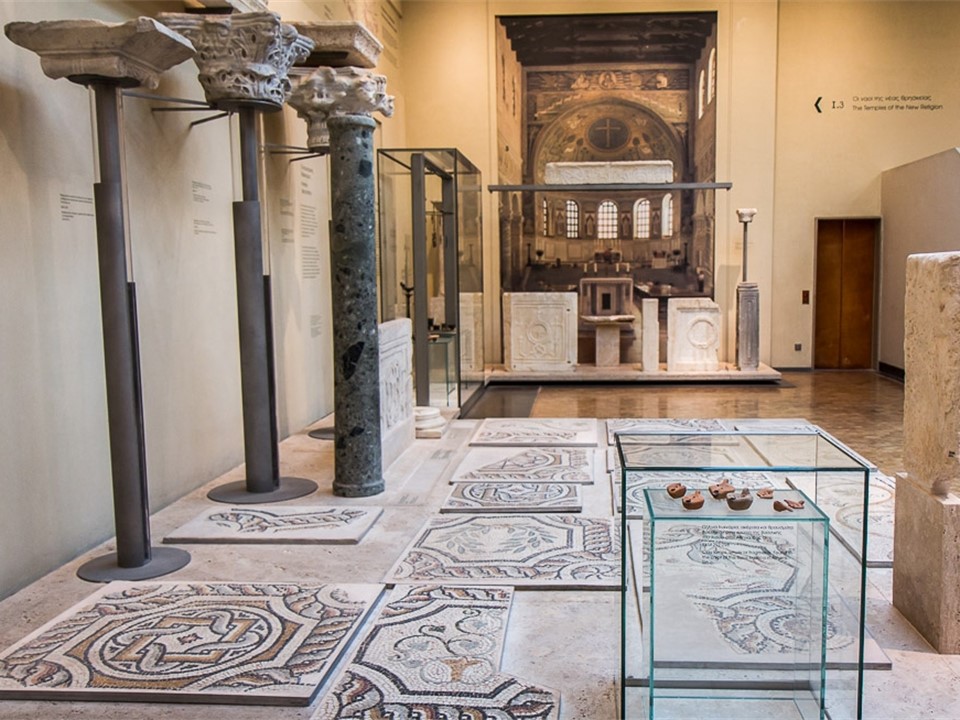
Exhibition of Mosaics from the Ilissos Basilica in Athens, 5th century AD, Byzantine and Christian Museum, Athens, Greece

Mosaics from the Ilissos Basilica in Athens

Exhibition of Mosaics from the Ilissos Basilica in Athens, 5th century AD, Byzantine and Christian Museum, Athens, Greece
Exhibition of Mosaics from the Ilissos Basilica in Athens, 5th century AD, Byzantine and Christian Museum, Athens, Greece http://www.byzantineathens.com/betaalphasigmaiotalambdaiotakappaeta-iotalambdaiotasigmasigmaomicronupsilon.html

How do they call him, how do they call him / the river? / Ilissos, Ilissos. / Let me tell you my little secret. / I love you, I love you.     /     Babies yell at their mom, / but I am desolate and orphaned. / Birds fly with their wings, / but I fly in the dance.     /     How do they call him, how do they call him / the river? / Ilissos, Ilissos. / Let me tell you my little secret. / I love you, I love you… Back in the late 50’ Ilissos was popularly sung by everyone in Greece. With music by Manos Hadjidakis and Lyrics by George Emirzas, it was a musical hit that made the little river that crossed Athens, legendary… Very few, if any, of those who sang along Nana Mouskouri knew about the Byzantine Basilica, let alone, of the Mosaics from the Ilissos Basilica in Athens… https://midifiles.gr/lyrics/ilisos-nana-mushuri-giovana-1956/ and https://www.youtube.com/watch?v=0cDeEYeR_0k

Ilissos Basilica Archaeological Site,  5th century AD, Athens, Greece
Ilissos Basilica Archaeological Site,  5th century AD, Athens, Greece http://www.byzantineathens.com/betaalphasigmaiotalambdaiotakappaeta-iotalambdaiotasigmasigmaomicronupsilon.html

Ilissos Basilica is one of the most important Early Christian monuments in the city of Athens… today, a “sad” archeological site, hardly anyone visits. Back in 1916 and 1917, George Sotiriou. a prominent scholar in the field of Christian Archaeology, excavated the area, discovered the Basilica and the lovely mosaics that are now exhibited in the Byzantine and Christian Museum in Athens. The Basilica was originally built on an islet in the middle of  Ilissos river (the islet was known as Βατραχονήσι – Frog Island)… located to the east of the Olympieion, popularly called today, the Columns of the Olympian Zeus, a colossal Athenian Temple that started during the 6th century BC, at the time of the Athenian tyrants, and finished by the Roman Emperor Hadrian in the 2nd century AD, 638 years later. The fifth-century Basilica was dedicated to Saint Leonides, the third-century Bishop of Athens who was put to death along with seven female martyrs… in 250 AD during the persecutions of Decius.https://athensattica.com/things-to-see/ancient-sites/ilissos-basilica/ and http://www.byzantineathens.com/betaalphasigmaiotalambdaiotakappaeta-iotalambdaiotasigmasigmaomicronupsilon.html

The Ilissos Basilica was probably founded in the years 423-450 by the Byzantine Empress Athenais-Eudocia, wife of the Emperor Theodosius II and Sotiriou excavations of 1916/17 revealed a Basilica of the transitional type – from the simple, timber roofed to the domed basilica. Excavations also brought to light a crypte-martyrium, where Leonides’ relics were kept, and another edifice, a baptisterium, in all probability for the needs of the growing Christian group of Athenian citizens. The basilica, according to the experts, was very carefully built and richly decorated with marble walls, mosaics, and sculptures. This Early Christian monument of Ilissos properly fills the gap in the continuous artistic and cultural evolution of the city of Athens. https://www.archaeology.wiki/blog/issue/the-early-christian-basilica-of-ilissos/

Ilissos Basilica Mosaics
Ilissos Basilica Mosaic depicting a Stork pecking at a Snake,  5th century AD, Floor Mosaic, 92 x 98 cm, Byzantine and Christian Museum, Athens, Greece https://www.byzantinemuseum.gr/en/permanentexhibition/ancient_world_to_Byzantium/temples_of_the_new_religion/?bxm=1756
Ilissos Basilica Mosaic depicting a Laurel Wreath,  5th century AD, Floor Mosaic, 98 x 97 cm, Byzantine and Christian Museum, Athens, Greece https://www.byzantinemuseum.gr/en/permanentexhibition/ancient_world_to_Byzantium/temples_of_the_new_religion/?bxm=1755

The group of mosaics, coming from the Ilissos Basilica and exhibited in the Byzantine and Christian Museum in Athens are of exceptional quality combining the best of Roman and Christian floor mosaic traditions. Inspired by the Roman tradition, the Ilissos Basilica mosaics show decorative features such as interlace in the form of chains (“guilloche”), stylized round flowers (rosettes), trailing ivy, motifs resembling fish scales and water birds. The Early Christian designs exhibited are vine scrolls from which hang bunches of grapes and vine leaves (symbol of the Christian Paradise), wreaths of laurel leaves (a well-known symbol of victory from Roman times), small crosses, and other geometrical and plant motifs. The 5th-century artist who designed these mosaics was a master colourist who favoured gentle hues of white, black, deep red, orange, grey, pale violet, brown, yellow, pink, blue and green. His drawing technique also showed an artist who liked discreet and charming lines, light touch, and great care in arranging the tesserae to follow the outlines. https://www.byzantinemuseum.gr/en/permanentexhibition/ancient_world_to_Byzantium/temples_of_the_new_religion/?bxm=1753

For a PowerPoint on the Mosaics from the Ilissos Basilica in Athens, please… Check HERE!

Parts of a Mosaic pavement, 5th century AD, Floor Mosaic, 62 x 151 cm, Byzantine and Christian Museum, Athens, Greece
Part of a Mosaic pavement decorated with a winding stem with leaves and grapes, 5th century AD, Floor Mosaic, 62 x 151 cm, Byzantine and Christian Museum, Athens, Greece https://www.byzantinemuseum.gr/en/permanentexhibition/ancient_world_to_Byzantium/temples_of_the_new_religion/?bxm=1758
Part of a Mosaic pavement decorated with a winding stem with leaves and grapes,
5th century AD, Floor Mosaic, 63 x 147 cm, Byzantine and Christian Museum, Athens, Greece https://www.byzantinemuseum.gr/en/permanentexhibition/ancient_world_to_Byzantium/temples_of_the_new_religion/?bxm=1759
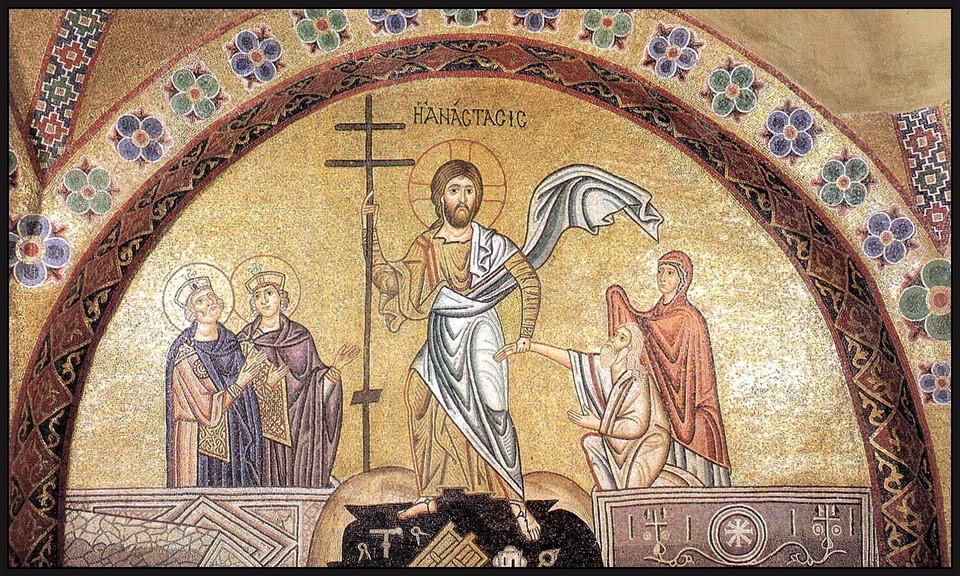
Anastasis, 11th century, Mosaic, Monastery of Hosios Loukas, Greece

Anastasis at the Monastery of Hosios Loukas

“For I delivered unto you first of all that which I also received, how that Christ died for our sins according to the Scriptures; and that He was buried, and that He rose again the third day according to the Scriptures; and that He was seen of Cephas, then of the twelve; after that, He was seen of above five thousand brethren at once.” 1 Cor. 15:3-6… The culmination for the Holy Week in the Orthodox Church comes with Anastasis! Happy Easter and… Rejoyce!https://www.goarch.org/-/holy-week-in-the-eastern-orthodox-church

This year’s Anastasis scene comes from the Narthex of the Katholikon Church in the Monastery of Hosios Loukas near the town of Distomo, in Boeotia, Greece. Along with the mid-11th century Nea Moni (“New Monastery”) on the island of Chios and the late-11th century Monastic Church at Daphni, in Attica, the visitor of these three Monasteries, will get an informative glimpse of monumental architecture and mosaic-work in Byzantium of the Macedonian Dynasty. A  glimpse that is impressive and awe-inspiring.  

Monastery of Hosios Loukas, founded in the early 10th century, Katholikon (1011-12) and the Church of the Theotokos (959-963), near the town of Distomo, in Boeotia, Greece
Monastery of Hosios Loukas, founded in the early 10th century, Katholikon (1011-12) and the Church of the Theotokos (959-963), near the town of Distomo, in Boeotia, Greece https://en.wikipedia.org/wiki/Hosios_Loukas

The location where the Monastery of Hosios Loukas was founded, is perfect… the slopes of Mount Helicon, a scenic valley and an olive grove. The founding father, Luke of Steiris… was respected and much loved by the local population. Retaining its authenticity, still, a vibrant Monastic Community with spiritual vigour, the Monastery of Hosios Loukas shows us today, how perceptive the 11th century Byzantines were!

The pilgrim/caller to the Monastery of Hosios Loukas is expected to visit three Churches, all of them unique in their own right.

Built under the great domed Katholiko Church, the Burial Crypt is decorated with remarkably well-preserved frescoes painted shortly after 1048 AD. Little damaged, with the exception of the apse, the iconographic programme of the Crypt is complete… an almost perfect example of how the interior of a Byzantine Church of the 11th century should be adorned.

Monastery of Hosios Loukas, founded in the early 10th century, Interior of the Church of the Theotokos (959-963), near the town of Distomo, in Boeotia, Greece

During the second half of the 10th century, the monastic community of Hosios Loukas built a remarkable Church, dedicating it to the Theotokos. Less visited by tourists, this is a place for serene contemplation. It is considered a masterpiece of Byzantine architecture, featuring the cross-in-square type architectural plan, similar to that of the Lips Monastery in Constantinople. Very little interior decoration survives but the beauty of the Church’s masonry is astounding. The cloisonne-style masonry is made of brick, stone or marble and curious pseudo-Kufic patterns are intricately displayed. Whenever I visit the Monastery of Hosios Loukas this is where I spent most of my time!

Monastery of Hosios Loukas, Interior of the Katholikon Church, 11th century, near the town of Distomo, in Boeotia, Greece
https://gallerybyzantium.com/unlocking-the-secrets-of-hosios-loukas/

The 11th century Katholiko Church of the Monastery, impressive and imposing, stands next to the church of the Theotokos. Its purpose was to house the relic of St. Luke, which is “…said to have exuded Myron, a sort of perfumed oil which produced healing miracles.” This newer church, dedicated to St. Luke, is of the octagonal cross-in-square architectural type, with coloured marble panels on the walls and mosaics on the surfaces above them. The result is a unique, rich and luminous interior. Standing in the middle of the Katholikon Church is a unique experience to “feel.” https://www.thebyzantinelegacy.com/hosios-loukas and https://gallerybyzantium.com/unlocking-the-secrets-of-hosios-loukas/

Monastery of Hosios Loukas, Katholikon Church Floor Plan, 11th century, near the town of Distomo, in Boeotia, Greece – The black-coloured star marks the location of the Anastasis mosaic
Monastery of Hosios Loukas, Katholikon Church Floor Plan, 11th century, near the town of Distomo, in Boeotia, Greece – The black-coloured star marks the location of the Anastasis mosaic http://papierdoreille.blogspot.com/2014/01/green-beautiful-byzantine.html

The amazing mosaic of the Anastasis in the Narthex area of the Katholikon Church of Hosios Loukas is a fine example of the early 11th-century style in Byzantine Art. It depicts the Resurrection of Christ, or in true Byzantine style, the Descent of Christ into Hades, according to the occult gospel of Nicodemus. Christ is depicted in the centre of the composition, unobstructed and enveloped by golden light, stepping at the gates of Hades and lifting Adam from within an open sarcophagus. Behind Adam is Eve and on the opposite side Biblical kings like Solomon and David. This is a mosaic of outstanding artistic quality, the product of a workshop whose practice goes back to Hellenistic times, stark and austere in essence but monumental, direct and highly spiritual.

Some Considerations on the Eleventh-Century Byzantine Wall Mosaics of Hosios Loukas and San Nicolò di Lido is an interesting article by Irina Andreescu-Treadgold to read.  aninterestinghttps://www.academia.edu/7926757/Some_Considerations_on_the_Eleventh_Century_Byzantine_Wall_Mosaics_of_Hosios_Loukas_and_San_Nicol%C3%B2_di_Lido?email_work_card=view-paper

For a Student Activity please…Check HERE!

Monastery of Hosios Loukas, Interior of the Katholikon Narthex, 11th century, near the town of Distomo, in Boeotia, Greece
Lion Hunt Mosaic (detail), late 4th century, from the House of Dionysos, Pella Archaeological Museum

Lion Hunt Mosaic

Lion Hunt Mosaic (detail), late 4th century, from the House of Dionysos, Pella Archaeological Museum
Lion Hunt (detail), late 4th century, from the House of Dionysos, Pebble Mosaic, 4.90 x 3.20 m., Pella Archaeological Museum

Is the Lion Hunt Mosaic at Pella inspired by Plutarch’s description that follows?    “Accordingly, he exerted himself yet more strenuously in military and hunting expeditions, suffering distress and risking his life, so that a Spartan ambassador who came up with him as he was bringing down a great lion, said: “Nobly, indeed, Alexander, hast thou struggled with the lion to see which should be king.” (Plutarch, Life of Alexander 40.5) This hunting-scene Craterus dedicated at Delphi, with bronze figures of the lion, the dogs, the king engaged with the lion, and himself coming to his assistance; some of the figures were moulded by Lysippus, and some by Leochares.”     https://penelope.uchicago.edu/Thayer/E/Roman/Texts/Plutarch/Lives/Alexander*/5.html     Could the Mosaic at Pella present Alexander the Great and Krateros? Is the Pella Mosaic a faithful copy of the Delphi ex-voto sculptural monument? This is not an easy question to answer…

Chrisoula Saatsoglou-Paliadeli, back in 1989, wrote an article Το ανάθημα του Κρατερού στους Δελφούς (The Votive Offering of Krateros at Delphi), I always enjoy reading, particularly when I visit Pella or Delphi with my students. This article is a detailed and well-documented reference to the Lion Hunt event Plutarch describes. It takes me on a trip to Delphi – where Krateros dedicated an impressive monument commemorating the famous Lion Hunt event Prutarch mentions, the Louvre – the residence of an interesting Lion Hunt relief sculpture from ancient Messene and the Archaeological Museum of Pella – home of the celebrated Lion Hunt mosaic.     https://www.academia.edu/7923619/%CE%A4%CE%BF_%CE%B1%CE%BD%CE%AC%CE%B8%CE%B7%CE%BC%CE%B1_%CF%84%CE%BF%CF%85_%CE%9A%CF%81%CE%B1%CF%84%CE%B5%CF%81%CE%BF%CF%8D_%CF%83%CF%84%CE%BF%CF%85%CF%82_%CE%94%CE%B5%CE%BB%CF%86%CE%BF%CF%8D%CF%82_%CE%9C%CE%B5%CE%B8%CE%BF%CE%B4%CE%BF%CE%BB%CE%BF%CE%B3%CE%B9%CE%BA%CE%AC_%CF%80%CF%81%CE%BF%CE%B2%CE%BB%CE%AE%CE%BC%CE%B1%CF%84%CE%B1_%CE%B1%CE%BD%CE%B1%CF%80%CE%B1%CF%81%CE%AC%CF%83%CF%84%CE%B1%CF%83%CE%B7%CF%82_%CE%95%CE%B3%CE%BD%CE%B1%CF%84%CE%AF%CE%B1_1_1989_79_100

Monument of Krateros at Delphi
Monument of Krateros at Delphi, probably around 320 BC, or at the end of the 4th century BC     https://twitter.com/CarolynPPerry/status/1328250004402790401

The impressive bronze monument, commissioned by Krateros and immortalized by Lysippos and Leochares, at Delphi, has unfortunately long perished. We can only guess that the protagonists of the composition were placed on a pedestal against the back wall of the building arrayed one next to the other. What survives, in the area between the Theater and the Temple of Apollo,  is an impressive structure, rectangular in shape, measuring some 15.27 x 6.35 meters and standing up to 4 meters high. The building was probably a portico with a colonnade on its façade and a dedicatory inscription on its rear, according to which the building was identified as the ex-voto of Krateros, the Macedonian general and close friend of Alexander the Great and his son by the same name, after his father’s death, probably around 320 BC, or at the end of the 4th century BC.

The dedicatory inscription reads… “Alexandros’s son, Krateros, promised this to Apollo, an honored and glorious man; his son, whom he begot in his palace and left as a child, composed it, Krateros, thereby fulfilling every promise to his father, hoping that the hunt for this bull-killing lion may have eternal and attractive fame for him. For when he followed Alexander and destroyed everything together with him, with that much-praised king of Asia, he defeated him and killed him when he fell into his hands in the land of the sheep-bearing Syrians.”     https://pausanias-footsteps.nl/regios/phokis/delphi-votiefgaven/?lang=en     Can we reconstruct this amazing sculptural composition? Plutarch’s description and the Delphi inscription present us with the necessary but inconclusive hints!

Hunt scene, known as "Alexander's Hunt" from Messene
Hunt scene, known as “Alexander’s Hunt” from Messene, 3rd or 2nd century BC, grey-blue marble, 0,59×1.52 m, the Louvre

Petros Themelis writes about the Messene Lion Hunting scene in the Louvre, in his article A Macedonian Horseman – the Relief Louvre, inv. no. ΜΑ 858 from Messene, presenting the latest archaeological discoveries and attributes it to the funerary monument of the Philliades family. “The stone block Louvre MA858 (height: 0,60 m, width: 1,205 m, depth: 0,28 m) carries a relief representing (on the right) a naked male figure with a lion-skin wrapped around his left arm, striking down a lion with a double axe, while a horseman wearing a Macedonian causia, chlamys, and belted chiton with short sleeves comes rushing up from the left side. The hunter with the lion-skin and the axe is usually identified with Alexander, while the horseman with the causia is identified with Craterus because the relief is taken to reflect Craterus’ Monument at Delphi.”     https://www.academia.edu/39501780/P_Themelis_2019_A_Macedonian_Horseman_the_Relief_Louvre_inv_no_MA_858_from_Messene_%CF%83%CF%84%CE%BF_EXCELLENCE_STUDIES_IN_HONOUR_OF_OLGA_PALAGIA

Lion Hunt Mosaic, late 4th century, from the House of Dionysos, Pella Archaeological Museum
Lion Hunt, late 4th century, from the House of Dionysos, pebble mosaic, 4.90 x 3.20 m., Pella Archaeological Museum

The Lion Hunt Mosaic at the Archaeological Museum of Pella, detached from the so-called house of Dionysus, is a masterpiece of mosaic making. “The bodies of the figures on the mosaic floors at Pella are highlighted against the dark background by white pebbles, and the sculpted volumes are accentuated by the chiaroscuro created by grey pebbles in various tonic gradations. Red pebbles… were used in a limited way… The ground in the mosaic of the lion hunt is characterised by its many colours, while the outline and details of the figures’ body parts are rendered by thin strips of lead or terracotta.” Please note the intensity of the figures’ movements, the lion’s position in the middle of the composition, moving forward/looking backwards, his right front pow stepping over the foot of the receding man to the right, wearing a Petasos…     https://www.latsis-foundation.org/content/elib/book_18/pella_en.pdf     and     http://www.pella-museum.gr/explore/museum/enotita1/kathimerini-zoi

My students and the Lion Hunt Mosaic, Archaeological Museum at Pella. For a PowerPoint, please… Check, HERE!

Lion Hunt Mosaic), late 4th century, from the House of Dionysos, Pella Archaeological Museum
Lion Hunt Mosaic (detail), late 4th century, from the House of Dionysos, Pella Archaeological Museum
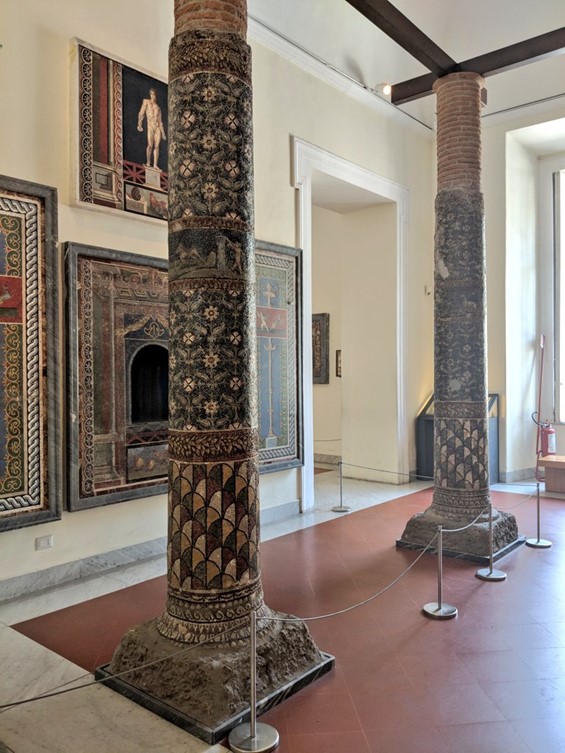
Mosaic Columns from The Villa of the Mosaic Columns in Pompeii

Villa of the Mosaic Columns

Mosaic Columns from The Villa of the Mosaic Columns in Pompeii
Mosaic Columns from The Villa of the Mosaic Columns in Pompeii, 1st century AD, Naples National Archaeological Museum

“If you have a garden in your library, we will want for nothing” wrote Marcus Tullius Cicero to his illustrious new friend Marcus Terentius Varro… and he is so right! Gardening can be so gratifying and the Romans understood it and thus “In the middle of Roman buildings…a roofless square, often with Greek sculptures and temples, was where the Hortus, the garden, was planted and enjoyed. Common Romans might only have had a small courtyard or paved square with pots. Many grew basic foods as a thin bulwark against starvation. The rich enjoyed much larger, more fertile and refined gardens, often closer to parks than yards…Cicero’s correspondent, Varro, was not only well-off but also a scholar of gardening and farming. In light of this, it’s likely that Varro did offer Cicero a well-stocked library, and in it a luxurious garden.” Villa of the Mosaic Columns is about one such lovely Garden, very specially decorated…     https://www.commonsenseethics.com/blog/5-things-that-you-need-to-be-happy-according-to-cicero

Mosaic Columns from The Villa of the Mosaic Columns in Pompeii

The Villa of the Mosaic Columns’ Pompeiian address is on the northern side of Via delle Tombe, behind the bars and shops facing the busy street leading to Herculaneum. Either way, you choose to enter this interesting Villa… you enter a Garden. I like to choose Entrance A (see POST Villa Plan) because Garden C is bigger, it has a mosaic-decorated Nymphaeum and a pergola supported on four magnificent Mosaic Columns. It is thanks to these unique mosaic columns that the Villa, justifiably,  took its name.    https://sites.google.com/site/ad79eruption/pompeii/villas-outside-the-walls/villa-of-the-figured-capitals

Mosaic Columns from The Villa of the Mosaic Columns in Pompeii

The Villa’s Columns are magnificent! They are covered in colourful mosaic decorations with successive bands of geometric, floral and/or figurative designs. The Villa is unfortunately in a poor state of preservation and thus soon after their discovery, the columns were removed and taken to the National Archaeological Museum in Naples where can today be seen.

Mosaic Columns from The Villa of the Mosaic Columns in Pompeii

The second Garden G is accessed by a wide-open area on the north side of Garden C as well as a corridor leading to Via delle Tombe. Very little survives of its original decoration apart from a Lalarium on its south-west corner. The colonnade to the north marks the entrance to the main living quarters which are unfortunately in an almost ruinous condition. The Villa was probably the most ostentatious in the area. “The decoration in fine painting and mosaics, the grandeur of the architecture and the size of the servant quarters put the Villa delle Colonne a Mosaico on a par with or greater than its immediate neighbours, above which it literally towered. Finally, the row of shops that lie beneath the Villa, which was certainly built during a combined sequence of construction, implies that one source of the villa owner’s wealth was the trades practised by those who worked and lived in this complex. Therefore, the shops supported the Villa economically as well as physically, extending the metaphor into a clearly visible statement of the social hierarchy of the city – a statement that complemented the public display that the Villa itself represented.”     http://online.sfsu.edu/pompeii/research2006.html

An interesting discovery lays at the Villa’s south/east side where, within a gated enclosure, a Tomb and a unique Blue and White Glass Vase were discovered. According to Jashemski… “Since this was the only tomb that had a door leading from the tomb chamber into the garden, and since the only entrance to the garden was from the villa of the Mosaic Columns, it was obvious that the tomb and its garden belonged to this villa.” Jashemski, W. F., 1993. The Gardens of Pompeii, Volume II: Appendices. New York: Caratzas, (p.256).

Today, the Blue Glass Vase, found in the Villa of the Mosaic Columns’ Tomb, is one of the most precious treasures of the Naples Archaeological Museum. We will discuss this amazing Vase in Villa of the Mosaic Columns, Part 2.

Glass Amphoriskos with cupids gather grapes from the Villa of the Mosaic Columns in Pompeii
Glass Amphoriskos with cupids gather grapes from the Villa of the Mosaic Columns in Pompeii, between circa 1 and circa 79 AD, Cameo Glass, Naples Archaeological Museum

I would like to finish this POST once again with Cicero, who, as he was growing older, he enjoyed more and more the calm and serenity of his gardens, either in his Tusculum Villa where he withdrew to his library and gardens to think and write, or his family Villa in Arpinum, where during his later years, he collected his scrolls and codices, away from Rome, for better protection. “By means of our hands, we struggle to create a second world within the world of nature,” Cicero wrote, thinking as a Stoic philosopher, for whom “the garden was a microcosm of the larger order of the cosmos.”     https://www.commonsenseethics.com/blog/5-things-that-you-need-to-be-happy-according-to-cicero

For a PowerPoint on the Villa of the Mosaic Columns, please… click HERE!

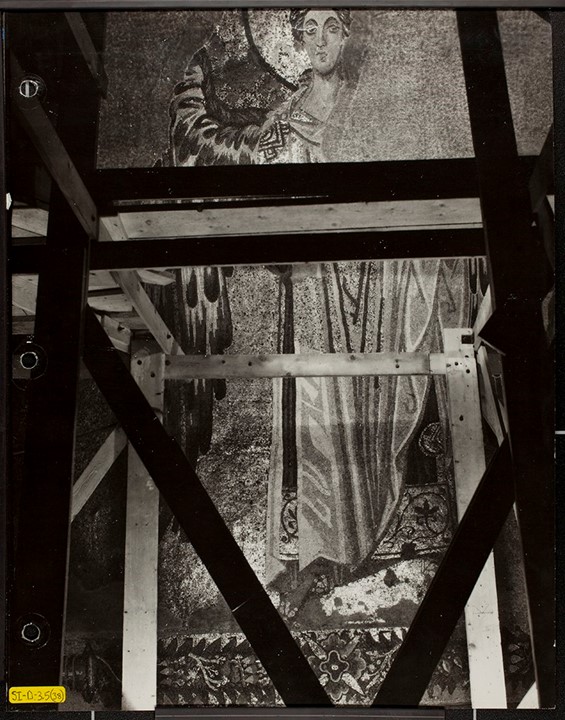
Archangel Gabriel, south side of the Bema of the Holy Apse of Hagia Sophia in Constantinople, present day Istanbul, Dumbarton Oaks Fieldwork Records and Papers

The Archangel Gabriel of Hagia Sophia

Archangel Gabriel, south side of the Bema of the Holy Apse of Hagia Sophia in Constantinople, present day Istanbul, Dumbarton Oaks Fieldwork Records and Papers
Archangel Gabriel, 9th century, south side of the Bema of the Holy Apse, entire figure seen through scaffolds, photographed in 1938, MS.BZ.004-03-01-02-016-029, The Byzantine Institute, Dumbarton Oaks Fieldwork Records and Papers, ca. the late 1920s-2000s, Image Collections and Fieldwork Archives at Dumbarton Oaks, Trustees for Harvard University, Washington, D.C.

“Whittemore is now working on a huge archangel, on the S. face of the arch in front of the E. semi-dome. On the same scale as the Virgin, he was one of her two guards. Whether his colleague, on the N. face, is preserved or not Whittemore doesn’t yet know. But the one on the S. face is very well preserved indeed: enough tests have been made to establish that. And he may be of the early Macedonian period: X or even IX—after 842, when images were finally restored. You may imagine with what thirst I await the revelation.” This is an excerpt from a letter Royall Tyler wrote to Mildred Barnes Bliss, back on October 11, 1936 about the Uncovering of the Mosaics of Hagia Sophia and The Archangel Gabriel of Hagia Sophia in particular.     https://www.doaks.org/research/library-archives/dumbarton-oaks-archives/historical-records/bliss-tyler-correspondence-excerpts#uncovering-of-the-mosaics-of-hagia-sophia–constantinople–october-1936

Archangel Gabriel, south side of the Bema of the Holy Apse of Hagia Sophia in Constantinople, present day Istanbul
Archangel Gabriel, Mosaic on the Southside of the Bema of the Holy Apse, 9th century, Hagia Sophia of Constantinople

The 1902 to 1953 correspondence between Mildred and Robert Woods Bliss, the founders of Dumbarton Oaks, and their close friend and art adviser, Royall Tyler, and his wife, Elisina, are important primary sources and document the formation of the Blisses’ art collection. They also discuss contemporary history, literature and poetry, music, politics, and expatriate life… https://www.doaks.org/research/library-archives/dumbarton-oaks-archives/historical-records/bliss-tyler-correspondence-excerpts

Two monumental mosaic Archangels, Michael and Gabriel, over 10 meters in height, stood guard flanking Mary with Christ Child on her lap at the Great Church of the Holy Wisdom of God in Constantinople. Dating from the 9th century, they were epic in size, towering over the Bema Soffit of the Holy Apse, massive and solid, yet… wherever you were standing and however you were looking at them, they seemed majestic, imposing and ethereal as they levitated on the golden mosaic bed of divine light. Archangels Michael and Gabriel stood regal and imposing, members of a celestial court of honour for Christ and his mother, splendidly dressed in white and gold just like the members of the Imperial Court stood next to the Emperor.

Archangel Gabriel, south side of the Bema of the Holy Apse of Hagia Sophia in Constantinople, present day Istanbul

Today, the presentation of Archangel Michael on the north side of the Bema soffit is regretfully almost totally missing. Gabriel, however, is still well preserved, helping us understand the magnificence of Hagia Sophia’s Holy Apse composition. My fascination stands with Gabriel’s face and the amazing ability of the Byzantine mosaicist to use hundreds of different-size tesserae and countless different coloured stones or glass to create a face of spirituality and transcendentalism on such a grand scale, with facial contours and a sense of three-dimensionality that astounds the viewer.

Archangel Gabriel, south side of the Bema of the Holy Apse of Hagia Sophia in Constantinople, present day Istanbul

To quote Bob Atchison “The flesh tones used in the face and neck are fine-grained white marble, Proconnesian white marble, Proconnesian grey, cream marble (used very sparingly), and two or three tones of pink marble. Extensive use is made, furthermore, of off-white milky glass which has sometimes a bluish, sometimes a purplish tinge; this forms the right outline of the face, the left outline of the forehead, the pockets under the eyes, the area of light shadow to the left of the nose, etc. Olive glass is used for strong shadows to the left of the nose, round the eyes, the dimple under the nose, and for the shadow under the mouth, where it is mixed with lighter shades of glass and with pink marble. The tip of the nose and parting of the mouth are in deep red glass. Vermilion glass is used in the lips (in the lower lip it is mixed with pink marble) and one line of it forms the end of the chin. The nostrils are in black glass. No green or yellow-green occurs in the archangel’s face.”     https://www.pallasweb.com/deesis/angel-bema-hagia-sophia.html

“It seems too good to be true that there is such a mass of the noblest mosaics ever created, waiting there to be revealed… And I needn’t say that in the whole field of art, there’s nothing that seems to me to touch this work, for importance, and for the unutterable joy these things give when they are uncovered.”     https://www.doaks.org/resources/bliss-tyler-correspondence/letters/11oct1936

For a Student Activity, please… check HERE!

Archangel Gabriel, south side of the Bema of the Holy Apse of Hagia Sophia in Constantinople, present day Istanbul
Archangel Gabriel, south side of the Bema of the Holy Apse of Hagia Sophia in Constantinople, present day Istanbul, Dumbarton Oaks Fieldwork Records and Papers
Workers tracing the lower part of Archangel Gabriel, the south Angel, in the Bema soffit of Hagia Sophia, 1939. From the collection: The Byzantine Institute, Dumbarton Oaks Fieldwork Records and Papers, ca. the late 1920s-2000s. Image Collections and Fieldwork Archives.

Hellenistic Mosaic of a Mischievous Dog

Alexandrian Mischievous Dog

Hellenistic Mosaic of a Mischievous Dog
Mosaic of a Mischievous Dog, Ptolemaic period, 2nd century BC, Length 3.25 m; width: 3.25 m, Museum of Antiquities – Bibliotheca Alexandrina     

There was once a Dog, according to Aesop, who was so ill-natured and mischievous that his Master had to fasten a heavy wooden clog about his neck to keep him from annoying visitors and neighbours. But the Dog seemed to be very proud of the clog and dragged it about noisily as if he wished to attract everybody’s attention. He was not able to impress anyone. You would be wiser, said an old acquaintance, to keep quietly out of sight with that clog. Do you want everybody to know what a disgraceful and ill-natured Dog you are? This is definitely not the case for the Alexandrian Mischievous Dog depicted in the most adorable Mosaic!    https://www.youtube.com/watch?v=gQDRKs8tfag    and    https://fablesofaesop.com/the-mischievous-dog.html

If you are a dog lover this Alexandrian Mosaic will become your favourite! It is about a kind but mischievous dog, that looks at you with big, guilty eyes because he has just dropped a pitcher down and spilt perfectly good wine… The Alexandrian Mosaic of this mischievous but remorseful Dog makes your heart leap and your hands open up for a big embrace!   

Hellenistic Mosaic of a Mischievous Dog

This wonderful 2nd century BC composition once decorated a floor in the royal quarter of Alexandria in Egypt. It is an astounding floor mosaic executed using the tiniest cubes in the Opus Vermiculatum (“worm-like work”) technique. Developed in Greece during the Hellenistic period, the “Opus Vermiculatum is a method of laying mosaic tesserae to emphasise an outline around a subject.”  This mosaic method allowed very fine details, imitating the illusionistic approach of Hellenistic painting. “It was generally used for emblēmata, or central figural panels, which were surrounded by geometrical or floral designs in opus tessellatum, a coarser mosaic technique with larger tesserae; occasionally opus vermiculatum was used only for faces and other details in an opus tessellatum mosaic.” https://en.wikipedia.org/wiki/Opus_vermiculatum    and    https://www.britannica.com/art/opus-vermiculatum

Hellenistic Mosaic of a Mischievous Dog

We will never know if the Mischievous Dog Mosaic depicts a scene from a popular Hellenistic literary work performed in Alexandria. The mosaic itself gives no clues. The mosaicist created a circular composition, stark and minimal, with the Dog mosaic as a precious emblēma in its center. Quoting the Library of Alexandria Museum site where the mosaic is exhibited “the mosaic illustrates a dog sitting next to an inverted Greek vase. The details of the scene highlight the artist’s ability to make a realistic portrait of the dog so as to express the strength and vitality of the animal. Thus, the dog’s coat, spotted with black, is finely depicted, as well as the red collar that surrounds its neck. The central stage includes several colours, including black, white and yellow. The artist was able to accentuate the shadow-light contrasts by representing the dog from the angle of 3/4; the front part reflects the light while the rest of the body is in the shade. The same is true for the bronze vase, the gradation of its colours shows the reflection of light on the central part, while the sides are more and more shaded. The artist, using these rigid and inanimate materials, has indeed managed to give depth to the scene presented. This piece testifies to the virtuosity of the mosaic design workshops in Alexandria.” http://antiquities.bibalex.org/Collection/Detail.aspx?lang=fr&a=859

For a Student Activity, please…Check HERE!

A view of the Bibliotheca Alexandrina in Alexandria, Egypt