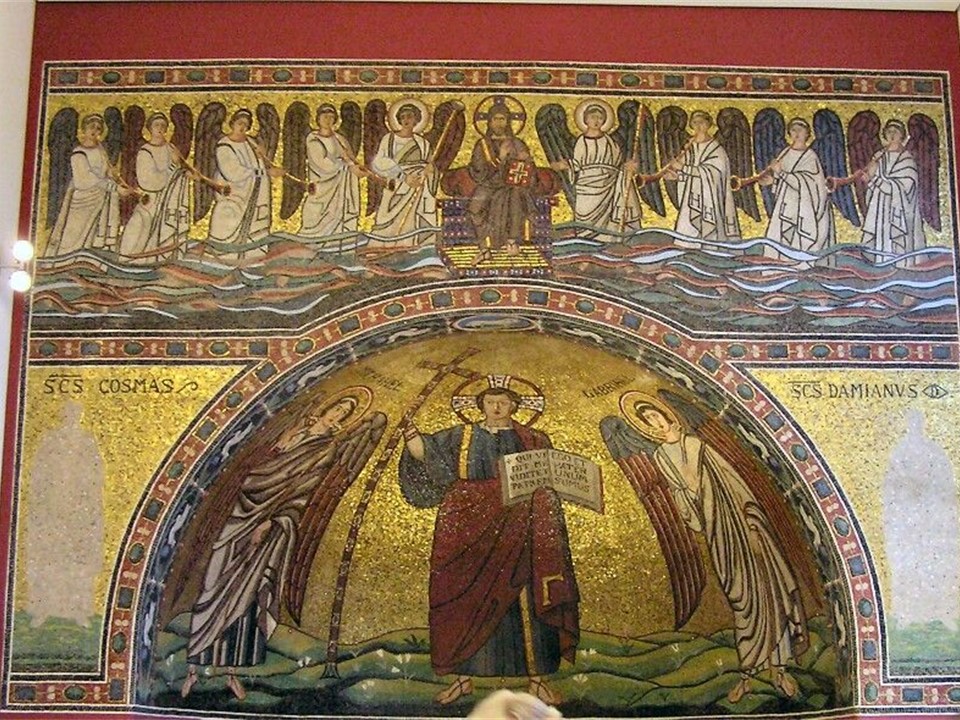
The 6th century Byzantine Mosaic from the Church of San Michele in Africisco

San Michele in Africisco has an amazing story to tell!

The 6th century Byzantine Mosaic from the Church of San Michele in Africisco
The San Michele Apse Mosaic is the main attraction of the Bode Museum in Berlin.

The 6th century Church of San Michele in Africisco has an amazing story to tell! It all started in Ravenna… when Giuliano Argentarius, a Byzantine court official and banker of great wealth and devotion, commissioned, as a votive offering to Archangel Michael, a new church in the Ravennate neighborhood known as Frigiselus.

Guliano’s Church in Figiselus, known as San Michele in Africisco, was magnificently adorned with mosaics and marble adornments. Unfortunately, the church as a place of worship no longer exists due to alterations and lootings. Very little of the original wall structures stand, while mosaics and sculptural pieces are scattered among the Bode Museum in Berlin, the National Museum of Ravenna, the Museum of Torcello, the Victoria & Albert Museum, and St. Petersburg. Today, in place of the church there is a Max Mara shop!

The 6th century Byzantine Mosaic from the Church of San Michele in Africisco (detail)

The Napoleonic Wars and conquest of Ravenna in 1805 are the beginning of the Church’s end. “San Michele was purchased by Andrea Cicognani and became a fish shop. In 1840 it was sold to antique dealer Giuseppe Buffa, who made a wood store out of it and built a wall to protect its apse mosaic. During those years an envoy of King Frederick William IV of Prussia was sent to visit the church, and he ordered the purchase of the apse mosaic. He obtained Pope Gregory III’s permission to take it to Berlin, but first, it was necessary to remove the mosaic from its wall support. Alessandro Cappi, secretary of the Accademia delle Belle Arti of Ravenna, refused to detach the mosaic… but Vincenzo Pajaro, a Venetian antique dealer, removed the mosaic…and eventually sent it to Berlin.” http://www.mosaicoravenna.it/convegno/la-diaspora-dellarcangelo-san-michele-in-africisco-e-leta-giustinianea/?lang=en

Today, the San Michele Apse Mosaic is the main attraction of the Bode Museum in Berlin. The mosaic’s main composition depicts a rare youthful and beardless Christ, standing between the winged Archangels, Michael and Gabriel, holding a monumental, bejeweled Cross and an open Bible. The apsidal mosaic is placed under a frieze of vines and doves, supposed to represent the Twelve Apostles.  Missing today, the Apse mosaic is flanked by standing depictions of Cosmas and Damian, the early Christian medicinal saints. Right above the apse, on a frieze-like wall, the 6th-century mosaicist depicted an older looking, bearded Christ, seated on a throne, flanked, once more by the Archangels and seven angels sounding trumpets.

The 6th century Byzantine Mosaic from the Church of San Michele in Africisco (watercolour)
Apse mosaic from San Michele in Africisco in Ravenna, partly labeled in Italian, signed Puhl & Wagner, 2nd half of the 19th century, watercolor, 48×61 cm, Berlin, sculpture collection and Museum of Byzantine Art SMB

Very little is known about Giuliano Argentarius, the founder of San Michele in Africisco. However, I did find some information about his extraordinary deeds in an article titled “Banking in Early Byzantine Ravenna” by Salvatore Cosentino. For more… please check: https://journals.openedition.org/crm/13746

Valuable information about the Church and its Mosaics can be accessed in “Reassembled Art and History: The San Michele in Africisco (Ravenna)Mosaics” by Carla Linville White, 2014, Louisiana State University and Agricultural and Mechanical College Master’s Theses: https://docplayer.net/54185237-Reassembled-art-and-history-the-san-michele-in-africisco-ravenna-mosaics.html

For a 3D Reconstruction of San Michele in Africisco by Lorenzo Mariani, please see: https://www.youtube.com/watch?v=FON1E-z5sIU

For a PowerPoint on the Church of San Michele Africisco, please… check HERE!

Heraklitos, Asarotos Oikos (Unswept Floor) Mosaic in the Musei Vaticani, Museo Gregoriano Profano, Rome

Heraklitos and the Asarotos Oikos Mosaic

Heraklitos, Asarotos Oikos (Unswept Floor) Mosaic in the Musei Vaticani, Museo Gregoriano Profano, Rome
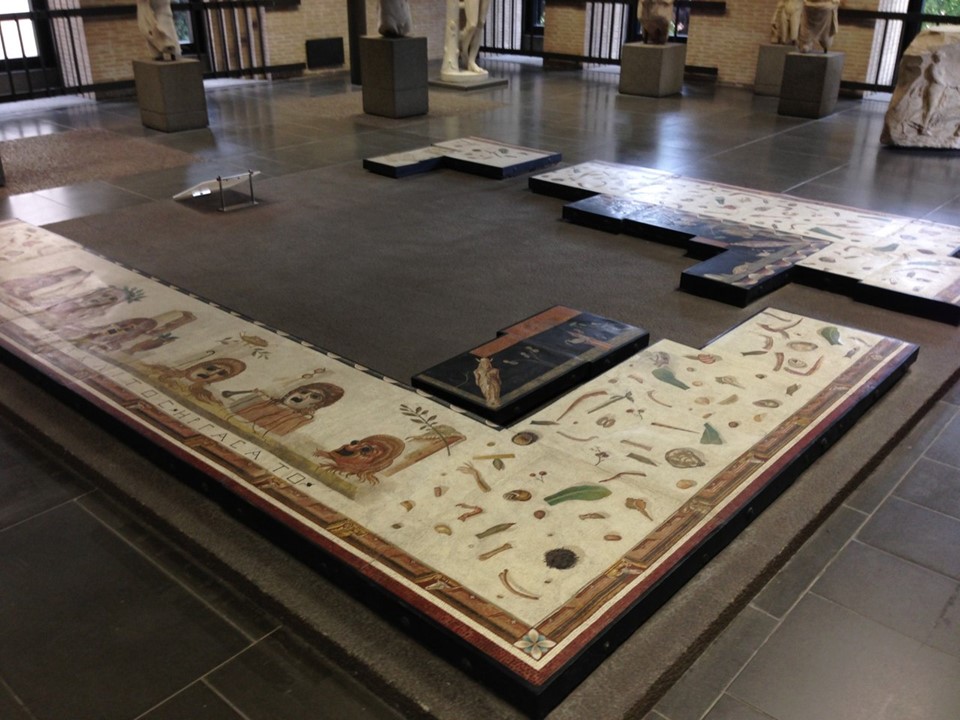
Heraklitos, Asarotos Oikos (Unswept Floor), 2nd century AD, Mosaic, 4.05 x 4.05 meters, Musei Vaticani, Museo Gregoriano Profano, Rome

Heraklitos and the Asarotos Oikos Mosaic is one of the many reasons why you should visit the Gregoriano Profano Museum in the Vatican!  It’s an exhibit I dearly love, a mosaic that amuses me, tests my observation… a work of art of the highest quality!

The story of the Asarotos Oikos theme in mosaic-work takes us back to the Hellenistic Period, to the great city of Pergamon on the coast of Asia Minor, and to a legendary mosaicist, called Sosus (εκ Περγάμου ψηφιδογράφος Σώσος). Pliny the Elder describes Hellenistic mosaic making and Sosus’s accomplishments as “…Paved floors originated among the Greeks and were skilfully embellished with a kind of paintwork until this was superseded by mosaics. In this latter field the most famous exponent was Sosus, who at Pergamum laid the floor of what is known in Greek as ‘the Unswept Room’ because, by means of small cubes tinted in various shades, he represented on the floor refuse from the dinner table and other sweepings, malting them appear as if they had been left there…” Pliny, Natural History, 36.60.25 https://www.loebclassics.com/view/pliny_elder-natural_history/1938/pb_LCL419.145.xml?readMode=reader

The Gregoriano Profano Museum in the Vatican has one of the finest Asarotos Oikos mosaics, carefully executed and brightly colored. It was discovered in 1833, on the Aventine Hill in Rome, and as the archaeologists established, it decorated the dining room floor of a Hadrian period villa. This is a unique mosaic, the masterpiece of Heraklitos, the mosaicist, proud to sign his name.  

Heraklitos created a complex floor mosaic composition. The threshold of the triclinium (the Roman dining-room) greeted guests with a design of theatrical masks, ritual objects, and the mosaicist’s signature! The central mosaic decoration presented a complex Nilotic scene, now mostly destroyed. The Assarotos Oikos themed mosaic, boarder-like, covered the four sides of the room depicting, on a white background, “…the debris of a banquet, the remains that would normally be swept away.” It is amusing for me to try to identify what Heraklitos depicted on this amazing floor… fruit, leafy vegetables, lobster and crab claws, clams and oysters, sea urchins, chicken bones, and nutshells, even a tiny mouse, gnawing on a walnut shell. I am equally amazed at the artist’s skill to demonstrate an understanding of three-dimentionality by using contrasting colors and casting shadows against the white floor background. http://www.museivaticani.va/content/museivaticani/en/collezioni/musei/museo-gregoriano-profano/Mosaico-dell-asarotos-oikos.html

An interesting article titled “The asàrotos òikos mosaic as an elite status symbol” by Ehud Fathy of the Tel Aviv University provides an interesting explanation of how we should read this mosaic theme. “The asàrotos òikos mosaics have all been discovered exclusively in the domestic spaces of the Roman elite. The manufacturing of such detailed mosaics must have demanded great financial investment, and while the mosaics must have amused the guests with their Trompe-l’œil qualities, it is hard to believe that such an expenditure was made with this sole purpose in mind. The aim of this article is to explore the asàrotos òikos mosaics as a Roman status symbol of elitist erudition… ” file:///C:/Users/aspil/Downloads/Dialnet-TheAsarotosOikosMosaicAsAnEliteStatusSymbol-6037238%20(1).pdf

For a PowerPoint on the Vatican Asarotos Oikos Mosaic, please… click HERE!

Nativity, The Church of the Holy Saviour in Chora

Church of the Holy Saviour in Chora

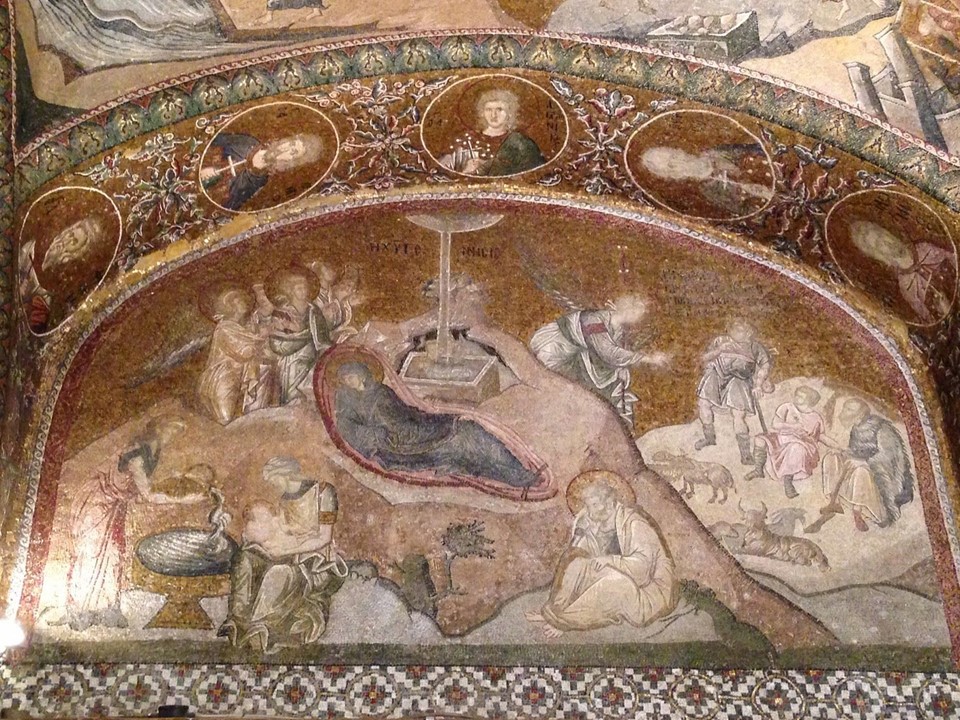
Nativity, The Church of the Holy Saviour in Chora

The Church of the Holy Saviour in Chora, part of a grand Monastery, has many stories to tell…

Tradition has it that the church, the Katholikon of a monastic complex, was originally built during the early 5th century, outside the walls of Constantinople, and its full name was “The Church of the Holy Redeemer in the Fields,” It makes sense. When the city of Constantinople expanded at the time of Theodosius II (408-450), and formidable land walls were built by the Emperor, the monastery retained the name Chora (in the Fields), but became part of the defended city.

Historical evidence tells us that it was Maria Dukaina, the mother-in-law of Alexius I Comnenus, who rebuilt the Chora Church and Monastery around 1077–1081 as a cross- domed church, a popular architectural style of the time. Early in the 12th century, yet another Comnenus, Isaac, the 3rd son of Emperor Alexius, stepped in, restoring the church after a disastrous earthquake.

Two centuries later, around 1316-21, the powerful Byzantine statesman Theodore Metochites enlarged the church and embellished it with many fine mosaics and frescoes. Today, the Church of the Holy Saviour in Chora stands as one of the finest examples of the Palaeologian Renaissance, in architecture and mosaic-work. Theodoros Metochitis political career was turbulent during the later years of his life: He was exiled by the usurper Emperor Andronicus III in 1328, but two years later, he was allowed to return to the city and live out the last two years of his life as a monk in his beloved Chora Monastery.

Soon after the fall of Constantinople to the Ottomans, the Chora Church was converted into a mosque, named Kariye Camii, serving the city’s Moslem population up until 1958, when it officially opened to the public as a museum, the Kariye Müzesi. Much of what we see today, much of what we know about Chora Church and Monastery is the work of Thomas Whittemore and Paul A. Underwood, from the Byzantine Institute of America and the Dumbarton Oaks Center for Byzantine Studies, who in 1948, sponsored a restoration and research program.

“Fear not, for, behold, I bring you good tidings of great joy which shall be to all people” Luke 2:10

Nativity, The Church of the Holy Saviour in Chora (detail)

I can only describe the Chora Church mosaics in general, and the Church’s Nativity scene in particular, as…brilliant,  outstanding, remarkable and exceptional! They best represent the refined taste of Theodore Metochites, a man, passionate about Greek antiquity and obsessed with the ancient Greek idea of ‘grace’ in art. I stand in front of them and I see elegance, harmony and balance in their compositions. I am amazed by the grace, sophistication and spirit of the depicted figures. I feel warmth, as I am enfolded by their divine light. I marvel at their Hellenistic artistic heritage…

Best Wishes for the Holiday Season!!!

ΥΓΕΊΑ ΣΕ ΌΛΟΥΣ

A PowerPoint on the Nativity scene in the Church of the Holy Saviour in Chora is… HERE!

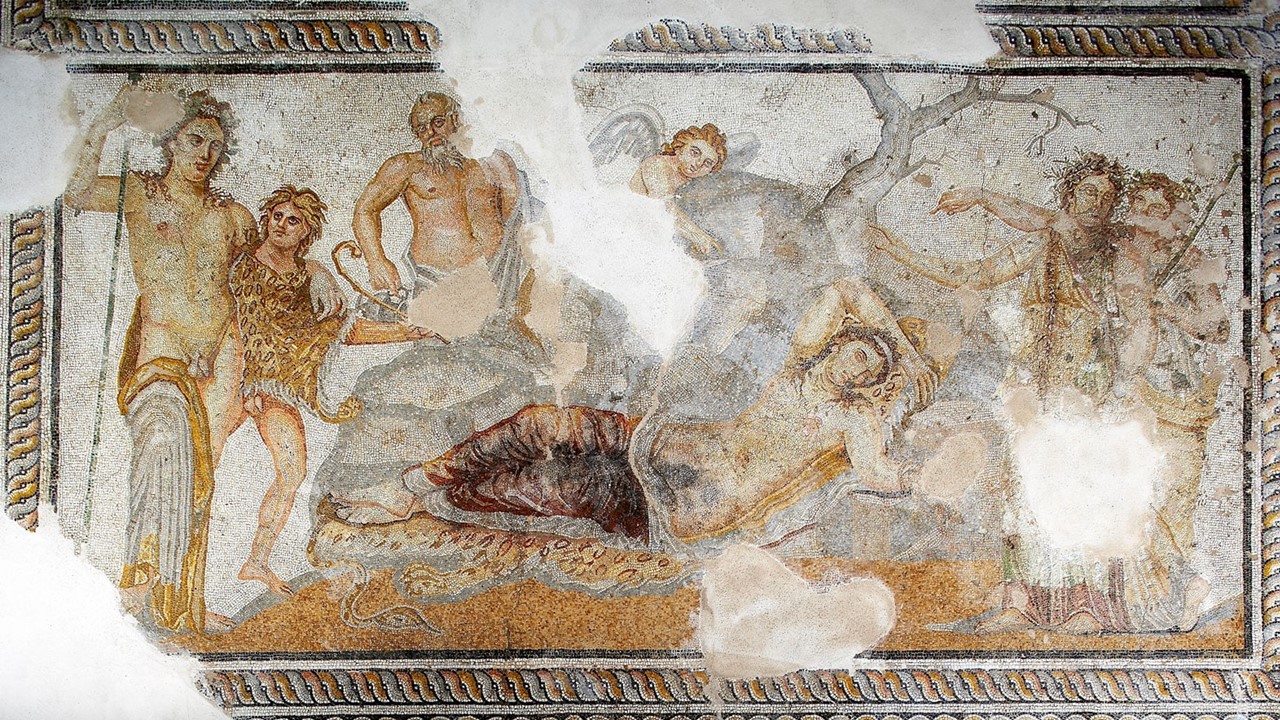
Dionysus and Ariadne floor mosaic in the Archaeological Museum of Thessaloniki.

Dionysus and Ariadne

Dionysus and Ariadne floor mosaic in the Archaeological Museum of Thessaloniki.
Dionysus and Ariadne, 200-250 AD, floor mosaic, Archaeological Museum of Thessaloniki

The Myth of Theseus, the Minotaur, Dionysus and Ariadne has it all! love, adventure, an impossible task, betrayal, and sacrifice. The adventure starts in the city of Troezene, where Theseus is born, and unfolds by travelling us to Athens, the island of Crete, the island of Naxos, and back to Athens again. My Grade 6 Host Country Studies students LOVE the Myth and the art, so, I prepared a PowerPoint Activity for them…

Instructions on what to do:

Research: Find 5 Artworks presenting the mythological princess Ariadne. Artworks can be paintings, sculptures, etc. How to do research for Artworks on Ariadne: Go to Google –Ariadne Myth – Pictures.

Research-Writing: Do not forget that the correct identification for each artwork you use is mandatory.  (Correct identification should include: Name of artist, the title of the artwork, date, medium, where the artwork is. For example, Titian, Bacchus and Ariadne, 1522-23, oil on canvas, the National Gallery, London)

Art: BE CREATIVE! Prepare an appealing PowerPoint!!!

For a short but well-documented presentation of the Mosaic, go to the Archaeological Museum of Thessaloniki site on its Highlights and scroll down… http://amth.gr/en/exhibitions/highlights

For a PowerPoint on the Myth, please… Check HERE!