Odilon Redon, 1840-1916, Pandora, 1910/1912

Odilon Redon and Pandora’s Box

Odilon Redon, 1840-1916, Pandora, 1910/1912
Odilon Redon, 1840-1916
Pandora, 1910/1912, oil on canvas, 143.5 x 62.9 cm, NGA, Washington DC, USA https://www.nga.gov/collection/art-object-page.46531.html#bibliography

It is nature also who orders us to obey the gifts she has given us. Mine have led me to dreams; I submitted to the torments of imagination and the surprises she gave me under my pencil; but I directed and led those surprises in accordance with the laws of the organism of art which I know, which I feel, with the single goal of producing in the spectator, by sudden attraction, the whole evocation, and the whole enticement of the uncertain within the confines of thought… writes Odilon Redon in his journals To Myself: Notes on Life, Art, and Artists… and I think of Odilon Redon and Pandora’s Box in Washington DC, at the National Gallery. https://www.goodreads.com/author/quotes/288740.Odilon_Redon

Odilon Redon is one of my favourite artists. As a student, I knew little of him. As a young teacher of Art History I hardly ever used his work… until, preparing for a Lesson Plan on the Myth of Pandora, I rediscovered his Pandora painting at the NGA and the Museum’s wonderful suggestions for Student Activities. My students responded positively to his imaginary world… and I was hooked!

Odilon Redon, 1840-1916, Self-Portrait, 1880
Odilon Redon, 1840-1916
Self-Portrait, 1880, oil on canvas, 33.3×52 cm, Palais des Beaux-Arts de Lille, France https://www.wikiart.org/en/odilon-redon/self-portrait-1880

I like how Odilon’s work is described at ARTSY… “Known for his unique blend of artistic naturalism and symbolic subject matter, Odilon Redon was highly influential among the late 19th century French avant-garde circle. Working in charcoal, pastel, oil, and lithography, Redon created imaginative scenes that, while often based in the supernatural, were nonetheless executed in a highly representational manner. Redon considered this descriptive accuracy essential, writing “every time that a human figure does not give the illusion that it is … about to come out of the picture frame to walk, act or think, the drawing is not a truly modern one.” Redon was influenced by the poetry of Charles Baudelaire and Stéphane Mallarmé and admired by the painters Gustave Moreau and Gustave Klimt—as such he is often remembered as a Symbolist, though Redon preferred autonomy and never actually considered himself part of the group.” What more could I add… https://www.artsy.net/artwork/odilon-redon-ari

My students and I are captivated by the Myth of Pandora and the elusive way Odilon presents her story… Off-centre, Pandora stands in front of an atmospheric background, misty and hazy, luminous, ethereal and a touch, mysterious. The power of the artist’s mind creates organic forms, indistinct and intangible. The colours the artist uses are subtle, understated, yet joyous, warm and earthy. The box in Pandora’s hands is small, easily discerned buts not ostentatious… http://www.hellenicaworld.com/Art/Books/en/BeyondTheVisibleTheArtOfOdilonRedon.html

Painted by: The Niobid Painter, The Creation of Pandora, 460BC-450 BC
Painted by: The Niobid Painter
The Creation of Pandora,
460BC-450 BC, Attic Red Figure Calyx krater, attributed to the Niobid Painter, Archaic period, British Museum https://www.britishmuseum.org/collection/object/G_1856-1213-1

The myth of Pandora is beautifully told by the experts of the National Gallery of Art in Washington DC… According to Greek mythology, in the beginning the earth was free from toil and misery. The land was covered with flowers and the rivers flowed with milk and honey. Earth was inhabited only by men, who had been created by Prometheus. He made them of clay and modeled them after the gods, which angered Zeus, the king of the gods. When Prometheus offended Zeus again by stealing fire from heaven to give to man, Zeus exacted revenge. He ordered Hephaestus, the god of the forge, to create Pandora, the first woman. The gods gave her many traits including beauty, curiosity, charm, and cleverness. Hence her name “Pandora,” meaning “all gifted” or, alternately, “a gift to all.” Before he left Pandora on earth, Zeus handed her a beautiful box saying, “This is my own special gift to you. Don’t ever open it.” As Zeus anticipated, Pandora’s curiosity got the best of her, and she opened the box, ending earthly paradise. From the small chest flew troubles and woes—sorrow, disease, vice, violence, greed, madness, old age, death—to plague humankind forever. However, Zeus did not realize that hope had been secretly added to the box by Promethesus. When Pandora opened the box and released trouble and woe into the world, hope was there to help people survive. https://www.nga.gov/education/teachers/lessons-activities/origin-myths/pandora.html

For interesting Student Activities, please click and explore the NGA site… https://www.nga.gov/education/teachers/lessons-activities/origin-myths/pandora.html

The myth of Pandora’s box by Iseult Gillespie at TEDEd is worth exploring… https://ed.ted.com/lessons/the-myth-of-pandora-s-box-iseult-gillespie

For a PowerPoint on the Myth of Pandora Teacher Curator prepared, please… Click HERE!

Odilon Redon, 1840–1916, Pandora, 1914
Odilon Redon, 1840–1916
Pandora, 1914, oil on canvas, 143.5 x 62.2 cm, the MET, NY https://www.metmuseum.org/art/collection/search/437383

The Labours of the Months: April

By an unknown Venetian artist…
The Labours of the Months: April, about 1580
By an unknown Venetian artist…
The Labours of the Months: April, about 1580, oil on canvas, 13.6 x 10.6 cm, National Gallery, London
https://www.nationalgallery.org.uk/paintings/italian-venetian-the-labours-of-the-months-january#painting-group-info

Whan that Aprill with his shoures soote:   When April with its sweet-smelling showers  /  The droghte of March hath perced to the roote,  Has pierced the drought of March to the root,   /  And bathed every veyne in swich licour  And bathed every vein (of the plants) in such liquid  /  Of which vertu engendred is the flour;   By the power of which the flower is created;  /  Whan Zephirus eek with his sweete breeth   When the West Wind also with its sweet breath,  /  Inspired hath in every holt and heeth   In every holt and heath, has breathed life into  /  The tendre croppes, and the yonge sonne   The tender crops, and the young sun  /  Hath in the Ram his half cours yronne,   Has run its half course in Aries,  /  And smale foweles maken melodye,  And small fowls make melody,  /  That slepen al the nyght with open ye   Those that sleep all the night with open eyes  /  (So priketh hem Nature in hir corages),   (So Nature incites them in their hearts)… Geoffrey Chaucer first line for The Canterbury Tales refers to April…   for The Labours of the Months: April cer/gp-aloud.htm

In London, at the National Gallery there are 12 small pictures, “painted on canvas and then each glued to a wooden panel. It is possible that they were made to decorate the recessed panels of a pair of doors. The paintings seem to have been planned in pairs with the figures facing each other and are currently displayed in two frames in groups of six. They show the ‘labours of the months’ – the rural activities that take place each month throughout the year.” This set of painted Doors combines simplicity in execution and extravagance in visual effect! https://www.nationalgallery.org.uk/paintings/italian-venetian-the-labours-of-the-months-january#painting-group-info

The painting that may represent “sweet-smelling” April, shows  a cooper making a wooden barrel. “He raises his mallet ready to strike the tool in his other hand. The work must be physically hard as he has tied a band of white cloth around his forehead to keep the sweat out of his eyes. The barrel will be used to store wine made from the grapes we see being pressed in September.”     https://www.nationalgallery.org.uk/paintings/italian-venetian-the-labours-of-the-months-april

By an unknown Venetian artist…
The Labours of the Months: April, about 1580
By an unknown Venetian artist…
The Labours of the Months: April, about 1580, oil on canvas, 13.6 x 10.6 cm, National Gallery, London
https://www.nationalgallery.org.uk/paintings/italian-venetian-the-labours-of-the-months-january#painting-group-info

Coopers were important craftsmen during the Middle Ages and the Renaissance. They created wooden barrels to store wine, spirits and salted meats, buckets to draw and carry water, wooden bowls and plates for daily use, pails, churns and tubs for various agricultural or home-industry needs. Coopers, like the one depicted in the small London painting, were respected and valued Renaissance professionals.

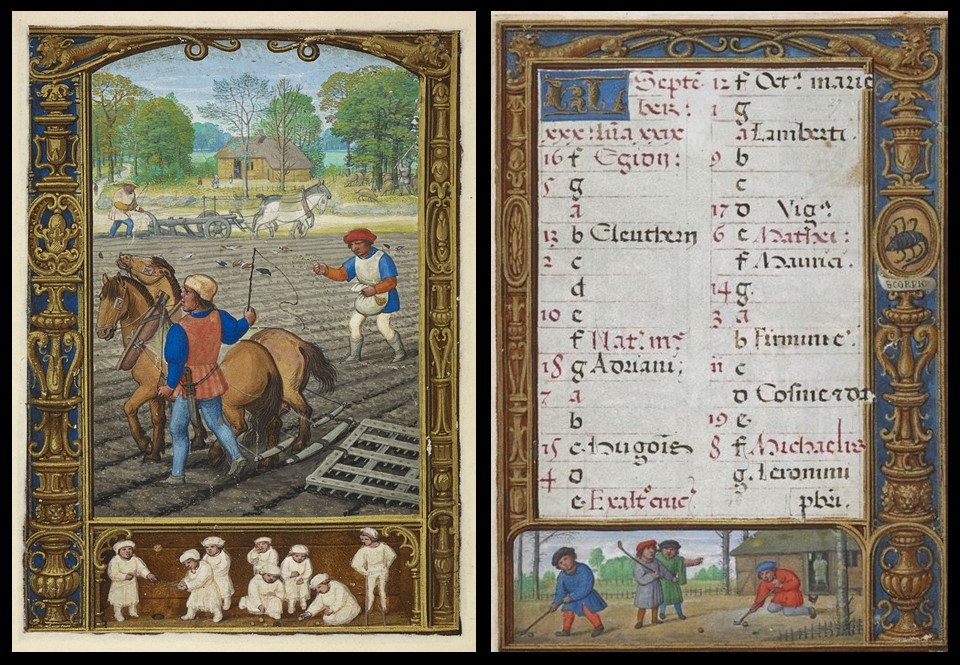
Depicting the Labours of the Months was a popular artistic theme that was frequently used in the decoration of Cathedrals and Churches, Castles and  Palaces, Psalters, Breviaries and Books of Hours across Europe during the Medieval and Early Renaissance period. Each month, depicting popular activities of peasants or/and the gentry throughout the year were sometimes paired with the Signs of the Zodiac circle. They would be either simple and small in size or large and elaborate, crafted in stone, wood, stained glass, painted in murals or often enough, painted in parchment. Many great Monuments and Libraries in Europe display fine examples of such artefacts for art lovers to enjoy.  http://www.livingfield.co.uk/ages/labours-of-the-months/

For a PowerPoint on The Labours of the Months at the National Gallery in London, please… Check HERE!

Andrea Mantegna, 1431-1506, Camera degli Sposi, The West Wall: The Meeting, (detail of the left panel), 1465-74

Teaching with Andrea Mantegna

Andrea Mantegna, 1431-1506, Camera degli Sposi, The West Wall: The Meeting, (detail of the left panel), 1465-74
Andrea Mantegna, 1431-1506
Camera degli Sposi, The West Wall: The Meeting, (detail of the left panel), 1465-74, Walnut oil on plaster, Camera degli Sposi, Palazzo Ducale, Mantua
https://commons.wikimedia.org/wiki/File:Andrea_Mantegna_075.jpg?uselang=it

“How great is the effect of reward on talent is known to him who labors valiantly and receives a certain measure of recompense, for he feels neither discomfort, nor hardship, nor fatigue, when he expects honor and reward for them; nay, what is more, they render his talent every day more renowned and illustrious. It is true, indeed, that there is not always one to recognize, esteem, and remunerate it as that of Andrea Mantegna was recognized. This man was born from very humble stock in the district of Mantua; and, although as a boy he was occupied in grazing herds, he was so greatly exalted by destiny and by his merit that he attained to the honorable rank of Chevalier, as will be told in the proper place…” This is how Giorgio Vasari introduces Andrea Mantegna, the artist who was is “seen to have been wrought with much art and diligence.” Teaching with Andrea Mantegna is a set of student activities and worksheets inspired by the great Italian artist I admire. To visit Andrea’ Camera degli Sposi in the Palazzo Publico in Mantua was for years an unreachable dream. In 1988 along with a group of students/friends my dream came to fruition and I was finally, in the middle of this amazing room… moved, I confess, and emotional.     http://www.travelingintuscany.com/art/giorgiovasari/lives/andreamantegna.htm

Andrea Mantegna, 1431-1506, The presentation of Christ in the temple (detail-Probably Self-portrait), 1465-1466
Andrea Mantegna, 1431-1506
The presentation of Christ in the temple (detail-Probably Self-portrait), 1465-1466, tempera on canvas, 86×67 cm, Gemäldegalerie, Berlin
https://commons.wikimedia.org/wiki/Category:Portraits_of_Andrea_Mantegna#/media/File:Andrea_Mantegna_049_detail_possible_self-portrait.jpg

When the time comes for me to introduce my students to Mantegna’s oeuvre I start with Giorgio Vasari’s final words. “Andrea was so kindly and praiseworthy in all his actions, that his memory will ever live, not only in his own country, but in the whole world; wherefore he well deserved, no less for the sweetness of his ways than for his excellence in painting…” and continue with the artist’s tutelage under Squarcione, who “made him practise much on casts taken from ancient statues and on pictures painted upon canvas which he caused to be brought from diverse places, particularly from Tuscany and from Rome. By these and other methods, therefore, Andrea learnt not a little in his youth…” I finish my presentation of Andrea Mantegna’s contribution to world art with his reaction to Squarcione’s criticism that “his pictures resembled not living figures but ancient statues of marble or other suchlike things.” My students are intrigued and a discussion takes place by how “This censure piqued the mind of Andrea; but, on the other hand, it was of great service to him, for, recognizing that Squarcione was in great measure speaking the truth, he set himself to portray living people, and made so much progress in this art, that, in a scene which still remained to be painted in the said chapel, he showed that he could wrest the good from living and natural objects no less than from those wrought by art. But for all this Andrea was ever of the opinion that the good ancient statues were more perfect and had greater beauty in their various parts than is shown by nature, since, as he judged and seemed to see from those statues, the excellent masters of old had wrested from living people all the perfection of nature, which rarely assembles and unites all possible beauty into one single body, so that it is necessary to take one part from one body and another part from another.”     http://www.travelingintuscany.com/art/giorgiovasari/lives/andreamantegna.htm

Andrea Mantegna, 1431-1506, The San Zeno Polyptych (detail), 1457-60
Andrea Mantegna, 1431-1506
The San Zeno Polyptych (detail), 1457-60, Tempera on panel,  480 x 450 cm, San Zeno, Verona
https://commons.wikimedia.org/wiki/Category:Details_of_Pala_di_San_Zeno_by_Andrea_Mantegna#/media/File:Andrea_Mantegna_024.jpg

Teaching with Andrea Mantegna References – References, a PowerPoint and Activities…

For the List of ONLINE References on Andrea Mantegna TeacherCurator put together, please… Click HERE!

For my PowerPoint on Andrea Mantegna, please… Click HERE!

I always feel confident discussing an artist with my students when I prepare my 7 Steps to Success Lesson Plan Outline

7Steps to Success Plan

For Student Activities (5 Activities), please… Click HERE!

I hope that Teaching with Andrea Mantegna will prove easy and helpful. Do you think it justifies my BLOG name Teacher Curator?

Andrea Mantegna, 1431-1506, Ceiling decoration of the Camera degli Sposi (detail), 1465-74
Andrea Mantegna, 1431-1506
Ceiling decoration of the Camera degli Sposi (detail), 1465-74, Walnut oil on plaster and fresco, Camera degli Sposi, Palazzo Ducale, Mantua
https://commons.wikimedia.org/wiki/Category:Camera_picta_-_Ceiling#/media/File:Andrea_mantegna,_camera_degli_sposi,_1465-74,_volta,_oculo,_07.jpg

By an unknown Venetian artist… The Labours of the Months: March, about 1580

The Labours of the Months: March

By an unknown Venetian artist… The Labours of the Months: March, about 1580
By an unknown Venetian artist…
The Labours of the Months: March, about 1580, oil on canvas, 13.6 x 10.6 cm, National Gallery, London
https://www.nationalgallery.org.uk/paintings/italian-venetian-the-labours-of-the-months-march

Dear March – Come in – / How glad I am – / I hoped for you before – / Put down your Hat – / You must have walked – / How out of Breath you are – / Dear March, how are you, and the Rest – / Did you leave Nature well – /Oh March, Come right upstairs with me –/I have so much to tell –     /     I got your Letter, and the Birds – / The Maples never knew that you were coming – / I declare – how Red their Faces grew – / But March, forgive me – / And all those Hills you left for me to Hue – / There was no Purple suitable – / You took it all with you –     /     Who knocks? That April – / Lock the Door – / I will not be pursued – / He stayed away a Year to call / When I am occupied –  / But trifles look so trivial / As soon as you have come     /     That blame is just as dear as Praise / And Praise as mere as Blame –   Dear March, Come in!, a poem by Emily Dickinson, is about the love and joy it brought to her… She personifies March as if he were a friend… and I find it a fitting introduction to the new POST The Labours of the Months: March!     https://poets.org/poem/dear-march-come-1320     and     https://www.poetryfoundation.org/poets/emily-dickinson

Church of Panagia Gorgoepikoos, or Hagios Eleftherios or Mikri Mitropolis, 12th or 15th century, Athens
http://www.religiousgreece.gr/athens-attica/-/asset_publisher/lpcrESlL5iOO/content/panagia-gorgoepekoos

Depicting The Labours of the Months in works of art is a tradition that goes back to ancient Greek times. The charming Church of Hagios Eleutherios in Athens, also known as the Panagia Gorgoepikoos or the Mikri (Small) Metropolis, made up entirely of spolia of both ancient and Christian monuments, is a good example to start with. Above the main entrance to the Church and under the roof cornice, the builders of this extraordinary church placed “a frieze of Pentelic marble, which shows the months of the Attic Calendar, some festivals, and the complete circle of the Zodiac.” This ancient frieze “attempts to put together and coordinate the lunar calendar (Attic months and festivals) and the solar calendar (the signs of the Zodiac).” Amazing…     https://hellenismo.wordpress.com/2012/12/01/the-frieze-of-the-attic-calendar/

Calendar Frieze at the Church of Panagia Gorgoepikoos or Hagios Eleftherios or Mikri Mitropolis (Date of the Calendar Frieze: 2nd century BC- Date of the Church: 12th or 15th century) Athens
Photo credit: http://surprisedbytime.blogspot.com/2011/10/cyriaco-and-little-metropolis.html
Drawings of the Calendar Frieze in the Church of Panagia Gorgoepikoos or Hagios Eleftherios or Mikri Mitropoli (Date of the Calendar Frieze: 2nd or 15th  century BC- Date of the Church: 12th century) Athens

Drawings of the Calendar Frieze in the Church of Panagia Gorgoepikoos or Hagios Eleftherios or Mikri Mitropoli (Date of the Calendar Frieze: 2nd or 15th  century BC- Date of the Church: 12th century) Athens
https://hellenismo.wordpress.com/2012/12/01/the-frieze-of-the-attic-calendar/

Olga Palagia, Professor of Classical Archeology at the National and Kapodistrian University of Athens, argues that the Calendar Frieze, in most probability,  was created in Athens for the Great Panathenaic festivities of the year 142/3. If this small Attic Calendar Frieze, Palagia still argues, is tied to Herodes Atticus, who presented Athens with a number of public buildings…if this Calendar Frieze was part of the grand Athenian marble Panathenaic Stadium complex, built entirely at the expense of Herodes Atticus for the Great Panathenaia that fell in 142/3… well,  makes it most interesting evidence of public Calendar representation… but in the realm of pure speculation!     The date and iconography of the calendar frieze on the little metropolis, Athens, JdI 123, 2008, by Olga Palagia,     https://www.academia.edu/843544/The_date_and_iconography_of_the_calendar_frieze_on_the_little_metropolis_Athens_JdI_123_2008

SO… The Calendar of the Months during Antiquity and the Labours of the Months later in history attracts our attention in Calendar works of Art adorning public buildings, Churches and Cathedrals of the time, striking Vitreaux Windows, amazingly colourful manuscripts, and paintings, monumental, like the eleven surviving panels in Torre Aquila I presented in 2020 (check: https://www.teachercurator.com/?s=torre%20aquila&cat=plus-5-results), or small, like the paintings in the National Gallery, in London, we will explore in 2021… month by month…     https://archive.org/details/labormonth00webs/page/n9/mode/2up Webster, James Carson – 1905-1989, The labors of the months in antique and mediaeval art to the end of the twelfth century, 1938, Evanston, Ill., Northwestern University,     and      https://www.nationalgallery.org.uk/paintings/italian-venetian-the-labours-of-the-months-march

By an unknown Venetian artist…
The Labours of the Months: March (detail) , about 1580
By an unknown Venetian artist…
The Labours of the Months: March (detail) , about 1580, oil on canvas, 13.6 x 10.6 cm, National Gallery, London
https://www.nationalgallery.org.uk/paintings/italian-venetian-the-labours-of-the-months-march

For the Venetian Month of March at the National Gallery, we have yet another outdoor scene. “A bearded man wearing a yellow tunic trims vines that have been trained to grow up two trees. The branches of the vine are bare, while the trees have a few brownish leaves. Pruning vines is an activity carried out in Italy in winter, when the plant is dormant, and in spring when the new leaves have started to grow.” Once more, young farmers need to bundle up and take care of the daily chores…     https://www.nationalgallery.org.uk/paintings/italian-venetian-the-labours-of-the-months-march

For a PowerPoint on The Labours of the Months at the National Gallery in London, please… Check HERE!

By an unknown Venetian artist… The Labours of the Months: March, about 1580, and Calendar Frieze at the Church of Panagia Gorgoepikoos, Hagios Eleftherios or Mikri Mitropoli (Date of the Calendar Frieze: 2nd century BC- Date of the Church: 12th or 15th century) Athens  
By an unknown Venetian artist…
The Labours of the Months: March, about 1580, oil on canvas, 13.6 x 10.6 cm, National Gallery, London     https://www.nationalgallery.org.uk/paintings/italian-venetian-the-labours-of-the-months-march
Calendar Frieze at the Church of Panagia Gorgoepikoos, Hagios Eleftherios or Mikri Mitropoli (Date of the Calendar Frieze: 2nd century BC- Date of the Church: 12th or 15th century) Athens     http://surprisedbytime.blogspot.com/2011/10/cyriaco-and-little-metropolis.html
Funerary Altar-Shaped Stele of Actor Marcus Varinius Areskon, 170-200 AD

Areskon is my Name and I am an Actor

Funerary Altar-Shaped Stele of Actor Marcus Varinius Areskon, 170-200 AD
Funerary Altar-Shaped Stele of Actor Marcus Varinius Areskon, 170-200 AD, Marble with traces of the original paint, 1670×70-72×52-66 cm, Archaeological Museum of Thessaloniki
Photo Credit: Kostas Papantoniou https://www.amth.gr/en/exhibitions/highlights

O man, with your wonderful dower, / O woman, with genius and grace, / You can teach the whole world with your power, / If you are but worthy the place. / The stage is a force and a factor / In moulding the thought of the day, / If only the heart of the actor / Is high as the theme of the play.     …     No matter what role you are giving, / No matter what skill you betray, / The everyday life you are living, / Is certain to colour the play./ The thoughts we call secret and hidden / Are creatures of malice, in fact;/ They steal forth unseen and unbidden, / And permeate motive and act. Ella Wheeler Wilcox (1850-1919) was an American author and poet who wrote THE ACTOR…an appropriate, in my humble opinion, introduction to our new POST… Areskon is my Name and I am an Actor.  http://www.ellawheelerwilcox.org/poems/pactor.htm     https://en.wikipedia.org/wiki/Ella_Wheeler_Wilcox

Funerary Altar-Shaped Stele of Actor Marcus Varinius Areskon, 170-200 AD
Funerary Altar-Shaped Stele of Actor Marcus Varinius Areskon, 170-200 AD, Marble with traces of the original paint, 1670×70-72×52-66 cm, Archaeological Museum of Thessaloniki Photo Credit: Kostas Papantoniou https://www.amth.gr/en/exhibitions/highlights

Marcus Varinius Areskon… I seek him out every time I visit the Archaeological Museum of Thessaloniki. I introduce him to my students every time I guide them around this wonderful “shrine” of the Muses… and yet I know so little about him. An inscription introduces himself.  Carved above his portrait and under it, the epitaph inscription reads… Λ(ούκιος) Σηνάτιος Οἴκιος καὶ Οὐαρε | νία Ἀρέσκουσα Μάρκῳ Οὐαρ[ε] | νίῳ Ἀρέσκοντι τῷ τέ | κνῳ μνήμης χάριν Lucius Senatius (probably an unknown member of the family) and Var(e)inia Areskousa to her son Marcus Var(e)inius Areskon in memory… I am intrigued… can the portrait of a young man and an inscription help us unravel the knot?     https://www.amth.gr/en/exhibitions/highlights

Areskon was the son of Var(e)inia Areskousa, he was related? to Lucius Senatius, he was Roman, he lived in Thessaloniki, and he died painfully young. This beautiful funerary memorial, in marble and vividly painted, the colours remain remarkably well-preserved, testifying to the economic ability of the family to honour their young demised member with a worthy memorial.     https://m.flickr.com/photos/69716881@N02/50914350016/in/faves-36551225@N05/

Areskousa and Areskon, mother and son, members of a popular family of actors, were probably entertainment “stars” of the time. This is what their names connotate (Areskon/Areskousa= one who pleases, who is popular). The mother was probably an actress of the popular mime theatre, while the son managed to elevate himself and become a young, versatile tragic actor of fame and fortune. His funerary monument is a proper testament to his popularity and wealth.

The portrait on his rectangular funerary altar shows him en face, upright, attired in military gear. His right hand is raised in salutation, the left seems to hold a sword?  In the upper left corner of the composition, still beautifully coloured, a mask, worn by male actors for a female theatrical role, identifies the male portrait as an actor of versatile abilities.

1917, Trip to the Archaeological Museum of Thessaloniki... my respects to Areskon...     Photo Credit: Kostas Papantoniou
1917, Trip to the Archaeological Museum of Thessaloniki… my respects to Areskon… Photo Credit: Kostas Papantoniou

The Portrait of Areskon is shown in the middle of a simple yet elegantly proportioned structure described by the Museum archaeologists as a funerary altar. It is simply framed, sits on a pedestal and is crowned by an inscribed pediment with a central rosette, leaves and stylized acroteria. It was discovered near the eastern fortification walls of Thessaloniki, almost embedded in an apartment building of modern times. Today, exhibited in the Archaeological Museum of Thessaloniki, it is considered one of the Museum’s highlights!

For a PowerPoint presenting a School Trip to the Archaeological Museum of Thessaloniki and the Funerary Altar of Areskon, please… Check HERE!

For a StudentActivity, please… Check HERE!

2017, Grade 4 STARS in front of the Archaeological Museum of Thessaloniki!
2017, Grade 4 STARS in front of the Archaeological Museum of Thessaloniki! Photo Credit: Kostas Papantoniou

PRINCESS FRESCO - The idyllic life of the daughters of Pharaoh, circa 1343-1335, painted plaster, 40x165, Ashmolean Museum

Nofernoferuaton and Nofernoferure

PRINCESS FRESCO - The idyllic life of the daughters of Pharaoh, circa 1343-1335, painted plaster, 40x165, Ashmolean Museum
PRINCESS FRESCO – The idyllic life of the daughters of Pharaoh, circa 1343-1335, painted plaster, 40×165, Ashmolean Museum
https://www.ashmolean.org/princess-fresco

“With the move to Amarna the art becomes less exaggerated, but while it is often described as ‘naturalistic’ it remains highly stylised in its portrayal of the human figure. The royal family are shown with elongated skulls and pear-shaped bodies with skinny torsos and arms but fuller hips, stomachs and thighs. The subject matter of royal art also changes. Although formal scenes of the king worshipping remain important there is an increasing emphasis on ordinary, day-to-day activities which include intimate portrayals of Akhenaten and Nefertiti playing with their daughters beneath the rays of the Aten… While traditional Egyptian art tends to emphasise the eternal, Amarna art focuses on the minutiae of life which only occur because of the light – and life-giving power of the sun.” writes Dr Kate Spence for BBC History and I use this quote as an introduction to Nofernoferuaton and Nofernoferure, my new POST on Egyptian Art.     http://www.bbc.co.uk/history/ancient/egyptians/akhenaten_01.shtml

I would like to continue with another short quote by Dr Kate Spence “Akhenaten is a source of endless fascination and speculation – this often masks the fact that we actually know very little about him.” This quote marks the beginning of my Grade 7 Unit on the Art of the Amarna Period. I have been teaching this Unit for years and I can only testify to the fact that the Amarna Period allure attracts my student’s attention and captivates their imagination. They like to read and listen to their teacher describe the genesis of an almost “monotheistic” religion, the dynamics within a powerful royal family, the building of a new capital city, and how Egyptian Art of the period moved towards naturalism and informality.

The Amarna Idiom is an artistic style that captivates human reaction. My students are “hypnotized” by the unique Amarna pictorial beauty of deformation. They are charmed, yet question how in the depiction of faces, thin, long necks, hold greatly elongated skulls… facial folds are the norm, narrow, slitted eyes are prominent and jaws seem to be “hanging” low. The Amarna style body rendering amazes my students as well, particularly the discrepancy between the upper, lower and middle parts of the human body… the dropped, thin shoulders, heavy potbelly, large hips and thighs, and the rather thin, almost frail, legs.

PRINCESS FRESCO - The idyllic life of the daughters of Pharaoh, circa 1343-1335, painted plaster, 40x165, Ashmolean Museum
PRINCESS FRESCO – The idyllic life of the daughters of Pharaoh, circa 1343-1335, painted plaster, 40×165, Ashmolean Museum
https://www.ashmolean.org/princess-fresco

At some point, towards the end of my Amarna Unit, I ran a survey, titled “My Favourite Amarna Work of Art,” as I am always interested to understand what artistic qualities attract the admiration of my students. Among the finalists in my survey is the fresco painting of Nofernoferuaton and Nofernoferure, coming from Akhenaton’s capital city Akhetaten, known today as Tell el- Amarna, and exhibited in the Ashmolean Museum. Students love the bright, warm, terracotta-coloured palette, the casual, relaxed composition theme, the depicted stylistic exaggerations, and the overall sense of family affection that embraces the pictorial arrangement.

This fresco, fragile and precious, was discovered in the early 1890s by William Flinders Petrie, the renown archaeologist, at Akhetaten, “The horizon of the Aten,” where the visionary Pharaoh Akhenaton lived with his queen, Nefertiti, their six daughters, Nofernoferuaton and Nofernoferure among them, and the rest of the royal family. “The painting was made on a thin layer of gesso – powdered gypsum mixed with a glue – applied to mud plaster on a brick wall… (Petrie) discovered that the wall had been much damaged by ants and its preservation is a tribute to Petrie’s remarkable skills as an archaeologist.” https://www.ashmolean.org/princess-fresco     and     https://www.amarnaproject.com/pages/amarna_the_place/central_city/index.shtml

Plans of the King’s House in Amarna and the area where the fresco of the two Princesses was located. The discussed fresco, with the figure of the discoverer (F. Petrie), added to give scale. The scene of princesses (Ashmolean Museum) as it was originally located on a wall in the King’s House, with the painted dado restored
https://www.amarnaproject.com/pages/amarna_the_place/central_city/index.shtml
https://www.semanticscholar.org/paper/Wall-Paintings-from-the-King%27s-House-at-Amarna-*-Weatherhead/6939baf93dc88d6774e539c9cda0f3e920d54515/figure/2

Unearthed in the King’s House, “an enclosure measuring 123 by 140 meters, inside of which the building took the form of a U around a garden, with the actual residence of the king at the rear,” the Princess’s fresco depicts “Akhenaten and Nefertiti relaxing with their daughters, two of which are sitting casually on floor cushions in the foreground. The red sash of Nefertiti’s dress falls behind them, and to the right are Akhenaten’s sandaled feet. Between them stand three more daughters; the sixth daughter was probably shown seated on her mother’s lap, as suggested by a surviving fragment depicting a baby’s hand. The style and subject of this painting are in direct contrast to conventional Egyptian art and reflects the revolutionary character of the period.” Simply but beautifully said…     http://www.touregypt.net/featurestories/royalestate.htm     and     https://www.ashmolean.org/princess-fresco

For a PowerPoint on Nofernoferuaton and Nofernoferure, please… Check HERE!

For a Student Activity, please… Check HERE!

If interested in smart Amarna period Resources and Activities, please… Check https://www.arch.cam.ac.uk/research/projects/current-projects/life-ancient-egypt-amarna-resources-schools/ancient-amarna  

Jan van Eyck, before 1395-1441, Portrait of a Man (Self Portrait?), 1433

Teaching with Jan van Eyck

Jan van Eyck, before 1395-1441, Portrait of a Man (Self Portrait?), 1433
Jan van Eyck, before 1395-1441
Portrait of a Man (Self Portrait?),
1433, oil on wood, 25,5 x 19 cm, National Gallery, London
https://www.wga.hu/frames-e.html?/html/e/eyck_van/jan/01page/13turban.html

When the time comes for me to introduce my students to Jan van Eyck’s oeuvre I start with his remarkable motto, Als Ich Can – As well as I can, inscribed in large Greek letters on the upper part of the frame of his Self-Portrait? at the National Gallery in London. Humble words… but appreciate how subtly they draw attention to his extraordinary skills as a painter. Where can you go wrong Teaching with Jan van Eyck?     https://www.nationalgallery.org.uk/paintings/jan-van-eyck-portrait-of-a-man-self-portrait

“Jan van Eyck is credited with originating a style of painting characterised by minutely realistic depictions of surface effects and natural light. This was made possible by using an oil medium, which allowed the building up of paint in translucent layers, or glazes.” These three lines by the National Gallery in London embody the essence of van Eyck’s painting style and technique. I like to read it to my students emphasizing his contribution to Western European Art. Information about his training and his life is scarce, we do know, however, that he was a member of the gentry class and that by 1425 he lived in Bruges and Lille as court painter to Philip the Good, Duke of Burgundy. We also know that in 1428 he travelled to Portugal to paint Philip the Good’s future wife, Isabella of Portugal.     https://www.nationalgallery.org.uk/artists/jan-van-eyck

“Hubrecht van Eyck, the most famous painter ever known, started this work of art; his brother Jan, who was second in the art, finished the task at the request of Joos Vijd. With this verse the donor consigns the work to your charge on May 6th 1432. Admire what they have done for you”. The famous inscription on the frame of the Ghent Altarpiece sets off my Jan van Eyck PowerPoint Presentation and lets my students admire what they (Hubrecht and Jan) have done for us.

The Adoration of the Mystic Lamb in the Ghent Altarpiece (detail) by Jan van Eyck, 1432, St. Bavo’s Cathedral, Ghent, Belgium
https://artsandculture.google.com/asset/the-ghent-altarpiece-adoration-of-the-mystic-lamb-detail-of-the-holy-spirit-in-the-guise-of-a-dove-hubert-and-jan-van-eyck/MwEFlDeCLbw9RQ

Introducing a former BLOG POST at the 2020 Ghent Museum of Fine Arts Exhibition, titled Van Eyck – An Optical Revolution, I further discuss with my students his painting characteristics: 1. How he perfected the Oil Technique by adding siccatives. With oil paints, he created rich, deep, lustrous colours, flawless golden tones, and amazing life-like textures. 2. How Observation of reality is key to Jan’s Art. For example, his portraits are lifelike to the minutest detail, his depiction of nature and natural phenomena are credible and authentic, his art seems like it’s competing with reality itself! 3. How Observation of Reality is key to Jan’s Art. For example, his portraits are lifelike to the minutest detail, his depiction of nature and natural phenomena are credible and authentic, his art seems like it’s competing with reality itself! 3. How Observing and Painting Optical Light Phenomena shows an artist deeply interested “in the painting of light, so crucial to his optical revolution.” Scholars believe that Jan van Eyck “not only gathers practical but also theoretical knowledge in order to reproduce the effects of light.”     https://vaneyck2020.be/en/the-optical-revolution/     and     https://www.teachercurator.com/art/van-eyck-an-optical-revolution/

Teaching with Jan van Eyck… Online References PowerPoints and Activities…

For the List of ONLINE References on Jan van Eyck’s oeuvre, TeacherCurator put together, please… Click HERE!

For my PowerPoint on the Ghent Altarpiece, please… Click HERE! https://www.teachercurator.com/wp-content/uploads/2021/02/Twith-JvanE-Ghent2-PP.pptx. List of Slides and Photo Credits for the Ghent Altarpiece PowerPoint, please… Click HERE!

For my PowerPoint on Jan van Eyck’s Oeuvre, please… Click HERE! List of Slides and Photo Credits for Jan van Eyck’s Oeuvre PowerPoint, please… Click HERE!

I always feel confident discussing an artist with my students when I prepare my Steps to Success Lesson Plan Outline

Seven Steps to Success Plan

For High School level Student Activity, please… Click HERE!

For a RWAP (Research-Writing-Art-Project), please… Click HERE!

I hope that teaching with Jan van Eyck will prove easy and helpful. Do you think it justifies my BLOG name TeacherCurator?

Student Activity
Alexandra D. and her Arnolfini Wedding RWAP Sketchbook Pages
Arnolfini Wedding Student Activities Sketchbook Pages
Marios M. and his Arnolfini Wedding RWAP Sketchbook Pages

The Labours of the Months: February

By an unknown Venetian artist…
The Labours of the Months: February, about 1580
By an unknown Venetian artist…
The Labours of the Months: February, about 1580, oil on canvas, 13.6 x 10.6 cm, National Gallery, London
https://www.nationalgallery.org.uk/paintings/italian-venetian-the-labours-of-the-months-january#painting-group-info

The Labours of the Months: February POST will start with In February, a poem by John Addington Symonds, the English poet, literary critic, cultural historian and writer of numerous biographies of writers and artists: “The birds have been singing to-day / And saying: “The spring is near! / The sun is as warm as in May, / And the deep blue heavens are clear.”   /     The little bird on the boughs / Of the sombre snow-laden pine / Thinks: “Where shall I build me my house, / And how shall I make it fine?     /     “For the season of snow is past; /  / The mild south wind is on high; / And the scent of the spring is cast / From his wing as he hurries by.”     /     The little birds twitter and cheep / To their loves on the leafless larch: / But seven foot deep the snow-wreaths sleep, / And the year hath not worn to March.https://discoverpoetry.com/poems/february-poems/

The Labours of the Months is a theme that frequently occurs during the Late Medieval-Renaissance Period Art. It attracts our attention in sculptural pieces adorning Churches and Cathedrals of the time, striking Vitreaux Windows, amazingly colourful manuscripts, and paintings, monumental, like the eleven surviving panels in Torre Aquila I presented in 2020 (check: https://www.teachercurator.com/?s=torre%20aquila&cat=plus-5-results), or small, like the paintings in the National Gallery, in London, we will explore in 2021… month by month… https://archive.org/details/labormonth00webs/page/n9/mode/2up Webster, James Carson – 1905-1989, The labors of the months in antique and mediaeval art to the end of the twelfth century, 1938, Evanston, Ill., Northwestern University,     and      https://www.nationalgallery.org.uk/paintings/italian-venetian-the-labours-of-the-months-january

By an unknown Venetian artist…
The Labours of the Months: February, about 1580
By an unknown Venetian artist…
The Labours of the Months: February (detail), about 1580, oil on canvas, 13.6 x 10.6 cm, National Gallery, London
https://www.nationalgallery.org.uk/paintings/italian-venetian-the-labours-of-the-months-january#painting-group-info

For 2021, I want to present something different, unpretentious but rare. In London, at the National Gallery, there are 12 small pictures, “painted on canvas and then each glued to a wooden panel. It is possible that they were made to decorate the recessed panels of a pair of doors. The paintings seem to have been planned in pairs with the figures facing each other and are currently displayed in two frames in groups of six. They show the ‘labours of the months’ – the rural activities that take place each month throughout the year.” This set of painted Doors combines simplicity in execution and extravagance in visual effect! The paintings, very small in size, about 13.6 x 10.6 cm, were achieved in vivid, bright, luxurious colours, like “ultramarine blue for the sky, strong vermilion and red lake for the clothing, with rich greens and yellows in the landscape. The restricted and repeated use of colour gives the group of little pictures a charming, decorative simplicity. All but one of the scenes show a man working outdoors on what appears to be the estate of a large villa, seen in several of the paintings, at the foot of the distant blue mountains.”     https://www.nationalgallery.org.uk/paintings/italian-venetian-the-labours-of-the-months-january#painting-group-info

For the Month of February, we have an outdoor scene. “A young man kneels beside a wooden block and cuts stakes with a hatchet. A line of stakes has already been set in the field behind him, which is ploughed into rows ready to be planted, perhaps with vines or olives. The stakes would be used to support the young plants.” The festivities of the holidays are over and now the young farmers need to bundle up and take care of the daily chores…

For a PowerPoint on The Labours of the Months at the National Gallery in London, please… Check HERE!

Constantino Brumidi

Constantino Brumidi, 1805-1880
The Apotheosis of Washington, 1865
Constantino Brumidi, 1805-1880
The Apotheosis of Washington, 1865, Fresco, 4,664 square feet, United States Capitol Building’s Rotunda, Washington, DC

Myrtle Cheney Murdock, the wife of John R. Murdock, the elected congressman from Arizona, was a teacher and an enthusiastic tour guide at the United States Capitol. She was amazed and dismayed at how little was known about Constantino Brumidi, the Greek/Italian/American artist of the Apotheosis of Washington on the Capitol’s Rotunda Dome. She frequently asked, “How can countless exquisite frescoes and paintings adorn our Capitol Building and yet the American people have little or no knowledge of their existence?” Researching for her Monograph on Constantino Brumidi, Michelangelo of the United States Capitol, she discovered the artist buried in an unmarked grave in Glenwood Cemetery. Myrtle Cheney Murdock’s research and dedication to Constantino Brumidi led to a posthumous appreciation of the artist’s artistic achievements and a commemorative plaque placed over his tomb in 1952, inscribed with a wish allegedly expressed by Brumidi back in 1855: “I have no longer any desire for fame and fortune. My one ambition and my daily prayer is that I may live long enough to make beautiful the Capitol of the one country on earth in which there is liberty.”     https://www.washingtonpost.com/gdpr-consent/?next_url=https%3a%2f%2fwww.washingtonpost.com%2flocal%2fbrumidi-study-of-capitol-dome-painting-to-go-to-smithsonian%2f2012%2f03%2f05%2fgIQAclhhtR_story.html     and     https://www.senate.gov/reference/reference_item/Michelangelo_of_the_US_Capitol.htm

Constantino Brumidi, 1805-1880
The Apotheosis of Washington, 1865
Constantino Brumidi, 1805-1880
The Apotheosis of Washington, 1865, Fresco, 4,664 square feet, United States Capitol Building’s Rotunda, Washington, DC

Constantino Brumidi’s father was Stavros Brumidis from Filiatra in the Peloponnese, who, after the 1770 Orlov insurrection, a major precursor to the Greek War of Independence in 1821, and fearing Ottoman repercussions,  fled Greece for Italy. Stavros Brumidis settled in Rome, married  Anna Bianchini, opened a coffee shop to support his family and in 1805 became the father of a boy named Constantino. The boy was artistic and talented, studied Art for fourteen years at the Academy of St. Luke in Rome and became quite successful as a fresco painter working for the Vatican. In 1849 he was caught up in the Italian Risorgimento, he was arrested, accused of serious crimes and sentenced to eighteen years in prison. The Pope pardoned him but his only hope for freedom was to leave Italy for the United States.     https://www.aoc.gov/explore-capitol-campus/art/constantino-brumidi

Constantino Brumidi, 1805-1880
The Apotheosis of Washington, 1865
Constantino Brumidi, 1805-1880
The Apotheosis of Washington (detai), 1865, Fresco, 4,664 square feet, United States Capitol Building’s Rotunda, Washington, DC

Brumidi reached the United States in September 1852 and for the next two years he worked, on private or church commissions in New York, Massachusetts and Mexico City. In December 1854 he met with Captain Montgomery C. Meigs, the Army Corps of Engineers officer who was supervising the construction of extensions to the Capitol. Impressed with Brumidi’s credentials, Meigs offered him the opportunity to paint for the United States Capitol through the 1860s and the 1870s. His major contribution  is the 1865 Apotheosis of Washington and the frieze of the new Capitol Dome.

For a PowerPoint on the Apotheosis of Washington, please… check HERE!

Constantino Brumidi, 1805-1880
The Apotheosis of Washington, 1865
Constantino Brumidi, 1805-1880
The Apotheosis of Washington (detail), 1865, Fresco, 4,664 square feet, United States Capitol Building’s Rotunda, Washington, DC

Pilastri Acritani (piers from the 6th century Church of the Holy Martyr Polyeuktos in Constantinople) and the Tetrarchs (from Constantinople, c. 305, porphyry) on the South-West side of the Basilica of San Marco, in Venice

Pilastri Acritani and European 19th century Art

Pilastri Acritani (piers from the 6th century Church of the Holy Martyr Polyeuktos in Constantinople) and the Tetrarchs (from Constantinople, c. 305, porphyry) on the South-West side of the Basilica of San Marco, in Venice
Spoils of War…
Pilastri Acritani (piers from the 6th century Church of the Holy Martyr Polyeuktos in Constantinople) and the Tetrarchs (from Constantinople, c. 305, porphyry) on the South-West side of the Basilica of San Marco, in Venice     https://venicewiki.org/wiki/Colonne_d%27Acri

“In December 1826, the German merchant and art collector Johannes David Weber (1773–1847) wrote to the younger Venetian jurist and local antiquarian Emanuel Antonio Cicogna (1789–1869) about two stone pillars on the south side of the Church of San Marco in Venice… With Weber’s letter begins the modern study of what came to be known as the PilastrιAcritni, the pillars of Acre, because Weber and many before him regarded them as trophies of the Venetian defeat of the Genoese at Acre in the mid-thirteenth century. Decorated with vine ornament, crosses, and Greek monograms, the piers are simple, if imposing, monoliths that have few overt clues to their origin; hence, the problem that Weber’s letter sought to solve. In 1960, the Venetian historiographic tradition that Weber represents was overturned by the discovery of the sixth-century Church of Hagios Polyeuktos in Istanbul. Its subsequent excavation proved that the piers came from this site, most likely in the aftermath of the Venetian-led Fourth Crusade that sacked Constantinople in 1204…” A straightforward introduction by Robert Nelson, I humbly borrow, for my new POST, Pilastri Acritani and European 19th century Art.     https://www.academia.edu/3585135/_The_History_of_Legends_and_the_Legends_of_History_The_Pilastri_Acritani_in_Venice_in_H_Maguire_and_R_Nelson_eds_San_Marco_Byzantium_and_the_Myths_of_Venice_Washington_D_C_Dumbarton_Oaks_Research_Library_and_Collection_63_90

John Ruskin, St. Jean d’Acre pillar on the southern side of the Basilica di San Marco
John Ruskin, 1819 – 1900
St. Jean d’Acre pillar on the southern side of the Basilica di San Marco, 1879, British Museum, London     https://www.apollo-magazine.com/john-ruskins-visions-of-venice/

“The Pilastri Acritani (‘Pillars of Acre’) are two elaborately decorated pillars,” writes David Hendrix in Byzantine Legacynear the southern side of the Basilica of San Marco in Venice. The pillars are among the many spoils looted in the sack of Constantinople in 1204. They were also considered by John Ruskin to be the two most noble pillars in Venice. As their name suggests, they were long regarded as trophies of the Venetian defeat of the Genoese in Acre. In 1960, excavations in Istanbul proved that they originated from the Church of Hagios Polyeuktos. Decorated with vine ornament, crosses, and Greek monograms, the pillars share features of other architectural remains found in the excavation which can now be found at the Istanbul Archaeological Museums. Most likely they were brought back to Venice after the sack of Constantinople in 1204. The area around the Church of Hagios Polyeuktos became of the Venetian sector of Constantinople, which was centered at the nearby Pantokrator Monastery…”     https://www.thebyzantinelegacy.com/pilastri-acritani

I enjoyed reading…     “The History of Legends and the Legends of History: The ‘Pilastri Acritani’ in Venice,” in H. Maguire and R. Nelson, eds., San Marco, Byzantium and the Myths of Venice, Washington, D.C.: Dumbarton Oaks Research Library and Collection, 63-90 and“Pilastri Acritani” in Byzantine Legacy. Both articles/presentations intrigued my curiosity to find 19th-century European artworks inspired by the amazing Constantinopolian treasures in the Basilica of San Marco in Venice. I searched the Internet and here is what I discovered… I am sure there is more, maybe another time another day… 

For a PowerPoint on the Pilastri Acritani and European 19th century Art, please… Check HERE!

Joseph Mallord William Turner, The Campanile and Piazza of San Marco (St Mark’s Square), Venice, with the Pilastri Acritani beside the Basilica, from the Porta della Carta of the Palazzo Ducale (Doge’s Palace)
Joseph Mallord William Turner, 1775–1851
The Campanile and Piazza of San Marco (St Mark’s Square), Venice, with the Pilastri Acritani beside the Basilica, from the Porta della Carta of the Palazzo Ducale (Doge’s Palace), 1840, Gouache, pencil and watercolour on grey wove paper, 282 x 191 mm, TATE, London     https://www.tate.org.uk/art/research-publications/jmw-turner/joseph-mallord-william-turner-the-campanile-and-piazza-of-san-marco-st-marks-square-venice-r1197042
Francesco Zanin, Venice, St. Mark's Square with the Acritani Pillars
Francesco Zanin, 1824-1884
Venice, St. Mark’s Square with the Acritani Pillars, oil on canvas, 65,5 x 45,5 cm, Salamon Gallery, Milan     https://www.salamongallery.com/dipinti_opera.php?codice=66