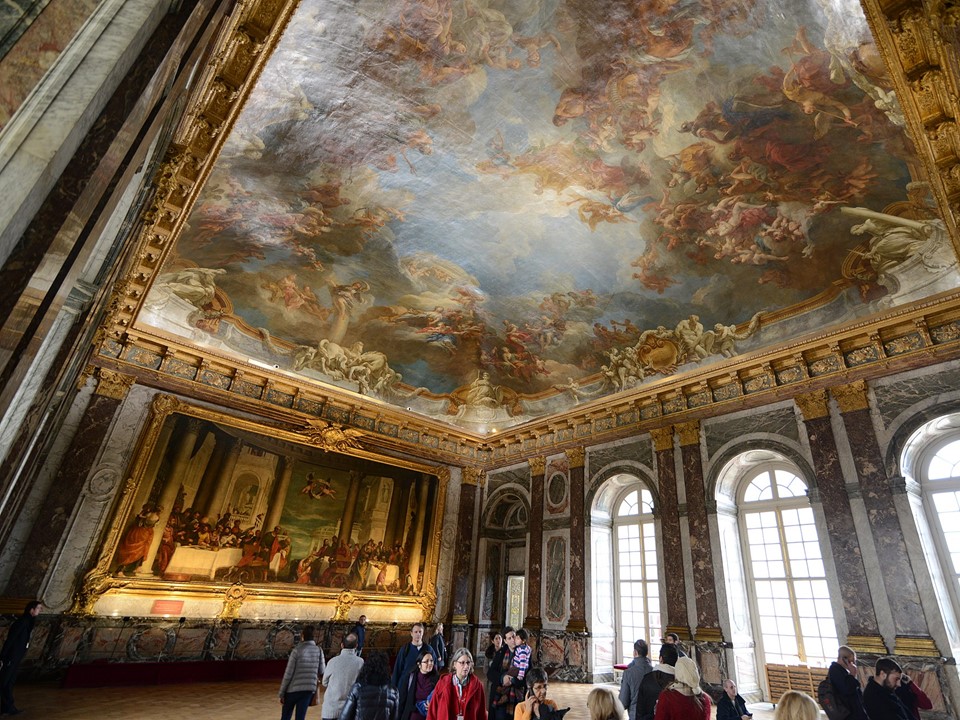
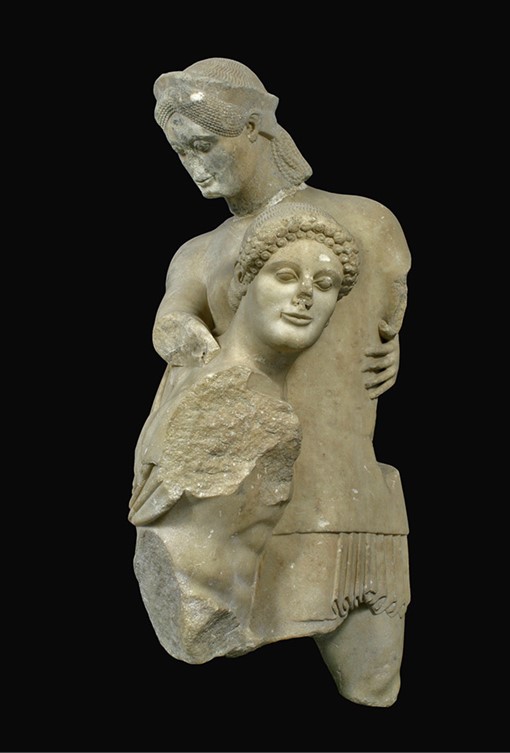
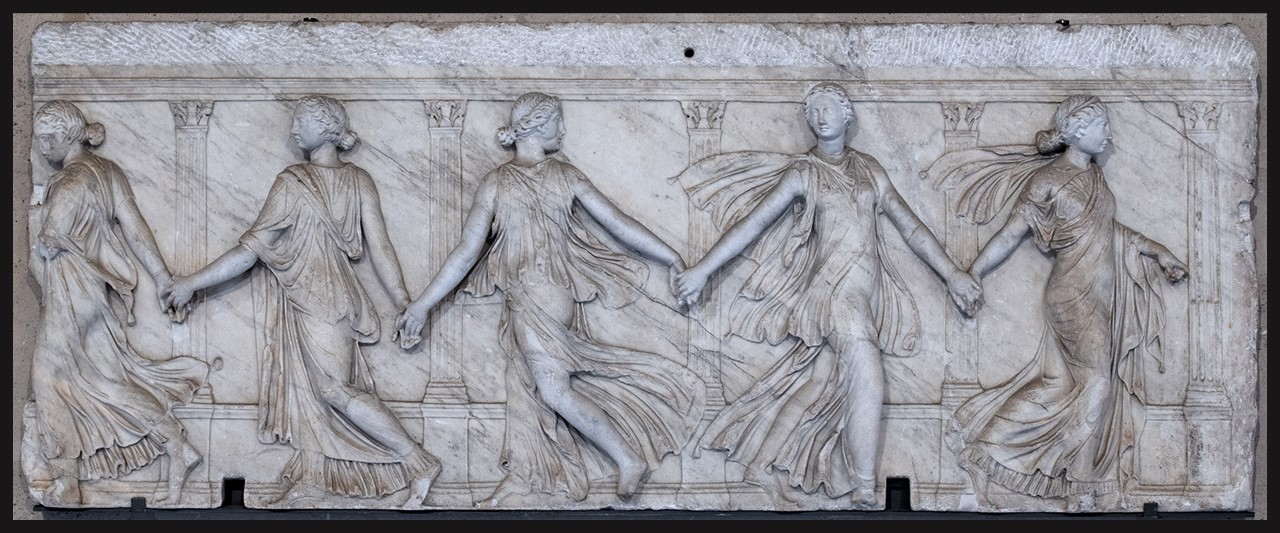
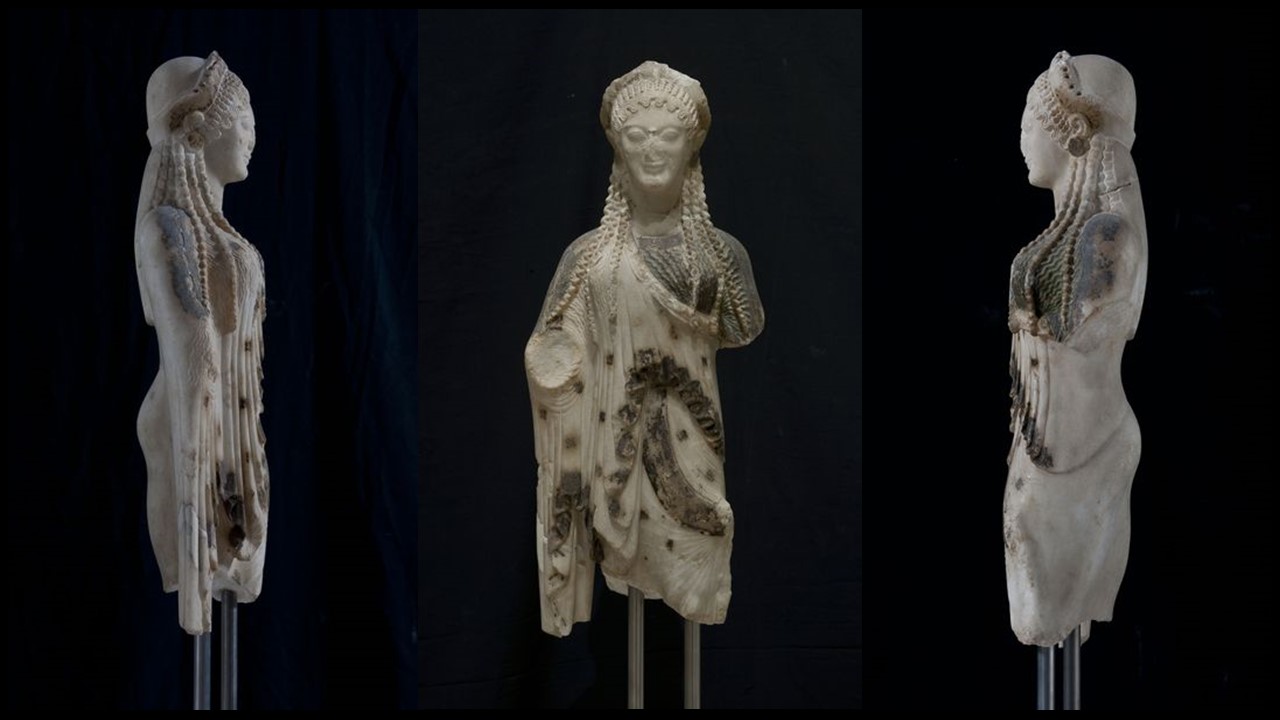
Homeric Hymn to Apollo evokes a divine Olympic dance of gods and Muses, echoed in the graceful Borghese Dancers and Poussin’s paintings, celebrating harmony, rhythm, and classical ideals of movement.
“Κάλλος” and the Kore from Chios
The “Kore from Chios,” displayed in the Kallos exhibition at the Museum of Cycladic Art, embodies Archaic Greek ideals of beauty (kallos) as a unity of physical elegance, refined drapery, and inner virtue.
Portrait of a Halberdier

Portrait of a Halberdier (Francesco Guardi?), 1529–1530, Oil (or oil and tempera) on panel transferred to canvas, 95.3 × 73 cm, The J. Paul Getty Museum, CA, USA
http://www.getty.edu/art/collection/objects/824/pontormo-jacopo-carucci-portrait-of-a-halberdier-francesco-guardi-italian-florentine-1529-1530/?dz=0.5000,0.5000,0.62
Reading Vasari’s Life of Jacopo da Pontormo, and preparing for the artist’s Portrait of a Halberdier, I would like to quote three remarks about his extraordinary abilities, by great masters of the time… Jacopo’s first work was, a little Annunciation, Raphael, upon seeing this, he marvelled, and foretold Jacopo’s future success. When Andrea del Sarto saw the figures of Faith and Charity painted by Pontormo for the central arch of the portico of the Basilica della Santissima Annunziata, he is reported saying to Jacopo, …your work is so good that I am sure you could not do better, and as you will have no lack of employment, use these designs (Pontormo wanted the painting changed and had created new designs for the portico) for something else. His work was of such beauty, continues Vasari, that for its new style and the sweetness of the heads of the two women and the charm of the infants it was the finest fresco ever seen till then. Michelangelo, on seeing it, and knowing it to be the work of a youth of nineteen, said… This youth, if he lives and continues to pursue art, will attain to heaven. http://www.artist-biography.info/artist/jacopo_da_fontormo/ and http://www.museumsinflorence.com/musei/Santissima-Annunziata.html
Jacopo Carucci, known as Pontormo, was a Mannerist Florentine artist, the son of Bartolomeo di Jacopo di Martino Carrucci, an artist as well. He was famous for his ambiguous approach to pictorial space and perspective, wherein his figures, spiritual rather than physical, painted in vivid, crisp colours with fluid contoured lines, float in space, twist, swirl, and entwine, defying the forces of gravity. Pontormo was a versatile painter famous for religious scenes, secular compositions, and insightful portraits. His portraits presenting the ruling Medici dynasty in Florence, the educated elite, and his less aristocratic friends, possess a rare psychological dignity that is enhanced by the artist’s fine eye for symbolism (which, in the case of the Medici’s, alluded to their political and economic power). https://www.theartstory.org/artist/pontormo-jacopo-da/

Study of Francesco Guardi as a Halberdier, 1529-30, Red Chalk, 209 x 169 mm, Galleria degli Uffizi, Florence, Italy
https://upload.wikimedia.org/wikipedia/commons/9/98/Jacopo_Pontormo_-_Halberdier_-_WGA18130.jpg
My favourite Pontrormo Portrait, in the Getty Museum, presents a young, fashionably dressed, Florentine foot soldier, holding a roncone or a halberd, a combination spear and battle-axe weapon, standing before a fortress wall. His direct stare and swaggering pose are strikingly poignant, given the smooth unlined face and slim body that betray him as no more than a teenager. According to Vasari, during the siege of Florence in about 1529, Pontormo painted a “most beautiful work, a portrait of young nobleman Francesco Guardi as a soldier.” It was common practice during the 1529 siege, boys too young to fight took up arms and followed their fathers on patrols in defense of the republic. The historian Benedetto Varchi remarked that these Florentine youths offered “the most beautiful sight… because they were as well armed as they were splendidly dressed.” Could the Portrait of the Halberdier portray young Francesco Guardi? I can only imagine how proud his father must have been! http://www.getty.edu/art/collection/objects/824/pontormo-jacopo-carucci-portrait-of-a-halberdier-francesco-guardi-italian-florentine-1529-1530/?dz=0.5000,0.5000,0.62 and https://www.metmuseum.org/art/collection/search/821849?&exhibitionId=%7b2c98eb4f-1cd0-43dc-912e-1fd5d5ef9c00%7d&oid=821849&pkgids=689&pg=0&rpp=20&pos=8&ft=*&offset=20
Pontormo’s Portrait of a Halberdier or young Francesco Guardi is currently exhibited in the Metropolitan Museum in New York, part of the magnificent Exhibition The Medici, Portraits & Politics, 1512-1570 (June 12-October 11, 2021). According to the MET experts… Through an outstanding group of portraits, this major loan exhibition will introduce visitors to the various new and complex ways that artists portrayed the elite of Medicean Florence, representing the sitters’ political and cultural ambitions and conveying the changing sense of what it meant to be a Florentine at this defining moment in the city’s history. The exhibition features over 90 works in a wide range of mediums, from paintings, sculptural busts, medals, and carved gemstones to drawings, etchings, manuscripts, and armor. Included are works by the period’s most celebrated artists, from Raphael, Jacopo Pontormo, and Rosso Fiorentino to Benvenuto Cellini, Agnolo Bronzino, and Francesco Salviati. I wish I could visit… to explore and marvel! https://www.metmuseum.org/exhibitions/listings/2021/medici-portraits-and-politics
For a PowerPoint on Portraits by Pontormo, please… Check HERE!
Daughters of Eleutherna

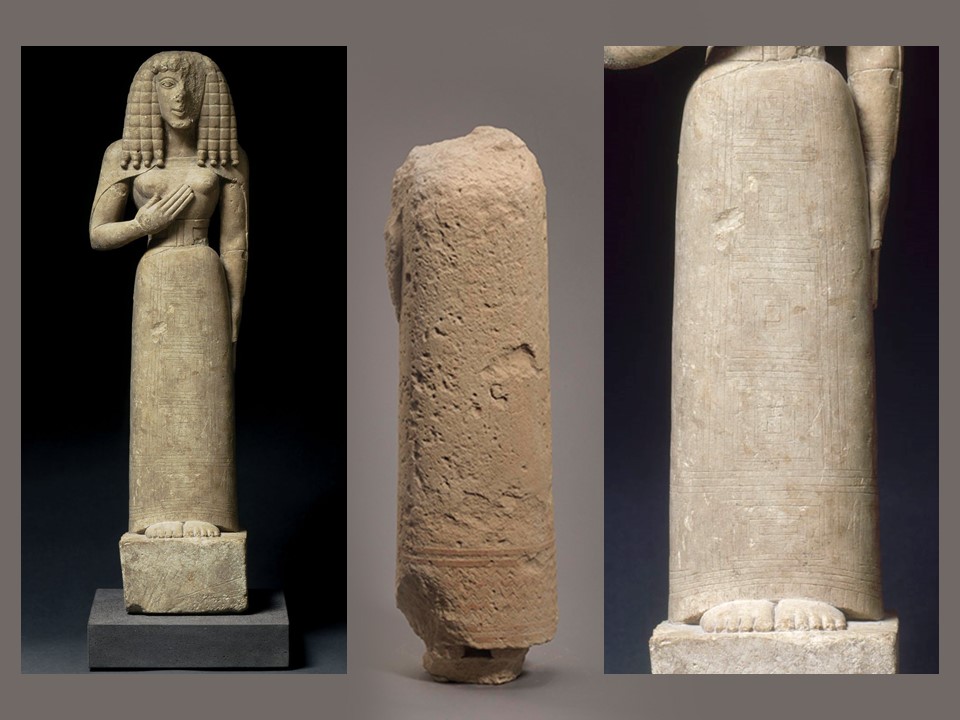
Daughter of Eleutherna, 7th century BC, limestone statuette, the surviving height of 60 cm, so a total of about one meter, Museum of Ancient Eleutherna
https://www.akg-images.com/archive/Dame-d%E2%80%99Auxerre-2UMDHUH75U8W.html
http://en.mae.com.gr/exhibits.html
https://burgondiart.wordpress.com/2015/02/19/la-mysterieuse-dame-dauxerre-est-elle-vraiment-bourguignonne/
The two statues Professor Nicholas Chr. Stampolidis, so affectionately calls Daughters of Eleutherna, hold me in fascination… “Crete was obviously the most important centre and it is the place where most of the stone sculptures of the Daedalic style originate. In contrast to the works that were directly influenced by oriental standards, the Daedalic sculptures depict mostly feminine forms. They are characterized by a complete frontality, and are represented with the hands placed on the thighs, with the hair combed into horizontal layers that were considered to be wigs -the known layered wig-like hair- usually with their head quite broadened and with clothes without folds. These elements can be seen in the known “Auxerre Kore”, who wears the characteristic large belt and her clothes are decorated with engravings and painted with a geometric pattern…” and, I would like to add, the badly damaged lower part of another Daedalic Kore at the Museum of Ancient Eleutherna. Foundation of the Hellenic World – http://www.fhw.gr/chronos/04/en/culture/321arts_sculp_daedalic.html

Back on December 1, 2004, until September 1, 2005, the Daughters of Eleutherna were exhibited side by side in a Museum of Cycladic Art Exhibition, titled, ELEUTHERNA, whose purpose was to bring together “…the results of systematic excavations conducted by the University of Crete at the site of ancient Eleutherna over the past 20 years… (and) to demonstrate the continuity of human presence and habitation in a city from the Early Bronze Age (3rd millennium BC) to the Middle Ages (12th-13th c. AD), that is, a period of some 4500 years.” This exhibition marked the beginning of a new Lesson Plan for ancient Greek Archaic Art! https://cycladic.gr/en/page/eleutherna

This Lesson Plan uses the Inquiry-based teaching method known as Visual Thinking Strategy introduced by Abigail Housen and Philip Yenawine which “uses art to teach visual literacy, thinking, and communication skills—listening and expressing oneself. Growth is stimulated by: looking at artworks of increasing complexity, answering developmentally based questions, and participating in peer-group discussions carefully facilitated by teachers.” Philip Yenawine, Visual Thinking Strategies: Using Art to Deepen Learning Across School Disciplines, 2013 https://www.amazon.com/Visual-Thinking-Strategies-Learning-Disciplines-ebook/dp/B00XO20380

8 Steps to a Lesson Plan Success

Prepare by Reading… https://www.ancient-origins.net/artifacts-other-artifacts/lady-of-auxerre-0010215 and https://www.louvre.fr/en/oeuvre-notices/statue-woman-known-lady-auxerre and https://www.tovima.gr/2008/11/24/culture/h-epistrofi-mias-kyrias/ and http://en.mae.com.gr/museum.html
Introduction Essential Questions: How do we communicate thoughts and feelings in the visual arts? – How do the arts of each period reflect the values of the culture? and Goals: Help students understand the importance of Daedalic Art in the development of Ancient Greek Sculpture – Assist students to connect the past with the present
Visual Learning PP: Show students what PP “teachercurator” has prepared, please… Click HERE!
Be Inquisitive 1: Ask Visual Learning Strategy Questions… and conduct a constructive conversation
Visual Learning Video: Show students the following Video titled “HALL B: THE LADY OF AUXERRE” directed by Andonis Theocharis Kioukas for the Museum of Ancient Eleutherna http://en.mae.com.gr/films.html
Be Inquisitive 2: Ask Questions… on the information provided by the Video on the Lady of Auxerre
Enduring Understanding: Daedalic Sculpture was the 1st step in the development of Ancient Greek Sculpture.
Assessment Activity: For an RWAP Activity, please… Check HERE! (RWAP stands for Research-Writing-Art-Project)

Last Supper in Pompeii

If your Christmas “walking shoes” take you to Oxford, England, go the Ashmolean Museum of Art and Archaeology to see Last Supper in Pompeii, a wonderful Exhibition on the Roman love affair with food and wine! Inspiration for this Exhibition comes from Pompeii, this amazing time capsule of 79 AD Roman life. Dr Paul Roberts, Head of the Ashmolean Department of Antiquities and exhibition curator, says: ‘The evocative names given to the excavations (the Villa of the Mysteries; the House of the Tragic Poet) have inspired everything from Victorian exhibitions, swords-and-sandals romances to countless scholarly works. Our fascination with the doomed people of Pompeii and their everyday lives has never waned. What better connection can we make with them as ordinary people than through their food and drink?’
Last Supper in Pompeii displays 300 objects related to the culinary arts and the role they played in Roman history and culture. Exquisite floor mosaics from the villas of the affluent Pompeiians, frescoes depicting banquets, and statues, fountains or furnishings that decorated famous triclinia, are all present. Precious or humble dining sets and utensils, simple cooking pots and carbonised food that was on the Pompeiian tables when the volcano erupted tell us interesting stories or Roman culinary voyages and cultural connections.
Useful sources: https://www.ashmolean.org/pompeii and https://www.ashmolean.org/article/last-supper-in-pompeii and https://www.smithsonianmag.com/smart-news/exhibit-spotlights-roman-delicacies-baked-dormouse-carbonized-bread-180972731/
My favourite Exhibition fresco is titled Distribution of Bread (AD 40–79) and comes from the House of the Baker in Pompeii. It shows a man behind a wooden counter handing a loaf of bread to a man, while a young boy reaches up eagerly. The shelves are heaped with loaves of the typical round Pompeiian bread, archaeologists even found carbonized one in its entirety. Scholars today believe that the fresco represents a politician’s free distribution of bread (annona) rather than a baker selling his loaves from a food stall.

The Distribution of Bread is a fascinating Pompeian fresco. I like the artist’s ability to create a sense of depth and space through a diagonal composition, his choice of earthy colours with touches of white and aubergine purple to accentuate the depicted figures. I also like the anecdotal details… the well-crafted wooden stall, the herringbone woven basket painted on the left side of the fresco, the abundance of displayed bread loaves… most of all, I like the human touch, the boy, impatient and eager to get his part of the Distributed Bread!
Bibliography of the House of Baker and the Distribution of Bread fresco: https://www.pompeiiinpictures.com/pompeiiinpictures/R6/6%2003%2003.htm and http://www.bbc.co.uk/history/ancient/romans/daily_life_gallery_02.shtml and https://www.ancient.eu/image/10622/sale-of-bread-fresco-pompeii/
An Activity students will enjoy is… HERE!
For a powerpoint prepared for the Exhibition, please… click HERE!