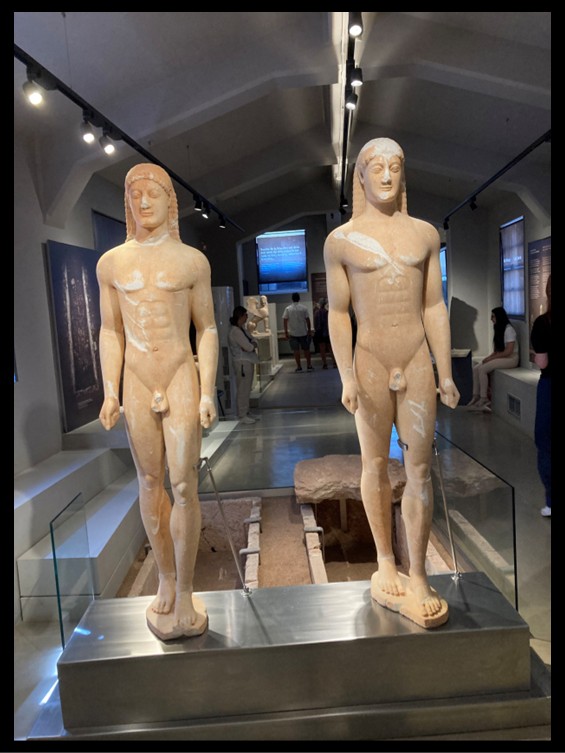
In 2010, Greek police arrested a ring of antiquities smugglers south of Corinth and uncovered something extraordinary: a matched pair of marble statues nearly 2,600 years old. Today those statues, known as The Klenia Kouroi, stand in the Ancient Corinth Archaeological Museum as one of the rarest funerary finds from Archaic Greece.
What Is a Kouros?
A kouros (plural: kouroi) is a type of freestanding marble statue made in Greece between roughly 600 and 480 BCE. Kouroi depict idealized nude young men, always in the same ‘stiff’, forward-facing pose: left foot stepped forward, arms held close to the body, and a faint, closed-lip expression scholars call the archaic smile.
These statues weren’t portraits in the modern sense. They were symbolic, used either as offerings in sanctuaries or as markers over graves, standing in for the person buried beneath. Their female counterparts, korai, served a similar role and are usually shown clothed rather than nude.
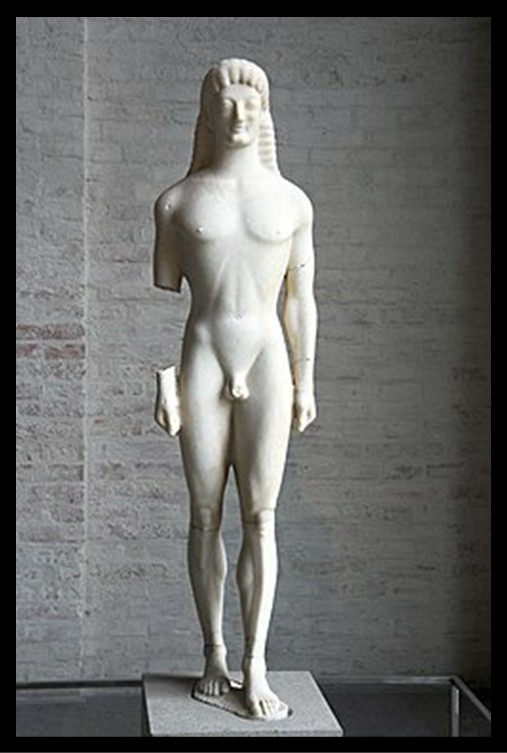
https://en.wikipedia.org/wiki/Kouros_of_Tenea
The most famous kouros from this region is the so-called Kouros of Tenea, unearthed near Corinth back in 1846 and now housed in Munich’s Glyptothek museum. The Klenia Kouroi are a separate, much later discovery from the same ancient territory, and that connection is part of what makes them so significant.
An Illegal Dig Near Corinth
The Klenia Kouroi take their name from Klenia (also spelled Klenies), a small district near the village of Chiliomodi, close to the site of the ancient city of Tenea, roughly 20 kilometers south of Corinth. Tenea’s necropolis had already produced the Munich Κouros over a century earlier, and it turns out the ancient cemetery still had more to give up.
Sometime before 2010, looters dug illegally into the site and found two marble Κouroi buried together. Rather than reporting the find, they attempted to sell the statues on the black market, reportedly demanding a price in the millions of euros. Greek police caught up with the smuggling ring in May 2010, recovering the statues before they could leave the country.
Once the site was secured, archaeologists carried out a proper excavation and recovered pieces the looters had missed, including the sarcophagus the two kouroi had originally stood beside. That combination, a matched pair of statues found with their burial container, is what makes the find so unusual. Experts have called it the only known example in Greece of an archaic funerary ‘statue pair. preserved together in its original grave context.
Restoration and Display
After the seizure, the statues were sent to the National Archaeological Museum in Athens for conservation work. The restoration reunited the recovered fragments with the main bodies of both figures, repairing damage likely caused during the illegal excavation.
In August 2011, the twin Kouroi of Klenia went on public display for the first time, at the Ancient Corinth Archaeological Museum. The unveiling was attended by Greece’s Culture Minister at the time, underscoring how significant the recovery was seen to be, both as an archaeological discovery and as a win against antiquities trafficking.
Why the Klenia Kouroi Matter
Beyond their rarity, the Klenia Kouroi offer real insight into Archaic burial customs in the Corinth region. Because they were found together with their sarcophagus, researchers have context that’s usually missing from kouroi in museum collections, most of which were separated from their original settings long before modern archaeology could document them.
The Klenia Kouroi add to a growing picture of ancient Corinthia as an unusually rich source of Archaic Greek sculpture. For museum visitors, they are also a reminder that Greece’s ancient sites remain places of discovery, and that some of the country’s important archaeological treasures have been saved not only through excavation and scholarship, but also through the efforts of those who protect them from illicit trafficking.
Classroom Activity: Step into the world of Archaic Sculpture with this hands-on Student Activity inspired by the Klenia Kouroi at Corinth. Explore the Student Activity →
Continue Exploring on Teacher Curator: Discover how the Klenia Kouroi can help us investigate Ancient Greek Sculpture during the Archaic period with related articles – Grave Stele of a Youth and a little Girl and Cleobis and Biton.
Sources and further Reading: To learn more about the Klenia Kouroi and their place in the sculpture of Archaic Corinthia, explore the academic presentation by Elena Walter-Karydi through the Center for Hellenic Studies at Harvard University – https://greece.chs.harvard.edu/events-conferences/rethinking-archaic-sculpture/program. For further information on recent archaeological discoveries at Tenea, including the Klenia Kouroi and their funerary context, explore the American School of Classical Studies at Athens site https://www.ascsa.edu.gr/news/newsDetails/videocast-t.