https://www.metmuseum.org/art/collection/search/465946 and https://www.christianiconography.info/metropolitan/medieval5thAvenue/demetriusIvory.html
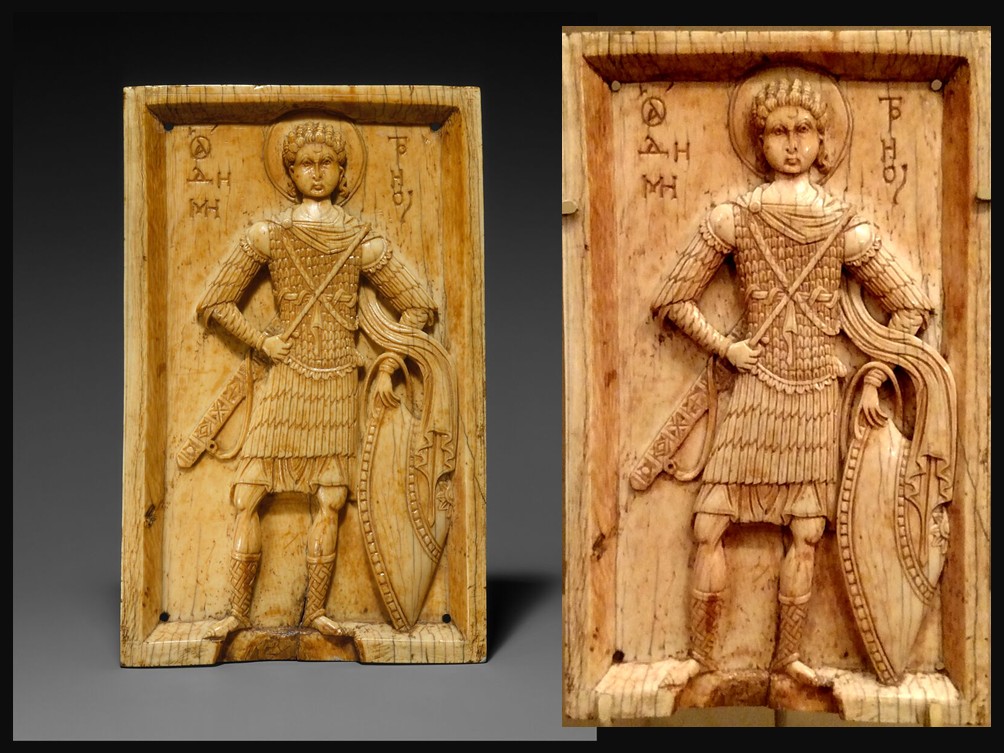
The Icon of Saint Demetrios at The Met is a remarkable image of faith and power. Standing erect, spear in hand and shield at his side, a soldier gazes out at you from a small ivory panel barely the height of a sheet of paper. He is Saint Demetrios, patron saint of Thessaloniki, beloved protector of the Byzantine faithful, and one of the most venerated military saints of the medieval Christian world. Carved around 950–1000 AD, this exquisite icon at The Metropolitan Museum of Art is a masterpiece in miniature: a window into Byzantine devotion, imperial politics, and the extraordinary skill of tenth-century craftspeople.
Who Was Saint Demetrios?
Demetrios was martyred in Thessaloniki during the early Christian persecutions, traditionally around 306 AD under the Emperor Galerius. Thessaloniki was the second most important city of the Byzantine Empire after Constantinople, and Demetrios became its beloved patron saint. Ancient accounts describe him as a young man of senatorial family, possibly a proconsul. His early identity was notably civilian: in his oldest depictions, he appears in patterned robes with the distinctive tablion, a decorative panel, of the senatorial class across his chest. He was not yet a soldier.
His military transformation came gradually. As miraculous interventions were credited to him during repeated attacks on Thessaloniki, Demetrios was reimagined as a warrior-protector. By the Middle Byzantine period (roughly the 9th through 12th centuries), the spear and shield had become his defining attributes. This Byzantine ivory icon, from the second half of the tenth century, captures that transformation at its height.
The Ivory Icon of Saint Demetrios: Materials and Technique
Warm-toned and fine-grained, elephant ivory was the prestige material of Byzantine sacred art. The Byzantines prized it as rare, exotic, and costly, a worthy medium for holy images. Craftspeople in Constantinople used it for everything from personal devotional icons to elaborate triptychs to imperial diplomatic gifts sent to rulers across Europe. Byzantine ivory carving reached its greatest heights in the tenth and eleventh centuries, and this icon of Saint Demetrios belongs to that golden age.
This panel measures just 19.7×12.1×1 cm, small enough to hold in two hands, yet monumental in its presence. Demetrios stands full-length, erect and alert. His name is inscribed in Greek in two parts across the composition. That labelling was not decorative habit: after the period of Iconoclasm (726–843 AD), inscribing a saint’s name became a theological act, anchoring the image firmly to its sacred subject.
Two features of the ivory’s frame are especially revealing. A cleft at the base may have held a pole or standard, meaning this intimate object could have been carried into battle or borne aloft in religious processions. Holes drilled through the back point to a different life entirely: the panel was likely later repurposed in the Latin West as a book cover, evidence of the long, winding journey that moved so many Byzantine objects into European collections through crusade, trade, and diplomatic gift-giving.
Iconography: How to Read a Byzantine Saint
In Byzantine art, the way a saint is depicted is never accidental. Objects, clothing, and posture form a visual language that medieval viewers could read as fluently as text. Soldier saints carry spears and shields. Clergy saints wear vestments and hold liturgical objects. Healer saints carry medicine boxes. Martyrs often hold crosses.
Before the Iconoclastic controversy, military dress for saints was rare. Afterwards, as the Byzantine Empire faced threats on multiple fronts, the soldier-saint became a powerful symbol: a figure embodying divine protection and earthly military strength together. Demetrios, alongside saints George and Theodore, came to stand for the idea that heaven’s warriors fought beside the empire’s armies. This Byzantine ivory icon is a prime example of art functioning as more than decoration. Whether it accompanied a general into battle or stood on a chapel altar, the message was consistent: Demetrios is here, and he is watching over us.
More than a thousand years after it was carved, the Ivory Icon of Saint Demetrios remains a remarkable witness to Byzantine faith and artistry. Though small in scale, it embodies the spiritual devotion, military ideals, and artistic sophistication of the medieval Byzantine world. Today, preserved at The Metropolitan Museum of Art, it continues to connect modern viewers with one of Byzantium’s most beloved saints.
Classroom Activity: Bring Byzantine art to life in your classroom with these four student activities inspired by the Ivory Icon of Saint Demetrios at The Metropolitan Museum of Art. Explore the Student Activities →
Continue Exploring on Teacher Curator: Discover more representations of Saint Demetrios and explore how Byzantine artists portrayed this beloved military saint: Saint Demetrios in prayer position with Patrons and Miniature Mosaic Icon of Saint Demetrios in Sassoferrato
Sources and further Reading: Want to look more closely at this remarkable little masterpiece? Visit The Metropolitan Museum of Art to explore the Ivory Icon of Saint Demetrios and discover more about its materials, imagery, and history: https://www.metmuseum.org/art/collection/search/465946. To step further into the fascinating world of Byzantine ivory carving, explore The Met’s Byzantine Ivories, an introduction to the craftsmanship, imagery, and devotional objects that made these small works so powerful: https://www.metmuseum.org/essays/byzantine-ivories.