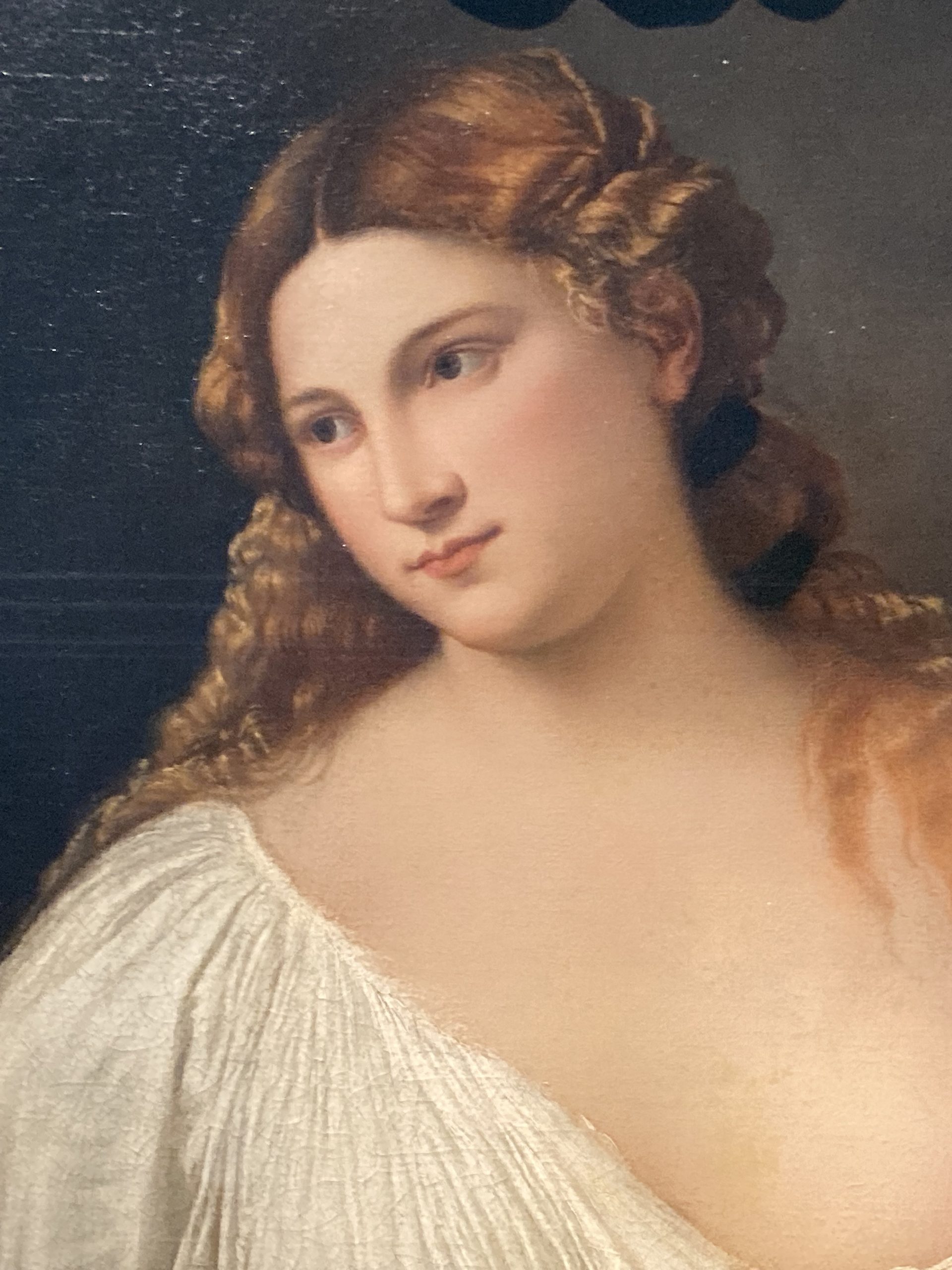
Flora (detail: face), ca. 1517, Oil on Canvas, 79.7 x 63.5 cm, Gallerie degli Uffizi, Florence, Italy – Photo Credit: Amalia Spiliakou, 2025
Titian’s Flora is one of the most recognisable images of feminine beauty in Venetian Renaissance painting. A young woman emerges from a dark background, her long copper-blonde hair falling loosely over her shoulders. Her white garment slips from one shoulder, revealing part of her breast, while in her right hand she holds a small bouquet of spring flowers. She looks beyond the picture towards the viewer with a quiet, self-possessed expression.
Painted around 1517, the work is now in the Uffizi Galleries in Florence. Yet the name Flora is not as straightforward as it might seem. The woman has traditionally been identified with Flora, the Roman goddess associated with flowers and spring, but this identification was made much later. According to the Uffizi, the painting was identified as Flora by the Dutch historian Joachim von Sandrart, who saw it around 1635. The uncertainty surrounding her identity is therefore an important part of the painting’s history.
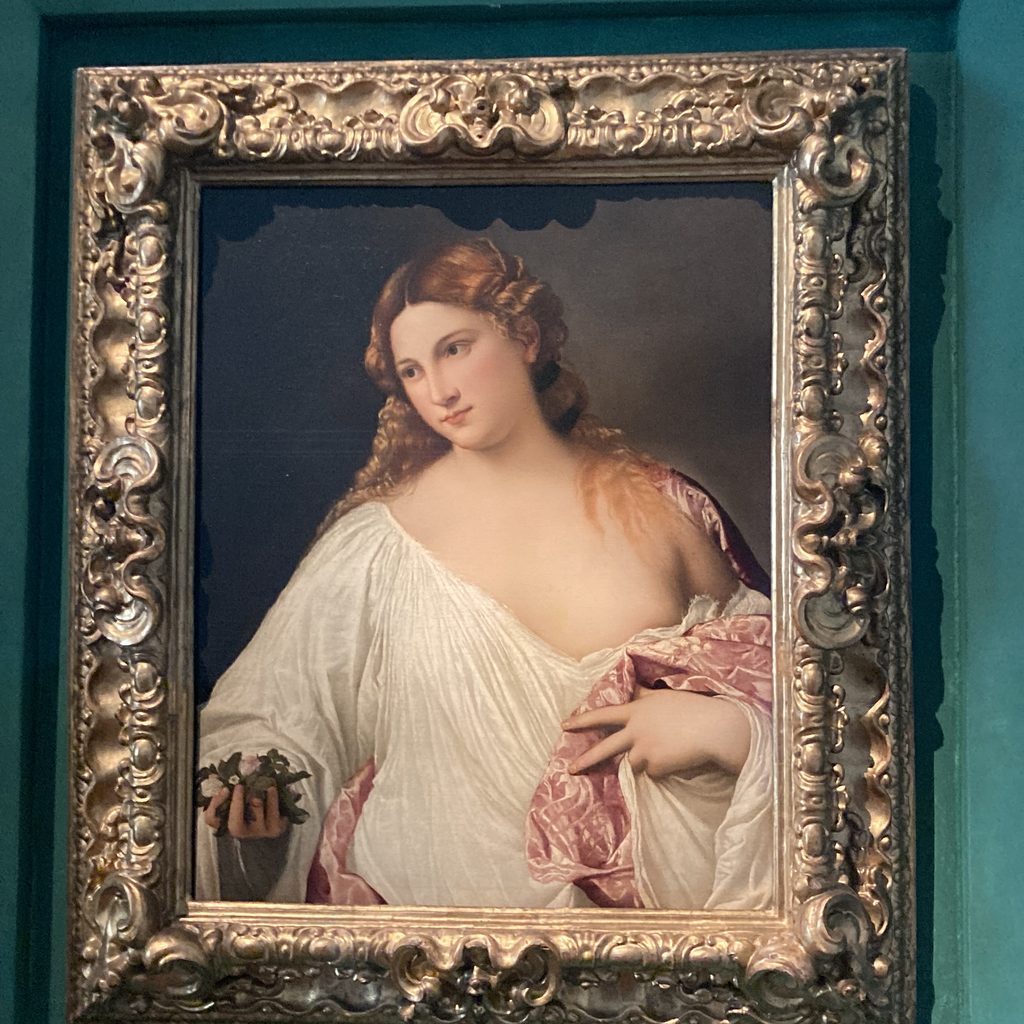
Flora, ca. 1517, Oil on Canvas, 79.7 x 63.5 cm, Gallerie degli Uffizi, Florence, Italy – Photo Credit: Amalia Spiliakou, 2025
A Venetian ideal of beauty
Titian was working in Venice at a time when artists were developing a new fascination with the image of the beautiful young woman. Rather than depicting an identifiable historical figure, these paintings often presented an ideal of feminine beauty through carefully constructed combinations of face, hair, clothing, gesture and sensuality.
The Uffizi places Flora within this Venetian tradition of the ‘Belle’, a group of images devoted to exceptionally attractive women. In this context, the painting does not necessarily require the woman to be a specific goddess or historical individual. Instead, she can be understood as an embodiment of feminine beauty itself, combining modesty and sensuality. This is one reason the painting remains so compelling. Titian gives us a figure who appears intimate and immediate, yet whose identity remains deliberately elusive.
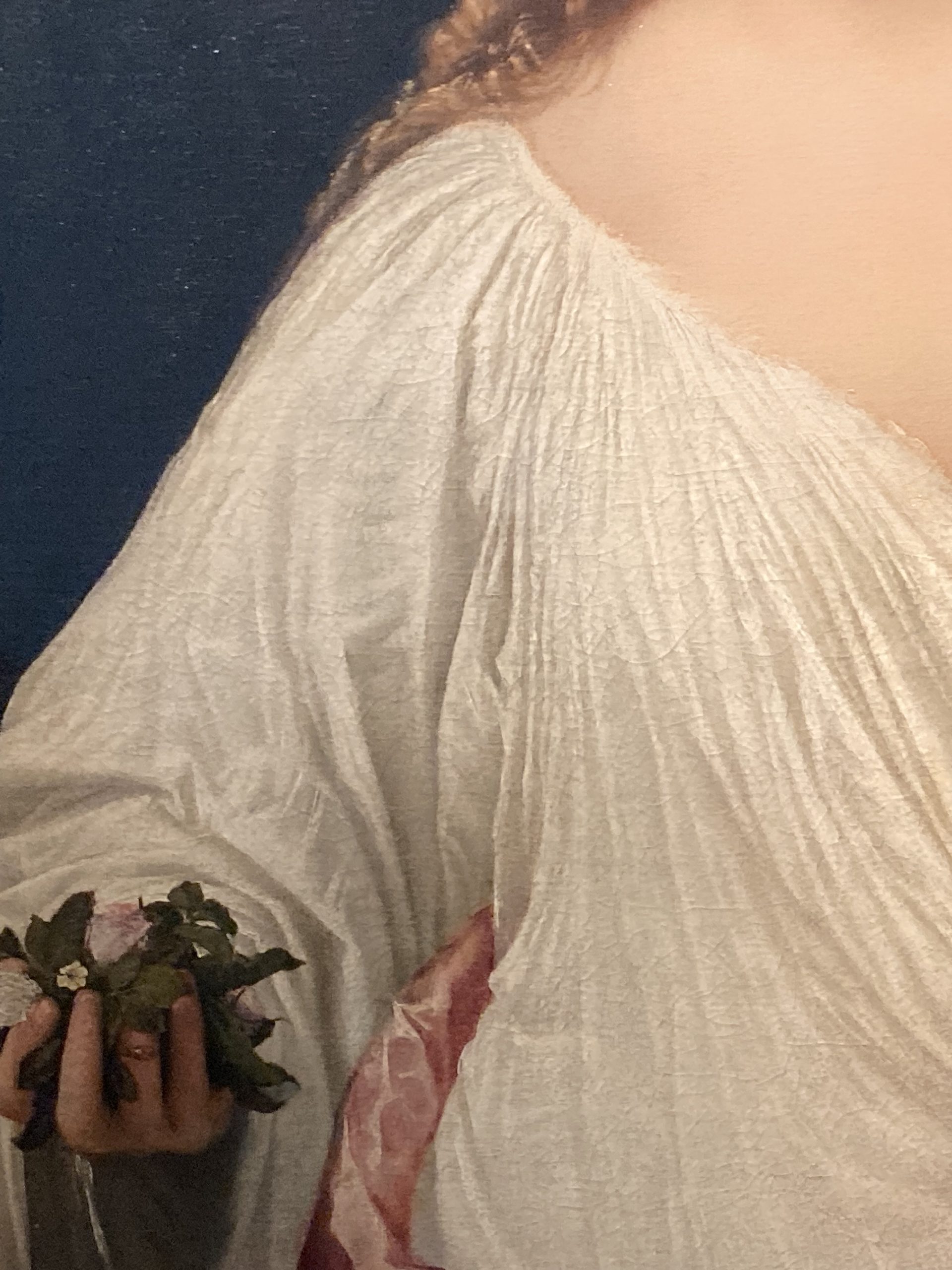
Flora (detail: ), ca. 1517, Oil on Canvas, 79.7 x 63.5 cm, Gallerie degli Uffizi, Florence, Italy – Photo Credit: Amalia Spiliakou, 2025
Colour, light and the Venetian imagination
Titian’s achievement lies not only in the subject but in the way paint creates the presence of the woman. Her luminous skin and pale garment stand out against the deep brown background. Her hair, with its characteristic copper-golden tones, frames the face and catches the light. The contrast between warm flesh, pale fabric, reddish-gold hair and the darker surrounding space creates an image of extraordinary visual richness without the need for an elaborate setting.
This concentration on colour and surface was central to the development of Venetian painting. Titian’s figures seem to exist through colour as much as through line or contour. The softness of the flesh, the weight of the fabric and the delicate flowers are all conveyed through subtle variations of tone and light.
The Uffizi notes that the woman’s appearance corresponds closely to contemporary Renaissance ideals of beauty, including pale luminous skin, rosy cheeks and long loose, copper-blonde hair, the colouring that would eventually become associated with the term “Titian red.”
Between modesty and sensuality
The woman’s clothing introduces an important tension. The white garment covers her body, yet it has slipped from one shoulder, exposing the breast. Her pose is neither overtly provocative nor completely modest. This ambiguity is characteristic of the painting. Titian does not present beauty as something purely innocent or purely erotic. Instead, the figure occupies a space between the two. The Uffizi describes this quality as a combination of pudicizia and voluptas, modesty and sensual pleasure.
Her direct gaze strengthens this sense of quiet confidence. She does not appear embarrassed by the viewer’s attention, nor does she make an obvious gesture of seduction. She simply meets the visual encounter with calm assurance.
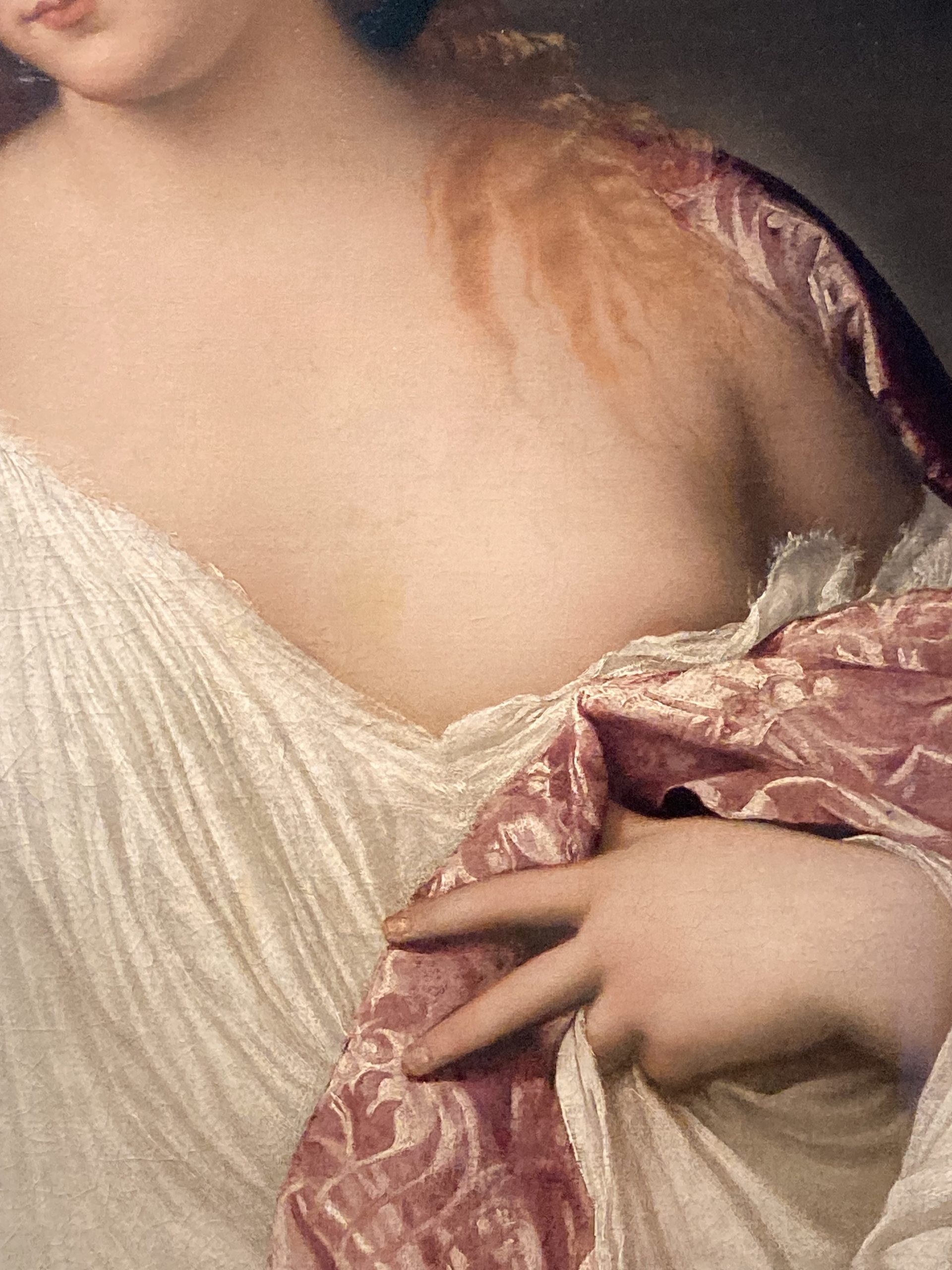
Flora (detail: ), ca. 1517, Oil on Canvas, 79.7 x 63.5 cm, Gallerie degli Uffizi, Florence, Italy – Photo Credit: Amalia Spiliakou, 2025
A mystery that belongs to the painting
It is tempting to search for a name behind the face: a goddess, a courtesan, a bride, a noblewoman or a particular model. Earlier interpretations have proposed several possibilities. Yet there is no secure evidence that allows the woman to be identified as a specific historical person.
Perhaps this is precisely what makes Flora so successful. Titian transforms an apparently simple half-length figure into an image that can operate on several levels at once. The flowers connect her with Flora and with the natural world; her clothing evokes both modesty and sensuality; her beauty belongs to the visual ideals of Renaissance Venice; and her ambiguous identity leaves room for the viewer’s imagination.
More than five hundred years after it was painted, Flora continues to resist a single explanation. Rather than weakening the painting, this uncertainty adds to its fascination. Titian gives us neither a fully explained mythological figure nor a clearly documented portrait. He gives us an image of feminine beauty that seems remarkably present while remaining, in the end, unknowable. And perhaps that is the real mystery of Flora: not simply who the woman was, but how Titian made an unnamed, or at least uncertainly named, woman appear so unforgettable.
PowerPoint Presentation: Ready to explore the theme further? Download the PowerPoint presentation and discover how Titian represented women through the ideas of pudicitia and voluptas. The presentation is ideal for teaching, discussion, or independent learning. Get the PowerPoint →
Continue Exploring on Teacher Curator: Continue exploring female portraits by Venetian artists with these related Teacher Curator articles: La Belle Nani by Paolo Veronese and Titian’s Portrait of Isabella d’Este. These articles offer further insight into Renaissance portraiture, Venetian women, and the ways artists represented female beauty and identity.
Sources and further Reading: To learn more about Titian’s female portraits and Flora, explore these reliable museum sources: Gallerie degli Uffizi: Titian, Flora, the official museum page for Titian’s celebrated painting https://www.uffizi.it/en/artworks/titian-flora and Kunsthistorisches Museum Vienna: Titian’s Vision of Women (2021), an online exhibition exploring Titian’s representations of women and the Venetian tradition of the belle Veneziane, including ideas of femininity, marriage, beauty, and symbolism https://tiziansfrauenbild.khm.at/en/?utm_source=chatgpt.com. These sources provide useful background for understanding Titian’s approach to female beauty, portraiture, and identity in Renaissance Venice.