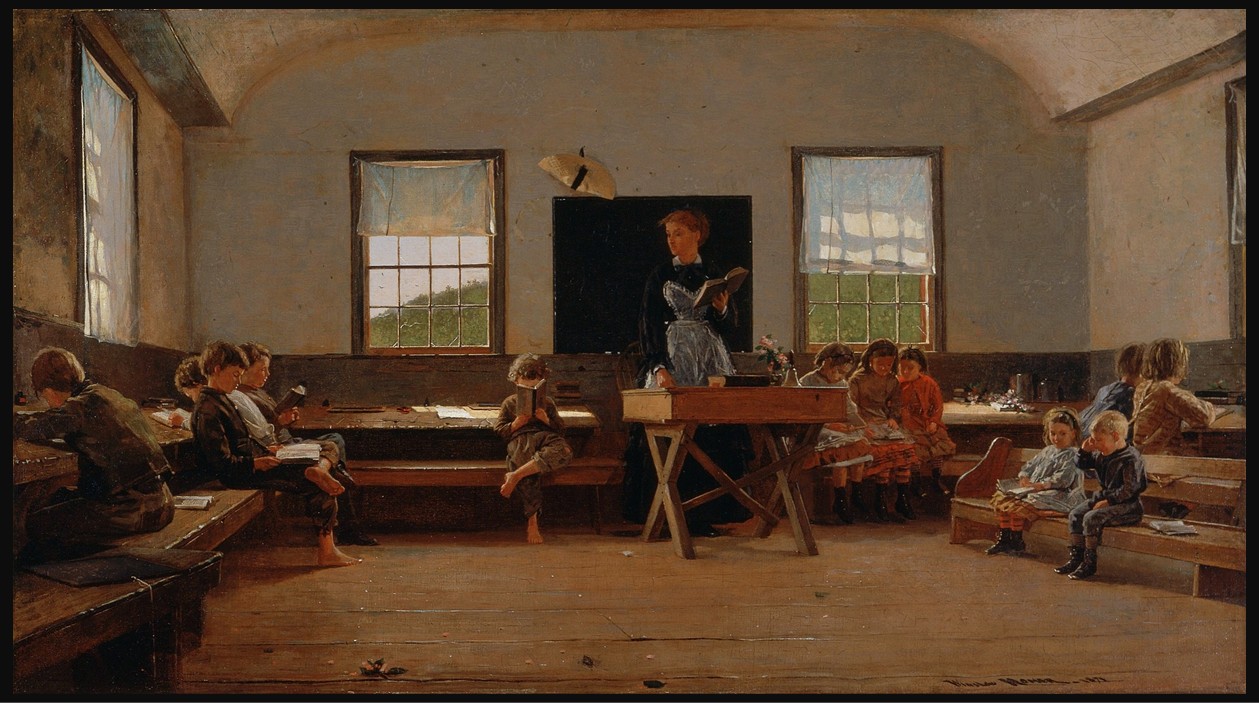
The Country School, 1871, Oil on Canvas, 54 x 97.2 cm, Saint Louis Art Museum, USA
https://www.slam.org/collection/objects/36767/
What does the first day of school look like? In 2026, Greek children will return to classrooms on September 11, carrying backpacks filled with books, notebooks and excitement about seeing friends again. But more than 150 years ago, Winslow Homer painted a classroom that feels surprisingly familiar.
In The Country School, painted in 1871, Homer takes us inside a rural American schoolhouse. Children sit at worn wooden desks while their young teacher stands at the front of the room. Some are attentive. Others seem distracted. One child appears absorbed in a book, while another looks far less interested in the lesson. At first glance, much has changed since Homer’s classroom. Look a little longer, however, and something wonderfully familiar begins to emerge.
A Classroom Full of Children
Homer was an American painter and illustrator known for his close observation of everyday life. In The Country School, he does not present an idealized picture of perfectly behaved pupils. Instead, he shows children as children really are: curious, restless, attentive, distracted and perhaps occasionally dreaming of being somewhere else.
The Saint Louis Art Museum describes the students as struggling to concentrate despite the attraction of sunshine, spring grass and outdoor play. Through the windows, the green landscape seems almost to call them outside. Fresh flowers decorate the teacher’s desk, while a few wilted blooms lie on the floor. It is an ordinary classroom scene, but Homer makes us look closely at its small details. And perhaps that is why it still speaks to us.
From 1871 to 2026
Homer’s school was very different from the classrooms Greek children will enter this September. The desks were wooden. The room was heated and lit very differently. There were no computers, interactive whiteboards or smartphones. A single teacher taught children in the same room, and the one-room schoolhouse itself was already beginning to disappear as American education changed after the Civil War.
Yet the children in Homer’s painting could easily belong to another century, or to our own. There is the child who is paying attention. The child who is distracted. The child who would rather look outside. The child completely absorbed in a book. And perhaps there is also the teacher wondering whether everyone is listening.
The Teacher at the Centre
The young woman standing at the front of Homer’s classroom deserves our attention too. In the years following the Civil War, women increasingly entered professions such as teaching. The Saint Louis Art Museum places The Country School within this period of social change, when older traditions were giving way to a modern post-war America.
Today, of course, teachers work in very different classrooms. But their essential role remains remarkably familiar: to guide, encourage, explain, challenge and inspire the children in front of them.
What Has Changed – and What Hasn’t?
On September 11, 2026, Greek schools will open their doors for another academic year. The classrooms will look different from Homer’s. The books will be different. The technology will be different. The subjects, teaching methods and expectations will have changed enormously.
But the experience of beginning a new school year may not be so different after all.
There will be anticipation and curiosity. There may be a little nervousness. There will be friendships renewed and new ones beginning. Some children will be eager to learn, while others may already be thinking about the playground, the sunshine outside or the end of the school day.
That is what makes Winslow Homer’s The Country School such a lovely painting with which to mark the beginning of a new school year. It reminds us that although schools change, children don’t change quite as much as we might think.
More than 150 years later, Homer’s classroom is still filled with something instantly recognizable: the energy, curiosity and wonderfully unpredictable nature of childhood.
And perhaps that is the perfect way to begin another school year.
PowerPoint Presentation: Ready to Dive Deeper? Download the presentation and explore this topic at your own pace — ideal for sharing, discussing, or simply learning more. Get the PowerPoint →
Continue Exploring on Teacher Curator: Expand your understanding of Winslow Homer’s Art with related articles: The Red School House by Winslow Homer and Homer’s Summer Night.
Sources and further Reading: To dive deeper into the world of Winslow Homer, visit the Saint Louis Art Museum site where The Country School painting is exhibited https://www.slam.org/collection/objects/36767/. Learn more about Education in the US and Homer in https://newenglandhistoricalsociety.com/flashback-photo-country-school-1871/, an article on how Winslow Homer painted the scene of a Country School in 1871, nearly two decades after Massachusetts became the first state to pass a compulsory education law in the United States. This is a New England Historical Society article.