https://www.theacropolismuseum.gr/en/sphinx-statue-0
What do you notice first when you look at the Sphinx Statue of the Acropolis, made around 540–530 BC? Her enigmatic smile? Her enormous wings? Her almond-shaped eyes? Or perhaps the strange combination of a human face, a lion’s body and the wings of a bird? At just 55 cm high, this small marble sculpture may seem delicate, but look closely and she becomes a fascinating doorway into Greek mythology, Archaic art and the beliefs of ancient Athens.
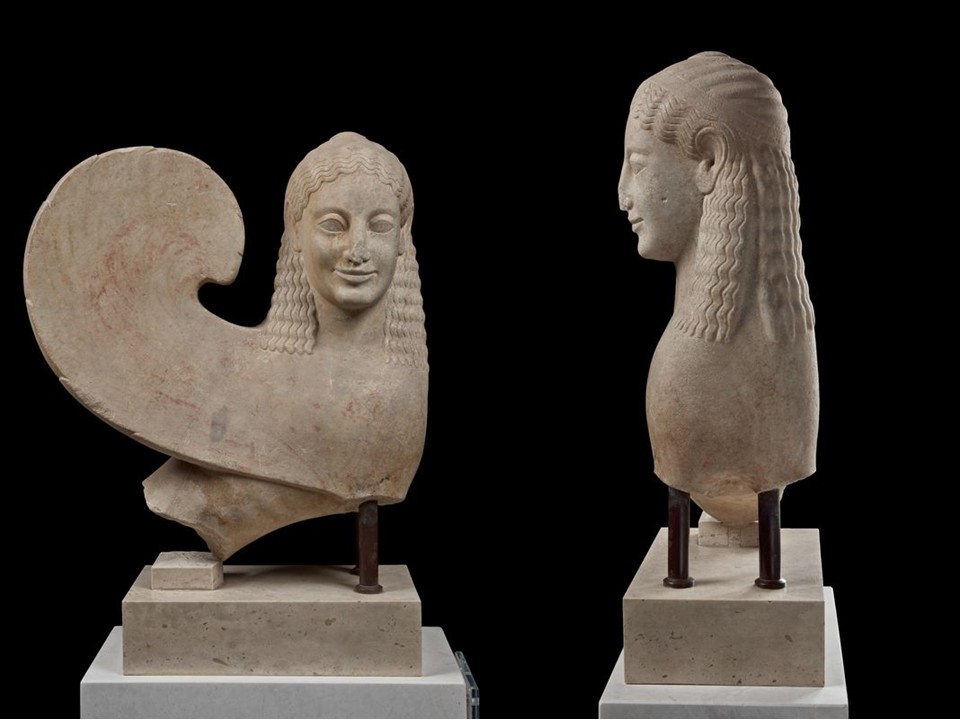
The Sphinx was carved from Parian marble and was discovered on the Acropolis of Athens. Today, she is displayed in the Archaic Acropolis Gallery of the Acropolis Museum. Originally, however, she would have looked quite different from the white marble figure we see today. Traces of colour reveal that her wings were decorated with red and black paint, reminding us that ancient Greek sculpture was often brightly coloured.
Look Closely
Take a moment before reading further. What can you discover? Look at her face. Her almond-shaped eyes, arched eyebrows and gently curved lips create the characteristic Archaic smile. Is she smiling? Perhaps—but the expression is not meant to show a particular emotion. Instead, the stylised smile is one of the visual conventions of Archaic Greek sculpture.
Now look at her hair. Long strands fall down her back, held by a broad band. Notice how carefully the sculptor has arranged the hair and defined its surface. Then look at the wings. They sweep backwards from her body, creating a strong sense of pattern and movement. Imagine them painted in their original colours. How different would this mysterious creature have looked?
Finally, look at her body. The Sphinx combines the head and upper body of a woman with the body of a lion and the wings of a bird. This unusual combination immediately tells us that we are looking at a creature belonging to the world of myth.
Who Was the Greek Sphinx?
The Greek Sphinx was a mythical creature associated with danger, mystery and the testing of human intelligence. Unlike the benevolent guardian figures sometimes encountered in other ancient cultures, the Greek Sphinx could be a terrifying presence.
Her most famous story takes place at Thebes. According to the myth, the Sphinx sat near the city and challenged travellers with a riddle. Those who could not answer were killed.
Her famous question was: “What creature walks on four legs in the morning, two at noon, and three in the evening?”
The answer was a human being. As a baby, a person crawls on four limbs; as an adult, walks on two legs; and in old age, may use a walking stick as a third support. When Oedipus correctly answered the riddle, the Sphinx was defeated. The story became one of the most memorable episodes in Greek mythology, connecting the Sphinx with the power, and danger, of knowledge.
A Sphinx on the Acropolis
But what was a Sphinx doing on the Acropolis of Athens? This particular sculpture was a votive offering, dedicated in a sacred context. It was discovered east of the Parthenon and was originally mounted on a tall column. Imagine her elevated high above the ground, her wings and mysterious face visible from a distance. Suddenly, the surviving 55-centimetre sculpture becomes part of a much larger and more impressive monument.
For the ancient Athenians, the Sphinx was not simply a character from a story. Mythological creatures could carry powerful associations with the supernatural, protection, danger and the boundary between the human and divine worlds.
From Marble to Myth
The Acropolis Sphinx offers us something particularly valuable: the opportunity to look at an ancient object and move between what we see and what we imagine. We see marble, carved hair, patterned wings and an Archaic smile. But behind these physical details lies a world of stories and beliefs. We can imagine the original colours, the sculpture standing on its tall column, and ancient visitors encountering this mysterious creature in the sacred landscape of the Acropolis.
And perhaps that is the best reason to look closely. A single sculpture can raise many questions: Who made it? Why was it dedicated? What did its original colours look like? What did the Sphinx mean to the people who saw her? And what stories might they have remembered when they looked into her enigmatic face?
The answers take us far beyond the marble, and into the fascinating world of Archaic Athens and Greek mythology.
Look closely. The Sphinx may be silent, but she still has a riddle to tell.
Classroom Activity: Bring Archaic Art to life in your classroom with this hands-on Student Activity inspired by the Sphinx at the Acropolis Museum. Explore the Student Activity →
Continue Exploring on Teacher Curator: Expand your understanding of Ancient Greek Archaic Sculpture with related articles: Grave Stele of a Youth and a little Girl and Temple A at Prinias
Sources and further Reading: To dive deeper into the world of Archaic Sculpture check the Archaic Acropolis Gallery site of the Acropolis Museum in Athens https://www.theacropolismuseum.gr/en/exhibit-halls/archaic-acropolis-gallery and Learn more about The Sphinx in Mythology: Myths, Legends and Powers from the official site of the Center of Excellence https://www.centreofexcellence.com/sphinx-in-mythology/