https://www.bonhams.com/auction/29818/lot/11/constantinos-maleas-1879-1928-coucher-de-soleil-a-constantinople/
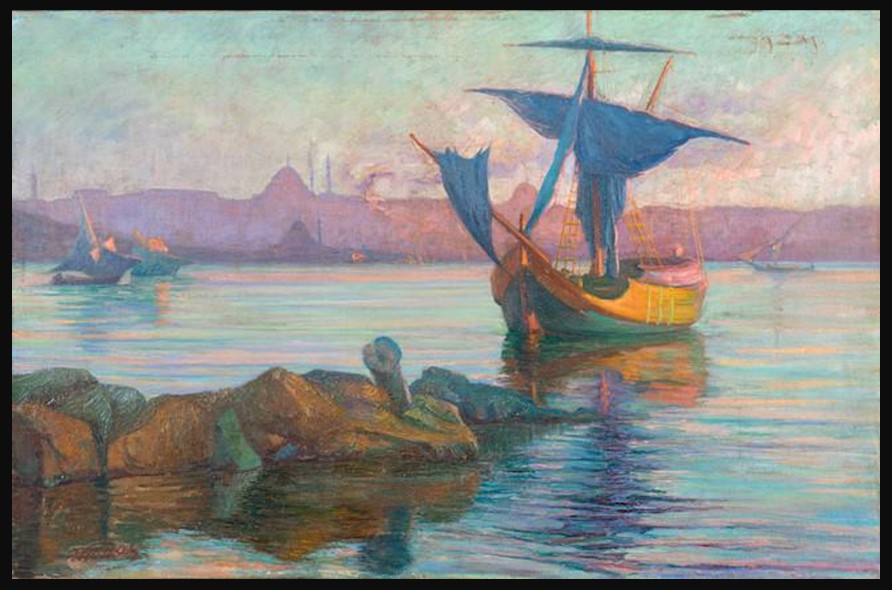
Sunset at Constantinople by Constantinos Maleas captures the city at the quiet threshold between day and night. Bathed in a warm, glowing haze, the skyline rises in silhouette above the shimmering Bosphorus, transforming Constantinople into a scene both majestic and dreamlike. Maleas does more than depict architecture; he evokes a poetic atmosphere where domes, minarets, and water merge in a luminous field of color, reflecting the city’s enduring beauty and its unique meeting of cultures, history, and light.
The Artist and His Early Influences
At the time he painted this work, Maleas was still in the early stages of his artistic development. Having studied in Paris at the turn of the twentieth century, he encountered the vibrant innovations of Post-Impressionism, which encouraged artists to move beyond strict realism and explore color, form, and emotion as expressive tools. These influences would become central to his mature style.
The Scene: Constantinople at Sunset
The painting presents the city as seen across water, most likely the Bosphorus, at the moment when the sun sinks behind the skyline. The outlines of monumental structures rise against the glowing sky, their forms softened by distance and atmosphere. Among these silhouettes one may imagine the distinctive domes and minarets of landmarks such as the Hagia Sophia or the Blue Mosque. Yet Maleas is less concerned with identifying specific buildings than with capturing the sensation of the place. The city appears suspended between land and water, light and shadow. The Bosphorus reflects the fading sun like a river of molten gold, while the skyline floats gently above it, creating an impression of stillness and quiet contemplation.
Color, Light, and Post-Impressionist Style
Color plays a central role in shaping the emotional atmosphere of the scene. Maleas uses radiant oranges, purples, and golds to evoke the shifting hues of sunset, allowing the sky to glow with a warm intensity. These colors spill across the water, creating shimmering reflections that animate the composition. The artist’s brushwork is loose yet deliberate, characteristic of Post-Impressionist painting. Rather than carefully delineating architectural detail, Maleas allows forms to emerge through patches of color and energetic strokes. The effect is one of movement and vitality, as if the city itself were breathing with the rhythm of the sea below.
Constantinople as Cultural Crossroads
For centuries, Constantinople has symbolized the meeting of East and West, and Maleas’s painting subtly reflects this identity. Western artistic techniques, particularly those derived from modern European painting, interact with a subject long associated with Orientalist fascination. Yet Maleas approaches the city not as an exotic spectacle but as a place of atmosphere and lived experience. By emphasizing color, mood, and the unity of landscape and architecture, the artist transforms a familiar subject into something distinctly modern. The city becomes less a topographical record and more an emotional landscape, where cultural boundaries dissolve into light and color.
A Literary Echo from the Past
Maleas’s vision finds an intriguing echo in the words of the English writer and traveler Lady Mary Wortley Montagu. Writing in January 1718 while residing in Pera, across the Golden Horn from the historic peninsula, she composed a poem titled Constantinople. From her window she described the remarkable panorama before her: Here from my Window I at once survey / The crouded City, & resounding Sea… Although separated by nearly two centuries and expressed through different artistic media, Montagu’s words and Maleas’s painting convey a similar sense of wonder. Both observers transform the city’s landscape into a personal meditation on beauty, distance, and perception.
Sunset at Constantinople by Constantinos Maleas transforms a famous cityscape into a radiant study of color, atmosphere, and memory. By blending Post-Impressionist technique with the evocative setting of Constantinople, he creates a work that is both modern in style and timeless in spirit. Like Montagu’s poetic reflection two centuries earlier, Maleas’s painting reminds us that certain places possess an enduring power to inspire artistic imagination. Seen through the glow of sunset, Constantinople becomes more than a city, it becomes a luminous meeting point of history, landscape, and personal reverie.
For a PowerPoint Presentation of Landscapes by Constantino Malea, please… Click HERE!
Curious to see more of Maleas’s landscapes? Check out my previous post on Monemvasia, another breathtaking example of how he transforms scenery with color and light… https://www.teachercurator.com/20th-century-art/monemvasia-by-konstantinos-maleas/?fbclid=IwY2xjawQWDFdleHRuA2FlbQIxMABicmlkETJNUWZnc3ZuTzNRMTNhVTZ0c3J0YwZhcHBfaWQQMjIyMDM5MTc4ODIwMDg5MgABHj0IeJD9OJMHlC8l4nesHkKvGxOAJDWtoeTXMLNosa51MWzFkiTh7YrzH-BS_aem_YUMU1Z8_o8SE0ZQ2rx7RLw
Bibliography: The most important scholarly study remains: Antonis Kotidis, Konstantinos Maleas (1879–1928), Athens: Adam Editions, 2000, for the poem Constantinople by Lady Mary Wortley Montagu https://www.poetryfoundation.org/poems/44759/constantinople-56d223fb55822 from Bonhams auction house https://www.bonhams.com/auction/29818/lot/11/constantinos-maleas-1879-1928-coucher-de-soleil-a-constantinople/ and the on line booklet https://anyflip.com/cxgjm/eejy/basic?utm_source=chatgpt.com