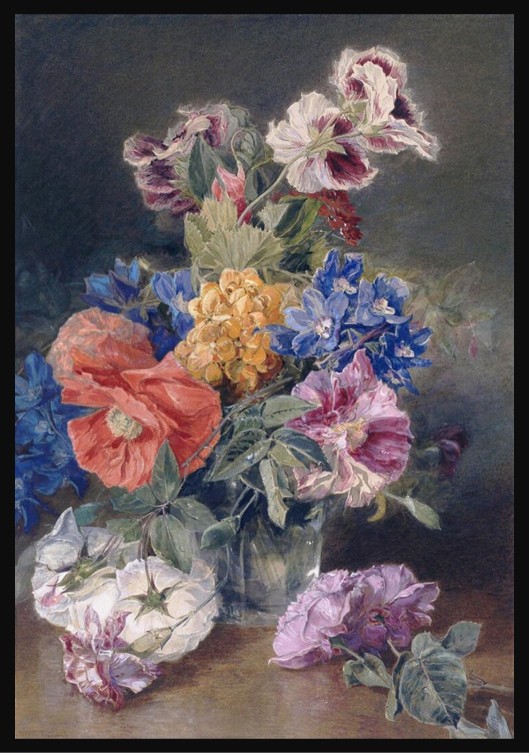
Roses, Poppy, Pelargonia, Delphinium and Calceolarias in a Glass Vase, 1859, Watercolour, 43.18×37.30 cm, Victoria and Albert Museum, London, UK
https://collections.vam.ac.uk/item/O1070493/roses-poppy-pelargonia-delphinium-and-watercolour-james-holland/
There’s something quietly miraculous about a great flower painting. And few examples are more charming than James Holland’s 1859 watercolour Roses, Poppy, Pelargonia, Delphinium and Calceolarias in a Glass Vase in the Victoria and Albert Museum. It stops time. A bouquet that would have wilted and dropped its petals within a week is held, trembling and vivid, for centuries. And what better way to welcome and celebrate July’s Flower of this Month than with James Holland’s Delphinium Watercolour, one of the most delicate and luminous floral studies of the Victorian age?
Roses, Poppy, Pelargonia, Delphinium and Calceolarias in a Glass Vase is exactly what it says on the tin, and all the more charming for it. Holland didn’t reach for a romantic title. He simply named the flowers. Roses in soft pinks and creams. A bold poppy. The frilled heads of pelargoniums. Warm yellow calceolarias, those curious little slipper-shaped blooms, nestled among the rest. And rising above them all, cool blue delphiniums reaching upward, as they do in every well-tended July garden.
The Delphinium: July’s Flower and Its Victorian Symbolism
Delphinium has been captivating gardeners and artists for centuries, and its symbolism is as layered as its blooms. The name itself comes from the ancient Greek word delphini, meaning dolphin, because the flower’s distinctive spur was said to resemble a dolphin’s back. In Greek mythology, the delphinium was believed to have sprung from the blood of Ajax, the warrior-hero, giving it a poignant association with remembrance and the beauty that can grow from sorrow.
By the Victorian era, delphiniums had found a central place in the language of flowers, floriography, where every bloom carried a message. Those tall, elegant spikes earned the delphinium the nickname “Queen of the Border.” And its meaning? The dreamer’s heart. Victorians also associated it with big-heartedness, levity, and protection, the idea that these towering blue flowers could quite literally ward off dark spirits. Blue delphiniums in particular signified dignity and grace. It’s a flower that looks upward, and encourages you to do the same.
For James Holland, painting in 1859, placing delphiniums in his summer bouquet was as natural as breathing. But for us, looking at this Victorian painting in July, those blue spires carry all that accumulated meaning, joy, goodwill, the dreamer’s heart, right into the present.
James Holland’s Early Life and Floral Painting Training
To understand why Holland painted flowers with such confidence, you need to know where he began. Born in Burslem, Staffordshire in 1799, the heart of the English Potteries, he started his working life at twelve years old, spending seven years at the Davenport factory painting flowers onto pottery and porcelain. That training left a permanent mark: his floral arrangements are “readable” from multiple angles, without a definitive top or bottom. It’s the plate-painter’s instinct, a design for a dinner plate has to work however you set it on the table.
When he moved to London in 1819, he carried that floral fluency with him. By 1824, Holland had a still life at the Royal Academy. He went on to become a full member of the Royal Watercolour Society and, over a long career, became celebrated above all for his luminous views of Venice. But flowers stayed with him always.
Why does James Holland’s Watercolour Matters?
What makes this V&A watercolour particularly special is its date. By 1859, Holland was sixty years old and had largely stopped exhibiting publicly. This wasn’t a showpiece, it was a painting made, it seems, for the quiet pleasure of making it. He signed it twice: his full name in the lower left corner, and his initials ‘JH 1859’ tucked onto a leaf in the lower right. That second, hidden signature feels like a private whisper, a painter signing his name into the garden itself.
The scale is generous and the technique has the loose confidence of a master at ease. Watercolour is an unforgiving medium, you cannot paint over mistakes. The freshness of Holland’s blooms, the transparency of that glass vase, the way light falls through the petals, these are the marks of someone who has spent a lifetime learning a flower’s secrets.
Holland is one of those artists too often described as “forgotten.” But in front of a painting like this, it’s hard to see why. He painted with warmth, precision, and a deep, unshowy love of the natural world. Today, the watercolour remains part of the collection of the Victoria and Albert Museum, where Holland’s delicate handling of flowers and light can still be admired.
On this first day of July, with the Delphiniums at their peak and summer properly underway, spend a moment with Holland’s bouquet. A flower that symbolises the dreamer’s heart deserves a painter who understood exactly that.
PowerPoint Presentation: Ready to Dive Deeper? Download the presentation and explore the topic of James Holland’s Flower Arrangements at your own pace — ideal for sharing, discussing, or simply learning more. Get the PowerPoint →
Continue Exploring on Teacher Curator: Expand your understanding of Flower Arrangements in Art with related articles: Irises by Vincent van Gogh and Daisies by Henri Matisse
Sources and further Reading: To dive deeper into the world of James Holland’s painting. Explore the full record at https://collections.vam.ac.uk/item/O1070493/roses-poppy-pelargonia-delphinium-and-watercolour-james-holland/ and https://collections.vam.ac.uk/search/?id_person=A4446&page=1&page_size=15